I am Iris.
Urban legends are not mere fabrications—
I am the storyteller who traces the unspoken truths with you.
- This article reads Japan’s changing security language through SDF rank-title debates, defense equipment transfers, and constitutional revision discussions.
- The footsteps of war do not appear only in missiles or bases. They can also appear in names, institutions, and the words written into constitutional debate.
- The deeper question is not only whether names change, but whether the public gradually becomes accustomed to a new image of the state.
When Names Change, Institutions Change in the Public Mind
War does not approach only through weapons.
Names change.
Institutions change.
Legal language changes.
Export rules change.
Constitutional language changes.
The public gradually becomes used to the changes.
In the previous article, I traced missile deployments, defense equipment transfers, information warfare, special operations, and AI war ideology as possible signs of Japan’s peace-state operating system being quietly updated.
This time, we move deeper.
Not to weapons first.
To names.
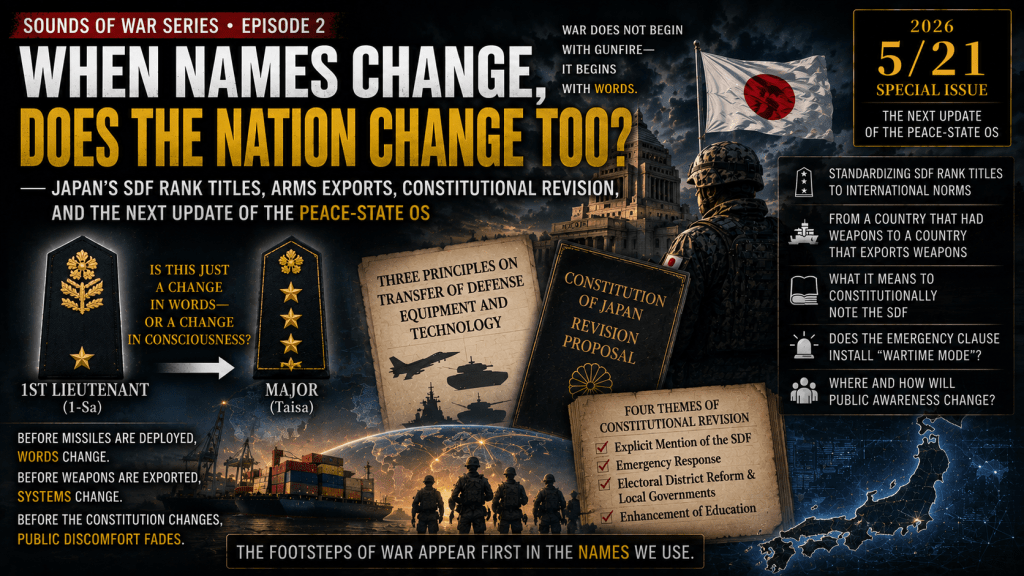
Japanese media has reported that Japan’s Ministry of Defense is moving toward changing the rank titles of senior Self-Defense Forces officers to terms closer to those used by foreign militaries.
For example, a 1st class captain-equivalent SDF rank may be called “colonel,” and senior generals may be described with titles closer to “general.”
At first glance, this may look like a simple naming change.
But names are never light.
When names change, the way an organization is seen also changes.
When the way an organization is seen changes, public perception changes.
When public perception changes, discomfort toward institutional change can gradually fade.
In urban-legend circles, it is sometimes said that systems first rewrite language.
War does not always enter through gunfire.
Sometimes it enters through words.
Of course, changing rank titles alone does not mean Japan is heading to war.
That would be too simplistic.
But if we are reading the update of Japan’s peace-state OS, changes in language cannot be ignored.
From “1-Sa” to “Colonel” — The Psychological Impact of Rank Titles
The Self-Defense Forces have long used distinctive rank titles.
Riku-shō.
Kai-shō.
Kū-shō.
1-Sa.
2-Sa.
3-Sa.
1-I.
2-I.
3-I.
These terms were part of Japan’s unique postwar vocabulary.
They created distance from the Imperial Japanese military and from ordinary military language.
The Self-Defense Forces are not the military.
SDF personnel are not soldiers in the ordinary domestic sense.
Japan is a country that does not wage war.
This postwar self-image lived partly inside the language.
But if titles shift toward terms such as colonel, major, captain, or general, the impression changes.
“1-Sa” sounds administrative and uniquely Japanese.
“Colonel” is immediately recognizable as military.
The change may make communication with foreign forces easier.
That is the rational argument.
Japan participates in international cooperation, joint exercises, and alliance coordination. Standardized rank equivalents can make practical communication smoother.
But practical logic does not erase symbolic meaning.
The more rational a change appears, the easier it is to miss what it does to public perception.
Institutions often arrive wearing the face of convenience.
The question is what convenience slowly normalizes.
International Standardization—or a Symbol of Militarization?
The key word is “international standardization.”
It sounds reasonable.
It sounds technical.
It sounds neutral.
It sounds difficult to oppose.
If the purpose is to make international cooperation easier, many people may accept it.
But the Urban Legend Notebook must ask:
What exactly is being standardized?
If Japan aligns rank titles with foreign militaries, does it only standardize translation?
Or does it also bring the Self-Defense Forces closer to the public image of an ordinary military?
Japan has long maintained a unique dual structure.
Domestically, the SDF has been described as different from an ordinary military.
Internationally, the government has explained that the SDF has attributes of an armed force under international law.
The SDF trains with foreign militaries.
It participates in military-to-military relationships.
And now, its titles may move closer to international military language.
This duality has existed for decades.
But if names change, the duality becomes more visible.
Japan may still keep the language of a peace state.
But its institutional vocabulary may move toward military normalization.
That tension is the center of this article.
From a Country with Weapons to a Country That Transfers Weapons
Rank titles are not the only language changing.
Defense equipment transfer is another example.
On April 21, 2026, Japan revised the Three Principles on Transfer of Defense Equipment and Technology and related operational guidelines. The Ministry of Defense stated that it would promote defense equipment transfer under the revised framework through public-private cooperation.
Here too, language matters.
“Arms exports” sounds heavy.
It feels connected to war.
“Defense equipment transfer” sounds softer.
It sounds like security cooperation.
It sounds like support for partners.
The legal and policy meanings are not identical, and they should not be treated carelessly as the same phrase.
But the public impression matters.
A country that “exports weapons” is one image.
A country that “transfers defense equipment” is another.
Japan’s defense minister has described equipment transfer as a way to strengthen the deterrence and response capability of allies and like-minded countries, while also maintaining and strengthening Japan’s defense production and technology base.
That is a coherent security argument.
But the structural question remains:
Is Japan moving from a country that possesses defense equipment to a country that supplies defense equipment?
Is Japan’s defense industry becoming part of a larger international military supply network?
And how clearly does the public understand that transition?
Names change.
Rules change.
Industry changes.
Together, those changes form a larger update.
What It Means to Constitutionally Mention the SDF
Next comes constitutional revision.
The Liberal Democratic Party has presented four broad themes for constitutional revision:
explicit mention of the Self-Defense Forces,
emergency response,
electoral district and local-government reform,
and enhancement of education.
The strongest connection to this article is the explicit mention of the SDF.
Supporters may describe this as clarification.
The SDF already exists.
The Constitution should clearly recognize it.
The legal position of SDF personnel should be stabilized.
The debate over unconstitutionality should be resolved.
There is a practical argument there.
But constitutionally naming something is not a minor act.
A constitution is the highest language of the state.
What is written there tells us how the state defines itself.
If the SDF is explicitly written into the Constitution, Japan’s postwar operating system moves into a new stage.
The SDF would move from an institution supported largely by interpretation to one formally written into the constitutional text.
That could protect the dignity and legal stability of SDF personnel.
It could also open the door to the next stage of security policy.
So the question is not only whether the SDF is written into the Constitution.
The question is what kind of state Japan becomes when it writes the SDF into its constitutional self-definition.
Does the Emergency Clause Install a Wartime Mode?
Another major constitutional issue is emergency response.
Large disasters.
Infectious disease.
Terrorism.
Internal unrest.
National emergencies.
Security crises.
The concern itself is understandable.
Japan is a disaster-prone country.
Maintaining political functions during major crises is a real problem.
Security emergencies cannot be dismissed.
But emergency clauses also raise serious concerns.
Could power concentrate during crisis?
Could parliamentary control weaken?
Could elections or terms be extended?
Could exceptional measures become normal?
Could crisis language be used to expand executive authority?
Materials from constitutional review discussions show both the practical arguments for emergency response and strong concerns about democratic safeguards and historical precedent.
Here again, the issue is not simple support or opposition.
A state may need crisis capacity.
But a democracy also needs limits, oversight, and exit conditions.
A state capable of responding to emergencies may be necessary.
A state that can live permanently in emergency mode is a different problem.
That difference matters.
The Words “Peace State” Remain While the System Changes
Japan’s uniqueness lies here.
The language of peace remains.
Exclusively defense-oriented policy remains.
The Three Non-Nuclear Principles remain.
The SDF is still described domestically as different from an ordinary military.
Most citizens do not appear to desire war.
But systems are moving.
Rank titles may be standardized.
Defense equipment transfers are expanding.
Constitutional revision discussions continue.
Emergency response clauses are debated.
Information warfare, space operations, and special operations are strengthened.
Defense industry is increasingly discussed as a national strategic base.
The signboard of the peace state remains.
But the internal system is being updated.
This may be a very Japanese way of changing.
Not a sudden rupture.
Not an open declaration.
But a series of technical, rational, administrative adjustments.
International standardization.
Deterrence.
Response capability.
Legal stability.
Disaster readiness.
Parliamentary continuity.
Public safety.
Each phrase sounds reasonable.
That is why the whole structure must be read.
Each piece may be rational.
But where does the whole system lead?
Where Will the Public Notice the Change?
Where will ordinary citizens notice the change?
When missiles are deployed?
When rank titles change?
When defense export rules are revised?
When a constitutional referendum is held?
When emergency clauses are debated?
When school textbooks change?
When politicians use different words?
When the media starts using military titles naturally?
Maybe no single event will create full awareness.
Perhaps small changes will accumulate until one day people feel it:
Something is different.
By then, much may already have changed.
This is the most important idea in the “Footsteps of War” series.
Crisis does not always arrive with a red alarm.
It arrives as ordinary news.
As policy revision.
As technical terminology.
As international standardization.
As defense cooperation.
As constitutional debate.
Then it enters daily life.
That is why people need to notice before they are shocked.
A Military That Is Not Called a Military
Japan’s language around the SDF has long contained a contradiction.
The SDF is not an ordinary military.
Yet it has attributes of an armed force under international law.
SDF personnel are not described domestically as soldiers.
Yet they train with foreign militaries.
Japan uses unique rank titles.
Yet it operates in international military contexts.
This contradiction was a postwar compromise.
It attempted to manage the memory of war, Article 9, the Cold War, the U.S.-Japan alliance, regional threats, domestic opinion, and international responsibility at the same time.
Japan created a unique vocabulary to hold that contradiction together.
Now, part of that vocabulary may be moving toward standardization.
The point is not to deny the SDF.
Rather, the question is how honestly Japan confronts the gap between reality, law, language, and public perception.
Will Japan continue with ambiguity?
Will it clarify the structure?
If it clarifies the structure, how far will authority expand?
Will citizens understand the choice before they make it?
These are not small questions.
Changing Names Also Adjusts Discomfort
There is another layer to rank-title changes.
They adjust discomfort.
At first, people may feel uneasy.
Words like “colonel” or “general” may remind some Japanese readers of prewar or wartime military structures.
But news repeats the terms.
Media explains them.
Official documents use them.
Young generations grow up hearing them.
The words become normal.
This process is not automatically bad.
Societies always adapt to language.
But normalization is powerful.
What first feels foreign becomes ordinary.
What becomes ordinary prepares the way for the next change.
That is why naming matters.
Before missiles are deployed, words change.
Before arms exports expand, policy terms change.
Before constitutional revision, public hearing changes.
The footsteps of war may appear first in the names we use.
Simple Opposition Is Not Enough
This is where I must be strict.
Simple opposition is not enough.
It is too easy to say:
All rank-title changes are bad.
All defense equipment transfers mean war.
All constitutional revision is dangerous.
All emergency clauses mean dictatorship.
That does not read reality accurately.
Japan’s regional environment is severe.
China, Russia, and North Korea cannot be ignored.
Taiwan Strait and Korean Peninsula tensions are real.
Disaster response is a real issue.
The dignity and legal stability of SDF personnel also matter.
So the answer cannot be reflexive rejection.
The answer must be condition-checking.
What changes?
Why does it change?
Who decides?
How is the public informed?
What limits exist?
Who oversees the authority?
What happens after the emergency ends?
What exactly will citizens be asked to approve in a referendum?
Fear alone cannot protect the future.
Complacency cannot protect it either.
Citizens need informed judgment.
Closing — The Footsteps of War Appear First in Language
When names change, does the state change too?
My answer is this:
Names alone do not change a state.
But when a state changes, names often change first.
Rank titles.
Defense equipment transfer.
Explicit mention of the SDF.
Emergency response.
International standardization.
Deterrence.
Response capability.
Contribution to peace and stability.
These words arrive wrapped in necessity.
And citizens slowly get used to them.
The footsteps of war enter institutions before they enter the battlefield.
They enter language before they enter institutions.
They enter fading discomfort before they enter language.
That is why we must watch words.
What changed?
What was softened?
What is called standardization?
What is wrapped in the language of public safety?
What is described as inevitable?
Japan’s peace-state OS has not disappeared.
But the update has begun.
Is this update truly meant to protect Japan?
Or does it pull Japan deeper into a larger war-capable structure?
The answer is not fixed.
And because it is not fixed, we must not look away now.
Next time—another fragment of truth we will trace together.
I will return to continue the telling.
References
A Japanese news reference for the reported plan to change senior SDF rank titles and the debate around its symbolic meaning.
A Diet document addressing the meaning of SDF rank-title changes and “international standardization.”
Official reference for defense equipment transfer, alliance cooperation, and the statement that the SDF has attributes of an armed force under international law.
Official reference for Japan’s April 21, 2026 revision of defense equipment transfer rules.
Official reference for the revision history and government explanation of defense equipment transfer policy.
Reference for the LDP’s four themes of constitutional revision: explicit mention of the SDF, emergency response, electoral district/local government reform, and education.
LDP reference material for constitutional-revision themes, including the SDF and emergency response.
Official material summarizing multiple party positions on emergency clauses, parliamentary continuity, and term extension debates.
This English article is scheduled for 23:00 JST on May 21, 2026.
Related Reading
The previous article in the “Footsteps of War” series, tracing Japan’s changing security structure through missiles, exports, and information warfare.
A key geopolitical read on sovereignty, alliance structure, bases, and the hidden architecture behind Japan’s security position.
A companion piece on AI governance, data integration, operational systems, and the symbolic role of Palantir in modern power.
Popular Posts
A strong UAP-related popular article for readers who want to trace how narratives mutate with technology and culture.
A long-running reader favorite on sovereignty, hidden structure, military presence, and geopolitical design.
A popular read on prophecy, sky omens, and the meaning people project onto signs of crisis and transition.
Submit an Urban Legend
If there is a rumor, unexplained story, symbolic pattern, or strange connection you want explored, send it in. I will not leave it as “just a rumor”—I will trace its structure, context, and narrative with care.

コメントを残す