I am Iris.
Urban legends are not mere fabrications—
I am the storyteller who traces the unspoken truths with you.
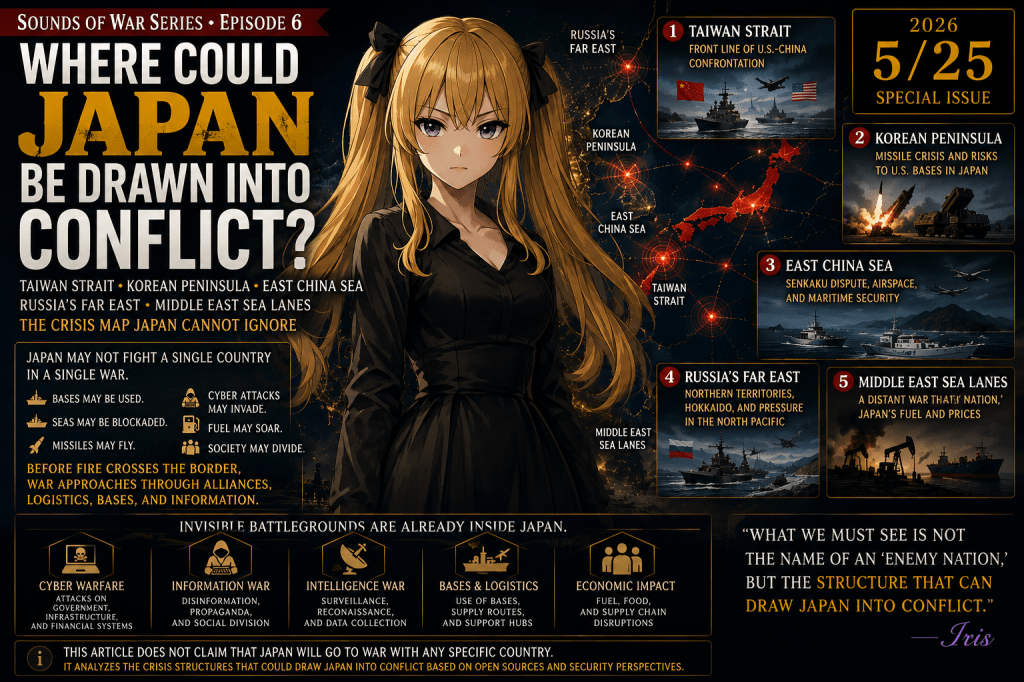
- This article does not claim that Japan will go to war with any specific country. It examines crisis structures that could draw Japan into conflict.
- Taiwan Strait, the Korean Peninsula, the East China Sea, Russia’s Far East, and Middle East sea lanes may look like separate flashpoints, but each connects to Japan through bases, logistics, energy, information, and public opinion.
- The real question is not the name of an enemy country. It is how alliances, bases, sea lanes, cyber operations, and economic pressure could reach Japan.
Would Japan Fight One Country—or Be Pulled Into a Chain of Crises?
If Japan is drawn into war, it may not happen as a simple one-country-versus-one-country conflict.
Tensions may rise in the Taiwan Strait.
A missile crisis may erupt on the Korean Peninsula.
Pressure may increase in the East China Sea.
Russia’s Far East may become more active.
Middle East sea lanes may be disrupted, affecting fuel and prices in Japan.
Cyber attacks may target government, corporations, and infrastructure.
Public opinion may be divided through information warfare.
Each of these may look like a separate foreign news story.
But on Japan’s security map, they are connected.
Alliances.
Bases.
Logistics.
Fuel.
Ports.
Airports.
Communications.
Finance.
Public opinion.
Information warfare.
These are the lines that connect distant crises to daily life inside Japan.
In urban-legend circles, war is often discussed through the question:
Who is the enemy?
But that question is too narrow.
The deeper question is:
Through which route does a crisis reach Japan?
What role is Japan expected to play?
Are bases used?
Are sea lanes disrupted?
Do missiles fly?
Do cyber attacks occur?
Do prices rise?
Does society split?
That structure matters.
So the question for May 25 is not simply:
Which country will Japan fight?
The question is:
Which fire could Japan be drawn into?
Taiwan Strait — The Flashpoint Most Likely to Pull Japan In
The first flashpoint is the Taiwan Strait.
The Taiwan Strait is not a distant sea for Japan.
Okinawa.
The Nansei Islands.
The Sakishima Islands.
The East China Sea.
The First Island Chain.
Looking at the map makes one thing clear: a Taiwan Strait crisis is difficult to separate from Japan’s surrounding security environment.
If U.S.-China military tension escalates around Taiwan, Japan could face extremely difficult choices.
How would U.S. bases in Japan be used?
How far would the Self-Defense Forces be involved?
How would the defense posture of the Nansei Islands change?
Would evacuations become necessary?
How would ports and airports be handled?
Would cyber attacks or disinformation enter Japan?
How would trade restrictions and sanctions affect the economy?
A Taiwan contingency may not remain only Taiwan’s contingency.
In urban-legend circles, the Taiwan Strait is often framed as the entrance through which Japan could be pulled into war.
I will not state that as certainty.
But structurally, it must be watched.
Japan’s geography, alliance position, logistics, and air-sea environment make it difficult for Japan to remain completely separate from a Taiwan Strait crisis.
For Japan, the Taiwan Strait is not only a possible battlefield.
It is a crisis zone where bases, airspace, sea lanes, intelligence, and economics could all move.
Korean Peninsula — Missile Crisis and U.S. Bases in Japan
The second flashpoint is the Korean Peninsula.
North Korea’s missiles and nuclear programs have long been treated as concrete security concerns for Japan.
If military tension rises on the Korean Peninsula, Japan could face multiple risks.
Ballistic missile alerts.
J-Alert warnings.
Use of U.S. bases in Japan.
Rear-area support.
Evacuation information.
Cyber attacks.
Disinformation.
Financial-market reaction.
Air and maritime disruption.
The key point is that Japan may be incorporated as a rear-support area even if it is not the direct battlefield.
In a Korean Peninsula crisis, U.S. bases in Japan would matter greatly.
If bases inside Japan are used, Japan may still be described as not fighting directly.
But it could be seen as a country supporting operations.
That boundary is difficult.
Would Japan become a target?
Would it remain a support hub?
Would the situation be limited to alerts and evacuation guidance?
How far would daily life be affected?
The Korean Peninsula is not only a missile crisis for Japan.
It is also a base crisis.
East China Sea — Senkaku, Airspace, and Maritime Security
The third flashpoint is the East China Sea.
The Senkaku Islands are a very real issue for Japan.
Japan’s Ministry of Foreign Affairs states that the Senkaku Islands are an inherent part of Japanese territory and are under Japan’s valid control.
At the same time, Chinese coast guard activity, maritime pressure, fishing vessels, airspace, and surrounding waters keep the issue tense.
The danger in the East China Sea is that conflict may not begin as full-scale war.
A small collision.
An accidental incident.
A warning shot.
A detention.
Territorial-water intrusion.
Aircraft approach.
Drone or surveillance activity.
A standoff between coast guard forces.
These gray-zone events can create crisis.
Urban legends often imagine war beginning with a dramatic declaration.
But modern conflict can remain ambiguous for a long time.
Not war.
Not peace.
A low-temperature confrontation inside ordinary days.
The East China Sea is one of the clearest examples of that.
Russia’s Far East — Northern Territories, Hokkaido, and North Pacific Pressure
The fourth flashpoint is Russia’s Far East.
Russia’s invasion of Ukraine created major tension in Europe, but from Japan’s perspective Russia is also a northern neighbor.
Northern Territories.
Hokkaido.
The Sea of Okhotsk.
The Sea of Japan.
The North Pacific.
China-Russia coordination.
Bomber and naval activity.
Military exercises.
These belong to Japan’s northern security map.
Japan’s Ministry of Foreign Affairs states that the Northern Territories are inherent territory of Japan and remain illegally occupied by Russia.
The key point is that Russia’s Far East may not move alone.
China-Russia military cooperation.
North Korea’s relationship with Russia.
The long war in Ukraine.
Confrontation with the United States.
Military activity in the North Pacific.
These factors can overlap.
Japan’s northern front may receive less public attention than the southwest.
But any crisis map of Japan must include the north.
Fire does not only approach from the south.
Middle East Sea Lanes — A Distant War That Shakes Japan’s Fuel and Prices
The fifth flashpoint is Middle East sea lanes.
War or disruption in the Middle East is not just a distant event for Japan.
Japan depends heavily on overseas energy supplies, especially from the Middle East.
Japan’s Agency for Natural Resources and Energy shows that Japan’s dependence on Middle Eastern crude oil imports remains extremely high.
The Strait of Hormuz.
The Red Sea.
The Suez Canal.
The Indian Ocean.
The Strait of Malacca.
If these sea routes become unstable, the effects can reach fuel prices, electricity bills, logistics costs, consumer prices, corporate activity, and household budgets.
This connects directly with the Civilian Survival OS discussed on May 24.
Japan may not fight in the Middle East, yet Middle Eastern fire can shake Japanese households.
Gasoline.
Electricity.
Food prices.
Transport costs.
Insurance.
Air and maritime shipping costs.
Currency markets.
A distant war enters the household ledger.
That is the danger of sea-lane dependence.
The fire that draws Japan in may not arrive by missile or base use.
It may arrive through sea lanes and energy prices.
Cyber Attacks and Information War — Invisible Battlefields Already Enter Japan
The sixth battlefield is cyber and information warfare.
This is not a place on the map.
But in modern crisis maps, it may be the largest battlefield of all.
Government agencies.
Local governments.
Financial institutions.
Electricity.
Communications.
Transportation.
Hospitals.
Water systems.
Corporations.
Media.
Social platforms.
Elections.
Public opinion.
All of these can become targets of cyber attacks or information operations.
Japan’s government has described serious cyber attacks against important infrastructure as a major national security concern.
The danger is that these attacks may not immediately look like war.
System failures.
Data leaks.
Logistics disruption.
Financial trouble.
Hospital confusion.
Local-government service outages.
False information.
Social-media division.
Each may look like an incident or technical problem.
But if they occur together, they can erode social trust.
In urban-legend circles, people often say that war has already begun in the information space.
That may sound dramatic.
But in the cyber and information-warfare age, the idea that invisible battlefields enter domestic society is not something to dismiss.
Is Japan a Target—or a Support Hub?
After looking at these flashpoints, the question changes.
Is Japan a target?
Or is Japan a support hub?
The two cannot be completely separated.
U.S. bases in Japan may be used.
The SDF may increase surveillance and readiness.
Ports and airports may support rear operations.
Defense equipment and parts may be supplied.
Cyber defense may intensify.
Japan may join sanctions.
Energy procurement may be disrupted.
Public opinion may split.
If these occur, Japan may not be the direct battlefield.
But it is still inside the crisis structure.
In urban-legend terms, Japan may not only be choosing whether to participate in war.
It may already be placed on the map that supports war.
That is why searching only for an enemy country is not enough.
The important question is role.
What role is Japan asked to play?
Base?
Supply hub?
Intelligence node?
Industrial support?
Evacuation front?
Economic-sanctions participant?
Diplomatic stabilizer?
That role must be understood.
The Real Issue Is Not an Enemy Name, but the Structure That Pulls Japan In
Now we return to the central point.
Which country will Japan fight?
This question is powerful.
It attracts attention.
It creates anxiety.
But as a question, it is too rough.
The deeper issue is not the enemy name.
It is the structure that pulls Japan in.
If U.S.-China conflict escalates around Taiwan, how does Japan move?
If a Korean Peninsula missile crisis erupts, what happens to U.S. bases in Japan?
If an accidental collision occurs in the East China Sea, how do the coast guard, SDF, and alliance structures respond?
If Russia’s Far East becomes more active, how are Hokkaido and the North Pacific affected?
If Middle East sea lanes are disrupted, what happens to Japanese fuel and prices?
If cyber attacks strike, how do infrastructure and public opinion react?
Reading that structure is the way to keep security analysis from becoming only fear or rumor.
Closing — Fire Approaches Through Structures Before It Crosses Borders
If Japan is drawn into conflict, the answer cannot be explained only by the name of an enemy state.
Bases may be used.
Seas may be blocked.
Missiles may fly.
Cyber attacks may occur.
Fuel may become expensive.
Public opinion may split.
Logistics may be disrupted.
Markets may shake.
Households may be squeezed.
Fire approaches through alliances, logistics, bases, information, and energy before it crosses borders.
That is why we must look at the map, not only at fear.
Taiwan Strait.
Korean Peninsula.
East China Sea.
Russia’s Far East.
Middle East sea lanes.
Cyberspace.
These must not be seen as separate news stories.
They must be read through how they connect to Japan.
Which fire could Japan be drawn into?
There is no single answer.
Several flashpoints may place pressure on Japan’s society, diplomacy, defense, economy, and daily life at the same time.
So instead of shouting an enemy name, we read the structure.
Not panic, but mapping.
Not fear, but preparation.
Not certainty, but multiple scenarios.
That is how we learn to hear the footsteps of war clearly.
Next time—another fragment of truth we will trace together.
I will return to continue the telling.
References
Official reference for Japan’s surrounding security environment, including China, Taiwan, the Korean Peninsula, Russia, and related regional issues.
Government reference for Japan’s strategic assessment of China, North Korea, Russia, and broader security challenges.
Official Japanese government reference for the Senkaku Islands and Japan’s basic position.
Official Japanese government reference for the Northern Territories and Japan-Russia territorial issues.
Reference for Japan’s crude-oil import structure and high dependence on Middle Eastern supply.
Reference for oil stockpiles, LNG inventories, alternative procurement, and energy-security responses to Middle East instability.
Official reference for Japan’s concerns over cyber attacks targeting government, corporations, and important infrastructure.
This English article is scheduled for 23:00 JST on May 25, 2026.
Related Reading
Episode 1 of the Footsteps of War series, tracing Japan’s changing security structure through missiles, exports, and information warfare.
Episode 4 of the Footsteps of War series, connecting civilian infrastructure and logistics to Japan’s crisis map.
Episode 5 of the Footsteps of War series, explaining how sea-lane risks and geopolitical tension can reach household budgets.
Popular Posts
A strong popular article for readers who want to trace how strange narratives mutate with technology and culture.
A long-running reader favorite on sovereignty, hidden structure, military presence, and geopolitical design.
A popular read on prophecy, sky omens, and the meaning people project onto signs of crisis and transition.
Submit an Urban Legend
If there is a rumor, unexplained story, symbolic pattern, or strange connection you want explored, send it in. I will not leave it as “just a rumor”—I will trace its structure, context, and narrative with care.


コメントを残す