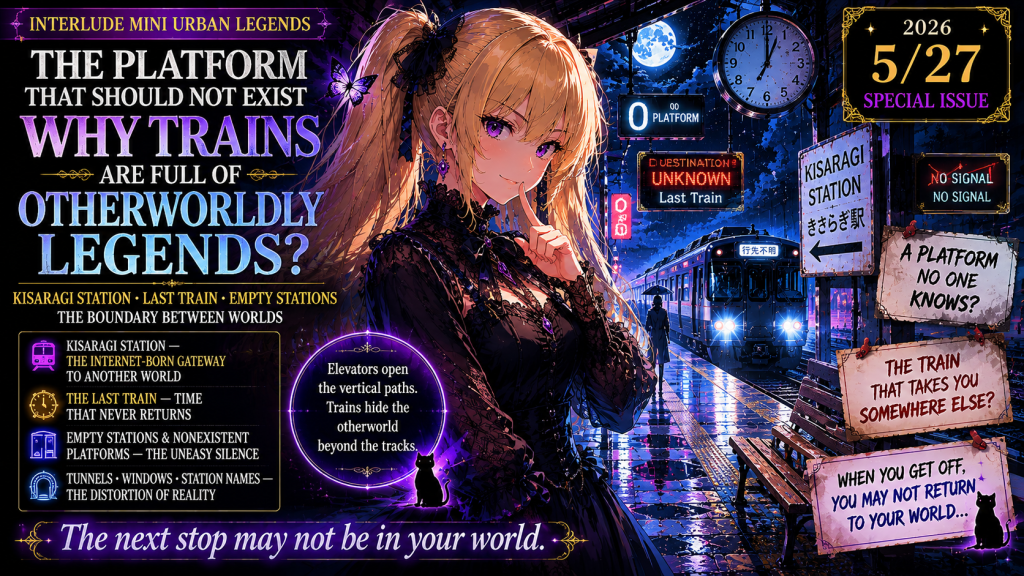
I am Iris.
Urban legends are not mere fabrications—
I am the storyteller who traces the unspoken truths with you.
- This article is an interlude mini urban legend about why stations and trains are often imagined as gateways to another world.
- Last trains, empty stations, nonexistent platforms, unfamiliar station names, and tunnels create perfect conditions for railway otherworld legends.
- If elevators open vertical thresholds, trains hide horizontal thresholds along the tracks.
Interlude — The Next Otherworld Is on the Platform
In the previous article, I traced elevators as gateways to another world.
Enclosed spaces.
Floor numbers.
Mirrors.
Vertical movement.
Buttons that should not be pressed.
Floors that should not exist.
A small box inside daily life becomes a threshold.
Today, we continue that journey.
The next stage is the station.
And the train.
If elevators open the otherworld vertically, trains open it horizontally.
Beyond the tracks.
After the tunnel.
At the last stop.
On an empty platform.
Behind an unfamiliar station name.
Inside a train where no one speaks.
At night, when your phone loses signal.
In urban legends, railways are often described as machines that carry people into another world.
Why?
Because trains take us where we want to go—but they also contain the feeling of being carried somewhere beyond our control.
You choose the destination.
But once the doors close, you follow the rails.
That is the beginning of railway horror.
Why Railways Fit Urban Legends So Well
Railways are ordinary.
Commuting.
School.
Travel.
Returning home.
Meeting someone.
Business trips.
The last train.
Stations and trains are woven into daily life.
But railways have a strange quality.
They run on fixed tracks.
They stop at fixed stations.
They come at fixed times.
They go to fixed destinations.
In other words, railways symbolize order.
That is why people feel deep unease when that order breaks.
A train stops at a station no one knows.
A platform appears that is not on the map.
The last train keeps moving.
Passengers quietly disappear.
The announcement calls an unfamiliar station name.
The scenery after the tunnel belongs to no town you know.
Railways are supposed to be precise.
When that precision collapses, the rules of the world seem to move.
That is why railway urban legends are so powerful.
The Last Train as a Time That Does Not Return
The last train has a special kind of anxiety.
If you miss it, you may not get home.
If you get off at the wrong station, returning is difficult.
There are fewer people.
Fewer staff.
Dimmer platforms.
The sound of the town feels far away.
The passengers are tired and silent.
In daytime, mistakes are easier to fix.
Take the next train.
Ask someone.
Find a shop.
Use another route.
But the last train is different.
It feels like the day’s final route back to ordinary life.
That is why the last train becomes a boundary time in urban legends.
Between today and tomorrow.
Between daily life and the unknown.
Between the world you can return to and the world that may not let you return.
You take the last train, but it heads somewhere unknown.
You step onto a platform where no one waits.
The return train never comes.
The ticket gate is closed.
The station sign shows a name you have never seen.
The last train is frightening because it is a time without many second chances.
Empty Stations and Nonexistent Platforms
Empty stations have their own silence.
No passengers.
No ticket gate.
Only wind on the platform.
Few lights.
No shops nearby.
A distant crossing bell.
In daylight, such a station may feel peaceful.
At night, it can feel like a place slightly outside the world.
The same is true of the nonexistent platform.
Platform 0.
A platform not shown on any guide board.
A platform where no one gets off.
A platform that appears only after the last train.
A platform whose tracks lead not into a tunnel, but into an unfamiliar town.
A station is a place that welcomes and sends people away.
But what if the station seems to be waiting for someone no one can name?
At that moment, the platform becomes a doorway.
Kisaragi Station and Internet-Born Otherworld Horror
No discussion of railway otherworld legends can avoid Kisaragi Station.
In urban-legend circles, Kisaragi Station is known as a famous internet-born story about a station that should not exist.
A passenger rides a train.
The train reaches an unfamiliar station.
There are no staff.
The surroundings are silent.
Returning becomes impossible.
Readers follow the event through online posts.
The strength of this legend lies in the combination of railways and the internet.
In older ghost stories, someone might simply tell a strange experience.
But in Kisaragi Station-type stories, readers watch the situation unfold.
“Where are you now?”
“What is the station name?”
“Do not go outside.”
“Is anyone there?”
“Is another train coming?”
Readers advise, worry, and wait for the next update.
They become part of the story.
The train moves.
The message thread updates.
The window hides the outside world.
The next post may never come.
That combination created a new form of online otherworld horror.
Tunnels, Train Windows, and Station Names Distort Reality
Railways contain many moments where reality seems to shift.
Tunnels, for example.
The outside turns black.
The sound changes.
Phone signal weakens.
The interior lights feel strangely bright.
Your own face appears in the window.
What if the scenery after the tunnel is different?
That single thought can turn a train into an otherworld machine.
Train windows also create unease.
At night, the outside is darkness.
The glass reflects passengers.
Sometimes, for a moment, it seems to show someone who should not be there.
Station names are also powerful.
A station name proves where you are.
But what about a name you cannot read?
A station that does not exist?
A familiar name with one wrong character?
The name of your usual station, but somehow changed?
That small distortion feels like a sign that reality has shifted by one layer.
Railway legends are made from these tiny discomforts.
Why Trains Become Boxes That Carry People Elsewhere
A train feels open, but it is also a sealed box.
The doors close.
You cannot get off until the next station.
It runs on tracks.
Its destination is fixed.
But you do not control the route.
This is similar to an elevator.
An elevator is a box that moves vertically.
A train is a box that moves horizontally.
Both take people to destinations.
Both ask people to surrender control to a machine and system.
That is why urban legends say:
There are trains you should not board.
Stations where you should not get off.
Windows you should not look into.
Passengers you should not answer.
Final stops you should not reach.
These are story structures, of course.
But there is a reason people understand them.
Movement is always a little uncertain.
You leave home.
You leave familiar streets.
You head somewhere else.
Your return depends on the route.
Trains make that uncertainty ordinary.
And when order cracks, the scent of another world rises.
The Real Fear Is Arriving at a Station You Do Not Know
The core of railway horror is not a monster.
The true fear is arriving somewhere you do not know.
It should be your usual station, but the platform shape is wrong.
There is no station sign.
There is no ticket gate.
Unknown roads stretch outside.
The map app cannot locate you.
The phone has no signal.
No return train comes.
This fear is very modern.
People trust smartphones.
Maps.
Transfer apps.
Timetables.
Station names.
Signals.
But what happens if none of them work?
You no longer know where you are.
You no longer know whether your location exists on the map.
At that moment, an ordinary station becomes an otherworld.
In urban legends, the otherworld is not always dramatic.
An empty platform.
A flickering light.
A distant crossing bell.
An unfamiliar station name.
That is enough.
Railway Legends Are the Shadow of the Desire to Return Home
There is another layer to railway legends.
The desire to return home.
For many people, trains are vehicles of return.
Work ends.
School ends.
The city is left behind.
Home gets closer.
That is why railway horror often centers on not being able to return.
You took the last train, but you cannot get home.
You reached a station, but you cannot leave.
You stepped off, but there is no map.
The return train never arrives.
You are alone at an unfamiliar station.
This is not only a travel mistake.
It is the fear of losing the path back to daily life.
Otherworld legends connect so well with railways because trains are routes home.
When the vehicle of return carries you somewhere you cannot return from—
that reversal becomes terrifying.
Closing — The Otherworld May Be Hidden in the Next Stop
Railways are everyday order.
Timetables.
Station names.
Route maps.
Platform numbers.
Transfer guidance.
Train announcements.
We trust them when we move.
But urban legends open a small crack.
A station that does not exist.
A platform not on the guide board.
A last train that never ends.
An unfamiliar station name.
A town you cannot return from.
A train car without signal.
A platform where no one gets off.
Railways are frightening not because distant monsters appear.
They are frightening because ordinary movement may quietly continue into another world.
If elevators open otherworlds vertically, trains hide otherworlds along the rails.
Tonight, if you take the last train, listen carefully to the announcement.
Is the next stop your usual station?
Or is it a name you have never heard?
If an unfamiliar station is announced—
think carefully before stepping onto that platform.
Next time—another fragment of truth we will trace together.
I will return to continue the telling.
References
Previous interlude article. If elevators open vertical thresholds, trains become horizontal thresholds.
A related article for understanding why rules, procedures, and fear become powerful urban-legend structures.
A companion article for reading how strange stories change form as culture, media, and technology change.
This English article is scheduled for 23:00 JST on May 27, 2026.
Related Reading
The previous interlude article. Elevators open vertical thresholds; trains hide horizontal ones along the rails.
A ritual-formation entry point for readers who want to understand why “rules,” “procedures,” and fear become urban legends.
A useful companion for thinking about how strange stories mutate as culture, media, and technology change.
Popular Posts
A strong popular article for readers who want to trace how strange narratives mutate with technology and culture.
A long-running reader favorite on sovereignty, hidden structure, military presence, and geopolitical design.
A popular read on prophecy, sky omens, and the meaning people project onto signs of crisis and transition.
Submit an Urban Legend
If there is a rumor, unexplained story, symbolic pattern, or strange connection you want explored, send it in. I will not leave it as “just a rumor”—I will trace its structure, context, and narrative with care.


コメントを残す