I am Iris.
Urban legends are not mere fabrications—
I am the storyteller who traces the unspoken truths with you.
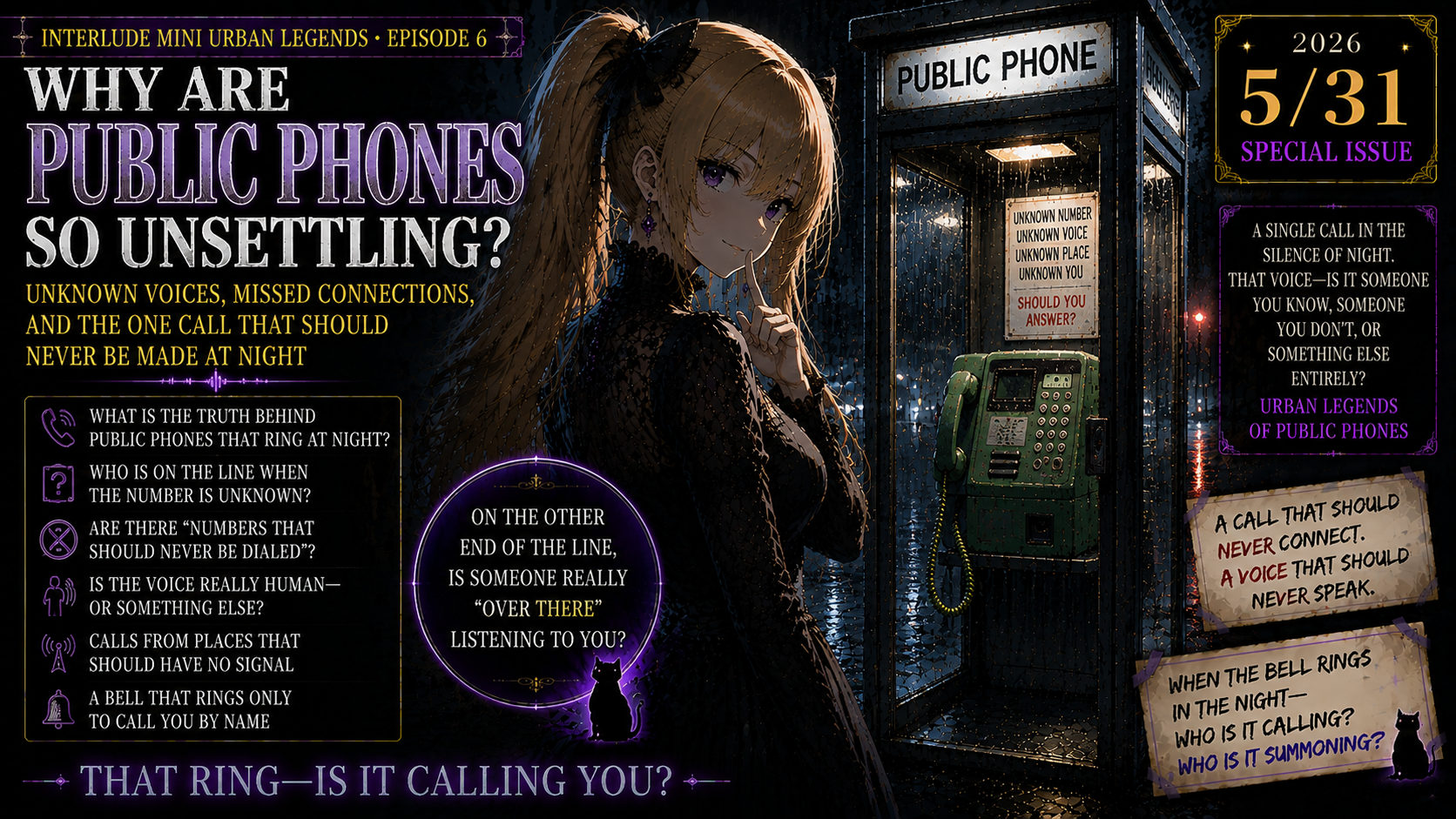
- This article is an interlude mini urban legend about why public phones and unknown calls can feel so unsettling.
- A phone ringing at night, a deserted phone booth, an unknown number, and a voice that should not connect all create the fear of invisible connection.
- The fear is not the phone itself. It is the uncertainty of who—or what—is on the other end of the line.
Interlude — The Final Otherworld Begins with a Call
Elevators open otherworlds vertically.
Trains carry otherworlds along the rails.
Late-night convenience stores hide otherworlds inside bright rooms.
Vending machines become unmanned boxes that respond.
Mirrors divide this side from the other side.
Then what is a public phone?
It is a device that connects you to someone you cannot see.
Today, smartphones are everywhere.
People use them for messages, maps, payments, information, work, and memory.
That is why public phones now feel strangely out of time.
A green phone on a street corner.
A phone at the edge of a station.
A rain-soaked phone booth.
A receiver almost no one seems to use anymore.
And yet, what if that phone rings at midnight?
Would you answer?
In urban legends, public phones are often described as devices that carry voices that should not connect.
Tonight, as the final entry in this interlude mini-series, we will trace why.
Why Phones Fit Ghost Stories So Well
A phone carries only a voice.
No face.
No expression.
No clear location.
No certain identity.
You can only judge the other person through sound.
That makes phone legends powerful.
If someone is standing before you, you can see them.
You know the distance.
You can read their face.
You can leave.
But on the phone, the other person is unseen.
Are they near?
Are they far away?
Are they alive?
Are they someone you know?
Or are they something that is not human?
The other end of the line is always a little dark.
In urban legends, that invisibility becomes the strange.
A voice arrives.
But the speaker remains unknown.
A phone is an everyday tool, yet it already contains invisible connection.
Public Phones and the Memory of Place
Unlike smartphones, public phones are tied to places.
Stations.
Hospitals.
Schools.
Shopping streets.
Parks.
Old apartment blocks.
Roadsides at night.
Rainy phone booths.
Someone once used that phone.
Someone waited there.
Someone cried there.
Someone may have made a final call there.
Public phones seem to carry the memory of place.
A smartphone belongs to an individual.
A public phone belongs to anyone.
Unknown people.
Unseen people.
People who stood there long ago.
Their traces can feel as if they remain inside the receiver.
Of course, this is the imagination of stories.
But in urban legends, places are often said to remember.
Old stations.
Old hotels.
Old hospitals.
Old phone booths.
When a phone stands there, the old voices can seem to remain inside it.
The Fear of a Public Phone Ringing at Night
One of the strongest public-phone legends is simple:
A phone that should not ring begins to ring.
A station at night.
An empty phone booth.
A roadside in the rain.
A platform after the last train.
A shopping street with no people.
Then the public phone rings.
Who would call that number now?
How does anyone know that number?
Why is it ringing at this exact moment?
A phone is usually something one person uses to call another.
But when a public phone rings, the direction reverses.
You are no longer the caller.
You are the one being called.
And the caller seems to know you are there.
That is what makes it frightening.
Is it coincidence?
A prank?
A call that has always come to that place?
Or is it ringing for you?
The bell brings fear before the voice does.
It is ringing.
Should you answer?
Should you not?
That hesitation is the entrance to the legend.
Unknown Numbers and Faceless Connection
In modern phone legends, unknown numbers are powerful.
You do not know who is calling.
The number may be hidden.
You cannot easily call back.
The caller has no visible identity.
An unknown call hides name, place, and context.
Many people feel uneasy when their phone displays an unknown number.
Why?
Because the caller reaches you, but you cannot see them.
They know enough to call.
But you do not know who they are.
That imbalance is frightening.
In urban legends, unknown calls are often described as calls that should not be answered.
You answer, and there is silence.
You answer, and there is static.
You answer, and a stranger speaks.
You answer, and someone says your name.
You answer, and you hear a voice you should no longer be able to hear.
The content is frightening.
But the deeper fear is not knowing why the call came to you.
That is the horror of unknown connection.
Numbers That Should Not Connect
Phone legends often involve numbers that should not connect.
A number that does not exist.
A number no longer in use.
The number of someone who passed away.
An old family number.
A number written on a forgotten note.
A number people say should never be dialed.
Phone numbers are practical.
Digits.
Lines.
Contracts.
Networks.
Destinations.
But the feeling that a sequence of numbers can connect you to somewhere is quietly strange.
You press numbers.
A tone rings.
Someone answers.
That simple sequence connects distant spaces.
Here lies the foundation of phone legends.
What if the number connects to a place that should not exist?
What if it reaches a house where no one lives anymore?
What if it reaches the voice of someone who should be gone?
The phone becomes a boundary between reality and the other side.
A number may be a small spell that leads somewhere.
Is the Voice on the Other End Truly Human?
A phone gives you a voice.
Only that.
That is why voice matters so much in phone legends.
A rough voice.
A distant voice.
A familiar voice.
An unknown voice.
A child’s voice.
An old person’s voice.
A voice like your own.
A voice you should never hear again.
The voice on the line has no body.
So imagination fills the space.
Where is the speaker?
What do they look like?
Why are they speaking to you?
Are they truly alive?
A voice can comfort people.
A family voice.
A friend’s voice.
A voice from memory.
But because it is only a voice, it can also frighten.
Is the one speaking on the other side truly human?
That question gives phone legends their depth.
A Phone Booth Is a Small Sealed Room
A public phone has one more unsettling feature.
The phone booth.
A transparent box.
Rain on glass.
Fogged windows.
A narrow space.
Visible from outside, yet slightly separated from the world.
Once inside, the street sounds feel distant.
A phone booth resembles an elevator in miniature.
A small enclosed space.
A boundary between outside and inside.
A world behind glass.
An invisible connection inside a sealed room.
At night, a phone booth becomes perfect for urban legends.
The outside is dark.
The inside is lit.
Rain slides down the glass.
The receiver looks old.
Someone may have left a note.
Coins may lie near the floor.
Then the bell rings.
That is already enough to make a ghost story.
A phone booth is a small otherworld inside the city.
The Real Fear Is Not Disconnection, but Connection
The essence of phone horror is not that the call fails.
The real fear is that it connects.
You dial a strange number.
It rings.
Someone answers.
You pick up an unknown call.
There is silence.
Then a voice begins.
A public phone rings at night.
You lift the receiver.
The voice says your name.
That connection is frightening.
Once a phone connects, you stand on the same line as the other side.
You hear.
You answer.
Your voice goes back.
That is a small exchange.
Whoever the other party is, once you respond, you enter the story.
In urban legends, that matters.
A strange thing is not complete when you see it.
It is not complete when you hear it.
It becomes complete when you answer.
The phone makes crossing that boundary too easy.
At the End of the Interlude Series
From May 26 onward, we traced small otherworlds in daily life.
Elevators.
Stations.
Late-night convenience stores.
Vending machines.
Mirrors.
Public phones.
None of them are extraordinary places.
They are ordinary things.
But when night, silence, loneliness, and discomfort overlap, they show another face.
Urban legends are not only about distant worlds.
They live in ordinary tools.
Familiar places.
Things we use without thinking.
Things that have been left behind.
Sometimes, an entrance opens there.
That is why urban legends remain fascinating.
A huge fear may shock people.
But a small discomfort near daily life can remain longer in the mind.
Closing — Is That Bell Ringing for You?
A public phone is only a communication device.
That is the simple answer.
But urban legends give it another layer.
An unseen caller.
An unknown number.
A number that should not connect.
A bell ringing at night.
A voice on the other end.
An empty phone booth.
A call that should not be answered.
A phone connects people.
But in stories, the other side may not always be human.
When that idea appears, the phone becomes a line to the otherworld.
Tonight, if you pass an empty phone booth—
and the bell suddenly rings—
it may be coincidence.
It may be a prank.
It may be only an old system behaving strangely.
But if the bell begins just as you approach—
and if you somehow feel that you must pick up the receiver—
think once before you answer.
Was that call made to someone?
Or was it ringing to call you?
Next time—another fragment of truth we will trace together.
I will return to continue the telling.
References
Episode 1 of the Interlude Mini Urban Legends series. A related article on small enclosed spaces and everyday thresholds.
Episode 5 of the Interlude Mini Urban Legends series. Mirrors are visual boundaries; public phones are vocal boundaries.
A related article for understanding why calls, rules, responses, and nighttime procedures become powerful urban-legend structures.
This English article is scheduled for 23:00 JST on May 31, 2026.
Related Reading
Episode 1 of the Interlude Mini Urban Legends series. Elevators and phone booths both turn small enclosed spaces into thresholds.
Episode 5 of the Interlude Mini Urban Legends series. Mirrors connect by sight; public phones connect by voice.
A ritual-formation article for readers who want to understand why rules, calls, responses, and nighttime procedures become legends.
Popular Posts
A strong popular article for readers who want to trace how strange narratives mutate with technology and culture.
A long-running reader favorite on sovereignty, hidden structure, military presence, and geopolitical design.
A popular read on prophecy, sky omens, and the meaning people project onto signs of crisis and transition.
Submit an Urban Legend
If there is a rumor, unexplained story, symbolic pattern, or strange connection you want explored, send it in. I will not leave it as “just a rumor”—I will trace its structure, context, and narrative with care.
コメントを残す