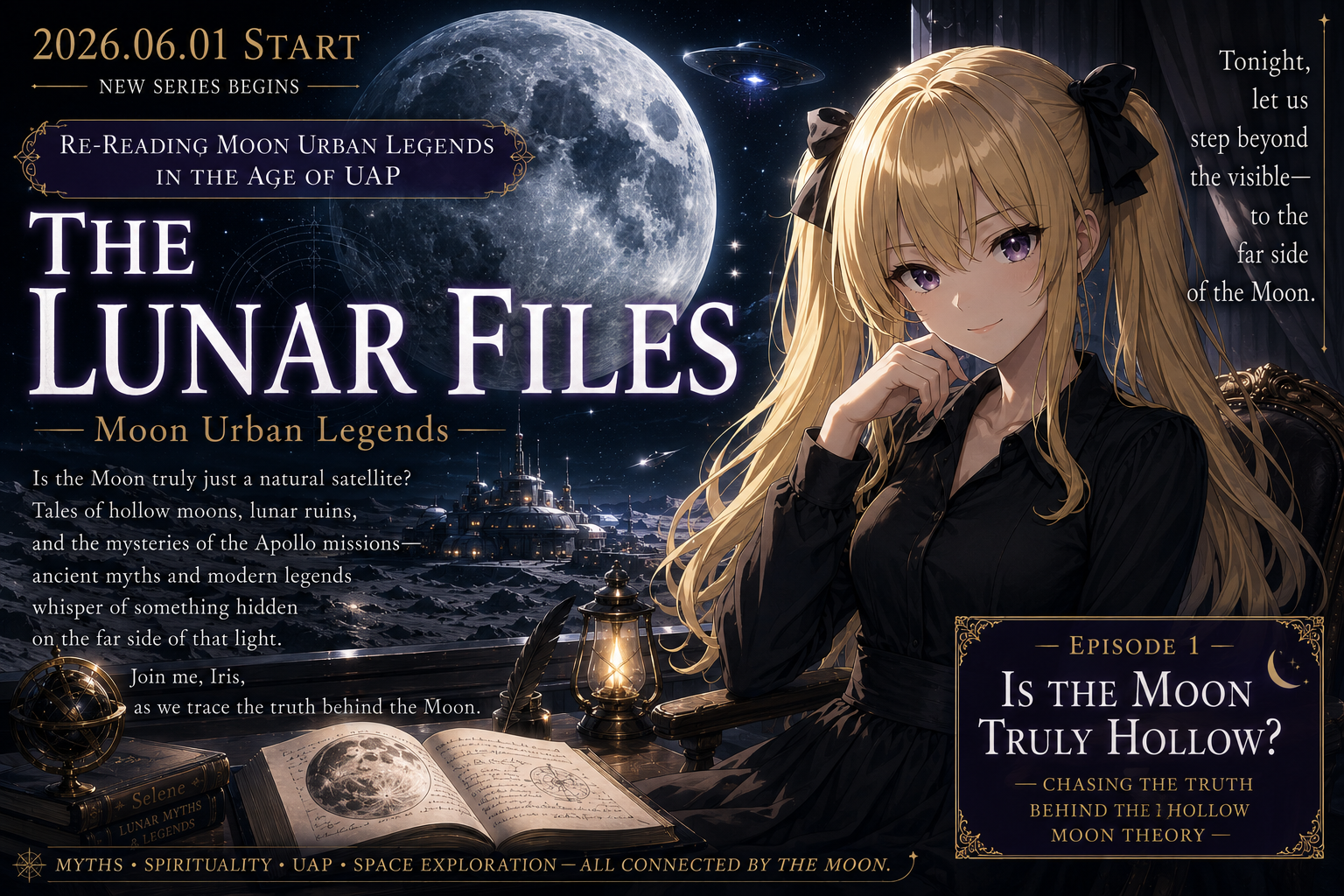
I am Iris.
Urban legends are not mere fabrications—
I am the storyteller who traces the unspoken truths with you.
- The Moon is one of the most studied bodies near Earth, yet it continues to attract some of humanity’s most persistent legends.
- Claims about an artificial Moon, lunar bases, hidden structures, or a “watching device” are not officially confirmed facts.
- The deeper question is not only what may be on the Moon, but why human beings keep projecting secrecy, memory, and surveillance onto it.
Why Does the Moon Attract So Many Secrets?
Look up at the night sky, and the Moon is there.
Near enough to feel familiar.
Far enough to remain unreachable.
Visible again and again, yet never fully possessed.
It grows.
It fades.
It disappears.
It returns.
That rhythm has shaped human imagination for thousands of years.
Before the Moon became a scientific target, it was already a vessel of meaning.
A calendar.
A lamp in the dark.
A symbol of death and rebirth.
A guide for tides, rituals, planting, travel, prayer, dreams, and fear.
Human beings did not merely observe the Moon.
They interpreted it.
That is why lunar urban legends are so powerful.
In urban-legend circles, the Moon is sometimes framed as more than Earth’s natural satellite.
It is said to be an artificial object, a hidden base, a cosmic archive, or even a vast device watching Earth from above.
None of those claims are officially confirmed.
But the force of the legend does not come only from evidence.
It comes from the emotional structure of the Moon itself.
The Moon is always visible, yet partly unknown.
It is close, yet unreachable.
It is ordinary, yet sacred.
It is scientific, yet mythic.
That contradiction makes it a perfect screen for secrecy.
The Lunar Files begin there.
Not with the question, “What is definitely hidden on the Moon?”
But with another question:
Why do we keep needing the Moon to hide something?
Re-reading Lunar Legends in the Age of UAP
For decades, mysteries in the sky were mostly called UFOs.
Flying saucers.
Lights in the night.
Objects that moved strangely.
Witnesses who saw something they could not explain.
Today, the language has shifted.
UFO has increasingly given way to UAP:
Unidentified Anomalous Phenomena.
That change matters.
The old word carried the atmosphere of science fiction, alien visitors, crashed craft, secret hangars, and whispered testimony.
The newer term is colder.
Data.
Sensors.
Airspace safety.
Classification.
National security.
Scientific analysis.
Public transparency.
The mystery did not disappear.
It entered institutional language.
And once the unknown becomes institutional, the story changes.
That is why lunar legends deserve to be read again now.
Artificial Moon theories.
Hollow Moon stories.
Lunar base rumors.
Apollo mysteries.
Strange lights.
The far side.
Ancient myths of beings connected to the Moon.
These legends are old, but the UAP era gives them a new atmosphere.
If something strange appears in the sky, people eventually ask:
Where did it come from?
Does it have a base?
Is there a place beyond Earth connected to it?
Is the Moon merely a symbol—or part of the story?
In urban-legend circles, the Moon often becomes the final destination of sky mysteries.
A light appears.
The explanation feels incomplete.
Earth seems too small to hold the answer.
So the imagination turns upward.
To the Moon.
The Artificial Moon Theory
The artificial Moon theory is one of the largest lunar legends.
In urban-legend circles, it is said that the Moon may not be a naturally formed satellite, but an object placed or engineered by an unknown intelligence.
This is not an officially confirmed fact.
Official science describes the Moon as Earth’s natural satellite, and lunar formation is studied through scientific models, including impact-related hypotheses.
But urban legends move differently.
They begin with coincidences that feel too precise.
The Moon appears at just the right distance to create total solar eclipses.
It influences human calendars and tides.
It keeps nearly the same face turned toward Earth.
It has shaped myths, rituals, sleep, fear, poetry, and measurement.
To science, these are subjects for astronomy, geology, orbital mechanics, and cultural history.
To urban legend, they become signs.
Too perfect.
Too symbolic.
Too useful.
Too present.
From there, the story begins:
What if the Moon was placed there?
What if it is not only being observed, but observing?
What if the Moon is not merely a satellite, but a structure?
The artificial Moon theory is not only about the Moon.
It is about the human discomfort with coincidence.
Some people can accept that a natural satellite became central to human civilization by chance.
Others feel that something so influential must have intention behind it.
That emotional need is where the legend lives.
Lunar Base Legends
Another persistent legend is the lunar base.
In urban-legend circles, the far side of the Moon, deep craters, or shadowed regions are sometimes described as places where hidden bases, ancient ruins, or non-human structures may exist.
Again, these claims are not officially confirmed.
But the legend survives because the Moon gives it a perfect setting.
The far side cannot normally be seen directly from Earth.
For most of human history, it was a hidden hemisphere.
And hidden places invite stories.
A sealed room.
A forbidden archive.
A tunnel no map shows.
A military zone behind a fence.
A station that should not exist.
A half of the Moon we cannot see from the ground.
Urban legends love such spaces.
The logic is simple:
If we cannot see it, something may be there.
Modern lunar missions have mapped the Moon in extraordinary detail.
NASA’s Lunar Reconnaissance Orbiter has studied the lunar surface, temperature, composition, and radiation environment.
Japan’s KAGUYA mission observed the Moon to study its origin and evolution.
Science has brought light to the lunar surface.
Yet the legends remain.
Why?
Because more images do not always remove mystery.
Sometimes they create new ones.
A shadow becomes a tower.
A crater rim becomes a wall.
A line becomes a road.
A bright point becomes a structure.
A photographic artifact becomes a hidden clue.
This does not mean the legend is true.
It means the Moon has become a surface where human pattern-seeking never rests.
The lunar base legend is less about confirmed structures on the Moon, and more about the way human imagination reads data when trust is unstable.
The Far Side and the Power of the Unseen
The far side of the Moon is not the dark side.
That is important.
Sunlight reaches the far side.
It is called the far side because it is the hemisphere normally turned away from Earth.
But the phrase itself carries power.
The far side.
It sounds like a place beyond sight.
Beyond public knowledge.
Beyond the familiar face of the Moon.
Every night, people see the Moon and feel they know it.
But they do not see all of it.
That half-known quality is the source of the mystery.
The far side is real.
It has been imaged.
It has been studied.
It is not merely fantasy.
And yet, from Earth, it remains psychologically distant.
This is why it attracts stories.
What is on the side we do not see?
Why does lunar exploration keep returning to the Moon?
Why do modern space programs continue to focus on polar regions, resources, landing sites, and long-term presence?
Why does the Moon keep reappearing in discussions of future space infrastructure?
Officially, these questions connect to science, exploration, technology, resources, and human spaceflight.
In urban-legend circles, however, they are often reframed:
Maybe humanity is returning to check something.
Maybe the far side contains evidence.
Maybe the Moon is not only a destination, but a witness.
That is the tension that makes the far side so powerful.
It is not entirely unknown.
But it is not emotionally settled.
Why Is the Moon Framed as a Watching Device?
Why, then, is the Moon sometimes described as a watching device?
There are three layers.
The first is mythic.
The Moon has long been treated as a watcher of the night.
When the Sun disappears, the Moon remains.
It hangs above the world like an eye in darkness.
Many cultures connected it to time, fate, fertility, dreams, madness, death, and renewal.
It watched over fields, seas, travelers, temples, and sleeping cities.
Not because it literally watched.
But because human beings experienced it that way.
The second layer is psychological.
The Moon reflects light.
It has a face-like presence.
It changes slowly, predictably, silently.
People often feel that the Moon is looking back.
A full Moon can feel exposing.
Moonlight can make hidden things visible.
A silent night under the Moon can feel observed.
That feeling matters.
Urban legends often grow from feelings before they grow from claims.
The third layer is modern.
In artificial Moon and lunar base legends, the Moon becomes more than a symbol.
It becomes infrastructure.
A platform.
A relay point.
An archive.
A surveillance system.
A silent station above Earth.
This is where ancient Moon symbolism meets modern technological anxiety.
In earlier ages, the Moon watched because it was divine.
In modern legends, it watches because it might be engineered.
The shape of the fear changes.
The emotional core remains.
Something above us sees more than we do.
Science Illuminates the Moon, But Shadows Remain
The Moon is no longer a blank mystery.
It has been orbited, mapped, photographed, measured, and studied.
Astronauts brought lunar samples back to Earth.
Robotic missions continue to examine its surface, composition, temperature, radiation environment, and potential resources.
NASA describes the Moon as Earth’s natural satellite.
LRO continues to provide detailed lunar data.
JAXA’s KAGUYA helped investigate the Moon’s origin and evolution.
Science has illuminated the Moon.
But illumination does not always end mythology.
Sometimes it sharpens it.
High-resolution images invite inspection.
Mission archives invite suspicion.
Scientific caution invites speculation.
The word “unidentified” invites imagination.
The UAP era makes every unexplained point in the sky feel newly charged.
That is why the Moon remains powerful.
It stands at the border between what we know and what we still imagine.
A scientific body.
A mythic mirror.
A target of exploration.
A screen for fear.
A place humanity has touched.
A place humanity still dreams about.
Conclusion — Is the Moon Hiding Something, or Are We?
Is the Moon truly just a natural satellite?
Officially, it is studied as Earth’s Moon: a natural satellite with a complex formation history, surface geology, polar resources, and deep scientific value.
But in urban-legend circles, it becomes something else.
An artificial object.
A hollow structure.
A lunar base.
A surveillance device.
A relic of ancient contact.
A silent witness to UAP mysteries.
A screen on which humanity projects its oldest questions.
Maybe the Moon hides something.
Or maybe human beings have always needed the Moon to hide something for us.
A fear.
A memory.
A lost origin.
A hope that we are not alone.
A suspicion that history is larger than official language can hold.
The Moon does not speak.
That is why we keep speaking for it.
And perhaps that is the true beginning of the lunar urban legend.
Next time—another fragment of truth we will trace together.
I will return to continue the telling.
References
NASA Science | Moon Facts
NASA’s official overview of the Moon, including its distance, structure, formation, surface, and scientific significance.
NASA Science | Lunar Reconnaissance Orbiter
Official mission page for LRO, which has mapped and studied the Moon’s surface, temperature, composition, and radiation environment.
JAXA / ISAS | KAGUYA
Official JAXA page for the KAGUYA / SELENE lunar orbiter mission and its scientific goals.
NASA Science | Kaguya
NASA’s mission summary for Japan’s KAGUYA lunar orbiter and its role in lunar origin and evolution research.
NASA Science | Unidentified Anomalous Phenomena
NASA’s official UAP page, useful for understanding the scientific and data-oriented framing of unidentified anomalous phenomena.
This English article is scheduled for 23:00 JST on June 1, 2026.
Related Reading
A gateway article for reading UAP as an institutional, political, and cultural phenomenon rather than only a UFO story.
A folklore-based UAP article connecting Japanese legend, mysterious vessels, and the long history of sky-related mysteries.
A visual and historical companion piece for understanding how the imagery of the unknown has changed over time.
Popular Posts
A popular prophecy article about celestial signs, mythic time, and the anxiety of transition.
A structural analysis of sovereignty, security, and the agreements that quietly shape political reality.
One of the blog’s classic urban-legend entries, exploring a ritual where play becomes fear.
Submit an Urban Legend
Share it with Iris. This notebook grows through the fragments brought by its readers.
Share & Follow
If you found this article interesting, I would be happy if you supported it by sharing or following.
コメントを残す