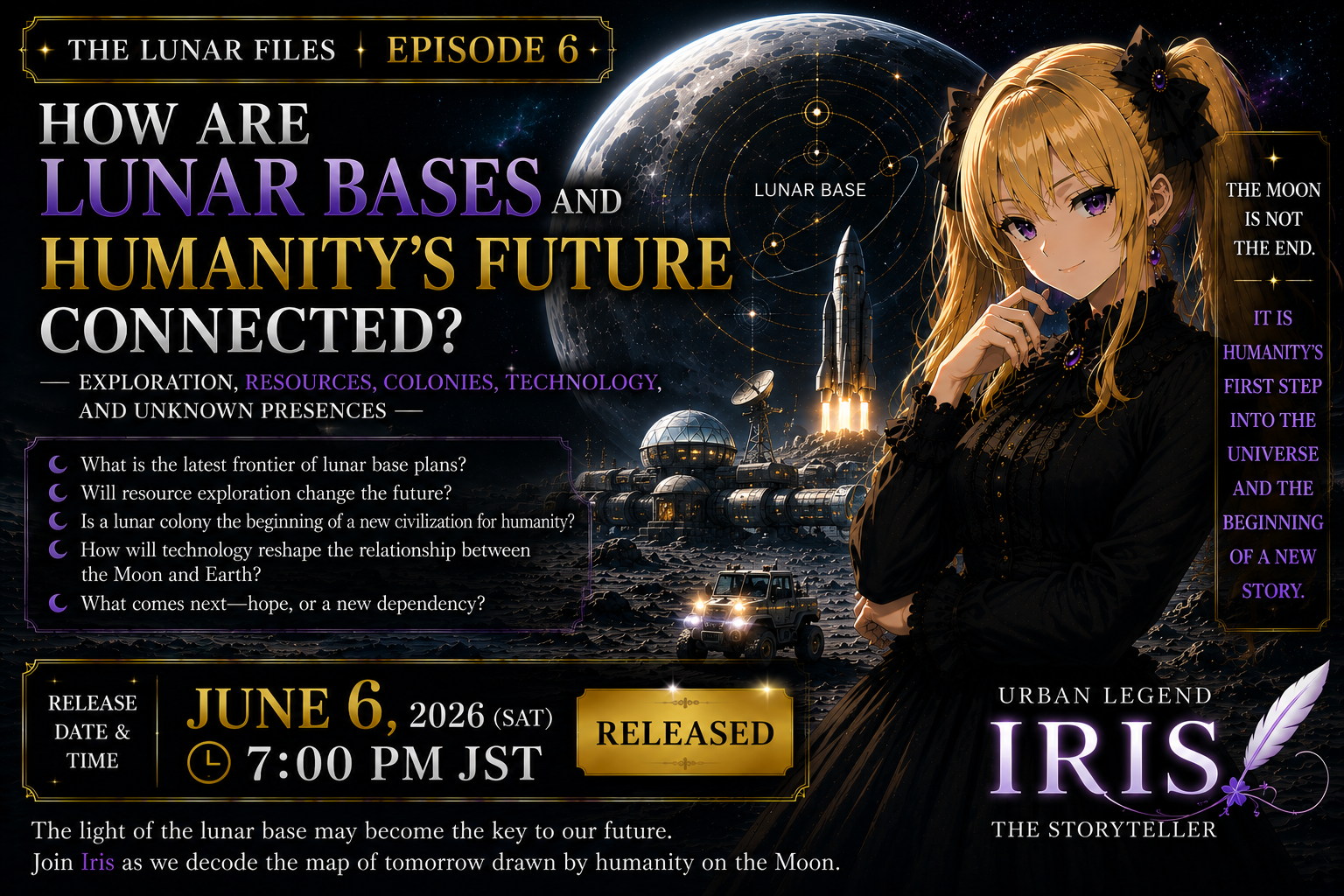
I am Iris.
Urban legends are not mere fabrications—
I am the storyteller who traces the unspoken truths with you.
- Lunar bases are no longer only a distant science-fiction image. They are now part of real discussions about future space exploration.
- Water ice, resource utilization, lunar habitats, communications, robotics, and Mars preparation connect the Moon to humanity’s long-term future.
- In urban-legend circles, however, lunar base plans are often reframed as a return to a place where something may already exist.
Lunar Bases Are No Longer Only Science Fiction
Lunar base.
The phrase still feels like science fiction.
Silver domes under a black sky.
Rovers moving across gray dust.
Astronauts walking beneath Earthlight.
Communication towers on the horizon.
Research modules buried under regolith.
A quiet voice crossing the distance between worlds.
For decades, lunar bases belonged mainly to future stories.
But today, the phrase is moving closer to real space-development language.
Artemis.
Gateway.
The lunar South Pole.
Water ice.
Resource utilization.
Long-duration missions.
Surface habitats.
Robotics.
Human operations beyond Earth.
The road from the Moon to Mars.
Humanity is not only imagining the Moon again.
It is planning around it.
This time, the goal is not simply to go, plant a flag, and return.
The new question is whether humans can remain.
Work.
Build.
Operate.
Extract.
Communicate.
Survive.
And eventually use the Moon as a stepping-stone toward deeper space.
That is the official future-facing framework.
But urban legends read the same movement differently.
Are humans truly preparing to build the first lunar bases?
Or are they returning to a place where something already exists?
Is the Moon a frontier?
Or a sealed site?
Is lunar development the beginning of a new civilization?
Or the unveiling of an older secret?
These claims are not officially confirmed.
But the power of the lunar base legend comes from the fact that the real future is already strange enough.
The Moon as a Test Ground for Mars
In modern exploration planning, the Moon is often treated as a proving ground.
It is close enough to Earth to support communication and return.
It is far enough to be genuinely hostile.
Its environment is difficult:
radiation, temperature extremes, vacuum, dust, limited resources, and operational isolation.
If humanity can live and work on the Moon, it may learn how to survive farther away.
Mars becomes slightly less abstract.
Deep space becomes slightly less unreachable.
The Moon is therefore not only a destination.
It is a rehearsal.
A place to test systems before the next planetary step.
Habitats.
Life support.
Surface mobility.
Power.
Communications.
Resource extraction.
Autonomous systems.
Human-robot collaboration.
Emergency response.
Psychology in isolated environments.
This is a practical scientific and engineering framework.
But urban legends add another question:
What kind of future is being rehearsed?
Is the Moon a training ground for exploration?
A prototype for off-world industry?
A controlled environment for new political systems?
A place where Earth’s existing power structures can be extended beyond Earth?
A lunar base is not only a structure.
It is a social experiment waiting to happen.
Once humans live beyond Earth, even temporarily, humanity changes.
Not all at once.
But symbolically, the boundary has been crossed.
Water Ice and the Turning Point of Lunar Resources
The discussion of lunar bases almost always leads to water ice.
Water is not only for drinking.
It connects to oxygen, hydrogen, fuel production, life support, and long-term operations.
If water can be accessed on or near the Moon, the meaning of lunar presence changes dramatically.
The Moon becomes not only a place to visit.
It becomes a place that may help sustain activity.
That is the key turning point.
Exploration becomes utilization.
A surface becomes infrastructure.
A destination becomes a resource environment.
This shift is practical, but also symbolic.
Humanity once looked at the Moon.
Then humanity reached the Moon.
Now humanity asks whether the Moon can be used.
Urban legends respond quickly to that shift.
Who will control lunar resources?
Will they be used for all humanity?
Will nations and corporations compete for them?
Will the Moon become the next frontier of extraction?
Will resource language become the polite face of territorial control?
These questions are not all urban legends.
Some are serious political, legal, and ethical concerns.
But in the lunar mythos, they become darker.
Perhaps resource exploration is not only about water.
Perhaps it is about finding something else.
Perhaps the Moon is valuable for reasons not fully explained.
The moment the Moon becomes usable, it also becomes contested.
And contested places always generate legends.
Lunar Colonies and the Question of a New Civilization
A lunar base is temporary.
A lunar colony is something else.
A colony implies continuity.
People staying.
Systems operating.
Rules forming.
Labor being organized.
Food, oxygen, water, energy, medicine, governance, communication, and law becoming necessary.
A lunar colony is not only architecture.
It is civilization in miniature.
What would happen to humans who live under another sky?
What happens when Earth becomes an object in the sky rather than the ground beneath one’s feet?
Would lunar-born generations think of Earth as home?
Would they feel separate?
Would they become a new cultural branch of humanity?
These questions are speculative.
But they are not meaningless.
Human identity has always been shaped by environment.
Mountains, islands, deserts, oceans, cities, borders, climates, and resources all shape cultures.
Why would the Moon be different?
Urban legends take this further.
Will lunar colonies be a hope for humanity?
Or a refuge for the selected few?
Will they be scientific communities?
Corporate territories?
Military outposts?
A new class system above Earth?
A place to escape a damaged planet?
A lunar colony could represent expansion.
But it could also represent division.
That is why the image is so powerful.
The first city on the Moon would not only be a technological achievement.
It would be the beginning of a new human story.
Technology, AI, and the Moon-Earth System
A lunar base cannot function without technology at every level.
Rockets.
Landers.
Power systems.
Habitats.
Rovers.
Robotics.
Life support.
Radiation shielding.
Dust mitigation.
Surface communications.
Remote operations.
Autonomous construction.
Resource extraction.
Sensor networks.
Artificial intelligence.
The Moon will likely be a place where humans and machines are tightly integrated.
That is not simply convenience.
It is necessity.
The environment is too hostile for humans to do everything directly.
Robots may arrive first.
AI systems may assist planning, maintenance, navigation, science, and resource monitoring.
Remote operations may connect Earth, lunar orbit, and the surface.
Here the urban legend becomes modern.
A lunar base is not only a settlement.
It is a network.
A system of sensors, machines, communications, and decision-making tools.
And once the Moon becomes a networked environment, an older legend returns in a new form.
The Moon as a watching place.
In ancient myth, the Moon watched because it was divine.
In modern technology, the Moon may watch because humans place instruments there.
Cameras.
Antennas.
Sensors.
Relays.
Mapping systems.
Resource monitors.
Autonomous machines.
The old idea of a “watching Moon” and the future reality of a monitored lunar environment begin to overlap.
The Moon may not be a natural surveillance device.
But humanity may turn it into an observation platform.
That is almost more unsettling.
Unknown Presences and the Persistence of Lunar Base Legends
Whenever lunar bases are discussed, urban legends bring in unknown presences.
Hidden bases already on the Moon.
Non-human observation posts.
Ancient installations.
Structures buried beneath the surface.
Signals from the far side.
Evidence that humanity is not the first intelligence to use the Moon.
These claims are not officially confirmed.
But they persist because the Moon is the nearest outside world.
It is not a distant star.
It is not an abstract galaxy.
It is visible almost every night.
Close enough to feel familiar.
Far enough to remain beyond ordinary verification.
That balance is perfect for legend.
The Moon can be looked at.
But not easily checked.
It can be mapped.
But not personally visited by most people.
It can be explained.
But not emotionally exhausted.
So people keep placing presences there.
If humanity is not alone, where would we notice first?
If something is watching Earth, where would it be?
If there is an outpost beyond Earth, why not the Moon?
If ancient myths, UAP reports, and space exploration all point upward, why does imagination keep returning to the same body?
The unknown presence in lunar base legends may not prove anything about the Moon.
But it reveals a great deal about humanity’s fear of cosmic solitude.
Is a Lunar Base Hope or a New Anxiety?
Lunar bases contain hope.
Science.
Exploration.
International cooperation.
Technological innovation.
A path to Mars.
A new view of Earth.
A chance to learn how humans might survive beyond their home planet.
But they also contain anxiety.
Resource competition.
Military use.
Surveillance.
Corporate ownership.
Unequal access to space.
Environmental damage beyond Earth.
The possibility that Earth’s conflicts will simply be exported to the Moon.
A lunar base does not automatically make humanity wiser.
It carries humanity with it.
Curiosity.
Courage.
Greed.
Fear.
Vision.
Competition.
Cooperation.
Control.
All of it.
That is why lunar base legends are so intense.
They are not only about what might be built on the Moon.
They are about what humanity might become once it can build there.
Will the Moon become a laboratory of cooperation?
A mining frontier?
A symbolic temple of human achievement?
A military high ground?
A corporate colony?
A sanctuary?
A watchtower?
The same structure can be read many ways.
And the Moon’s silence allows every reading to gather.
Re-reading Lunar Bases in the Age of UAP
The UAP era gives lunar base legends new energy.
Unidentified anomalous phenomena are now discussed through the language of airspace safety, sensor data, military reporting, scientific analysis, and national security.
That does not prove hidden lunar bases.
It does not prove non-human structures on the Moon.
It does not prove that lunar development is secretly connected to contact.
But it changes the atmosphere.
Once the unknown in the sky becomes an official topic, people naturally look for origins.
Where do such phenomena come from?
Could they have a base?
Could there be a relay point beyond Earth?
Could the Moon be involved?
Are lunar exploration and sky mysteries part of the same larger map?
These questions can become reckless if forced into certainty.
But as urban legend, they matter.
They show how sky mysteries and lunar futures are becoming connected in the imagination.
The Moon is not only the past of human myth.
It is also the future of human expansion.
That double role makes it powerful.
A base on the Moon may be science.
It may be infrastructure.
It may be strategy.
It may be a dream.
But in the urban-legend imagination, it is also a doorway.
A boundary between humanity and whatever comes next.
Conclusion — Lunar Bases Are the Beginning of Humanity’s Next Story
How are lunar bases connected to humanity’s future?
There is no single answer.
For science, they are platforms for exploration, research, technology testing, resource study, and preparation for Mars.
For politics, they raise questions of ownership, law, cooperation, competition, and power.
For civilization, they ask what happens when human society is no longer confined to Earth.
For urban legends, they become something even more charged.
A hidden contact point.
A watchtower above Earth.
A return to a place already occupied.
A refuge for the selected.
A sign that humanity’s future is being divided.
A doorway into the unknown.
The Moon has received humanity’s myths for thousands of years.
Now it may receive humanity’s machines, habitats, laws, and ambitions.
That is why lunar bases matter.
They are not only about the Moon.
They are about what humanity chooses to carry beyond Earth.
Hope.
Fear.
Curiosity.
Control.
Memory.
Technology.
And the old suspicion that we are not alone.
The Moon is not the end.
It may be the first step into a new story.
Next time—another fragment of truth we will trace together.
I will return to continue the telling.
References
NASA | Moon to Mars / Artemis Program
NASA’s official Artemis page, describing the Moon as a stepping-stone for future Mars exploration and deep-space development.
NASA | Gateway
NASA’s official Gateway page, describing the lunar-orbit outpost supporting Artemis lunar surface missions and future deep-space exploration.
NASA | Moon to Mars Architecture
NASA’s architecture framework defining elements needed for long-term, human-led scientific discovery in deep space.
NASA | NASA’s Water-Hunting Tool Will Help Scout Moon’s South Pole
NASA’s article on water-ice scouting at the lunar South Pole and resource-related exploration in cooperation with JAXA and ISRO’s LUPEX mission.
NASA Science | Unidentified Anomalous Phenomena
NASA’s official UAP page, useful for understanding the scientific and data-oriented framing of unidentified anomalous phenomena.
This English article is scheduled for 23:00 JST on June 6, 2026.
Related Reading
Episode 1 of The Lunar Files, opening the theme of the Moon as a watcher, base, and UAP-era symbolic object.
Episode 3 of The Lunar Files, tracing the far side, the lunar South Pole, and the psychology of hidden lunar regions.
Episode 5 of The Lunar Files, connecting the Moon to myth, belief, symbolism, and humanity’s shared imagination.
Popular Posts
A popular prophecy article about celestial signs, mythic time, and the anxiety of transition.
A structural analysis of sovereignty, security, and the agreements that quietly shape political reality.
One of the blog’s classic urban-legend entries, exploring a ritual where play becomes fear.
Submit an Urban Legend
Share it with Iris. This notebook grows through the fragments brought by its readers.
Share & Follow
If you found this article interesting, I would be happy if you supported it by sharing or following.
コメントを残す