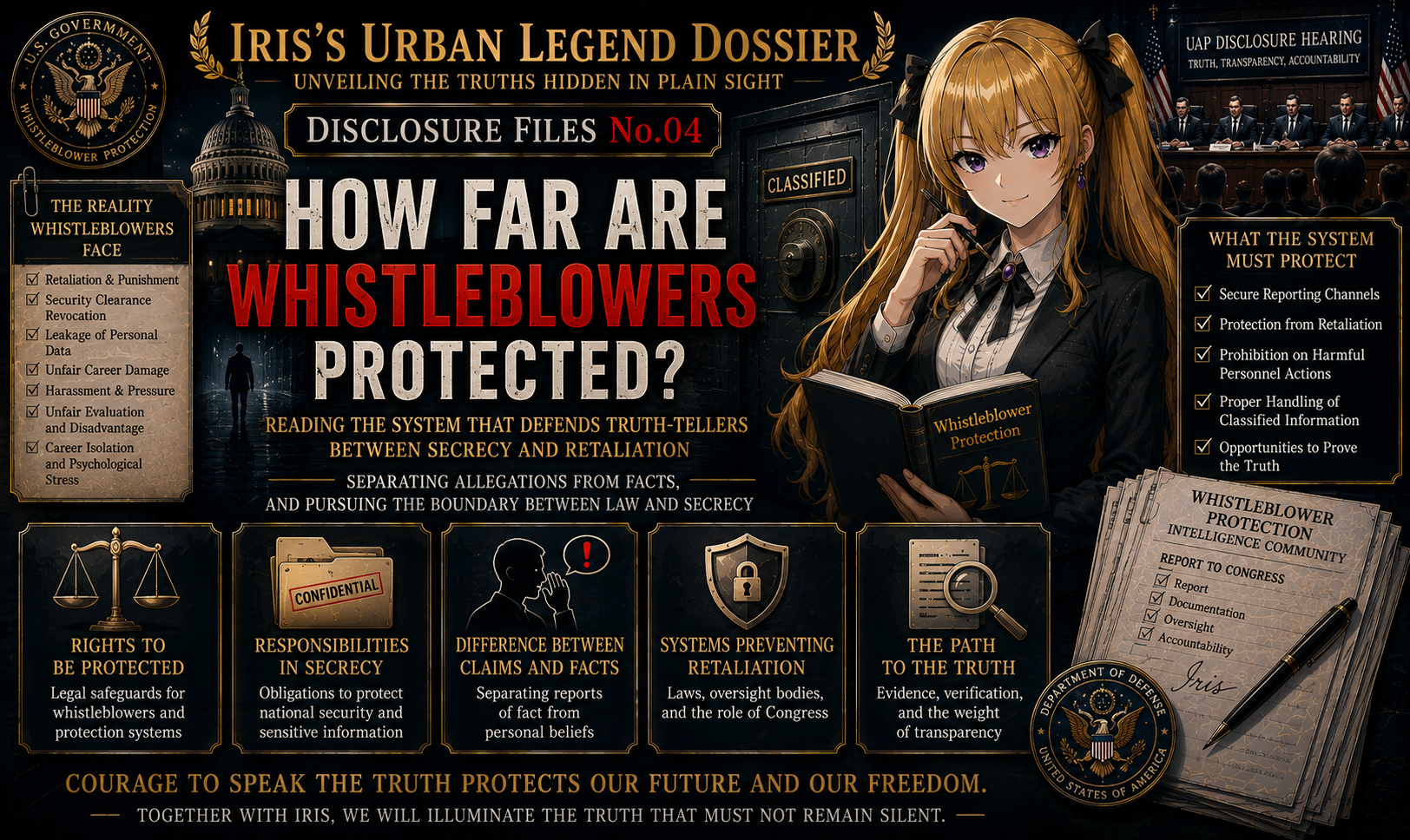
I am Iris.
Urban legends are not mere fabrications—
I am the storyteller who traces the unspoken truths with you.
Disclosure Files No.04.
In the previous file, we examined the apparent gap between AARO and members of Congress.
AARO states that it has not verified evidence of extraterrestrial technology.
Some lawmakers continue to ask whether AARO has received access to every record required for that conclusion.
Whistleblowers are expected to carry information across that gap.
Note: This article does not treat allegations involving recovered craft, non-human intelligence, reverse-engineering programs, or hidden government activity as established fact merely because they were raised by a whistleblower.
It also does not conclude that every professional disadvantage alleged by a UAP witness was an act of government retaliation unless an appropriate investigation has established that finding.
It separates reporting rights, classified-information obligations, anti-reprisal systems, congressional oversight, and the factual verification of the underlying allegation.
What Does It Mean to Be “Protected”?
The statement—
Whistleblowers are protected by law—
sounds like a single powerful shield.
A person may assume that protection means:
the employee cannot be dismissed,
classified information can be given directly to Congress or the press,
the source will remain completely anonymous,
a security clearance cannot be suspended,
the allegation must be accepted as true,
and the investigation must produce the result the whistleblower expects.
The real system is more fragmented.
Different rules can apply to:
members of the Armed Forces,
Defense Department civilian employees,
Intelligence Community personnel,
government contractors,
former employees,
and people with access to classified information.
The central protections generally concern:
the right to make a lawful disclosure,
the right not to be restricted from communicating with authorized oversight bodies,
protection against retaliatory personnel action,
protection against the use of a security-clearance decision as punishment,
and access to secure reporting channels.
Those protections do not create:
a general right to publish classified information,
automatic immunity for unrelated misconduct,
official confirmation of the allegation,
permanent entitlement to a particular position or clearance,
or a guarantee that the complaint will be substantiated.
Protecting the whistleblower and verifying the whistleblower’s claim are connected, but separate, processes.
A Whistleblower Is Not Automatically a Public Leaker
Popular stories often portray a whistleblower as someone who removes secret documents and releases them to journalists or the internet.
That is not how classified whistleblower protection is designed to operate.
The right to report wrongdoing and the right to disclose classified information publicly are not the same right.
The system attempts to create authorized routes to people and institutions capable of receiving protected information, including:
inspectors general,
the Defense Department Inspector General,
the Intelligence Community Inspector General,
properly authorized congressional committees,
secure government reporting systems,
and AARO’s authorized program-reporting process.
By contrast, a whistleblower may create a separate legal problem by:
sending classified files to a personal email account,
posting them on social media,
giving complete records to an uncleared person,
or transmitting them through an unclassified network.
A public-interest motive does not automatically remove classification obligations.
The system is not intended to destroy secrecy.
It is intended to prevent secrecy from becoming a permanent shelter for waste, abuse, illegality, or serious oversight failure.
Can an NDA Prevent a Report to AARO?
AARO accepts reports from current and former government employees, service members, and contractor personnel with direct knowledge of U.S. government programs or activities related to UAP.
Its official reporting guidance states that an authorized disclosure is not barred by a nondisclosure agreement previously signed by the reporting individual.
This matters because a person should not be told:
Your NDA prohibits you from cooperating with AARO.
You may not report a UAP-related government program requested by Congress.
But the removal of the NDA barrier does not remove classification.
The report must still:
use an authorized process,
come from a person eligible to report,
distinguish firsthand knowledge from information received from others,
place classified material only in an authorized secure environment,
and avoid knowing or willful false reporting.
The rule is not:
A whistleblower may now publish the material.
It is:
A whistleblower may provide the material to the authorized investigative system without the NDA being used as a gag.
That is a narrow but important path between silence and unrestricted release.
Why Does AARO Require Direct Knowledge?
AARO emphasizes direct knowledge of a government UAP-related program or activity.
Direct knowledge can include personal involvement with:
a program,
a facility,
a document,
a contract,
a budget,
a material-handling process,
an operational order,
or a chain of authority.
This requirement does not mean every secondhand report is worthless.
It means an investigation must reach the original source.
Suppose A heard the story from B.
B heard that C had seen a document.
C said that D had worked inside the program.
A may be entirely sincere.
The investigation must still determine:
whether D exists,
whether D had the required access,
what D actually observed,
whether original records survive,
and whether the program name was formal, informal, or mistaken.
Whistleblower protection should preserve more than a dramatic allegation.
It should preserve the route from allegation to testable source material.
Where Can Classified Information Be Submitted?
The method of delivery is especially important when a complaint contains classified information.
Official Defense Department guidance provides different secure methods for information at different classification levels.
Ordinary internet channels are not authorized repositories for classified evidence.
Secure government networks, classified facilities, controlled courier procedures, and approved communications may be required.
AARO similarly warns reporters not to place classified material into its public form or ordinary email.
This creates a difficult position.
The whistleblower is told:
Provide evidence or the allegation cannot be verified.
At the same time:
Do not release the evidence publicly.
A person who follows the rule may look unsupported to the public.
A person who publishes the source material may face allegations of unauthorized disclosure.
That is why inspectors general and cleared members of Congress are essential.
They can examine material in a secure setting and, when possible, produce an unclassified conclusion.
Protection for Members of the Armed Forces
Members of the Armed Forces have statutory protection concerning communications with members of Congress and inspectors general.
Protected matters may include alleged:
violations of law or regulation,
gross mismanagement,
abuse of authority,
and substantial dangers to public health or safety.
A service member may also complain that someone improperly restricted an authorized communication.
An adverse personnel action following a disclosure is not automatically retaliation.
Investigators may examine:
whether a protected communication occurred,
whether the responsible official knew or believed that the individual had made the disclosure,
whether an unfavorable action was taken or threatened,
whether a favorable action was withheld,
and whether the same decision would have occurred without the disclosure.
A legitimate performance decision, disciplinary measure, assignment, or security action does not become retaliation merely because the employee is also a whistleblower.
The prohibited conduct is an adverse action caused by the protected disclosure.
Protection Inside the Intelligence Community
Intelligence personnel operate under a different set of risks.
The underlying program may itself be classified.
A public disclosure can expose:
sources,
methods,
operations,
technical capabilities,
foreign partnerships,
and national vulnerabilities.
The Intelligence Community Inspector General provides channels for reporting matters such as:
fraud,
waste,
abuse,
gross mismanagement,
criminal or illegal intelligence activity,
and certain urgent concerns involving intelligence programs.
Under the ICWPA framework, qualifying matters may be transmitted through an inspector general to the congressional intelligence committees.
Anti-reprisal protections can address personnel decisions and actions affecting security clearances or access to classified information.
But the protection has limits.
A person who knowingly files false information, or acts with willful disregard for whether it is true, does not receive the same protection.
The system is designed to protect good-faith reporting—not a predetermined story presented without concern for accuracy.
The Security Clearance Vulnerability
For an employee whose career depends on classified access, a security clearance is not merely a credential.
Without access, the person may be unable to:
perform assigned duties,
enter the relevant facility,
attend operational meetings,
review the evidence needed for the job,
or remain in the same position.
A suspension or revocation can therefore have the practical effect of removing the whistleblower from the workplace.
At the same time, the government has a legitimate obligation to review access when national-security concerns arise.
Possible grounds can include:
improper handling of classified information,
false reporting,
security violations,
foreign influence,
or other individualized risks.
The central question becomes:
Was the access decision a genuine security judgment?
Or was a security judgment used as a tool to silence a protected disclosure?
U.S. protections expressly recognize that an action affecting classified access can itself become a form of reprisal.
That point matters because an organization does not need to formally fire a whistleblower if it can remove the access required to perform the job.
A Substantiated Security-Clearance Reprisal Case
A real Defense Department investigation illustrates the point.
In 2024, the DoD Inspector General announced that it had substantiated part of a whistleblower reprisal allegation involving a Navy cyberwarfare organization.
The case was not related to UAP.
Its value lies in showing how the protection process operates.
The investigation considered:
whether protected disclosures occurred,
whether the responsible official knew of them,
whether the official recommended an action affecting eligibility for classified access,
and whether the same recommendation would have been made in the absence of the disclosures.
The Inspector General found that the evidence did not clearly and convincingly establish that the clearance-related recommendation would have occurred without the protected disclosures.
The case demonstrates that:
clearance retaliation is not merely theoretical,
an inspector general can investigate it,
and a reprisal allegation can be substantiated.
It does not prove that every clearance dispute involving a UAP witness is retaliation.
Each case still requires its own record.
What Counts as Retaliation?
Retaliation can extend beyond dismissal.
Depending on the person’s status and the applicable authority, it may involve:
demotion,
reassignment,
blocked promotion,
negative evaluation,
loss of duties,
contract termination,
removal from important work,
an adverse security-clearance recommendation,
or the withholding of a favorable action.
Threats can also influence reporting.
A person may be told or led to believe that speaking will:
end the career,
damage the family,
remove classified access,
or lead to isolation inside the organization.
But a subjective feeling of retaliation is not the final legal test.
An investigation must identify:
the protected disclosure,
the decision-maker’s knowledge,
the adverse or withheld action,
the timing and surrounding evidence,
and the organization’s independent justification.
Protection means that the allegation receives an independent review.
It does not mean that the whistleblower’s interpretation is adopted automatically.
Retaliation and the Underlying UAP Claim Are Separate Questions
Suppose a whistleblower claims:
A secret UAP retrieval program exists.
After I reported it, I lost my duties.
Two separate issues arise.
First:
Does the retrieval program exist?
Second:
Was the whistleblower subjected to an unlawful reprisal?
A confirmed reprisal would not automatically establish the retrieval program.
An organization can mistreat someone even when the underlying claim is mistaken or unproved.
Failure to prove the retrieval program would not automatically establish that no retaliation occurred.
A manager can retaliate against an employee whose allegation ultimately cannot be verified.
Urban-legend narratives often merge the questions:
The person suffered.
Therefore the person reached the truth.
Therefore the allegation is correct.
A lawful investigative system must refuse that shortcut.
The claim and the treatment of the claimant require separate evidence.
Is Complete Anonymity Guaranteed?
Inspector-general processes seek to protect a complainant’s identity.
Complete anonymity, however, cannot always be guaranteed.
A sufficiently detailed complaint can reveal:
the office,
the project,
the date of a meeting,
the small number of people with access,
or the identity of the person who created a document.
An investigation may also require interviews, document requests, and confrontation of the facts.
In some circumstances, the source cannot be meaningfully investigated without becoming identifiable to a limited number of authorized people.
A public congressional witness gives up anonymity entirely.
That exposure can increase professional and personal risks.
It can also make hidden pressure more difficult by drawing public attention.
Anonymity therefore has two effects.
It protects the individual.
It can also limit cross-examination and independent verification.
Whistleblower Status Is Not Immunity
A person does not receive immunity for every act merely by identifying as a whistleblower.
Protection does not ordinarily excuse:
unrelated misconduct,
deliberate falsification,
unauthorized removal of classified records,
alteration of evidence,
or other violations independent of the protected disclosure.
Nor does whistleblower status mean that:
all criticism is retaliation,
the witness cannot be questioned,
contradictions should not be examined,
or original records need not be produced.
Legitimate verification includes:
testing inconsistencies,
checking source independence,
requesting documents,
and comparing alternative explanations.
Those steps are not inherently attacks on a whistleblower.
But verification can become intimidation when an organization unnecessarily exposes personal information, attacks character rather than evidence, uses private medical information as a weapon, or deliberately isolates the person for reporting.
Protection and scrutiny must coexist.
Why the 2025 Hearing Focused on Whistleblower Protection
In September 2025, the House Task Force on the Declassification of Federal Secrets held a hearing titled:
“Restoring Public Trust Through UAP Transparency and Whistleblower Protection.”
The title did not promise confirmation of extraterrestrial life.
It emphasized:
transparency,
protection,
and public trust.
The hearing examined whether:
federal agencies had provided adequate UAP information,
AARO and the Intelligence Community were sufficiently transparent,
Congress could oversee taxpayer-funded activity,
and people with relevant information could report without retribution.
Lawmakers argued that whistleblowers should be able to discuss spending, classification policy, declassification procedures, and UAP-related programs through authorized processes without punishment.
The hearing itself did not verify every claim presented by its witnesses.
It identified a structural need:
Congress cannot test an allegation when the people holding the information are too afraid to report it.
Why Does Silence Continue When Protection Exists?
Formal protection does not remove every practical risk.
First, causation is difficult to prove.
An agency may characterize an adverse action as:
ordinary management,
performance assessment,
contract administration,
or a legitimate security decision.
Second, investigations take time.
The whistleblower may lose duties, income, reputation, or relationships while the case remains unresolved.
Third, organizational culture can punish without issuing a formal order.
A person may be labeled disloyal, unstable, difficult, or untrustworthy.
Fourth, a classified career depends heavily on continuing access.
Even a temporary suspension can be devastating.
Fifth, the result of an investigation may remain partly classified.
The public may never learn what the inspector general confirmed.
The system exists.
The personal and professional cost of using it can remain high.
Is Public Disclosure the Last Resort?
When internal channels appear ineffective, a whistleblower may turn to Congress, journalists, or a public hearing.
Public attention can:
force institutional action,
help preserve records,
and reduce the risk of invisible pressure.
But it can also:
expose classified information,
distort an ongoing investigation,
freeze a preliminary allegation into a permanent narrative,
draw attention to relatives and colleagues,
and make later correction more difficult.
A witness who cannot publicly produce classified evidence may become trapped between two images:
a courageous revealer of hidden truth,
or a person making extraordinary claims without proof.
Public disclosure can move a system.
It can also transform an unresolved allegation into an identity from which the witness can no longer escape.
Seven Questions for Evaluating UAP Whistleblower Protection
When reading a UAP whistleblower story, seven questions are useful.
First:
What is the person’s legal and employment status?
Different rules apply to service members, intelligence employees, civilians, contractors, and former personnel.
Second:
Where was the disclosure made?
AARO, an inspector general, Congress, a supervisor, a journalist, and social media are not legally equivalent channels.
Third:
Did the person possess firsthand knowledge?
Or was the account based on information from other sources?
Fourth:
Was classified information provided through an authorized secure route?
An inability to speak publicly is not the same as a failure to provide evidence privately.
Fifth:
What specific adverse action allegedly occurred?
Dismissal, reassignment, evaluation, clearance action, or contract termination?
Sixth:
Did the decision-maker know about the disclosure, and is there evidence connecting the two events?
Chronology alone does not establish reprisal.
Seventh:
Are the truth of the disclosure and the existence of retaliation being evaluated separately?
Without that separation, neither the person nor the evidence receives a fair investigation.
Five Layers of the UAP Whistleblower Story
The issue can be divided into five layers.
The first is the documented protection system.
Authorized channels and anti-reprisal frameworks exist for several categories of military, intelligence, civilian, and contractor personnel.
The second is the documented disclosure.
A person submitted information to AARO, an inspector general, Congress, or another authorized body.
The third is the allegation itself.
A hidden program, recovered material, secret imagery, funding, or unauthorized activity.
The fourth is the claimed retaliation.
Loss of duties, clearance problems, blocked promotion, privacy violations, or intimidation.
The fifth is the urban-legend connection.
The person was retaliated against, therefore the UAP claim must be true.
The protection system exists because the government already knows aliens are present.
Evidence cannot be released because the concealment is perfect.
Every criticism of the witness is an intelligence operation.
The first two layers can often be documented.
The third and fourth require separate evidence.
The fifth consists of meaning added to unresolved space.
Conclusion — Protect the Opportunity to Verify, Not a Predetermined Answer
How far are UAP whistleblowers protected?
The United States has systems intended to protect:
lawful reporting,
communication with authorized oversight,
freedom from prohibited personnel reprisal,
freedom from retaliatory security-clearance action,
and secure transmission of classified concerns.
Those systems are real.
They are not complete.
Coverage differs by employment status.
Procedures are complex.
Classified evidence cannot be displayed publicly.
Retaliation can be difficult to prove.
Investigations can take years.
Most importantly, protection of the whistleblower is not official validation of the allegation.
Confusing the two would damage both goals.
Without protection, essential information may never emerge.
Without verification, every allegation can become a self-sealing story.
The system should protect:
the opportunity to speak,
the opportunity to submit records,
the opportunity to receive independent review,
and the opportunity to proceed without unlawful retaliation.
It should not protect a conclusion from examination.
Courage is required to report a serious concern.
Institutions require equal courage to test that concern honestly.
In the next file, we will move from the United States to Japan.
What is Japan’s parliamentary group for UAP issues actually attempting to accomplish?
Is it a political movement seeking official recognition of extraterrestrial visitors?
Or did it begin from questions involving airspace, national security, critical infrastructure, and fragmented government information?
We will follow its path from formation to formal recommendations.
Next time—another fragment of truth we will trace together.
I will return to continue the telling.
References / Sources
U.S. House Committee — 2025 UAP Transparency and Whistleblower Protection Hearing
U.S. House Committee — 2025 Hearing Wrap-Up
AARO — U.S. Government UAP-Related Program / Activity Reporting
AARO — Authorization to Receive Classified UAP-Related Information
U.S. Code — 10 U.S.C. §1034 Military Whistleblower Protection
U.S. Department of Defense OIG — Whistleblower Reprisal Investigations
U.S. Department of Defense OIG — Whistleblower Reprisal Complaints
U.S. Department of Defense OIG — Classified Complaints and ICWPA Reporting
Intelligence Community Inspector General — Hotline, ICWPA and Reprisal Review
U.S. Department of Defense — Implementation of PPD-19
Intelligence Community Inspector General — External Review Panel Procedures
U.S. Department of Defense OIG — Navy Security-Clearance Reprisal Investigation
Posting Time
English articles are published at 23:00 (JST).
Related Reading
The Real Gap Between AARO and Congress
The article separates AARO’s scientific assessment from Congress’s concern that the evidentiary record and access process may be incomplete.
How Far Can Sworn Testimony Become Evidence?
A guide to separating firsthand observation, secondhand information, classified claims, and independently testable evidence.
What Did the U.S. UAP Hearings Actually Reveal?
An examination of the boundary between government acknowledgment of unresolved reports and official confirmation of extraterrestrial life.
Popular Posts
The Hopi Prophecy and the Approaching Comet — The Blue Star Kachina and the Turning of the Age
A popular examination of cosmic signs, prophecy, and narratives of civilizational transformation.
The US–Japan Status of Forces Agreement — A Hidden Treaty That Shapes Japan’s Sovereignty
A structure-focused article about military presence, national sovereignty, and institutions outside ordinary public view.
Hitori Kakurenbo — Japan’s Haunted Ritual
One of the diary’s most widely read examinations of the boundary between ritual, rumor, and fear.
Submit an Urban Legend
If you know an urban legend involving UAP whistleblowers, classified information, congressional reporting, security-clearance action, or retaliation, share it through the comments or social media.
Iris will separate lawful disclosure, the underlying allegation, the reprisal claim, and meanings added by later narratives.
Share & Follow
If you found this article interesting, I would be happy if you supported it by sharing or following.
コメントを残す