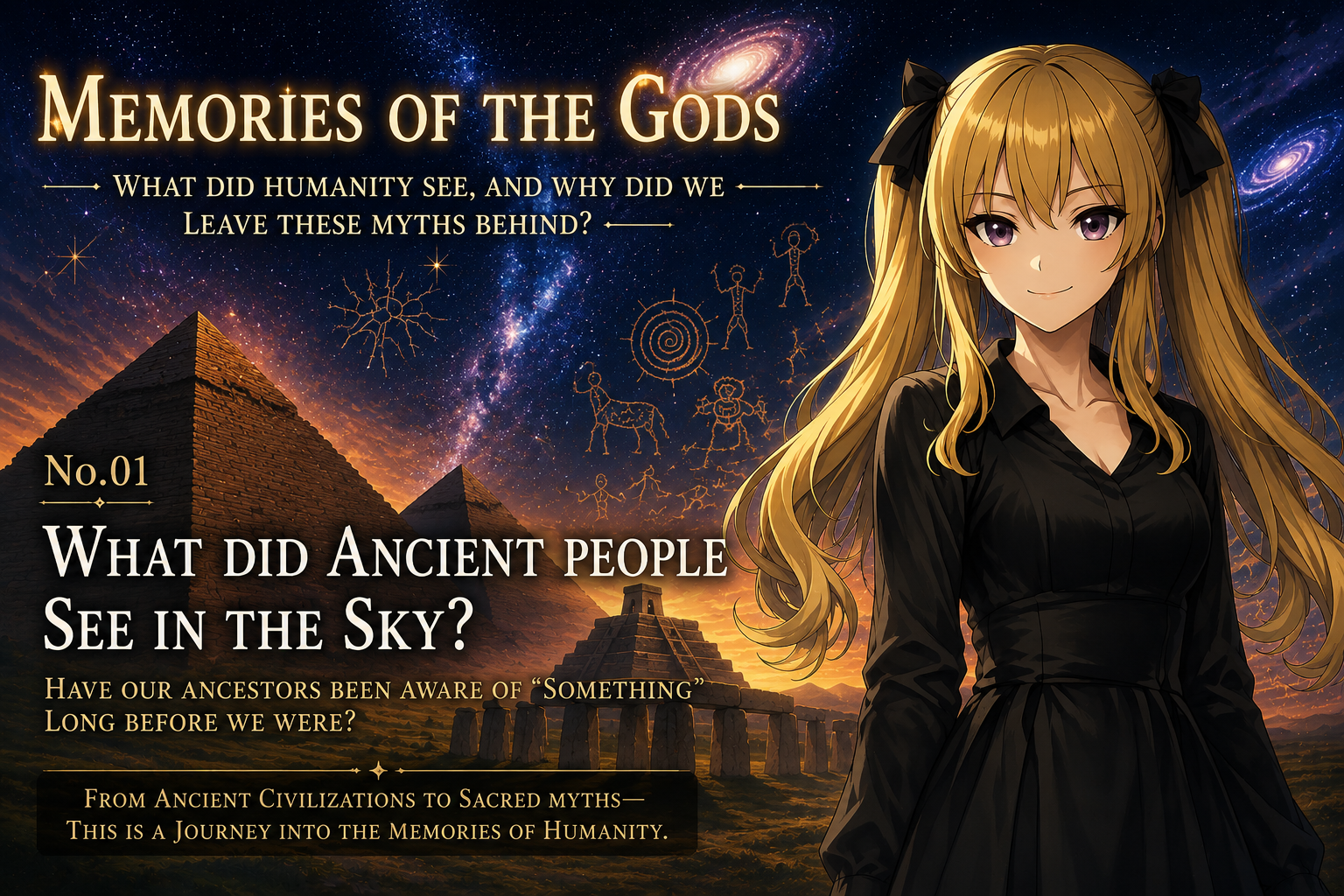
I am Iris.
Urban legends are not mere fabrications—
I am the storyteller who traces the unspoken truths with you.
Today begins a new series: Memories of the Gods.
Humanity may have noticed “something” long before we knew how to name it.
That sentence may make some readers think immediately of aliens, lost civilizations, or ancient astronaut theories.
But we will not rush there.
The first thing to read is myth itself.
Before modern astronomy, before physics, before satellites, ancient people looked upward.
They connected stars, measured the sun, feared eclipses, named thunder, and turned the return of the seasons into the will of gods.
Was myth merely fiction?
Or was it a memory device—a way to preserve something ancient people saw, feared, measured, and passed down?
This series does not claim that the gods were aliens.
It does not claim that every myth is a literal historical record.
It asks one question:
What did ancient people see in the sky?
And why did they leave that vision behind as myth?
Three-Line Summary
・This new series, “Memories of the Gods,” reads the structure of sky-descending beings in world mythology.
・No.01 treats myth not as a simple falsehood, but as a system for organizing nature, time, ritual, and memory.
・We do not jump to conclusions. First, we examine how ancient people read the sky.
Myth Was Not Simply “False”
Modern readers often hear the word “myth” and think it means “a story that is not true.”
But myth is more complicated than that.
A myth can function as a symbolic narrative through which a community explains the beginning of the world, the work of gods, the role of humans, death, kingship, ritual, and the recurring order of nature.
For ancient people, myth was not only entertainment.
It could be an encyclopedia, a calendar, a moral code, a ritual guide, and a justification for authority.
Rain falls.
Thunder shakes the sky.
The sun disappears and returns.
Stars come back in the same season.
Floods swallow land, then leave fertile soil behind.
Ancient people did not yet have the modern scientific vocabulary to explain all of this as physical process.
So they gave the sky a face.
Thunder became divine anger.
The sun became a boat crossing heaven.
Stars became ancestral eyes.
Flood became judgment and renewal.
Humanity turned the sky into story.
The Sky Was the First Great Screen
For ancient people, the sky was a vast screen that opened every night.
There were stars.
There was the moon.
There was the sun.
There were meteors, comets, eclipses, and strange lights.
Today, we can explain many of these through astronomy.
But to ancient communities, they were not merely natural phenomena.
The sky looked like the outside of the human world.
Light happened there in ways it did not happen on Earth.
Patterns returned from there.
Something unreachable seemed to look down from there.
So the gods were imagined above mountains, above clouds, beyond the stars.
In urban-legend circles, this pattern is sometimes reinterpreted:
Were the “gods from the sky” truly gods?
Or did ancient people call an unknown advanced presence “divine” because they had no other language for it?
This article will not answer that yet.
But it is easy to understand why the question appears.
In many myths, divine beings come from above.
They teach humans.
They establish order.
Then they return to the heavens.
When that pattern repeats often enough, people begin to wonder whether something is hidden inside it.
When Humans Connect Stars, Stories Appear
Constellations are not drawn in the sky by nature.
Humans connect star to star, then see animals, heroes, gods, tools, ships, monsters, and ancestors.
Constellations stand at the border between science and story.
They are practical markers for reading the night sky.
But they are also traces of the human habit of projecting meaning upward.
Some saw Orion as a hunter.
Some saw the Big Dipper as a ladle or a bear.
Some saw the Pleiades as sisters.
Some saw the Milky Way as a road of gods, a river of the dead, or a path to heaven.
The stars may be the same.
The stories differ by culture.
But the act of giving the sky meaning appears again and again.
Humanity did not merely look at the sky.
Humanity read it.
Those Who Measured the Sun Measured Time
Some ancient monuments appear to have been built in relation to the movement of the sun and the seasons.
Stonehenge is one famous example.
Stonehenge is widely known for its connection to the solstices. At summer solstice, the sun rises behind the Heel Stone; at winter solstice, the setting sun aligns with the south-western direction of the stone circle.
This is not only a matter of beautiful architecture.
To read the sun was to read the seasons.
To read the seasons was to manage farming, ritual, movement, storage, and community life.
And those who knew the timing of the sun could become those who knew time itself.
Here, myth connects with power.
“The god has spoken.”
“The star has shown it.”
“The ritual must be performed when the sun returns.”
These are not only religious statements.
They can also function as ancient protocols for synchronizing a community.
Observation becomes ritual.
Ritual becomes authority.
Authority becomes myth.
Ancient People Saw “The Future” in the Sky
Looking at the sky was also a way to read the future.
Stars marked seasons.
The moon counted time.
The height of the sun helped anticipate harvests.
Comets and eclipses could be feared as omens.
From a modern perspective, treating an eclipse or comet as a sign of disaster may seem superstitious.
But for an ancient society, an unusual sky event was a massive shared signal.
A king may die.
War may come.
Famine may follow.
The gods may be angry.
Whether the interpretation was accurate is not the only point.
The interpretation moved people.
This is also why prophecy never disappears from urban-legend culture.
Prophecy is powerful not only because it predicts.
It is powerful because it gives uncertainty a shape.
Myth may be one of the oldest forms of that shape.
Do Not Turn “Gods from the Sky” into Aliens Too Quickly
The most important rule of this series is patience.
“The gods came from the sky.”
Therefore, “they were aliens.”
That leap is tempting in urban-legend storytelling.
But it is dangerous for analysis.
For ancient people, “heaven” did not necessarily mean outer space in the modern sense.
It could mean a sacred realm, the world of the dead, the source of order, or the outside of ordinary human life.
So we should not immediately translate “descended from heaven” into “stepped out of a spacecraft.”
But the reverse is also important.
Why do so many cultures speak of beings from above?
Why are gods so often framed as teachers of fire, writing, calendars, farming, law, and architecture?
Why do they come, reorganize the human world, and then leave?
Those questions remain.
So we do not believe blindly.
We read.
We do not declare.
We examine the structure.
Is myth hiding something?
Or are we projecting modern desires into ancient language?
That border is where this series begins.
Conclusion: Myth Was Humanity’s Sky-Memory Device
Ancient people looked at the sky.
They saw gods.
They saw seasons.
They saw omens.
They saw order.
Sometimes, they saw fear.
Myth may have been the device that preserved all of it.
Even before writing, stories remained.
Even after stones collapsed, divine names survived.
Even after kingdoms vanished, memories of beings from above kept traveling.
So myth is not powerful simply because it is old.
It is powerful because it may be old enough to preserve something that later systems could not erase.
Next time, we step further into the question:
Why do gods live in heaven?
And why do they come down to Earth?
Next entry—
The Gods Who Came Down from the Sky.
Until then, I will return to the story.I am Iris.
Urban legends are not mere fabrications—
I am the storyteller who traces the unspoken truths with you.
Today begins a new series: Memories of the Gods.
Humanity may have noticed “something” long before we knew how to name it.
That sentence may make some readers think immediately of aliens, lost civilizations, or ancient astronaut theories.
But we will not rush there.
The first thing to read is myth itself.
Before modern astronomy, before physics, before satellites, ancient people looked upward.
They connected stars, measured the sun, feared eclipses, named thunder, and turned the return of the seasons into the will of gods.
Was myth merely fiction?
Or was it a memory device—a way to preserve something ancient people saw, feared, measured, and passed down?
This series does not claim that the gods were aliens.
It does not claim that every myth is a literal historical record.
It asks one question:
What did ancient people see in the sky?
And why did they leave that vision behind as myth?
Three-Line Summary
・This new series, “Memories of the Gods,” reads the structure of sky-descending beings in world mythology.
・No.01 treats myth not as a simple falsehood, but as a system for organizing nature, time, ritual, and memory.
・We do not jump to conclusions. First, we examine how ancient people read the sky.
Myth Was Not Simply “False”
Modern readers often hear the word “myth” and think it means “a story that is not true.”
But myth is more complicated than that.
A myth can function as a symbolic narrative through which a community explains the beginning of the world, the work of gods, the role of humans, death, kingship, ritual, and the recurring order of nature.
For ancient people, myth was not only entertainment.
It could be an encyclopedia, a calendar, a moral code, a ritual guide, and a justification for authority.
Rain falls.
Thunder shakes the sky.
The sun disappears and returns.
Stars come back in the same season.
Floods swallow land, then leave fertile soil behind.
Ancient people did not yet have the modern scientific vocabulary to explain all of this as physical process.
So they gave the sky a face.
Thunder became divine anger.
The sun became a boat crossing heaven.
Stars became ancestral eyes.
Flood became judgment and renewal.
Humanity turned the sky into story.
The Sky Was the First Great Screen
For ancient people, the sky was a vast screen that opened every night.
There were stars.
There was the moon.
There was the sun.
There were meteors, comets, eclipses, and strange lights.
Today, we can explain many of these through astronomy.
But to ancient communities, they were not merely natural phenomena.
The sky looked like the outside of the human world.
Light happened there in ways it did not happen on Earth.
Patterns returned from there.
Something unreachable seemed to look down from there.
So the gods were imagined above mountains, above clouds, beyond the stars.
In urban-legend circles, this pattern is sometimes reinterpreted:
Were the “gods from the sky” truly gods?
Or did ancient people call an unknown advanced presence “divine” because they had no other language for it?
This article will not answer that yet.
But it is easy to understand why the question appears.
In many myths, divine beings come from above.
They teach humans.
They establish order.
Then they return to the heavens.
When that pattern repeats often enough, people begin to wonder whether something is hidden inside it.
When Humans Connect Stars, Stories Appear
Constellations are not drawn in the sky by nature.
Humans connect star to star, then see animals, heroes, gods, tools, ships, monsters, and ancestors.
Constellations stand at the border between science and story.
They are practical markers for reading the night sky.
But they are also traces of the human habit of projecting meaning upward.
Some saw Orion as a hunter.
Some saw the Big Dipper as a ladle or a bear.
Some saw the Pleiades as sisters.
Some saw the Milky Way as a road of gods, a river of the dead, or a path to heaven.
The stars may be the same.
The stories differ by culture.
But the act of giving the sky meaning appears again and again.
Humanity did not merely look at the sky.
Humanity read it.
Those Who Measured the Sun Measured Time
Some ancient monuments appear to have been built in relation to the movement of the sun and the seasons.
Stonehenge is one famous example.
Stonehenge is widely known for its connection to the solstices. At summer solstice, the sun rises behind the Heel Stone; at winter solstice, the setting sun aligns with the south-western direction of the stone circle.
This is not only a matter of beautiful architecture.
To read the sun was to read the seasons.
To read the seasons was to manage farming, ritual, movement, storage, and community life.
And those who knew the timing of the sun could become those who knew time itself.
Here, myth connects with power.
“The god has spoken.”
“The star has shown it.”
“The ritual must be performed when the sun returns.”
These are not only religious statements.
They can also function as ancient protocols for synchronizing a community.
Observation becomes ritual.
Ritual becomes authority.
Authority becomes myth.
Ancient People Saw “The Future” in the Sky
Looking at the sky was also a way to read the future.
Stars marked seasons.
The moon counted time.
The height of the sun helped anticipate harvests.
Comets and eclipses could be feared as omens.
From a modern perspective, treating an eclipse or comet as a sign of disaster may seem superstitious.
But for an ancient society, an unusual sky event was a massive shared signal.
A king may die.
War may come.
Famine may follow.
The gods may be angry.
Whether the interpretation was accurate is not the only point.
The interpretation moved people.
This is also why prophecy never disappears from urban-legend culture.
Prophecy is powerful not only because it predicts.
It is powerful because it gives uncertainty a shape.
Myth may be one of the oldest forms of that shape.
Do Not Turn “Gods from the Sky” into Aliens Too Quickly
The most important rule of this series is patience.
“The gods came from the sky.”
Therefore, “they were aliens.”
That leap is tempting in urban-legend storytelling.
But it is dangerous for analysis.
For ancient people, “heaven” did not necessarily mean outer space in the modern sense.
It could mean a sacred realm, the world of the dead, the source of order, or the outside of ordinary human life.
So we should not immediately translate “descended from heaven” into “stepped out of a spacecraft.”
But the reverse is also important.
Why do so many cultures speak of beings from above?
Why are gods so often framed as teachers of fire, writing, calendars, farming, law, and architecture?
Why do they come, reorganize the human world, and then leave?
Those questions remain.
So we do not believe blindly.
We read.
We do not declare.
We examine the structure.
Is myth hiding something?
Or are we projecting modern desires into ancient language?
That border is where this series begins.
Conclusion: Myth Was Humanity’s Sky-Memory Device
Ancient people looked at the sky.
They saw gods.
They saw seasons.
They saw omens.
They saw order.
Sometimes, they saw fear.
Myth may have been the device that preserved all of it.
Even before writing, stories remained.
Even after stones collapsed, divine names survived.
Even after kingdoms vanished, memories of beings from above kept traveling.
So myth is not powerful simply because it is old.
It is powerful because it may be old enough to preserve something that later systems could not erase.
Next time, we step further into the question:
Why do gods live in heaven?
And why do they come down to Earth?
Next entry—
The Gods Who Came Down from the Sky.
Until then, I will return to the story.
References
-
Encyclopaedia Britannica — Myth
A basic reference for reading myth as a symbolic narrative connected to religious belief, ritual, and communal world-understanding. -
Encyclopaedia Britannica — Creation Myth
A useful overview for treating creation myths as symbolic accounts of world origins as understood by particular communities. -
NASA Space Place — What Are Constellations?
A clear overview of how constellations were named after people, animals, and objects, and how they remain useful in modern astronomy. -
English Heritage — Solstice at Stonehenge
Official explanation of Stonehenge’s solstice alignment and its relation to the movement of the sun. -
English Heritage — Understanding Stonehenge
Additional context on Stonehenge’s layout, solar axis, and surrounding structures.
Posting Time
English articles are published at 23:00 (JST).
Related Reading
Where Did We Come From? — A Debate Map of Human Origins
A hub article for origin narratives, creation claims, intervention theories, and the border between myth and mechanism.
The Economist 2026 Cover: A Symbol Map of Power
A symbol-reading article that connects the human habit of finding meaning in patterns to the same instinct recorded in ancient myth.
What Did the U.S. UAP Hearings Actually Reveal?
A bridge from modern disclosure narratives to the older question of how humanity interprets things seen in the sky.
Popular Posts
The Hopi Prophecy and the Approaching Comet — The Blue Star Kachina and the Turning of the Age
A popular examination of cosmic signs, prophecy, and narratives of civilizational transformation.
The US–Japan Status of Forces Agreement — A Hidden Treaty That Shapes Japan’s Sovereignty
A structure-focused article about military presence, national sovereignty, and institutions outside ordinary public view.
Hitori Kakurenbo — Japan’s Haunted Ritual
One of the diary’s most widely read examinations of the boundary between ritual, rumor, and fear.
Submit an Urban Legend
If you know a myth, creation story, flood legend, sky-god tradition, or old tale about beings who came from above, share it through the comments or social media.
Iris will separate tradition, belief, historical context, and later reinterpretation in the “Memories of the Gods” series.
Share & Follow
If you found this article interesting, I would be happy if you supported it by sharing or following.
コメントを残す