I am Iris.
Urban legends are not mere fabrications—
I am the storyteller who traces the unspoken truths with you.
In the previous entry, we read the vimanas, the flying vehicles of the gods.
The gods descend from the sky.
They teach civilization.
They drown worlds in water.
They travel through heaven.
Today, we move to an even stranger place.
Not the sky, but a star.
Not only gods, but oral tradition.
Not only myth, but the question of invisible astronomical knowledge.
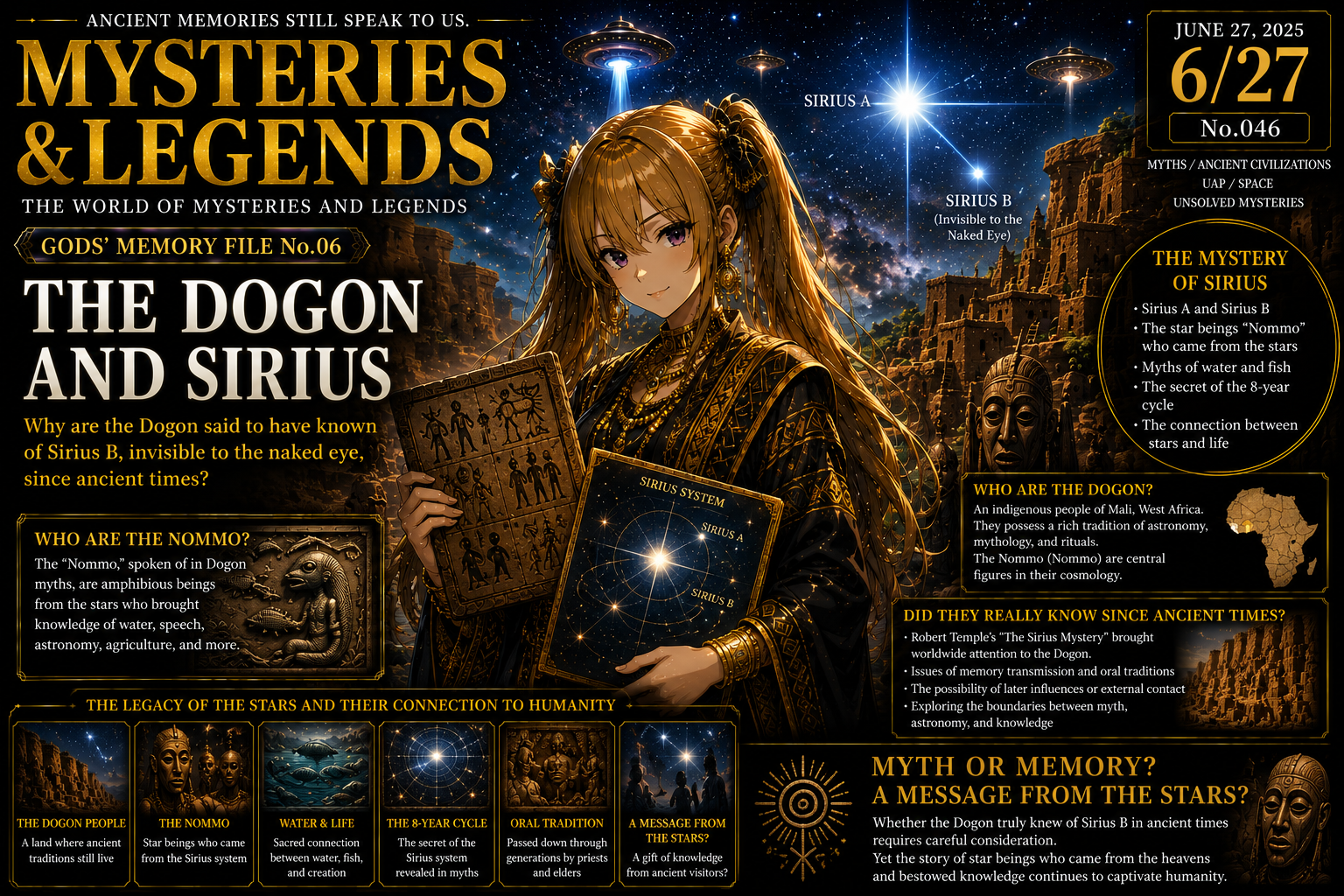
Today’s theme is the Dogon and Sirius.
The Dogon people of Mali, in West Africa, have long been associated with traditions involving Sirius.
The most famous claim is that they knew of Sirius B, the companion star of Sirius, before modern astronomy could observe it directly.
Sirius B is a faint white dwarf.
It cannot be seen with the naked eye.
In modern astronomy, an unseen companion to Sirius was predicted in the nineteenth century and visually observed in 1862.
So did the Dogon truly know of Sirius B from ancient tradition?
Or did this story emerge from a mixture of oral tradition, ethnographic interpretation, outside knowledge, and later ancient astronaut readings?
We will not rush to an answer.
We will separate the layers.
Three-Line Summary
・The Dogon and Sirius story is famous because it raises the question of whether a traditional culture knew about an invisible companion star.
・Griaule and Dieterlen’s report made the story famous, but van Beek’s later restudy raised important doubts.
・The case must be separated into tradition, fieldwork, possible knowledge transfer, and later ancient astronaut interpretation.
Who Are the Dogon?
The Dogon are a people of Mali, strongly associated with the Bandiagara region.
Their culture is known for masks, ritual life, ancestor traditions, cosmology, and symbolic systems.
One of the most famous elements is the Sigui ceremony, which is connected with Sirius.
Sirius is the brightest star in the night sky.
It is not surprising that many cultures have treated it as important.
The mystery begins elsewhere.
The urban-legend question is whether the Dogon knew not only Sirius itself, but also its invisible companion, Sirius B.
If that were true, the question would be obvious:
How could they know it without telescopes?
Was it the result of ancient observation?
Was it taught by outsiders?
Or was the story expanded later by interpretation?
Sirius B, the Invisible Companion
Sirius is highly visible.
Sirius B is not.
Sirius B is the white dwarf companion of Sirius A.
It is faint and difficult to observe because it lies close to the brilliant Sirius A.
In modern astronomy, the existence of an unseen companion was inferred from irregularities in Sirius’s motion.
In 1862, Alvan Clark visually observed Sirius B.
That means Sirius B is not the kind of star one simply recognizes by looking at the sky.
This is why the Dogon story became so powerful.
An invisible star.
A traditional people.
A knowledge claim that appears to precede modern observation.
A connection to ritual and cosmology.
The structure is almost irresistible.
Griaule and Dieterlen’s Report
The story became famous through the work of French ethnologists Marcel Griaule and Germaine Dieterlen.
In 1950, they published a study often known as “A Sudanese Sirius System,” reporting complex Sirius-related knowledge among the Dogon and neighboring groups.
Their report described a system involving Sirius and companion stars, ritual cycles, cosmology, and symbolic meaning.
Later, this material became central to ancient astronaut and New Age interpretations.
“The Dogon knew Sirius B before modern astronomy.”
“The knowledge may have come from beings beyond Earth.”
“The Nommo were visitors from Sirius.”
In that way, Dogon tradition was transformed into a story of star-born teachers.
The Nommo — Beings of Water and Stars
In discussions of Dogon cosmology, the Nommo often appear.
They are associated with water, life, speech, creation, and order.
In later urban-legend interpretations, they are sometimes described as beings from Sirius.
Here, the entire “Memories of the Gods” series seems to converge.
Gods from the sky.
Teachers of civilization.
Water and recreation.
Flying vehicles.
Beings from the stars.
The Dogon and Sirius story gathers many of these motifs at once.
That is why it is powerful.
But the stronger a story is, the more carefully it must be read.
To identify the Nommo immediately as extraterrestrials may be tempting.
But doing so risks replacing the tradition with a modern interpretation before we have understood the tradition itself.
We need to separate the layers:
Dogon belief.
Ethnographic fieldwork.
Modern astronomical knowledge.
Later ancient astronaut theory.
Our own desire to find contact in the past.
These are not the same thing.
Van Beek’s Restudy
There is also a major challenge to the story.
In 1991, anthropologist Walter van Beek published a restudy of Griaule’s work.
His field evaluation raised serious questions about whether the Dogon broadly shared the Sirius knowledge reported by Griaule and Dieterlen.
This does not simply “disprove” the Dogon.
It changes the question.
Was the knowledge widely shared tradition?
Was it limited to particular informants or ritual specialists?
Did interpretation enter through the fieldwork process?
Could outside astronomical knowledge have entered the tradition before or during the research?
This is not an attack on oral tradition.
It is a reminder that recording tradition is never a neutral act.
A researcher asks.
An informant answers.
The answer is translated.
The material is organized.
A paper is written.
Meaning can shift at every stage.
Myth is not a fossil.
It lives through people, situations, questions, and retellings.
Did Outside Knowledge Enter the Story?
One common explanation is knowledge transfer.
By the late nineteenth and early twentieth centuries, missionaries, administrators, travelers, and researchers had entered many parts of Africa.
Sirius B had already been observed in 1862.
Modern astronomical knowledge could, in theory, have entered local conversation before being absorbed into symbolic systems.
Would that make the tradition false?
Not so quickly.
Cultures often absorb outside knowledge and reinterpret it through existing symbols.
A new fact may enter an old cosmology and become part of a living tradition.
That does not make the culture fake.
It shows that tradition changes.
The hard question is where older tradition ends and later knowledge begins.
That uncertainty is exactly what keeps the urban legend alive.
Why the Story Refuses to Disappear
The Dogon and Sirius story remains powerful despite criticism.
Why?
Because its structure is beautiful.
A West African tradition.
The brightest star in the sky.
An invisible companion.
Knowledge before modern observation.
The water-being Nommo.
Teachers from the stars.
Ancient astronaut theory.
When these pieces connect, people see something vast.
Perhaps humanity has always known more about the stars than we admit.
Perhaps myths preserve memories of contact.
Perhaps civilization carries traces of a knowledge from beyond Earth.
These questions are powerful.
But powerful questions require careful separation.
Conclusion: The Mystery Is Not Only the Star, but Transmission
Did the Dogon truly know of Sirius B from ancient tradition?
There is no simple answer.
Griaule and Dieterlen’s report remains an important document.
Van Beek’s restudy raises serious doubts about how it should be interpreted.
The possibility of modern knowledge transfer cannot be ignored.
So we must separate:
What was said in tradition.
What was recorded by researchers.
What later writers turned into ancient astronaut theory.
What modern readers want to see in the story.
The Dogon and Sirius mystery is not only a mystery about a star.
It is also a mystery about how knowledge travels, changes, and becomes myth.
The invisible star asks us:
What did humanity see in the sky?
What did we entrust to the stars?
And where does knowledge end and myth begin?
Next time, we move toward the conclusion of this series.
Was myth only fiction?
Or was it memory?
Next entry—
Whose Memory Is Myth?
Until then, I will return to the story.
References
-
Encyclopaedia Britannica — Dogon
A basic reference for Dogon culture, ritual life, and the relationship between Sirius and the Sigui ceremony. -
Marcel Griaule & Germaine Dieterlen — Un système soudanais de Sirius
The 1950 paper reporting a Sirius-related cosmological system among the Dogon and neighboring groups. -
Walter E. A. van Beek — Dogon Restudied: A Field Evaluation of the Work of Marcel Griaule
A restudy that raises important questions about Griaule’s interpretation of Dogon cosmology and Sirius knowledge. -
American Museum of Natural History — Friedrich Bessel: Discoverer of White Dwarf Sirius B
A reference for the prediction and 1862 visual observation of Sirius B. -
Chandra X-ray Observatory — Sirius Matters: Alien Contact
A supplementary reference on how the Dogon and Sirius story entered ancient astronaut and alien-contact interpretations.
Posting Time
English articles are published at 23:00 (JST).
Related Reading
Where Did We Come From? — A Debate Map of Human Origins
A hub article for origin narratives, creation claims, intervention theories, and the boundary between myth and mechanism.
What Did the U.S. UAP Hearings Actually Reveal?
A modern sky-disclosure article that separates testimony, institutions, interpretation, and later narrative.
The Economist 2026 Cover: A Symbol Map of Power
A symbol-reading article that helps frame how signs, images, and patterns become narratives of hidden meaning.
Popular Posts
The Hopi Prophecy and the Approaching Comet — The Blue Star Kachina and the Turning of the Age
A popular examination of cosmic signs, prophecy, and narratives of civilizational transformation.
The US–Japan Status of Forces Agreement — A Hidden Treaty That Shapes Japan’s Sovereignty
A structure-focused article about military presence, national sovereignty, and institutions outside ordinary public view.
Hitori Kakurenbo — Japan’s Haunted Ritual
One of the diary’s most widely read examinations of the boundary between ritual, rumor, and fear.
Submit an Urban Legend
If you know a myth, creation story, flood legend, sky-god tradition, star legend, or old tale about beings who came from above, share it through the comments or social media.
Iris will separate tradition, belief, historical context, and later reinterpretation in the “Memories of the Gods” series.
Share & Follow
If you found this article interesting, I would be happy if you supported it by sharing or following.
コメントを残す