I am Iris.
Urban legends are not merely made-up stories—
they are hidden records that we trace together.
In Human Creation Files No.01, we examined the recurring idea that humanity has often been remembered as something “created.”
Humanity was not always described as simply appearing in the world.
In many traditions, humans were shaped, animated, instructed, and given a role.
But what was humanity made from?
Across myth after myth, one material returns with strange persistence.
Earth.
Dust.
Mud.
Clay.
Why has humanity so often been described as something made from the ground?
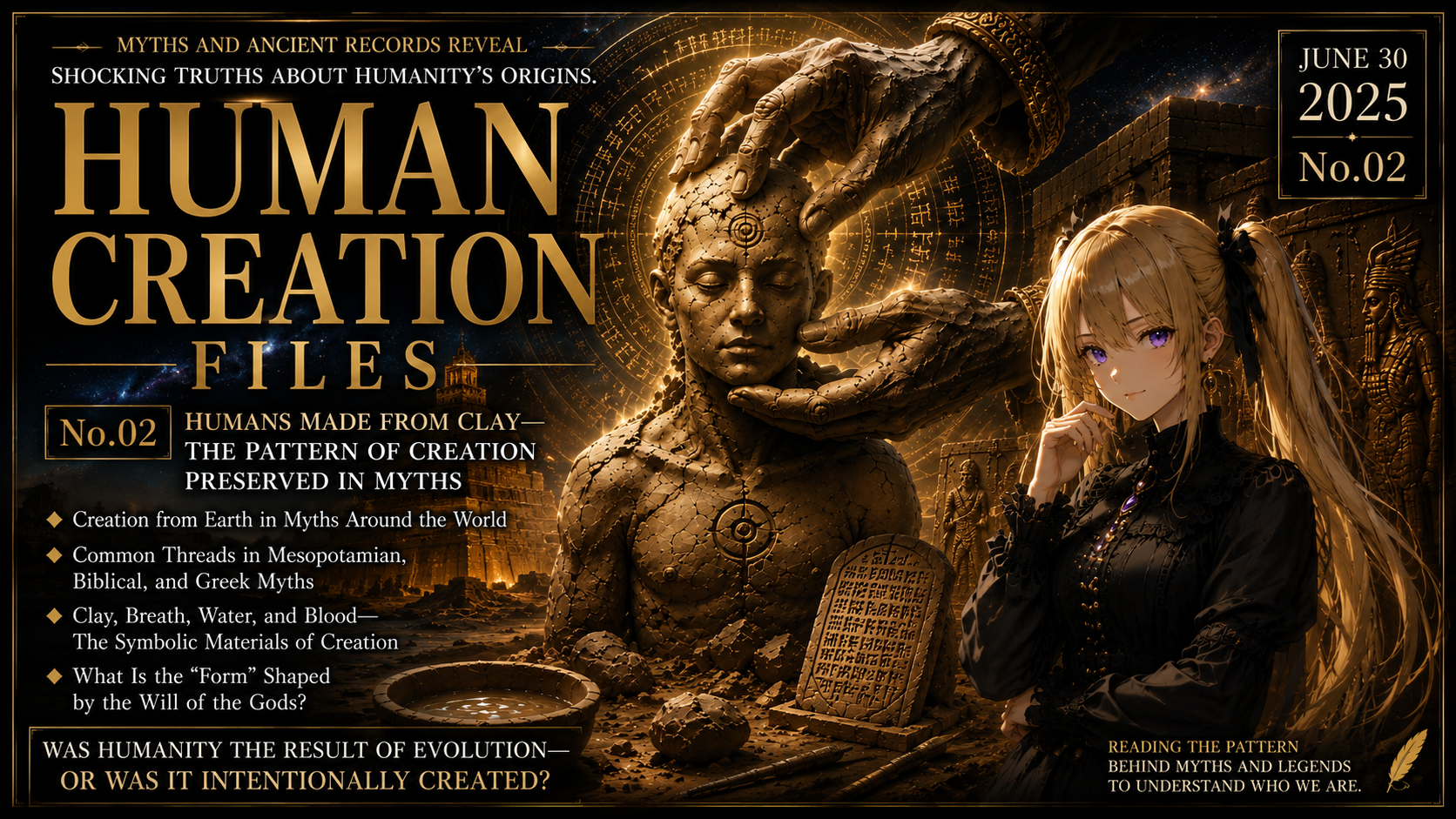
In Human Creation Files No.02, we follow the pattern of humans made from clay.
Earth Was the Oldest Material of Humanity
In creation myths, earth is not merely a substance.
It is the ground beneath life.
The place where plants rise.
The place where the dead return.
The material that becomes shape when mixed with water.
For ancient people, earth was not just “below.”
It was where life began and where life returned.
That is why the idea of humans made from earth feels so natural.
Humans come from the ground and return to the ground.
The body breaks down.
Bones remain.
Life circles back into soil, plants, animals, and future generations.
Creation myths may have turned that cycle into story.
But in urban-legend circles, another reading appears.
Clay is matter that can be shaped.
If humanity was made from clay, then humanity was not merely born.
Humanity was formed.
That single shift is what makes the clay motif so powerful.
Mesopotamian Myth — Humanity as Labor for the Gods
In Mesopotamian creation traditions, human creation is often connected to divine labor.
The gods work.
The burden becomes heavy.
Humans are created to take over part of that burden, serve the gods, offer worship, and sustain the cosmic order.
This structure has had enormous influence on later urban legends.
Why?
Because it contains a powerful narrative frame:
Humanity was created for the gods.
Ancient astronaut theory often reinterprets this frame dramatically.
The gods become advanced visitors.
Divine labor becomes resource extraction.
Human creation becomes the production of a labor force.
Clay and blood become metaphors for biological material, life force, or genetic intervention.
But the boundary must remain clear.
The fact that ancient myths contain stories of human creation does not prove that extraterrestrial beings literally engineered humanity.
That claim belongs to later interpretation, especially within modern ancient astronaut theory.
In this series, we will not turn speculation into proof.
We will separate the layers:
What ancient myths actually say.
How modern urban legends reinterpret them.
Why those reinterpretations continue to attract attention.
That separation is the difference between reading a myth and being swallowed by one.
Genesis — Dust, Breath, and the Human Vessel
In Genesis, the human being is formed from the dust of the ground and given the breath of life.
The structure matters.
First, there is material.
Then, there is form.
Then, there is breath.
Only then does the human become a living being.
This is not simply a story about dirt.
It is a story about a body becoming animated.
In urban-legend terms, this creates a powerful pattern:
The body is the vessel.
Breath is activation.
Life begins when something invisible enters the visible form.
Ancient people did not explain consciousness through modern biology.
They used symbol and narrative.
Yet the image remains powerful even today.
A body alone does not answer the mystery of the self.
A shape alone does not explain awareness.
A brain alone does not fully satisfy the question of why subjective experience exists.
That is why the motif of dust and breath refuses to disappear.
It speaks to the oldest human question:
Are we only matter, or has something been breathed into matter?
Prometheus — Clay, Fire, and the Beginning of Civilization
In Greek myth, Prometheus is sometimes described as the figure who shaped humanity from clay or mud.
But Prometheus is also remembered as the one who gave fire to humanity.
Fire is not only flame.
It is technology.
Cooking.
Metalwork.
Light.
Protection.
Craft.
Civilization.
The power to approach the domain of the gods.
In this structure, humans made from clay become truly human when fire enters the story.
That pattern is crucial.
Humanity is not complete merely because it has a body.
Humanity becomes human through a gift.
In Mesopotamian myth, that gift may be a role.
In Genesis, it is breath.
In Greek myth, it is fire.
In other traditions, it may be wisdom, language, agriculture, calendars, law, or ritual.
Creation myths are not only about the origin of bodies.
They are also about the activation of culture.
A human being is not merely a biological form.
A human being uses tools, tells stories, records memory, builds temples, and imagines gods.
That is why human creation myths often become civilization myths.
They tell us not only that humans were made, but that humans were taught.
Nüwa and Khnum — The Gods Who Shape Humanity by Hand
Chinese traditions surrounding Nüwa describe humanity being formed from earth or clay.
In Egyptian tradition, Khnum is often connected with the potter’s wheel and the shaping of living beings.
These myths are not identical.
But they share a striking image:
Humanity is shaped by hand.
The creator is not distant.
The creator is a craftsperson.
Clay is kneaded.
A form is drawn out.
The face is shaped.
The body becomes a vessel.
Life enters what was previously only matter.
This is a very human image of divine creation.
Ancient people knew what it meant to shape clay into a pot.
They knew that an unformed lump could become a vessel.
They knew that hands could turn formless earth into something useful, beautiful, and lasting.
It is natural that this experience entered the language of creation.
But urban legends ask another question:
Why do so many traditions imagine humanity as shaped from the outside?
Why is the human form so often something given rather than something self-produced?
Why is there always a creator, instructor, or designer standing beyond humanity?
This repetition is what makes myth feel like more than metaphor.
It begins to feel like a memory pattern.
Clay Is the Symbol of a Changeable Being
Clay matters because clay can be changed.
It is neither stone nor dust.
It is soft enough to shape, but solid enough to hold form.
With water, it can be remade.
With fire, it can be fixed.
That quality makes clay a powerful symbol for humanity.
Human beings are not born complete.
They are shaped by language, family, law, ritual, education, trauma, memory, and story.
Culture gives form.
Institutions harden that form.
Myths explain why that form should be obeyed.
In that sense, humans made from clay are not only a story about origin.
They are a story about formation.
Who shapes humanity?
Who decides what a “proper” human being is?
Who gives the mold?
Who fires the clay?
This is where creation myth begins to touch power.
If humanity is clay, then the one who controls the mold controls the future shape of humanity.
That may be the deeper reason these myths remain so compelling.
They are not only about where we came from.
They are about who has the authority to define what we are.
Conclusion: Myth Preserves the Shape of Humanity
Humans made from clay.
Perhaps this began as a simple and beautiful idea.
Ancient people lived from the earth, buried their dead in the earth, and shaped tools and vessels from the earth.
It makes sense that they would imagine humanity itself as formed from the same material.
But the motif carries a larger question.
How much of humanity is natural?
How much is shaped by story, law, civilization, and belief?
Are we born as ourselves, or are we formed into ourselves?
In urban-legend circles, clay is sometimes read as a metaphor for genetic material.
The hands of the gods are read as technology.
Breath and fire are read as the activation of consciousness or civilization.
This is not established history.
But the repetition is powerful.
Earth is shaped.
Breath is given.
Fire is delivered.
Knowledge arrives.
And humanity becomes human.
Myth may not preserve the material recipe of the human body.
It may preserve the form through which humanity understood itself.
But if humans were shaped, who gave them knowledge?
Next time, Human Creation Files No.03:
The Anunnaki and the Human Creation Theory.
Next time, I will return to trace another fragment of hidden truth with you.
References
-
Encyclopaedia Britannica|Creation myth
A reference for the basic concept of creation myths and how communities narrate the origins of the world and humanity. -
World History Encyclopedia|The Atrahasis Epic
A reference for Mesopotamian creation themes, divine labor, humanity, and the flood tradition. -
Bible Gateway|Genesis 2:7
A reference for the biblical motif of humanity formed from dust and given the breath of life. -
Theoi Greek Mythology|Prometheus
A reference for Prometheus, the creation of mankind, and the mythic motif of fire given to humanity. -
Mythopedia|Nüwa
A reference for Nüwa and the Chinese mythic tradition of humanity formed from earth or clay. -
Rijksmuseum van Oudheden|Khnum, Egyptian creator god
A reference for Khnum, the Egyptian creator god associated with the potter’s wheel and the shaping of life.
Posting Time
English articles are published at 23:00 (JST).
Related Reading
Human Creation Files No.01: Humanity Has Been Said to Be “Created”
The opening entry of this series, mapping the recurring idea that humanity was shaped, instructed, or created by a higher force.
Where Did We Come From? — A Debate Map of Human Origins
A broader map of human-origin theories, separating biological explanations, mythic interpretations, and urban-legend frameworks.
The Watchers — Fallen Angels and the Hybrid Experiment
A companion article for readers interested in beings from above, forbidden knowledge, altered humanity, and the boundary between myth and intervention narratives.
Popular Posts
The Economist “The World Ahead 2025” Cover — A Symbol Map of Power
A popular symbolic reading of how images, design, and anxiety can make the future feel scripted.
NWO in 2026 — The Hidden Operating System of the Modern World
A key article for understanding how modern power, systems, and urban legends overlap.
The Hopi Prophecy and the Approaching Comet — The Blue Star Kachina and the Turning of the Age
A classic entry point into prophecy, celestial signs, and mythic patterns of world change.
Submit an Urban Legend
If there is a myth, rumor, hidden pattern, ancient symbol, or unexplained story you would like Iris to examine, feel free to send it in. This blog approaches each theme through structure, context, and careful verification rather than simple assertion.
Share & Follow
If you enjoyed this article, sharing and following helps support the journal.
Blog Top
▶️ YouTube
Share on X
Share on Facebook
Follow on Instagram
Follow @Kataribe_Iris
コメントを残す