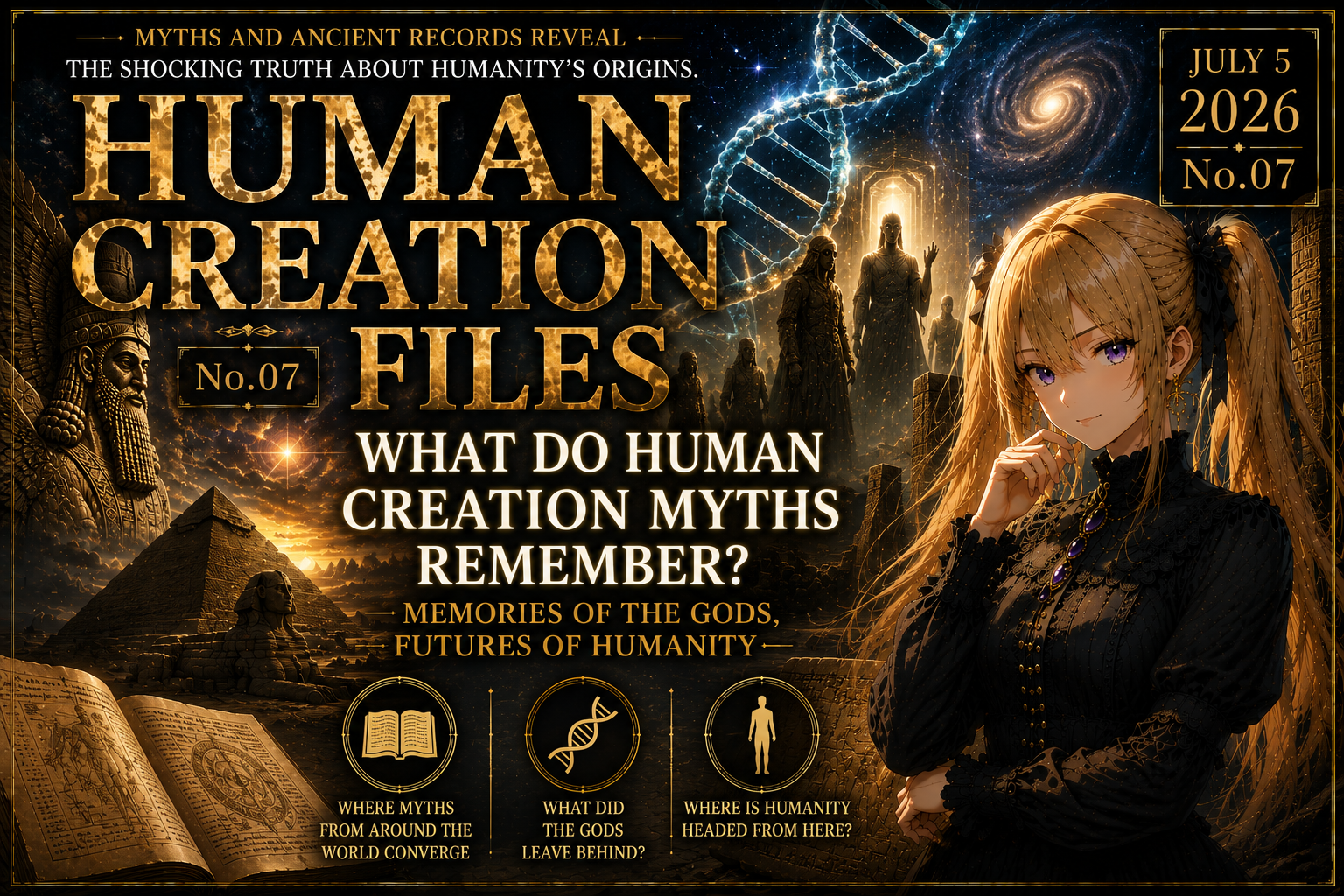
I am Iris.
Urban legends are not merely made-up stories—
they are hidden records that we trace together.
In the Human Creation Files, we have followed the question of human origins through the borderland between myth and urban legend.
Humanity has been said to be “created.”
Humans have been said to be shaped from clay.
The Anunnaki have been reimagined as makers of humankind.
The Nephilim and giant legends have blurred the boundary between gods and humans.
Prometheus and Enki have appeared as figures who gave humanity fire, wisdom, and civilization.
And in the modern age, the DNA modification theory has emerged as a new creation myth written in the language of genetics.
So now, one final question remains.
What do human creation myths remember?
In Human Creation Files No.07, we will gather the threads of this series and examine the memory hidden inside the myths of human creation.
Different Myths Speak the Same Question in Different Languages
Human creation myths differ greatly across cultures.
In some myths, humans are made from earth.
In others, they are shaped from clay.
In others, divine breath gives life to a body.
In others, blood becomes part of the creation.
In others, fire, wisdom, or civilization is given from beyond humanity.
And in some traditions, beings appear between gods and humans.
On the surface, these are different stories.
But beneath them, a repeated structure appears.
Humanity does not simply appear.
Humanity is shaped.
Humanity is animated.
Humanity is instructed.
Humanity is altered by contact.
And humanity becomes the being that asks where it came from.
That repetition is what makes creation myths more than old stories.
They may preserve a shared human unease.
Why are we here?
Are we only the result of chance?
Did something shape us?
Was there purpose, design, or intervention behind human existence?
Myth was one of humanity’s earliest ways of answering that question.
The First Memory — Humanity Was Made from Material
One of the strongest patterns in creation myths is the idea that humanity has material.
Earth.
Dust.
Clay.
Blood.
Bone.
Breath.
Light.
Fire.
Humans do not emerge from nothing.
They are formed from the material of the world.
This matters.
Earth is the ground of life.
Clay is matter that can be shaped.
Blood is life and inheritance.
Breath is animation.
Fire is civilization.
Wisdom is the power to cross boundaries.
Creation myths do not only explain the physical origin of humanity.
They ask what humanity is made of.
What belongs to the body?
What belongs to the earth?
What enters from beyond matter?
What turns a form into a living being?
In urban legends, this ancient material language is rewritten in modern terms.
Clay becomes biological material.
Blood becomes genetic information.
The hands of the gods become life technology.
Breath becomes consciousness.
DNA becomes the new clay of the modern creation myth.
The age changes.
The question remains.
What is humanity made of?
The Second Memory — Humanity Was Activated
Creation myths often contain another powerful pattern.
A body alone is not enough.
A figure made from dust needs breath.
A being shaped from clay needs life.
A weak creature needs fire.
An incomplete humanity needs wisdom.
Human creation myths often include an activation event.
A form becomes alive.
A living thing becomes aware.
A group becomes a civilization.
A creature becomes human in the cultural sense.
This is why the activation motif matters so much to urban legends.
When did human consciousness awaken?
When did language begin?
When did symbolic thought appear?
When did religion, art, ritual, and civilization start?
Myths describe that moment as breath, fire, divine speech, heavenly teaching, or the gift of wisdom.
Modern urban legends translate it into genetic modification, intellectual activation, outside intervention, or a civilization program.
The language changes.
The core question does not.
When did humanity become more than an animal?
The Third Memory — The Gods Were Too Close to Humanity
In human creation myths, the gods are not always distant.
They make humans.
They give life.
They teach wisdom.
They unite with humans.
They punish humans.
They save humans.
They determine human destiny.
The gods stand very close to the human beginning.
That closeness is one of the reasons urban legends grow from myth.
If the gods were only symbols of nature, why are they remembered as makers, teachers, judges, and sometimes partners of humanity?
If myth is only imagination, why does it repeatedly describe acts of creation, instruction, and boundary-crossing?
Urban legends answer with another possibility.
Perhaps the gods were visitors.
Perhaps they were memories of a lost advanced civilization.
Perhaps they were ancient teachers, rulers, or technicians misunderstood by early humanity.
Perhaps they represented something real, later translated into sacred language.
This is not established history.
But the closeness of gods and humans inside creation myths is real as a mythic structure.
The gods are too close.
And that closeness creates the space where ancient astronaut theory and intervention narratives take root.
The Fourth Memory — Knowledge Was Both Gift and Danger
Another repeated element in human creation myths is the danger of knowledge.
Prometheus gives fire.
Enki is connected with wisdom and creative power.
The Watchers are said to teach forbidden knowledge.
Many myths describe humanity changing after receiving something from beyond itself.
Knowledge saves humanity.
But it also makes humanity dangerous.
Fire gives warmth.
Fire also burns cities.
Metalworking gives tools.
It also makes weapons.
Writing preserves memory.
It also supports law, taxation, control, and empire.
Science heals.
It also gives humanity the power to alter life itself.
Through knowledge, humanity approaches the gods.
Through knowledge, humanity gains the power to destroy itself.
That is why myth rarely treats wisdom as a simple blessing.
Knowledge is surrounded by theft, punishment, taboo, rebellion, and collapse.
Human creation myths may remember not only the joy of gaining knowledge.
They may also remember the fear of possessing it.
The Fifth Memory — Humanity Wants to Cross Boundaries
The Nephilim.
Giants.
Demigods.
Divine kings.
Forbidden bloodlines.
Hybrid beings.
These stories share one theme:
Boundaries are crossed.
Gods and humans.
Heaven and earth.
Human and animal.
Nature and civilization.
Life and technology.
Creation and modification.
Humans create boundaries.
Then humans imagine crossing them.
Myth gives that desire the form of giants, heroes, demigods, and forbidden offspring.
Modern urban legends translate it into hybrids, genetic modification, extraterrestrial contact, and altered humanity.
The question remains the same:
How far can humanity go before it stops being human?
Can humanity approach the divine?
Can humanity remake itself?
Should humanity cross the boundary it inherited?
This is not only an ancient question.
AI, genome editing, neuroscience, cyborg technologies, and space settlement all push humanity toward the same border.
That is why human creation myths do not become obsolete.
The more the future arrives, the more ancient myths begin to sound like warnings.
Are Myths History, Metaphor, or Something Else?
Here, the boundary must remain clear.
Reading human creation myths does not mean treating every myth as literal history.
Humans made from clay.
The Anunnaki creating humanity.
The Nephilim walking the earth as a proven race.
Ancient beings modifying human DNA.
These cannot be asserted as established facts.
But that does not make myth meaningless.
Myth is not only a record of events.
It is a record of human self-understanding.
How did humans explain themselves?
How did humans understand their birth?
Where did humans place themselves between nature, gods, and civilization?
If we ask those questions, myth remains useful.
The task is not to believe everything.
It is also not to dismiss everything.
The task is to separate the layers.
What does the ancient myth actually say?
What did later interpreters add?
What did modern urban legends expand?
What fears, desires, and questions are reflected in the story?
That separation is the true discipline of reading urban legends.
What Human Creation Myths Remember
So what do human creation myths remember?
They remember awe before nature.
They remember the feeling of coming from the earth and returning to it.
They remember the mystery of life before science could explain it.
They remember the danger of civilization.
They remember the pride and fear of knowledge.
They remember humanity’s desire to approach the gods.
They remember the refusal to believe that human existence is only an accident.
Urban legends add one more possibility.
Perhaps myth preserves distorted memories of something older:
lost civilizations, forgotten contacts, misunderstood technologies, or events that ancient people could only describe through gods and sacred language.
That possibility cannot be proven here.
But dismissing myth too quickly also misses something important.
Myth may not be evidence.
But it is a vault of questions.
Human creation myths may not preserve the answer.
They preserve the question.
Conclusion: Humanity Still Does Not Fully Know Itself
Human creation myths are stories about the past.
But they are also stories about the future.
That is because humanity is now approaching powers once reserved for gods.
Reading genes.
Editing DNA.
Building AI.
Imagining artificial life.
Preparing for life beyond Earth.
Connecting brains and machines.
Redefining the limits of the human body.
Humanity is beginning to reach toward the creative role it once assigned to gods.
That is why creation myths return.
Did the gods make humanity?
Did humanity make the gods?
Is myth memory?
Is myth metaphor?
Is myth warning?
Or is myth a prophecy of what humanity itself will become?
There is no final answer here.
But one thing can be said.
Humanity still does not fully know itself.
Perhaps we came from earth.
Perhaps we became human when we looked at the stars.
Perhaps we received knowledge.
Perhaps we were never touched by gods at all, but evolved into beings capable of dreaming them.
Either way, humanity keeps asking.
Where did we come from?
Who made us?
What do we remember?
And where are we going?
Human creation myth is humanity’s oldest unsolved file.
Next time, a special edition:
The Economist “The World Ahead 2026” Midyear Review — What Did the Cover Symbols Tell Us?
Next time, I will return to trace another fragment of hidden truth with you.
References
-
Encyclopaedia Britannica|Creation myth
A reference for the basic concept of creation myths and how communities narrate the origins of the world and humanity. -
Smithsonian National Museum of Natural History|Human Evolution Interactive Timeline
A reference for the long process of human evolution and the scientific framework that differs from mythic creation narratives. -
NHGRI|The Human Genome Project
A reference for how modern science has transformed the way human genetic information is understood. -
ORACC|Anunna (Anunnaku, Anunnaki)
A reference for the Anunna / Anunnaki as a group of deities in ancient Mesopotamian religion. -
ORACC|Enki/Ea
A reference for Enki / Ea as a Mesopotamian deity associated with wisdom, magic, and subterranean freshwater. -
Theoi Greek Mythology|Prometheus
A reference for Prometheus and the mythic motif of fire given to humanity.
Posting Time
English articles are published at 23:00 (JST).
Related Reading
Human Creation Files No.06: Where Did the DNA Modification Theory Come From?
The previous article in this series, examining DNA modification theory as a modern creation myth written in the language of genetics.
Human Creation Files No.01: Humanity Has Been Said to Be “Created”
The opening entry of this series, mapping the recurring mythic structure that humanity was shaped, animated, or instructed by a higher force.
Where Did We Come From? — Human Origins Debate Map
A broader map of human-origin theories, separating biological evolution, creation myths, intervention narratives, and modern urban legends.
Popular Posts
The Economist “The World Ahead 2025” Cover — A Symbol Map of Power
A popular symbolic reading of how images, design, and anxiety can make the future feel scripted.
NWO in 2026 — The Hidden Operating System of the Modern World
A key article for understanding how modern power, systems, and urban legends overlap.
The Hopi Prophecy and the Approaching Comet — The Blue Star Kachina and the Turning of the Age
A classic entry point into prophecy, celestial signs, and mythic patterns of world change.
Submit an Urban Legend
If there is a myth, rumor, hidden pattern, ancient symbol, or unexplained story you would like Iris to examine, feel free to send it in. This blog approaches each theme through structure, context, and careful verification rather than simple assertion.
Share & Follow
If you enjoyed this article, sharing and following helps support the journal.
Blog Top
▶️ YouTube
Share on X
Share on Facebook
Follow on Instagram
Follow @Kataribe_Iris
コメントを残す