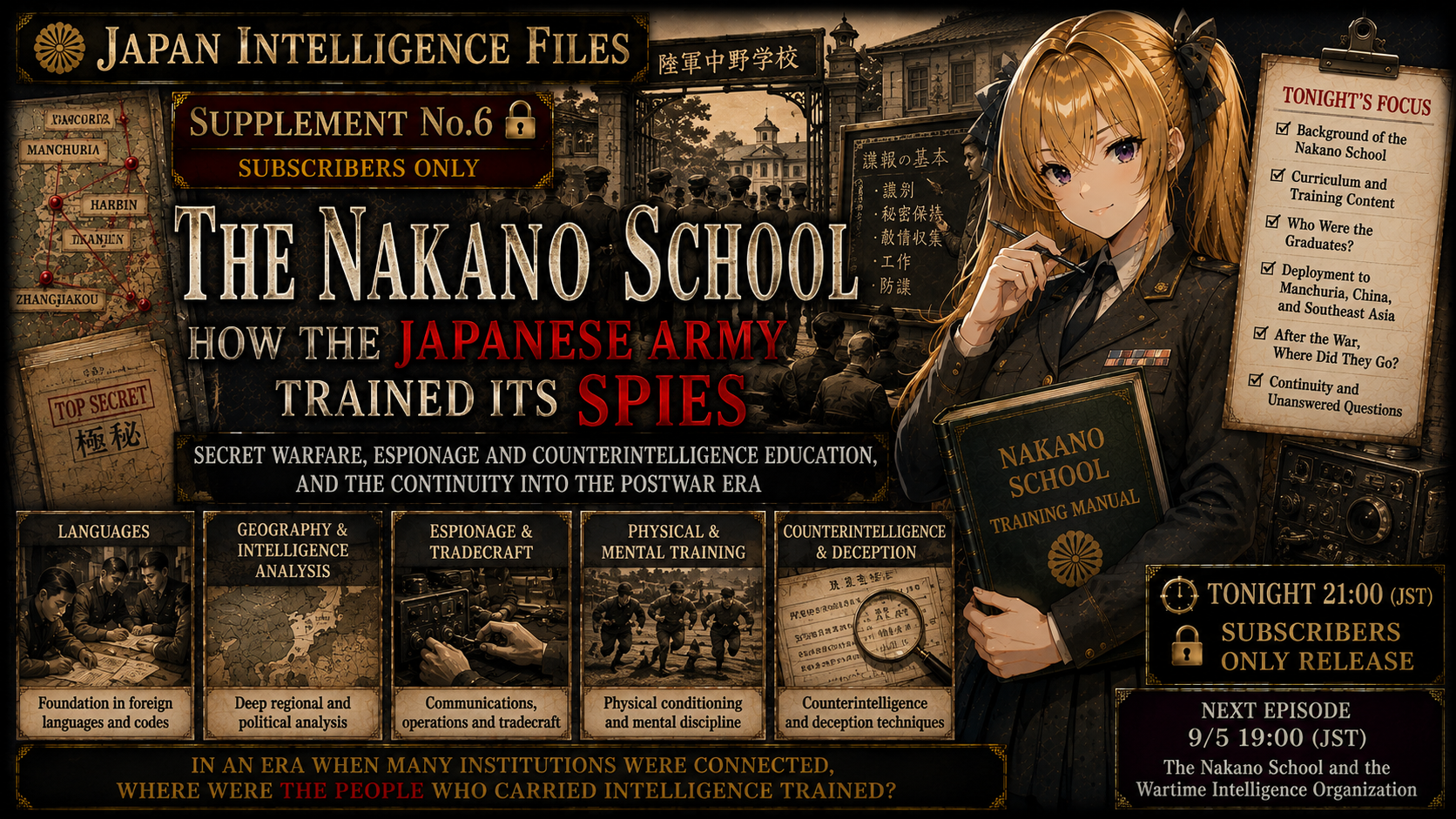
I am Iris.
Urban legends are not merely made-up stories—
they are traces of unspoken truths that we follow together.
Japan Really Did Have a School for Secret Warfare
Yesterday,
we followed the intelligence network that developed across Manchuria.
The Kwantung Army.
Special-service organizations.
Military police.
Police.
Consulates.
Mantetsu.
Different institutions collected different kinds of information.
But institutions require people.
Someone had to read foreign newspapers.
Understand local politics.
Recognize military infrastructure.
Protect secrets.
Establish relationships.
Analyze information.
And sometimes operate where ordinary military identity could not be displayed.
Imperial Japan created an institution to train such personnel.
The Nakano School.
Japan Intelligence Files.
File No.06.
Today we examine what the school actually was—
and what it was not.
It Did Not Begin Under the Name “Nakano School”
The story begins in 1938.
The Japanese Army established a predecessor organization commonly associated with the training of rear-service and secret-warfare personnel.
The first class began with nineteen students.
Training initially took place in Tokyo.
In 1939,
the institution moved to Nakano,
on the site of a former military communications facility.
Then,
in August 1940,
the Army Nakano School was formally established under an official school ordinance.
The famous name therefore came after the training system had already begun to operate.
Why Use an Innocent-Sounding Name?
A school openly called:
Spy Academy,
Espionage School,
or Secret Operations College
would defeat part of its own purpose.
Its predecessor carried the far less dramatic title:
Rear-Service Personnel Training Institute.
The name illustrates a recurring lesson in intelligence history.
An organization’s title does not always describe its real functions clearly.
The same principle appeared in earlier files involving Mantetsu,
special-service organizations,
and public-security institutions.
By 1941, the School Was Closely Connected to the General Staff System
In 1940,
Nakano became a formal Army school.
In 1941,
it was placed under the direct authority of the Chief of the Army General Staff.
That institutional shift matters.
The General Staff dealt with military planning,
operations,
foreign military information,
and strategic assessment.
Nakano was becoming part of the system that produced personnel for the secret side of war.
It was not simply an eccentric private training camp.
It was a military institution.
What Did Students Learn?
Popular imagination focuses on:
codes,
disguises,
surveillance,
secret communications,
and covert tradecraft.
Those subjects make good spy fiction.
Some specialized instruction of that kind did exist.
But surviving school histories,
memoirs,
and more recent archival research reveal a much broader curriculum.
Foreign languages.
Foreign affairs.
Geography.
Military conditions.
Economics.
Transportation.
Psychology.
Statistics.
Intelligence.
Counterintelligence.
Propaganda.
Secret warfare.
Communications.
Practical exercises.
The objective was larger than teaching tricks.
Recent Research Has Brought the First Class Into Sharper Focus
In 2025,
Masayuki Ikeda published
The Nakano School as Seen by My Grandfather: What the First Class Records Reveal.
The study uses materials left by early students—
lecture notes,
diaries,
memos,
and records of exercises.
That matters because Nakano has accumulated decades of legend.
Movies,
memoirs,
postwar rumors,
and conspiracy narratives often overlap.
Contemporary student material allows researchers to move closer to what was actually taught.
The School Needed People Who Could Think Outside a Normal Military Environment
A conventional soldier normally operates within a visible military structure.
Uniform.
Rank.
Unit.
Commanding officer.
Orders.
An intelligence operative may face a different environment.
Foreign territory.
Civilian surroundings.
Limited communications.
Uncertain information.
No commander standing nearby.
That requires more than technical skill.
Observation.
Judgment.
Language.
Adaptability.
Memory.
Political awareness.
Understanding of people.
Nakano’s unusually broad education becomes easier to understand in that context.
Language Was an Operational Tool
English.
Russian.
Chinese.
Foreign-language study appeared in the school’s educational programs.
These were not merely academic subjects.
An officer operating abroad might need to:
read local newspapers,
understand conversations,
study documents,
follow political debates,
or build relationships.
Language was part of intelligence collection.
A translation error could become an intelligence error.
Geography Was Intelligence Too
Throughout this series,
maps keep returning.
The Meiji General Staff.
Military surveying.
Mantetsu.
Special-service organizations.
And now Nakano.
Roads.
Railways.
Rivers.
Ports.
Factories.
Mountains.
Settlements.
Population.
Infrastructure.
A person trained to observe a landscape for intelligence purposes sees a different landscape from an ordinary traveler.
Where others see a bridge,
an intelligence officer may see:
structure,
transport capacity,
strategic value,
security,
and alternative routes.
Intelligence and Counterintelligence Are Mirrors
Collect information—
intelligence.
Prevent the enemy from collecting yours—
counterintelligence.
The two disciplines are inseparable.
Someone who understands how intelligence is collected
also understands where information systems are vulnerable.
That is why a school preparing intelligence personnel also needed to teach security and counterintelligence.
The Word “Mōryaku” Is Difficult to Translate
Another important subject was mōryaku—
often translated as:
subversion,
deception,
political warfare,
or covert operations.
In modern Japanese,
the word can sound almost synonymous with conspiracy.
Historically,
within the military context,
it could refer more broadly to activities designed to influence enemy behavior,
political conditions,
public opinion,
or local forces.
Propaganda.
Psychological influence.
Political contacts.
Deception.
Secret operations.
Nakano was therefore concerned not only with obtaining information,
but with how information and human relationships could affect events.
Nakano Was a School — Not the Headquarters of Every Japanese Secret Operation
This distinction matters.
Nakano trained personnel.
It did not automatically command every mission carried out by its graduates.
Operational authority could belong to:
the General Staff,
field armies,
special-service organizations,
local headquarters,
or other institutions.
The existence of a training school does not mean that every Japanese covert activity was centrally controlled from Nakano.
Graduates Were Dispersed
Graduates were sent to different areas and organizations.
China.
Manchuria.
Southeast Asia.
Military headquarters.
Special-service organizations.
Intelligence-related assignments.
The first-class records examined in recent scholarship also show diverse post-graduation careers.
This produces an important historical effect.
After graduation,
the words “Nakano School” may disappear from the organization chart.
The person remains.
The School May Have Created Networks Without Creating One Organization
Students shared:
teachers,
courses,
terminology,
training,
classmates,
and professional culture.
Then they dispersed.
That creates the possibility of personal networks.
A classmate is not a chain of command.
A former instructor is not automatically a secret superior.
But shared training can create:
trust,
common methods,
professional relationships,
and a common way of interpreting information.
That distinction becomes essential when we reach the postwar period.
The War Changed the School
The Nakano School of 1938
was not identical to the school of 1944.
As Japan’s strategic situation deteriorated,
training requirements changed.
Long-term intelligence work remained one part of the story.
But guerrilla warfare,
operations behind enemy lines,
and preparation for increasingly desperate conditions became more important.
The institution adapted to the war.
The Futamata Branch
In 1944,
a branch school was established at Futamata in Shizuoka Prefecture.
Its focus included guerrilla warfare and irregular operations.
Hiroo Onoda,
who later remained on Lubang Island in the Philippines for decades after the war,
was a member of the first Futamata class.
But that fact must be used carefully.
Onoda’s wartime training does not represent every Nakano student from every period.
Different year.
Different course.
Different strategic environment.
A Former Futamata Student Described Training to “Think About” the Landscape
In a 2026 interview,
a former first-class Futamata student recalled exercises in which trainees were asked to evaluate ordinary objects such as bridges.
How long was it?
What was beneath it?
What would the terrain mean in an operation?
The important idea was not simply destruction.
It was observation.
Assessment.
The Japanese word he used was close to:
consideration,
analysis,
or deliberate examination.
The landscape became data.
Was Nakano a Modern Ninja School?
There are accounts of instruction relating to ninjutsu.
That makes the comparison irresistible.
Ninja.
Nakano.
Postwar intelligence.
Beppan.
One secret lineage.
But the historical rule remains the same.
Studying historical covert techniques
does not prove institutional descent from Iga or Koka organizations.
Functional similarity is not organizational continuity.
Fact, Interpretation, Urban Legend, and the Boundary
Documented facts:
The predecessor of the Nakano School began training personnel in 1938.
The institution moved to Nakano in 1939.
It became the formal Army Nakano School in 1940.
It later came under the Army General Staff system.
Its curriculum included broad foreign-area and secret-warfare subjects.
A Futamata branch emphasizing guerrilla warfare was created in 1944.
—
Interpretation:
Nakano was designed not merely to teach spy techniques,
but to develop personnel capable of operating independently in complex foreign and secret-warfare environments.
—
Urban-legend claims:
Nakano was the modern institutional descendant of Japan’s ninja organizations.
Its alumni secretly preserved the school after 1945.
Postwar Japanese police,
military-intelligence organizations,
and the alleged Beppan are direct institutional successors.
—
Boundary of speculation:
Former students surviving after 1945
does not prove that the Nakano School itself survived institutionally.
Direct continuity requires evidence connecting:
personnel,
orders,
budgets,
recruitment,
training systems,
and chains of command
across the 1945 divide.
Tomorrow — Crossing 1945
The school disappeared with Japan’s defeat.
Its people did not.
That is where the hardest question begins.
Where did former Nakano personnel go?
Did Occupation-era intelligence organizations use them?
Did they enter business,
politics,
policing,
or Japan’s new security institutions?
And how much evidence actually exists for claims connecting them to postwar intelligence organizations?
Tomorrow,
Japan Intelligence Files crosses 1945.
Nakano School and postwar Japanese intelligence.
Not by drawing a line first—
but by testing whether the documents allow us to draw one at all.
Next time—another fragment of truth we will trace together.
I will return to continue the telling.
References / Sources
Meiji University — The Former Site and History of the Army Nakano School
University historical material covering the school’s predecessor, move to Nakano, formal establishment, Futamata branch and wartime development.
National Diet Library — Masayuki Ikeda, The Nakano School as Seen by My Grandfather
A 2025 study using lecture notes, diaries, memoranda and other materials left by members of the first class.
National Diet Library — Army Nakano School, edited by the Nakano Alumni Association
A major postwar school history published in 1978.
TV Asahi — Testimony From a Former Student of the Futamata Branch
A 2026 interview concerning irregular-warfare training during the final phase of the war.
Posting Time
English articles are published at 23:00 (JST).
Related Reading
The opening file that asks whether any direct historical line can be drawn from wartime intelligence to modern Japan.
A modern comparison for intelligence personnel, public-security work and institutional boundaries.
An Occupation-era mystery in which former military networks and intelligence theories later became part of the debate.
Essential background for the institutional rupture that followed Japan’s defeat in 1945.
Popular Posts
Submit an Urban Legend
Have a story involving the Nakano School, wartime intelligence, Occupation-era networks, Japanese public security or alleged postwar covert organizations? Send the details through the blog contact page or comments, preferably with documentary sources.
Share & Follow
🌐 Blog Top ▶️ YouTube 𝕏 Share on X Share on Facebook Follow on Instagram
コメントを残す