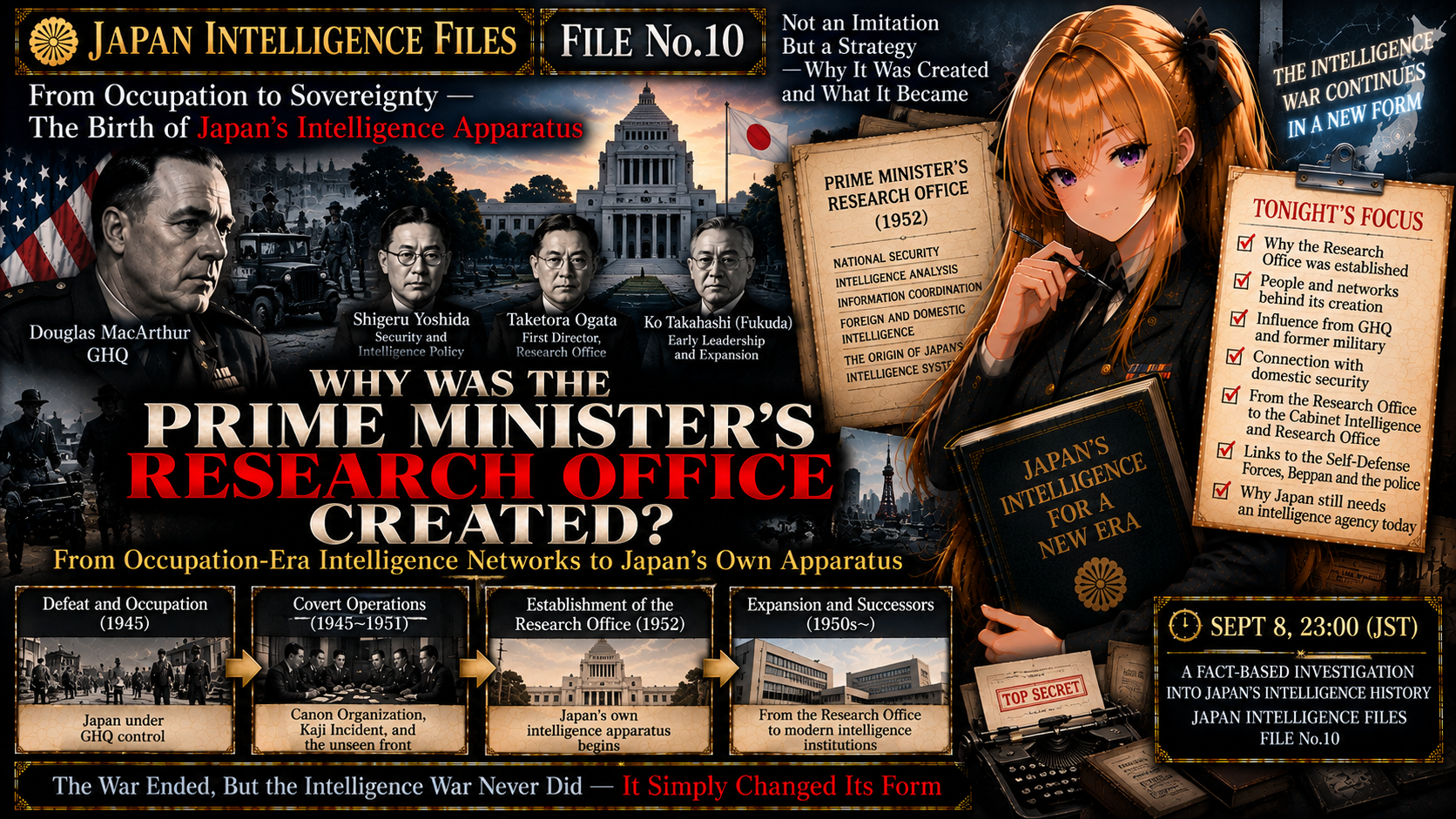
I am Iris.
Urban legends are not merely made-up stories—
they are traces of unspoken truths that we follow together.
The Occupation Ended. The Intelligence Problem Did Not.
Yesterday,
we entered the covert world of the Canon Organization.
Before that,
GHQ/G-2,
Charles Willoughby,
Seizo Arisue,
Torashiro Kawabe,
and Takushiro Hattori.
Those files showed how American occupation intelligence made use of Japanese personnel,
regional knowledge,
and human networks after 1945.
But in 1952,
the framework changed.
Japan regained sovereignty.
The Occupation ended.
The Japanese government now faced a fundamental question.
Who would collect and analyze information for Japan itself?
The Foreign Ministry?
The police?
The emerging security forces?
Or an organization directly connected to the Prime Minister?
Japan Intelligence Files.
File No.10.
Today we examine the institutional origin of Japan’s postwar Cabinet intelligence system.
The Secretariat Research Office of the Prime Minister.
1952 — The Official Beginning
The Japanese government’s official history identifies 1952 as the beginning of this institutional lineage.
The Secretariat Research Office of the Prime Minister was established within the Prime Minister’s Office.
It later developed into:
the Cabinet Research Office in 1957,
the Cabinet Intelligence and Research Office—
CIRO—
in 1986,
and ultimately,
in July 2026,
the National Intelligence Bureau.
Japan’s current government therefore identifies the small 1952 organization as the formal institutional ancestor of its modern Cabinet intelligence apparatus.
It Did Not Begin as a Japanese CIA
The early organization was small.
Historical research and the recollections of founding personnel identify Jun Murai,
a former Home Ministry and police official,
as its first chief.
The first staff was tiny.
This was not an organization comparable in size or authority to:
the CIA,
MI6,
or the Soviet security apparatus.
It began much more modestly.
Research.
Collection.
Analysis.
Reports for the Prime Minister.
Why Create It Just Before Sovereignty Returned?
During the Occupation,
Japan’s ability to conduct an independent foreign and security policy was restricted.
But sovereignty meant responsibility.
The Soviet Union.
Communist China.
The Korean Peninsula.
The United States.
Domestic political movements.
Economic reconstruction.
Labor unrest.
Security.
Japan’s Prime Minister needed information that did not belong to only one ministry.
That created a coordination problem.
Japan Already Had Organizations That Collected Information
The Foreign Ministry possessed diplomatic reporting.
Police organizations possessed domestic-security intelligence.
The emerging security forces required military information.
Other ministries produced economic and technical reporting.
But each institution viewed events from its own perspective.
The Prime Minister needed something different:
information assembled for the Cabinet as a whole.
That basic problem would shape Japanese intelligence for decades.
Intelligence Did Not Mean Only Secret Agents
Surviving early research material is revealing.
The organization examined:
public opinion,
social trends,
mass culture,
broadcasting,
popular literature,
and political statements by intellectuals.
That may not resemble spy fiction.
But it is intelligence in a broader sense.
What does society believe?
What information is influencing people?
Which political ideas are spreading?
How are international events being interpreted?
The state does not need a stolen document to ask those questions.
Early Intelligence Was Also Open-Source Analysis
Newspapers.
Books.
Broadcasts.
Statistics.
Academic specialists.
Government reporting.
Combine enough information,
compare it,
and convert it into an assessment.
That is a familiar principle in modern intelligence.
The earliest Cabinet research organization was therefore as much an analytical apparatus
as a secret-information organization.
Jun Murai and the Problem of Personnel Continuity
Murai’s career raises the same question we encountered earlier in this series.
A new institution can contain people with old experience.
Murai came from the prewar Home Ministry and police world.
That does not mean the prewar police system simply changed its name and became the Research Office.
The legal institutions were different.
The political environment was different.
But experience crossed the historical break.
Again:
personnel continuity
is not identical to
institutional continuity.
Shigeru Yoshida Needed a Cabinet-Level View
Prime Minister Shigeru Yoshida operated in an exceptionally difficult strategic environment.
Independence.
The U.S.-Japan security relationship.
The Korean War.
Communism.
Rearmament.
China.
The Soviet Union.
Economic reconstruction.
Information was not an abstract academic matter.
It directly affected national policy.
A Prime Minister who had to judge all of those questions needed an institution capable of looking across ministry boundaries.
Taketora Ogata Enters the Story Later
Taketora Ogata is frequently associated with the early history of Japanese postwar intelligence.
But the chronology matters.
Ogata was not the first chief of the 1952 Research Office.
That role belonged to Jun Murai.
Ogata’s importance grew as the Japanese government considered creating a stronger and more centralized intelligence structure.
This distinction prevents two different stages of the story from being merged into one.
Was There Really a “Japanese CIA” Plan?
Declassified American intelligence records make the question much more interesting.
A 1953 U.S. intelligence report described the Japanese government as organizing an information committee to prepare for a new central intelligence agency.
The report identified Ogata as its chairman.
Another American file described Yoshida as giving Ogata responsibility for coordinating Japanese intelligence activity.
These are intelligence reports,
not Japanese founding statutes.
But they show that the idea of a stronger centralized intelligence institution was not invented decades later.
Yet the Japanese CIA Never Appeared
Why?
Because intelligence already existed inside competing bureaucracies.
Police possessed domestic security information.
The Foreign Ministry possessed diplomatic networks.
Security institutions needed military intelligence.
Ministries protected their own sources,
authority,
and expertise.
A powerful new central organization would have required those bodies to surrender part of their control.
That was politically and bureaucratically difficult.
Japan Chose a Distributed Model
The postwar Japanese system therefore developed differently from the simplified image of one national spy agency.
Police intelligence remained with the police.
Public Security Intelligence developed separately.
Diplomatic information remained within the Foreign Ministry.
Military intelligence developed within the defense establishment.
Cabinet intelligence increasingly became the place where information was:
collected,
integrated,
analyzed,
and presented to political leadership.
Japan’s intelligence system became a network rather than one pyramid.
1957 — The Cabinet Research Office
In 1957,
the original Prime Minister’s Secretariat Research Office was reorganized.
The Cabinet Research Office was established within the Cabinet Secretariat.
This strengthened the institutional connection between intelligence analysis
and the Cabinet itself.
1986 — CIRO
In 1986,
another reorganization created the Cabinet Intelligence and Research Office.
CIRO.
The organization expanded over time.
Domestic information.
International information.
Economic information.
Analysis.
Coordination.
Reporting to the Prime Minister and Cabinet leadership.
Intelligence Became More Than Political Reporting
The Cabinet’s information responsibilities expanded.
After the Great Hanshin-Awaji Earthquake,
an information center was created to gather urgent information around the clock.
Japan later introduced intelligence-gathering satellites.
The intelligence system increasingly dealt with:
national security,
terrorism,
major disasters,
international crises,
economic issues,
and advanced imagery.
The meaning of “Cabinet intelligence” had changed dramatically from the small office of 1952.
July 31, 2026 — The National Intelligence Bureau
Then came the most important institutional change in decades.
On July 31, 2026,
Japan implemented the Act establishing the National Intelligence Council.
The Cabinet Intelligence and Research Office and the position of Director of Cabinet Intelligence were reorganized into:
the National Intelligence Bureau,
headed by the Director-General of National Intelligence.
The Japanese government explicitly identifies the 1952 Research Office as the institutional origin of the new Bureau.
The formal line is therefore clear:
That Is Not the Same as a Line From the Nakano School
This entire series has repeatedly returned to one seductive diagram.
Nakano School.
GHQ.
Occupation intelligence.
Cabinet intelligence.
Beppan.
National Intelligence Bureau.
Place the names in chronological order,
and they appear to form one hidden lineage.
But chronology is not genealogy.
Japan’s government gives its Cabinet intelligence institution an official lineage beginning in 1952.
Not at the Nakano School.
Not in GHQ/G-2.
Not in Z Unit.
Possible influences,
personnel links,
and inherited expertise are separate historical questions.
Was the Cabinet Research Office Japan’s CIA?
Not really.
The CIA combined broad foreign-intelligence responsibilities with capabilities that Japan’s Cabinet intelligence organization did not possess in the same form.
Japan’s system remained divided among multiple institutions.
The Cabinet intelligence body increasingly coordinated and analyzed intelligence rather than absorbing every collection and operational function.
This distinction is essential when comparing Japan with other countries.
Was Fragmentation a Weakness?
Possibly.
Distributed systems can produce:
bureaucratic rivalry,
information silos,
duplication,
and delays.
But centralization has risks too.
A single powerful intelligence agency concentrates enormous authority.
Postwar Japan lived with that tension for decades.
How much should be centralized?
How much should remain inside specialist ministries?
The Question Survived for Seventy-Four Years
In 1952,
the central problem was:
Who integrates information for the Prime Minister?
In 2026,
Japan created a stronger National Intelligence Bureau and National Intelligence Council.
The structure changed dramatically.
The question did not.
Fact, Interpretation, Urban Legend, and the Boundary
Documented facts:
Japan established the Secretariat Research Office of the Prime Minister in 1952.
Jun Murai was central to the early organization.
The system became the Cabinet Research Office in 1957
and CIRO in 1986.
On July 31, 2026,
CIRO was reorganized into the National Intelligence Bureau.
The Japanese government officially identifies the 1952 organization as the Bureau’s institutional origin.
—
Interpretation:
Japan’s Cabinet intelligence system developed because the government needed an institution capable of integrating domestic and international information across ministerial boundaries after sovereignty was restored.
—
Urban-legend claims:
The Research Office was secretly created by GHQ as a continuation of wartime intelligence organizations.
It was a Japanese branch of the CIA.
The Nakano School,
Occupation intelligence,
Cabinet intelligence,
Beppan,
and today’s National Intelligence Bureau are all successive names for the same hidden organization.
—
Boundary of speculation:
Documented American contacts,
former wartime personnel,
and foreign influence are legitimate subjects for investigation.
They do not by themselves establish direct institutional succession.
Tomorrow — Why Is Japanese Intelligence Divided Among So Many Organizations?
Now we have reached modern Japan.
The National Intelligence Bureau.
Public-security police.
The Public Security Intelligence Agency.
The Foreign Ministry.
Defense intelligence.
Self-Defense Force intelligence.
And the alleged Beppan.
Who collects what?
Who can investigate?
Who can arrest?
Who handles foreign intelligence?
Who reports to the Cabinet?
Why did Japan build a distributed system instead of one giant intelligence service?
September 9.
Japan Intelligence Files.
File No.11.
We begin assembling the complete modern intelligence map—
and move another step closer to VIVANT.
Next time—another fragment of truth we will trace together.
I will return to continue the telling.
References / Sources
Cabinet Secretariat — The History of CIRO
Official chronology from the Secretariat Research Office of the Prime Minister in 1952 to CIRO.
Cabinet Secretariat — National Intelligence Council / National Intelligence Bureau
Official record of the July 31, 2026 reorganization and the Bureau’s institutional lineage beginning in 1952.
National Diet Library — Minro Shigaki / Toshimitsu Kishi, Records of the Cabinet Research Office
Source concerning Jun Murai and the small founding organization.
National Diet Library — Social Trends Research Materials, 1952
Contemporary publications documenting early research into public opinion, culture, broadcasting and political discourse.
CIA Reading Room — Taketora Ogata / Japanese Intelligence Personalities and Activities
A 1953 U.S. intelligence report concerning plans for a stronger central Japanese intelligence organization.
Australian National University — Tessa Morris-Suzuki, Democracy’s Porous Borders
Research concerning occupation-era intelligence networks and their connections to the emerging Japanese postwar system.
Posting Time
English articles are published at 23:00 (JST).
Related Reading
The Occupation-era covert network immediately preceding Japan’s independent Cabinet intelligence system.
How former military knowledge crossed the 1945 institutional rupture.
A modern comparison showing why Cabinet intelligence and public-security policing are different institutions.
The opening investigation that began this journey through Japan’s intelligence history.
Popular Posts
Submit an Urban Legend
Have a story involving CIRO, the CIA, Japanese public security, the National Intelligence Bureau, Beppan or postwar intelligence networks? Send it through the blog contact page or comments, preferably with documentary sources.
Share & Follow
🌐 Blog Top 𝕏 Follow on X ▶ Follow on YouTube Share on Facebook Follow on Instagram
コメントを残す