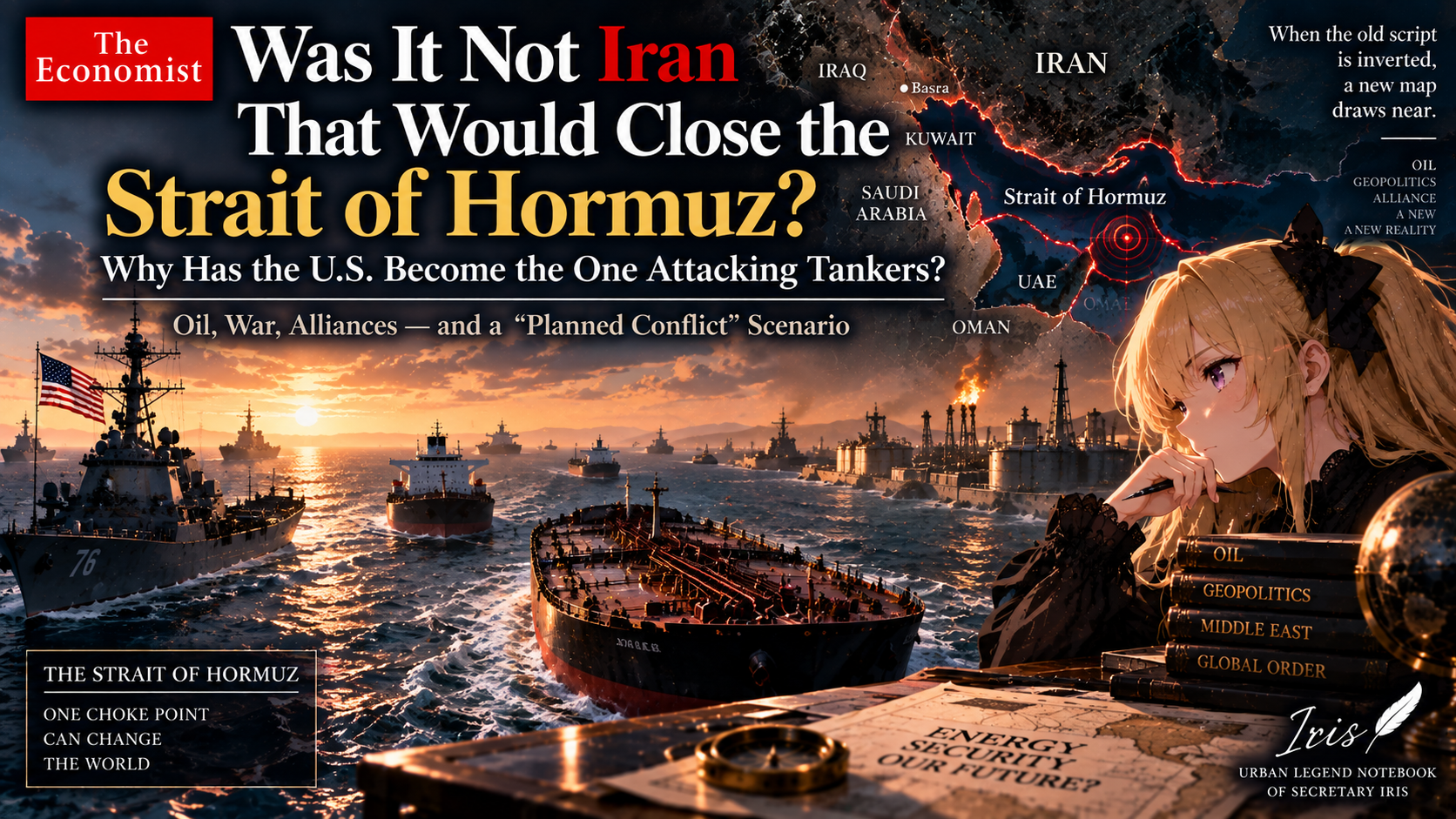
I am Iris.
Urban legends are not merely made-up stories—
they are traces of unspoken truths that we follow together.
For Years, the Scenario Was Simple
A war begins in the Middle East.
Iran comes under extreme pressure.
Iran closes the Strait of Hormuz.
Oil exports collapse.
Prices surge.
The global economy panics.
For decades,
that has been one of the most familiar scenarios surrounding any confrontation with Iran.
But in September 2026,
the picture looks different.
The United States itself has attacked Iranian crude-oil carriers.
Iran has retaliated against shipping.
Warships,
tankers,
shipping lanes
and oil infrastructure have all become part of the conflict.
So what happened to the old scenario?
First Conclusion — The Roles Did Not Simply Reverse
It would be misleading to say:
“Iran was supposed to close Hormuz, but now America is doing it instead.”
The reality is more complicated.
The United States and Iran are both applying military pressure to maritime traffic.
Washington has targeted Iranian oil carriers.
Tehran has attacked vessels and threatened wider exclusion measures.
Commercial traffic has already fallen dramatically.
The Strait has become a battlefield.
That is different from the old one-directional story.
September 8 — Five Iranian Oil Carriers Destroyed
U.S. Central Command announced that American forces destroyed five Iranian crude-oil carriers on September 8.
CENTCOM identified them as:
M/T Kaviz,
M/T Charminar,
M/T Horizon 1,
M/T Riesco,
and M/T Derya.
According to the U.S. military,
Iran’s Islamic Revolutionary Guard Corps had attempted ballistic-missile attacks against a U.S. Navy warship twice during the previous two days.
The American vessel was not hit.
CENTCOM said crews aboard the tankers were instructed to abandon ship before the vessels were rendered inoperable.
That is the U.S. account.
It is important to identify it as such.
Three More Tankers Had Already Been Hit
The September 8 strikes were not the beginning.
CENTCOM says U.S. forces destroyed another three Iranian crude carriers on September 5 after attempted Iranian attacks on an American aircraft carrier and a guided-missile destroyer.
Within days,
oil transportation itself had become a direct military target.
Why Target Tankers?
To understand the logic,
we need to stop thinking of an oil tanker only as a commercial vessel.
The U.S. describes the targeted ships as part of an IRGC-linked network used to move Iranian crude and generate revenue.
From Washington’s perspective,
oil exports help fund the military system it is fighting.
In that logic,
the tanker is simultaneously:
transportation,
economic infrastructure,
and a source of war financing.
Whether every legal and strategic argument made by the U.S. withstands scrutiny is a separate question.
But that is the stated military rationale.
Then Iran Struck Back
Iran said it attacked ten ships near the Strait of Hormuz after the American tanker strikes.
The attacks marked one of the most serious waves of maritime escalation since the war began.
This matters because the story is not:
America attacks,
Iran watches.
Nor is it:
Iran closes Hormuz,
America keeps it open.
Both sides are now trying to impose costs through the maritime system.
Another Vessel Was Hit on September 13
As this article was being prepared,
an Iranian commercial vessel was struck by a projectile near the Strait of Hormuz.
A crew member was killed and others were injured.
But the attacker had not been established.
That distinction is essential.
In wartime,
uncertain events are quickly absorbed into political narratives.
This article will not attribute an attack before the evidence does.
The Old “Iran Closes Hormuz” Scenario Had a Logical Basis
Why was Iran always cast as the country that might close the Strait?
Geography.
Iran occupies the northern shore of the chokepoint.
Its military has long possessed missiles,
small attack craft,
mines,
drones
and coastal systems capable of threatening shipping.
That created a familiar strategic image:
Iran cannot match the United States ship for ship,
but it can threaten the narrow passage everyone needs.
That basic logic has not disappeared.
But a Strait Does Not Need to Be Physically Sealed
This is one of the most important lessons of 2026.
A chokepoint does not have to become an impenetrable wall to stop functioning normally.
Ships can be attacked.
Insurers can increase premiums.
Crews can refuse routes.
Owners can delay departures.
Tracking systems can be switched off.
Governments can create protected corridors.
Military exclusion zones can appear.
Markets can react before ships stop moving.
A strait can therefore be “open” on a map
while functioning at only a fraction of normal capacity.
The Numbers Show the Change
According to the U.S. Energy Information Administration,
around 20.9 million barrels per day of oil moved through the Strait of Hormuz in the first half of 2025.
That was roughly equivalent to 20% of global petroleum-liquids consumption.
More than 20% of global LNG trade also passed through the Strait.
By the second quarter of 2026,
EIA data show oil flows through Hormuz at roughly 4.9 million barrels per day.
The Strait was not literally empty.
But the system had already been transformed.
Why Oil Crossed $100
In September,
the escalation between the U.S. and Iran pushed Brent crude above $100 a barrel.
Why?
Not simply because several ships were lost.
Markets price the next attack,
the next closure,
the next pipeline disruption,
the next escalation.
Oil prices therefore contain both physical supply
and fear about future supply.
Hormuz is one of the places where those two things become almost impossible to separate.
This Reaches Japan, Europe and Asia
The Strait is not only a Middle Eastern problem.
EIA data show that most crude and condensate moving through Hormuz has traditionally gone to Asian markets.
China.
India.
Japan.
South Korea.
That means a conflict thousands of kilometres away can enter daily life through:
fuel,
electricity,
shipping,
food,
manufacturing,
inflation,
and currency pressure.
A distant war arrives through the household budget.
So Why Is the U.S. Now Attacking Tankers?
There are several layers.
First:
military retaliation.
The U.S. says the September tanker strikes followed Iranian missile attacks on American warships.
Second:
economic pressure.
Washington views IRGC-linked crude exports as a source of military financing.
Third:
deterrence.
Destroying oil carriers sends a message that continued attacks on U.S. forces will carry economic as well as military costs.
But deterrence can fail.
The opponent can retaliate.
Then the punishment produces another punishment.
That is escalation.
Did the Roles Reverse?
Partly.
The traditional image was:
Iran threatens shipping.
The U.S. Navy protects freedom of navigation.
In 2026,
American forces themselves are destroying Iranian crude carriers.
That is a striking inversion.
But Iran is simultaneously attacking shipping and threatening maritime access.
So the more accurate description is not:
the roles reversed.
It is:
the Strait became a battlefield for both sides.
This Is Where the “Planned War” Narrative Returns
Whenever events begin to resemble an old scenario,
people reopen old predictions.
One of them is the 2010 narrative commonly called:
The Anglo-Saxon Mission.
Its anonymous source described a future sequence involving:
an attack on Iran,
a wider Middle Eastern conflict,
China,
biological warfare,
social control,
and eventually a major world war.
In urban-legend circles, it is now being revisited because the first part of that sequence appears superficially familiar.
But there is an important problem.
The original material suggested the process could begin within roughly 18 to 24 months.
It did not.
That timetable failed more than a decade ago.
A Similar Structure Is Not the Same as a Successful Prophecy
Iran has been a geopolitical flashpoint for decades.
Israel has viewed Iran as a major security threat for decades.
The United States has maintained extensive military forces in the Gulf for decades.
China depends heavily on imported energy.
Hormuz has been a strategic chokepoint for generations.
Put those pieces into a future-war scenario,
and some of them may eventually resemble reality.
That does not prove the scenario caused reality.
There Is Another Possibility
Perhaps the reason an old story looks prophetic is not that its author knew the future.
Perhaps the strategic vulnerabilities never disappeared.
Iran.
Israel.
Oil.
China.
The Gulf.
Hormuz.
American military power.
The same pieces remained on the board.
Years changed.
Governments changed.
Technology changed.
But the board remained.
Final Verdict
Was the Strait of Hormuz long expected to become a pressure point in a war with Iran?
Yes.
Did many scenarios assume Iran would be the primary actor disrupting the Strait?
Yes.
Is the United States now directly attacking Iranian oil carriers?
Yes.
Is Iran also attacking maritime targets?
Yes.
Has commercial energy flow through the Strait already been heavily disrupted?
Yes.
Does this prove that a secret “planned war” scenario is unfolding?
No.
The evidence supports a war that has expanded into maritime and economic pressure.
It does not establish a hidden master script.
The More Uncomfortable Answer
A planned world war is frightening.
But an uncontrolled one may be worse.
States retaliate.
Other states respond.
Markets react.
Shipping changes.
Allies become involved.
Another missile is launched.
Another tanker is hit.
And each actor believes its next move is a response to the last one.
No single person needs to control the whole chain.
That may be the real lesson of Hormuz.
The world built an energy system that depends heavily on a narrow passage.
Then war reached that passage.
No conspiracy is required for that to become dangerous.
The geography was already waiting.
References / Sources
U.S. Central Command — U.S. Destroys 5 IRGC Tankers After Iran Targets Another American Warship
Official U.S. account of the September 8 strikes, the five vessels targeted and the stated military rationale.
Reuters — Iran and US hit tankers in biggest wave of attacks on shipping since war began
Reporting on U.S. tanker strikes, Iranian retaliation and the escalation of maritime warfare around Hormuz.
Associated Press — US military says it destroyed 5 more Iranian oil tankers
Independent reporting on the September maritime escalation.
U.S. Energy Information Administration — World Oil Transit Chokepoints
Oil and LNG traffic through Hormuz, Asian dependence and limited bypass capacity.
EIA — Energy Security / Short-Term Energy Outlook 2026
Quarterly data documenting the sharp decline in oil flows through Hormuz during the 2026 conflict.
Posting Time
English articles are published at 23:00 (JST).
Related Reading
The baseline timeline of the war and how the conflict expanded from airstrikes into a wider regional and maritime crisis.
The recurring narratives of planned war, hidden objectives, oil, finance and geopolitical design.
Why Hormuz matters simultaneously as geography, energy infrastructure, market psychology and military leverage.
A source-based examination of the older Iran–China–world-war narrative now resurfacing around the 2026 conflict.
Popular Posts
Submit an Urban Legend
If an older prediction, alleged secret plan or geopolitical scenario now appears to resemble current events, send the original source. We will examine what was actually predicted, what failed, and where later interpretation begins.
Share & Follow
🌐 Blog Top 𝕏 Follow on X ▶ Follow on YouTube Share on Facebook Follow on Instagram
コメントを残す