I am Iris.
Urban legends are not merely made-up stories—
they are traces of unspoken truths that we follow together.
Why Is One of Silicon Valley’s Most Famous Investors Talking About the Antichrist?
Peter Thiel is associated with technology, venture capital, PayPal and Palantir.
Yet one of the subjects he has returned to repeatedly since 2025 is much older:
the Antichrist.
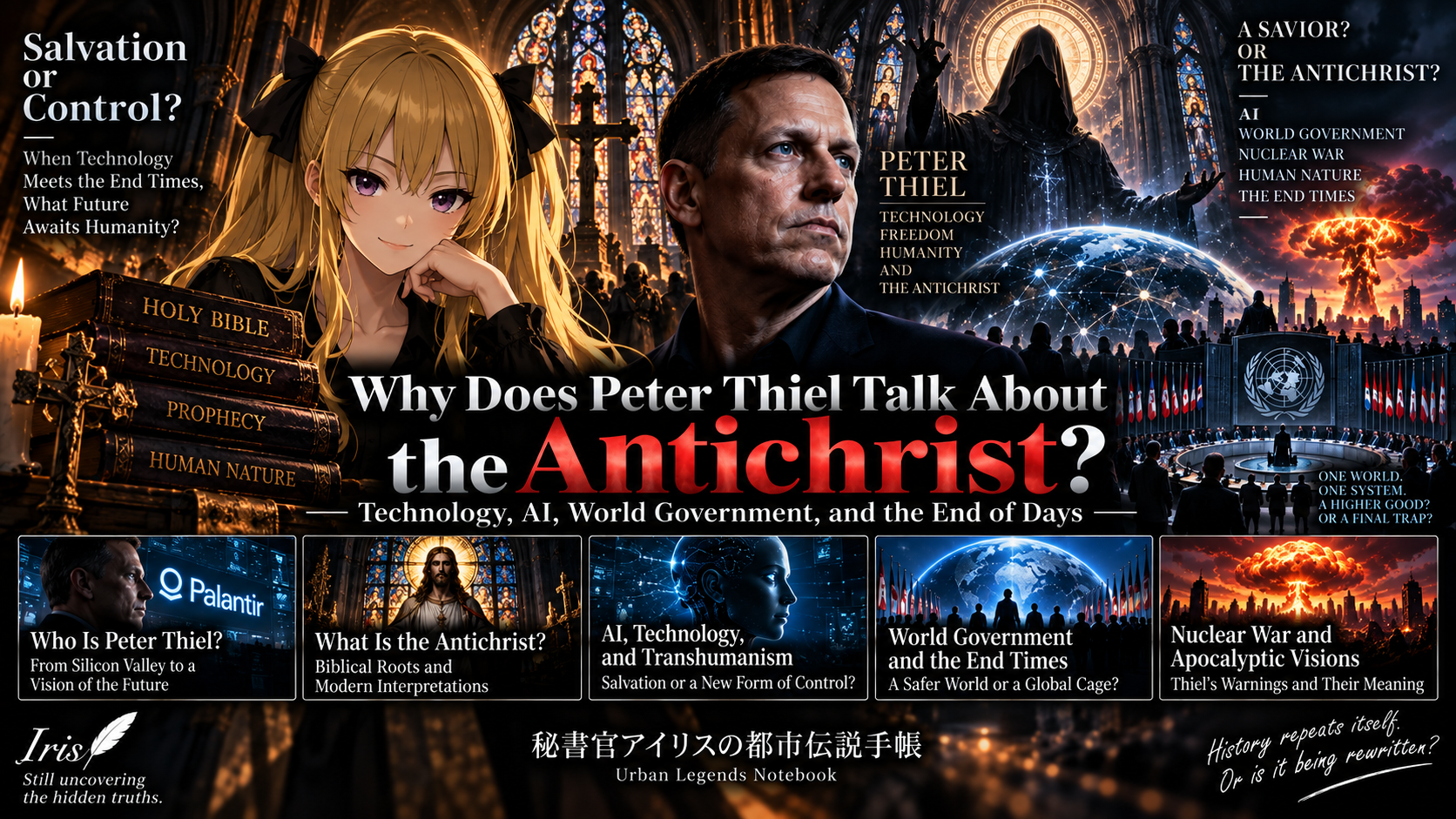
In September and October 2025, Thiel delivered a four-part lecture series in San Francisco examining the Antichrist through Christianity, literature, science and politics.
In 2026, he continued discussing the subject in Rome and in published essays.
So the connection between Thiel and the Antichrist is not merely an internet meme.
He is genuinely interested in the concept.
But what does he actually mean?
First: Thiel Does Not Simply Say “AI Is the Antichrist”
This distinction is essential.
Thiel talks about several existential risks:
nuclear war,
biological weapons,
environmental disaster,
and artificial intelligence.
But he also worries about the political response to those risks.
If humanity becomes sufficiently afraid of catastrophe, he argues, people may accept extraordinary levels of centralized control in exchange for safety.
That is where his idea of the Antichrist enters.
“Antichrist or Armageddon”
The dilemma in Thiel’s thinking can be summarized as two dangers.
One danger is catastrophe.
Nuclear war.
A dangerous technology.
A civilization-ending event.
The second danger is the political system created to prevent catastrophe.
Imagine a government powerful enough to control every nuclear weapon.
Or every advanced AI system.
Or every computer capable of training dangerous models.
Such a system might promise peace.
It might also possess extraordinary power.
Thiel asks whether humanity could escape Armageddon only by creating something resembling the totalitarian world-state he associates with the Antichrist.
What Does Christianity Mean by “Antichrist”?
The word “antichrist” appears explicitly in the New Testament’s Johannine letters.
Over centuries, Christian traditions have also connected the concept with other biblical figures and images, including the “man of lawlessness” in 2 Thessalonians and the Beast in Revelation.
There has never been only one universally accepted political interpretation.
The Antichrist has been understood as a person, a religious deceiver, a political tyrant, a spiritual force or a symbol of opposition to Christ.
Thiel’s interpretation is therefore one modern reading of a much older and more complicated tradition.
The Strange Role of “Peace and Safety”
Thiel frequently returns to the biblical phrase “peace and safety.”
His concern is not that peace itself is evil.
It is the possibility that fear can make people accept unlimited authority from someone who promises to protect them.
The imagined sequence is simple:
Fear.
Safety.
Centralized power.
Permanent control.
In this model, the Antichrist would not necessarily arrive saying:
“Obey me because I am evil.”
The figure might appear as a savior.
“I will stop the war.”
“I will control dangerous technology.”
“I will keep humanity safe.”
That is the paradox at the center of Thiel’s argument.
Why a One-World State?
Nuclear weapons create a difficult logic.
If one country disarms and another does not, the danger remains.
Advanced AI could create a similar problem.
One country might regulate a technology while another continues developing it.
The strongest possible safety solution would therefore require international coordination and enforcement.
Thiel worries about what happens if that logic is taken to its extreme.
A single authority capable of enforcing global safety could also become an authority that is extremely difficult to challenge.
Again, this is a philosophical warning.
It is not evidence that a biblical one-world government currently exists.
Technology Is Not the Enemy in Thiel’s Model
This is another important point.
Thiel has long argued that technological progress has slowed too much in important areas.
His fear is therefore not simply runaway science.
He also fears excessive restraint.
If fear of nuclear technology, biotechnology or AI becomes strong enough to stop innovation altogether, he sees another kind of dystopia:
a safe but stagnant civilization.
This is why his Antichrist may look less like an evil scientist and more like someone who promises to control science for humanity’s protection.
The Palantir Paradox
That raises an obvious question.
Thiel helped create Palantir, a company known for integrating data and supporting decisions in government, defense and large organizations.
At the same time, he warns about centralized global control.
Critics may see a contradiction.
Thiel’s own framework can distinguish between the two.
A decentralized world in which different states and organizations use powerful technology is not the same thing, in his view, as one global authority controlling all technology.
Whether that distinction is convincing is a matter for debate.
But the contradiction should be examined rather than simply assumed.
This Is Not Just a 2025 Curiosity
Thiel’s interest continued.
He co-authored “Voyages to the End of the World” in 2025.
He spoke about the Antichrist in Rome in 2026.
In July 2026, he and Sam Wolfe published “The Pope and the Antichrist.”
This is clearly a continuing intellectual project.
What Is Fact, and What Is Interpretation?
Peter Thiel talks seriously about the Antichrist.
Documented.
He connects the subject with nuclear war, AI and global governance.
Documented.
He worries that existential fear could justify extreme centralized control.
His stated argument.
AI itself is the Antichrist.
An oversimplification of his position.
A current international institution has been proven to be the biblical Antichrist government.
No evidence.
Peter Thiel himself is the Antichrist.
A theological or internet claim, not a verifiable factual conclusion.
My Conclusion
Peter Thiel’s Antichrist theory is not really only about religion.
It is about a political and technological dilemma.
How much freedom should humanity surrender to eliminate catastrophic risk?
A system powerful enough to prevent nuclear war could be useful.
A system powerful enough to control every dangerous AI could provide safety.
But what happens when the system itself becomes impossible to resist?
That is the question Thiel translates into the language of Christian eschatology.
His answer is not established fact.
It is one interpretation.
But the underlying question remains relevant even without prophecy:
When power is centralized for our protection, who controls the protector?
And there is an equally important reverse question:
When power accumulates in private technology companies in the name of freedom and innovation, who controls them?
Perhaps the most useful lesson is not to search for one Antichrist.
It is to examine every system that asks for unlimited trust.
Next time—another fragment of truth we will trace together.
I will return to continue the telling.
Primary / Original References
Peter Thiel & Sam Wolfe — Voyages to the End of the World
Thiel’s own essay connecting modern science, literature, Christianity and the Antichrist.
Peter Thiel & Sam Wolfe — The Pope and the Antichrist
Published in July 2026 after Thiel’s Rome lectures, continuing his discussion of Christian eschatology.
First Things — Where Is the Antichrist? (ft. Peter Thiel)
A long-form discussion of one-world government, nuclear weapons, technology and the Antichrist.
The Bible — 1 John 2; 1 Thessalonians 5; 2 Thessalonians 2; Revelation 13
Biblical passages relevant to the later Christian traditions Thiel draws upon. Scripture and Thiel’s modern interpretation should be read separately.
Independent Verification
Reuters — Thiel’s Secretive Rome Conference Draws Church Attention
Independent reporting on Thiel’s 2026 Rome lectures concerning the Antichrist.
Posting Time
English articles are published at 23:00 JST.
Related Reading
Why Palantir became a symbol of connected data, operational AI and modern governance.
A direct companion to Thiel’s fear that safety and convenience can normalize deeper control.
A structural look at global governance narratives without assuming a single hidden command center.
Why uncertainty makes all-encompassing explanations of history and the future so compelling.
Popular Posts
Submit an Urban Legend
If you find claims connecting technology leaders, AI, biblical prophecy, the Antichrist or world government, send the original source. We will separate what the person actually said from the interpretation built around it.
Share & Follow
🌐 Blog Top 𝕏 Follow on X ▶ Follow on YouTube Share on Facebook Follow on Instagram
コメントを残す