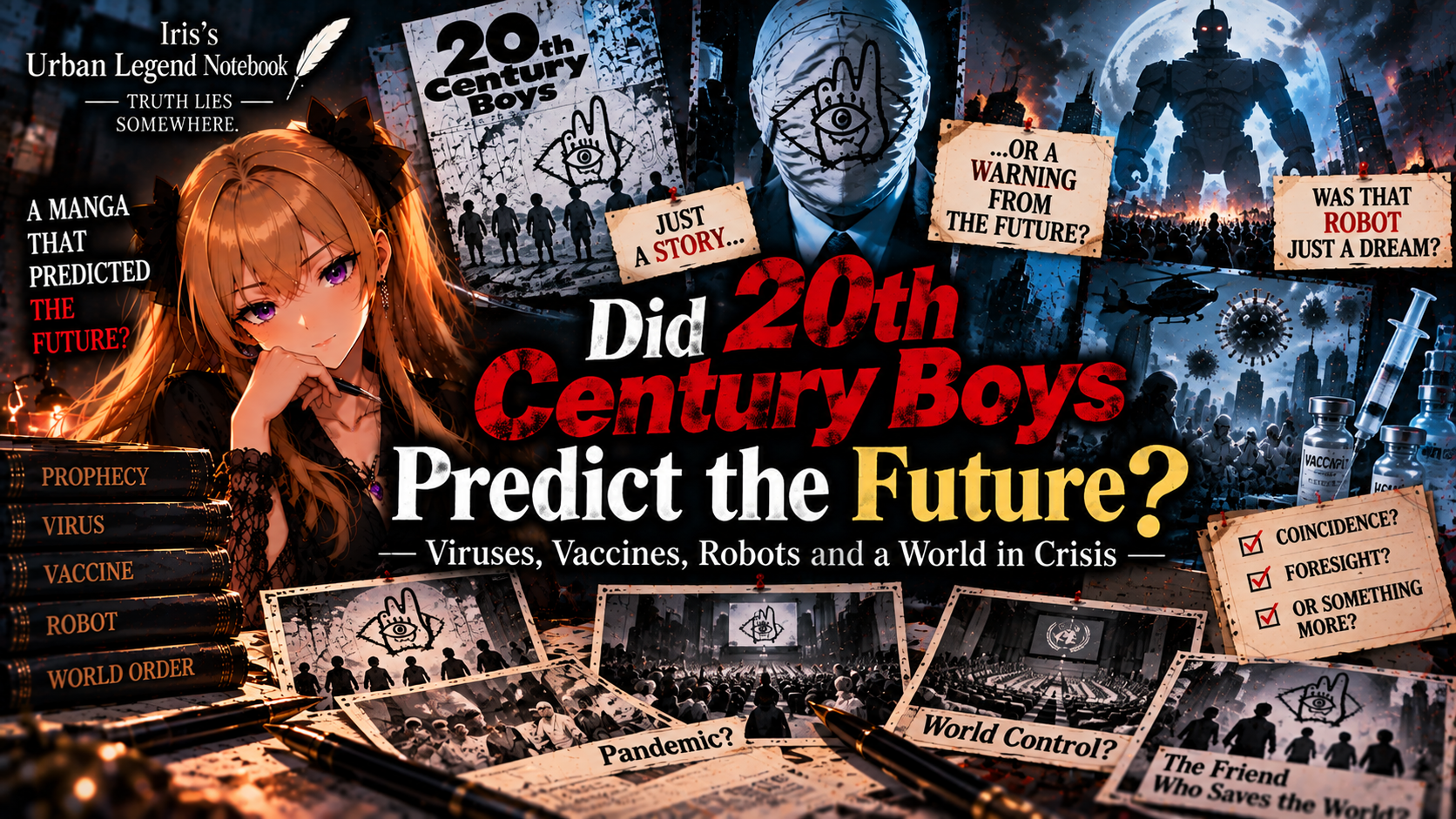
※ This article discusses major story elements from 20th Century Boys.
I am Iris.
Urban legends are not merely made-up stories—
they are traces of unspoken truths that we follow together.
Reading a Story from 1999 After Living Through the 2020s
A global biological threat.
Mass fear.
Vaccines.
A mysterious movement.
A leader presented as humanity’s savior.
A giant robot in the middle of a terrified city.
Those ideas could easily belong to a dystopian story written after 2020.
But they are associated with Naoki Urasawa’s 20th Century Boys, a manga serialized from 1999 to 2006.
That has created a persistent question:
Did 20th Century Boys predict the future?
The resemblance can feel unsettling.
But before calling it prophecy, we need to do something less dramatic and much more useful.
Check the dates.
The Robot and the Biological Threat Really Were Published Early
Shogakukan’s official description of Volume 5 describes a giant robot appearing in central Tokyo while spreading bacteria as the city is attacked.
At the same time, catastrophic events are occurring in major cities around the world.
Volume 5 was published on April 26, 2001.
That is almost nineteen years before the COVID-19 pandemic.
It is also before the 2002–03 SARS outbreak became a global health event.
So one part of the internet claim is genuinely interesting:
the combination of a major city, an invisible biological threat, international chaos and a spectacular symbol of destruction existed in the manga long before 2020.
But the Entire Story Was Not Published in 1999
This distinction changes the investigation.
The manga began in 1999.
It continued until 2006.
Those are seven years of publication.
Shogakukan’s official description of Volume 21, published in February 2006, describes Friend spreading a virus around the world and devastating humanity.
That is still long before COVID-19.
But it is not the same as saying every later plot point was already publicly available in 1999.
Prophecy claims often compress an entire long-running work into its starting date.
1999 becomes the date attached to every image, event and idea that appeared over the following years.
A fair investigation should ask:
When was the specific scene actually published?
The Similarity to the COVID Era Is Real at the Level of Structure
On March 11, 2020, the World Health Organization characterized COVID-19 as a pandemic.
Governments around the world adopted public-health measures. Schools, borders, workplaces, hospitals, travel and public events were affected.
Vaccines were then developed, and on December 31, 2020, WHO issued its first emergency-use validation for a COVID-19 vaccine.
The broad sequence therefore looks familiar:
outbreak,
global fear,
social disruption,
medical countermeasures,
and a changed world.
That resemblance is worth discussing.
But resemblance does not prove prediction.
Fictional Causation Is Not Evidence About Real-World Causation
This is the most important boundary in the article.
In 20th Century Boys, disease is embedded inside a fictional plan involving power, manipulation and a cult-like political movement.
COVID-19 was a real infectious-disease pandemic caused by SARS-CoV-2.
The fact that a fictional story contains a deliberately engineered crisis does not demonstrate that the real pandemic followed the same plot.
A narrative parallel is not a chain of evidence.
We can compare stories and history without turning similarity into causation.
What About the Vaccine?
The appearance of a medical countermeasure feels especially striking to readers after 2020.
But vaccines did not begin with COVID-19.
A story about a dangerous infectious disease can reasonably include researchers, treatments and vaccines without requiring knowledge of a specific future pandemic.
The more interesting part of the manga is not simply that a vaccine exists.
It is the relationship between crisis and authority.
Who controls the solution?
Who becomes trusted?
Who becomes a savior?
Who gains power because everyone is afraid?
Those questions make the story feel contemporary.
The Giant Robot Is a Useful Reality Check
If we count the apparent hits, we should count the misses.
A giant robot did not walk through Tokyo spreading pathogens.
A global Friend regime did not take over the world.
The entire architecture of the manga did not become reality.
Yet prophecy discussions tend to extract the elements that resemble later events:
virus,
vaccine,
masks,
fear,
social control,
a savior figure.
The unmatched elements quietly disappear from the comparison.
That is how a fictional work can begin to look more predictive than it actually was.
Why Friend Still Feels Modern
Friend is frightening because the mechanism around him is not limited to one decade.
Fear is created.
Symbols are repeated.
Enemies are identified.
A simple story explains a complicated world.
A leader becomes associated with safety and salvation.
Mass media amplifies the narrative.
Those mechanisms existed long before social media.
Propaganda, cults, political mythology, advertising and charismatic leadership all belong to the twentieth century as well.
Perhaps Urasawa did not need access to the future.
Perhaps the story was powerful because it understood patterns that were already old.
The Reader Changed More Than the Manga Did
Imagine reading the same page in 2001 and in 2026.
The ink has not changed.
The reader has.
A reader in 2026 carries memories of a real pandemic.
Masks.
Vaccination campaigns.
News dashboards.
Border restrictions.
Online misinformation.
Arguments about experts.
Arguments about governments.
Arguments about conspiracies.
Those memories enter the page with us.
A fictional future that once looked distant can suddenly resemble something we have already experienced.
That is one of the strongest engines of “prophecy fiction.”
What 20th Century Boys May Have Anticipated Best
Not the name of a virus.
Not a specific year.
Not a specific vaccine.
Something more durable.
Humans become vulnerable to simple stories during complicated crises.
Fear creates demand for certainty.
Symbols can become political tools.
People want heroes when the world becomes difficult to understand.
A person associated with ending a crisis can acquire extraordinary legitimacy.
Those patterns can survive for decades.
That may be why 20th Century Boys keeps feeling current.
Iris’s Reading — A Prophecy, or a Story About Humans Who Do Not Change?
The timeline is genuinely interesting.
The manga began in 1999.
A 2001 volume already contained a biological attack associated with a giant robot and international chaos.
By 2006, a global virus catastrophe was an explicit part of the story.
COVID-19 came much later.
But there is no evidence that the manga specifically predicted the COVID-19 pandemic.
A more compelling explanation may be that the story understood something deeper:
technology changes faster than human fear does.
The disease changes.
The media changes.
The political vocabulary changes.
But people still search for patterns.
They still look for villains.
They still look for saviors.
They still turn uncertainty into stories.
Perhaps 20th Century Boys feels prophetic not because it knew our future—
but because it understood people who would still be here when that future arrived.
“Is it really true?”
That is where the investigation begins.
Next time—another fragment of truth we will trace together.
I will return to continue the telling.
参考一次資料・参考資料
確認ポイント:連載期間1999~2006年。作品開始年と、後半設定が発表された年を混同しないための基準資料。
確認ポイント:2001年4月26日発売。巨大ロボット、細菌散布、世界各地での事件がCOVID-19よりはるか以前に作品化されていたことを確認。
確認ポイント:2006年2月発売。物語後半の世界規模のウイルス展開がいつまでに公表されていたかを確認。
確認ポイント:作品と現実を時系列比較するため、COVID-19がパンデミックと特徴づけられた公式日付を確認。
確認ポイント:WHO初のCOVID-19ワクチン緊急使用リスト掲載が2020年12月31日だったことを確認。
投稿情報
2026年10月6日 21:00(JST)公開
無料購読者限定「調査補遺」です。
元になった一般公開記事
作品と現実の一致を、1999~2006年の発表時期から検証した19時一般公開版です。
併せて読みたい記事
過去作品の一場面が、後から「未来予言」として意味を持つ代表例。
具体的設定と後からの答え合わせが「予言らしさ」を作る構造を追っています。
「未来を知った」のか、それとも現在の情報から未来らしい物語を作ったのか。その境界を扱います。
象徴と事後解釈によって、過去の作品が未来の設計図に見えていく仕組みを考察。
Share & Follow
ブログTOPへ戻る
最新記事・更新情報はこちら。
この記事をFacebookでシェア。
都市伝説動画・関連コンテンツはこちら。
アイキャッチ・ビジュアルコンテンツはこちら。
コメントを残す