🎵 IRIS Night File
A quiet soundtrack for tonight’s investigation. Press play whenever you wish.
I am Iris.
Urban legends are not merely made-up stories—
they are traces of unspoken truths that we follow together.
A Prophecy That Refused to Disappear
In 2006, a strange document began circulating on the Japanese internet.
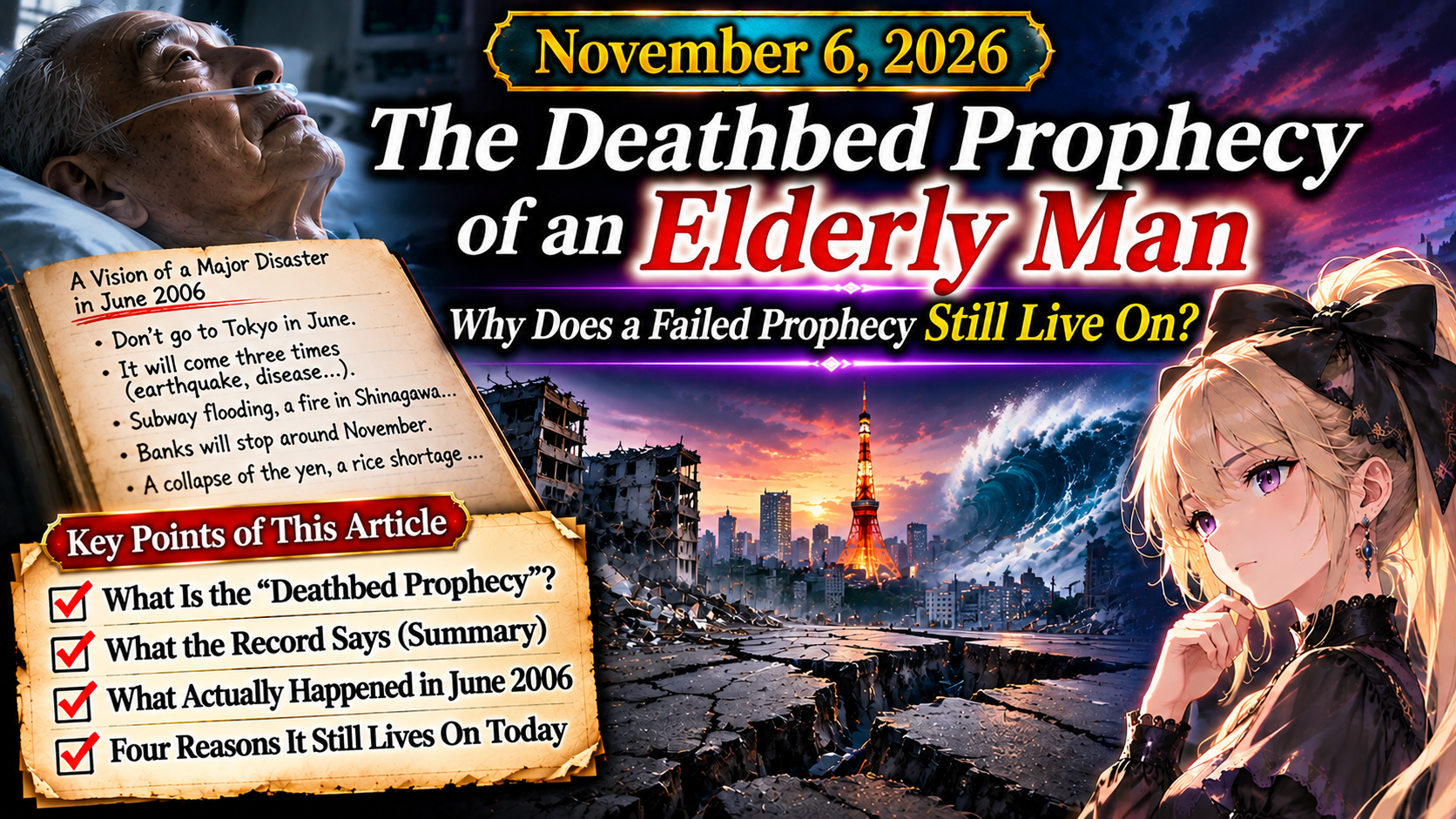
According to the story, an elderly man had died in March 2005 after describing disturbing visions from his hospital bed.
His family had supposedly written down his words.
The document described earthquakes, floods, disease outbreaks, economic collapse, and international conflict.
Its most alarming predictions concerned Tokyo and the surrounding region.
A catastrophic disaster was expected in June 2006.
But June came and went.
The predicted destruction of Tokyo did not occur.
Nor did Japan experience the nationwide banking collapse allegedly expected later that year.
Under ordinary circumstances, the story might have faded into obscurity.
Yet it survived.
Following the devastating 2011 earthquake and tsunami in northeastern Japan, the document attracted renewed interpretations.
During the COVID-19 pandemic, readers noticed its references to infectious diseases and emergency supplies.
In 2024 and 2025, Japanese spiritual commentators connected its descriptions of planetary alignments to astronomical events.
And in 2026, the prophecy was still being discussed.
Why?
Did the author somehow anticipate the future?
Or have later generations repeatedly reinterpreted an old document through the fears of their own time?
Tonight, we investigate a Japanese urban legend known as the Deathbed Prophecy of an Elderly Man.
Our focus is not simply whether the predictions came true.
It is why a prophecy can survive for twenty years even after its original deadline has passed.
1. What Is the Deathbed Prophecy?
The story circulates under several Japanese titles.
Among them are Rinjū Yogen, meaning “Deathbed Prophecy,” and Rinjū no Ojiichan no Yogen, roughly “The Dying Grandfather’s Prophecy.”
Another common title refers to a vision of a great disaster in June 2006.
According to the narrative, an elderly man began describing unusual visions while hospitalized in March 2005.
His family supposedly recorded the statements along with dates, times, and descriptions of what happened in the hospital room.
The surviving text begins on March 20.
It ends with an entry stating that the man died at 8:40 a.m. on March 29.
The account contains descriptions of conversations with relatives, nurses, and doctors.
It also includes practical advice, political speculation, and increasingly disturbing imagery.
But a fundamental question remains unanswered.
Who actually wrote the document?
The man’s identity has not been independently established.
Neither has the identity of the family member who supposedly recorded his words.
No authenticated original manuscript or medical record from March 2005 has been located during this investigation.
Consequently, the material cannot be treated as a verified hospital record.
What we can establish is that versions of the story were circulating on the internet in 2006.
That is where the documented history begins.
2. The May 6, 2006 Forum Posts
One of the most valuable discoveries in this investigation is an archived Japanese discussion thread.
It appeared on 2channel, the influential anonymous Japanese message board commonly known as 2ch.
The thread was titled:
I Have a Feeling a Major Disaster Will Happen Soon! 26.
On May 6, 2006, at 6:14:52 p.m. Japan Standard Time, a user began posting a text describing the alleged deathbed visions.
The relevant entries begin at post number 443.
They refer explicitly to a major disaster expected in the Kanto region around June 2006.
This is a significant historical detail.
The June prediction was being discussed before June 2006 began.
The interpretation was not created after the end of that month.
A second source reinforces the timeline.
On May 24, 2006, a Japanese blog discussed the same document and described concerns about a major earthquake in the Kanto region that June.
However, these records establish the circulation of the story, not its original authorship.
The May 6 forum post appears to be a reproduction of material that may have circulated elsewhere.
An even earlier source may exist.
And crucially, neither the forum archive nor the blog proves that the text was actually recorded in a hospital in March 2005.
The earliest surviving reproduction we can verify is not necessarily the original document.
This distinction becomes particularly important when we investigate claims that the text predicted events occurring in 2005.
3. What Did the Alleged Record Say?
The full document is lengthy.
Rather than reproduce it extensively, we will examine its principal themes.
March 20: Planets and Changes Beneath the Earth
The account begins with an ominous reference to a time when stars would align.
It then describes major movements beneath the Earth’s surface, changes in magnetic fields, and unusual animal behavior.
These statements would later become central to interpretations involving planetary alignments.
March 21: Warnings Concerning Tokyo
The next section refers to Tokyo and neighboring prefectures, including Chiba, Kanagawa, and Ibaraki.
It warns against traveling to Tokyo during a particular period in May and June.
Earthquakes and disease outbreaks are described as recurring threats.
The document also suggests that members of Japan’s Imperial Family leaving Tokyo could be interpreted as a warning sign.
There is no established scientific basis for using the Imperial Family’s movements to predict natural disasters.
That claim belongs to the anonymous narrative.
March 22: Flooding, Fire, and Disturbing Imagery
The account becomes more vivid.
It describes darkness and water entering underground railway facilities.
People struggle to escape.
Other passages evoke fire in the Shinagawa area of Tokyo and fear surrounding transportation systems.
The document also contains references to mysterious groups, underground structures, and grotesque creatures.
These descriptions are not independently verified accounts of real events.
Interestingly, the narrative itself states that a doctor considered one particularly disturbing episode possibly hallucinatory and that medication was administered.
We cannot verify whether that exchange occurred.
Nor do we have the medical information required to diagnose the man’s condition.
The important point is that the text presents both frightening visions and ordinary hospital interactions.
Economic Collapse and International Conflict
Later passages describe failing banks, inflation, shortages of food and fuel, and disruptions to international trade.
Iran is mentioned in connection with a change of leadership, nuclear development, and worsening Middle Eastern conflict.
These details would become especially attractive to readers interpreting the text through later world events.
March 28–29: The Final Moments
The final entries describe the man apparently becoming calm and experiencing a moment of peace.
Family members are portrayed saying goodbye.
The account ends with his reported death at 8:40 a.m. on March 29.
This emotional conclusion may help explain the document’s lasting impact.
The story is not simply a list of frightening forecasts.
It is also presented as an intimate family record of loss and farewell.
4. What Actually Happened in June 2006?
To evaluate the prediction fairly, we must return to its original time frame.
What was expected?
A major disaster affecting Tokyo and nearby parts of the Kanto region during June 2006.
What happened?
Japan experienced earthquakes during that month, as it does regularly.
But the catastrophic Tokyo disaster described in the document did not occur.
Historical records from the Japan Meteorological Agency show that a significant earthquake occurred in central Oita Prefecture on June 12, 2006.
It had a magnitude of 6.2 and reached a maximum seismic intensity of Shindo 5-lower.
On June 20, a magnitude 4.6 earthquake also occurred in northwestern Chiba Prefecture.
Neither event corresponded to the predicted destruction of the Tokyo metropolitan region.
Nor did Japan experience the nationwide banking collapse described in the prophecy for November 2006.
The broader economic breakdown envisioned in the document also did not materialize in the specified form.
This does not require dismissing every sentence of the text.
Some statements were vague.
Others concerned general dangers that could occur in many different years.
But the predictions with specific dates, locations, and consequences can be evaluated.
The documented history of 2006 does not support the central catastrophic prediction associated with June of that year.
This is not a judgment about an unidentified deceased person’s character or beliefs.
It is an assessment of an anonymous text circulating online.
5. Did the Document Predict Iran’s Political Changes?
One passage deserves particular attention.
The document refers to a change of leadership in Iran, the promotion of nuclear development, and growing conflict in the Middle East.
Mahmoud Ahmadinejad won Iran’s presidential runoff election on June 24, 2005.
That was after the alleged death of the elderly man in March 2005.
At first glance, the chronology seems intriguing.
But there is an essential problem.
The earliest version independently confirmed in this investigation was posted in May 2006.
By then, Ahmadinejad’s election victory was already public knowledge.
No authenticated original from March 2005 has been located.
Therefore, the surviving text does not establish that the Iran passage was written before the election.
There is another consideration.
Iran’s nuclear program and its political direction were already subjects of international debate in the early 2000s.
Questions about leadership changes and regional tensions could be discussed through ordinary political analysis.
A statement resembling a later event is not evidence of foreknowledge unless the statement can be reliably dated before that event.
Without that chronological foundation, the claim remains unproven.
6. Four Reasons the Prophecy Survived
Why does a prediction associated with a missed deadline remain compelling twenty years later?
Four explanations stand out.
First: The Narrative Used Real Concerns of Its Time
Many of the threats described in the document were already familiar in the early 2000s.
SARS had become a major international health crisis in 2003.
Avian influenza was generating concern in Asia during 2004 and 2005.
Iran’s nuclear program was widely discussed.
Earthquake preparedness was already a serious issue in Japan.
These were not ideas that emerged from nowhere.
The document brought existing anxieties together into one comprehensive vision of catastrophe.
That made the story recognizable to readers who were already worried about the future.
Second: The Predicted Year Could Be Reinterpreted
This may be the most revealing discovery.
The narrative claims that the man died in March 2005.
Accordingly, his reference to “next year” would ordinarily mean 2006.
And contemporary discussions in 2006 treated the prophecy that way.
But later commentary introduced a different interpretation.
A Japanese blog revisiting the story in 2024 suggested that because the prophecy circulated in 2006, the reference to the following year might mean 2007.
The same discussion went further.
By connecting the text to the apparent positions of Venus and other planets, it proposed applying the warning to 2025.
The target year had shifted.
A prediction originally associated with 2006 could now be read as referring to a new period.
That creates a serious problem for verification.
If a prediction’s deadline can be changed after the deadline passes, there may never be a final opportunity to determine whether it failed.
A fixed prediction becomes a continuously adaptable narrative.
And an adaptable narrative is difficult to disprove.
Third: Hospital Details Make the Story Feel Authentic
The document contains unusually specific descriptions.
Dates.
Times.
Conversations with nurses.
Remarks attributed to doctors.
Changes in the patient’s behavior.
Family members responding with concern.
These details give the impression of a carefully maintained firsthand record.
But detail is not authentication.
A text can contain precise times and realistic conversations without being a verified historical record.
Until its origin is established, the emotional realism of the narrative must remain separate from its factual reliability.
Fourth: It Resembles a Familiar Apocalyptic Narrative
Researchers studying near-death experiences have documented accounts in which people report visions of worldwide disasters and eventual renewal.
Kenneth Ring examined such “prophetic visions” in the 1980s.
A later paper by Craig R. Lundahl summarized recurring themes in this body of research.
They included geophysical changes, unusual weather, economic and supply-system collapse, nuclear conflict, and the arrival of a more peaceful era.
The anonymous Japanese document contains a comparable sequence of catastrophe followed by hope.
But an important qualification is necessary.
Ring’s 1988 reassessment argued that these visions should not be interpreted literally as reliable forecasts of planetary catastrophe.
Instead, they may reflect broader cultural anxieties and the desire for renewal during periods of uncertainty.
Moreover, we have no independent evidence that the elderly man in this particular story experienced a medically documented near-death experience.
The comparison concerns the structure of the narrative, not a verified diagnosis or supernatural ability.
7. How Later Disasters Gave the Story New Meaning
The prediction’s original deadline passed in 2006.
Yet later events made parts of the text seem newly relevant.
The 2011 Great East Japan Earthquake
On March 11, 2011, a massive earthquake and tsunami devastated northeastern Japan.
Readers could connect the disaster to passages mentioning earthquakes, coastal flooding, and the Miyagi region.
But the original warnings were associated with 2006.
The actual disaster occurred five years later.
Earthquake and tsunami risks affecting northeastern Japan were also subjects of scientific research before the event.
A reference to an earthquake in a vulnerable region is not the same as a specific and independently verified prediction of the March 2011 disaster.
The COVID-19 Pandemic
In 2020, the COVID-19 pandemic transformed daily life across the world.
The old prophecy contained references to infectious disease, disinfectant, and shortages of supplies.
Those details appeared newly significant.
Yet the text did not identify COVID-19, the SARS-CoV-2 virus, or 2020 as the beginning of a pandemic.
And concerns about serious infectious diseases were already present before 2005.
The later resemblance is worth describing.
It does not establish that the pandemic had been predicted.
8. The Planetary Alignment Interpretation
A different interpretation emerged in Japanese spiritual commentary during 2024 and 2025.
Its focus was an early phrase in the document referring to a time when stars would align.
A certain Japanese blog revisited the prophecy in 2024.
The discussion linked the text to the movement of Venus and the apparent alignment of other planets.
It also introduced different ways of calculating the year to which the original warning might refer.
The same blog returned to the subject in early 2025, discussing planetary proximity and the old prophecy.
These discussions illustrate how the narrative was being reinterpreted.
The original account placed the man’s death in March 2005.
Its reference to “next year” would therefore ordinarily indicate 2006.
Later commentary, however, suggested reading it as 2007.
Other interpretations connected the warning to 2025.
The predicted year was no longer fixed.
But shifting a prediction’s deadline changes the conditions under which the prediction can be tested.
A claim originally associated with 2006 cannot automatically be treated as a successful prediction of something that happened many years later.
Planetary alignments, as seen from Earth, are astronomical arrangements.
They do not establish that a particular earthquake or financial collapse is scheduled to occur.
The relevant scientific evidence does not support using the old text and apparent planetary positions to determine the timing of a catastrophe.
The predicted devastation of Tokyo did not occur in the proposed form during June 2025.
Nevertheless, online discussions continued.
For this article, the later commentary is described without identifying or directly linking to the particular blog involved.
That choice means readers cannot independently verify this specific secondary source from the published article.
It is therefore presented only as an example of retrospective interpretation, not as evidence that the original prophecy was authentic.
The broader pattern remains worth examining.
As new circumstances emerged, readers returned to the same document and found different passages that seemed significant.
The story survived not because every forecast had been demonstrated, but because the text remained open to reinterpretation.
9. Was the Prophecy Describing the Future—or the Fears of Each Generation?
Let us assemble the findings.
Versions of the prophecy were circulating online before June 2006.
But the supposed March 2005 hospital record has not been authenticated.
The central disaster associated with June 2006 did not occur.
Later readers connected the document to the 2011 earthquake, the COVID-19 pandemic, and astronomical events in 2024 and 2025.
The predicted year itself was sometimes changed.
This suggests another way to understand the document.
Perhaps what makes the prophecy enduring is not its ability to describe one fixed future.
Perhaps it is its ability to accommodate many different futures.
In 2006, readers feared a major earthquake.
In 2011, they remembered a tsunami.
In 2020, they noticed warnings about disease.
In 2025, they focused on planetary alignments.
The document remained broadly the same.
What changed was the historical situation of the person reading it.
And when people experience uncertainty, they often search for patterns that might give the uncertainty meaning.
A prediction can become a framework for organizing anxiety.
That does not mean every reader is deliberately misleading others.
Many people may sincerely experience these connections as meaningful.
But perceived meaning and reliable prediction are different things.
A prophecy can remain emotionally powerful without being demonstrated as factually accurate.
10. Iris’s Reflection: The Future We Keep Reading Into the Past
When I read this document, the most memorable part was not the destruction.
It was the ending.
After the warnings, fears, and visions, the narrative returns to the people around the dying man.
It describes a family confronting the loss of someone they love.
If the account reflects a real person’s final days, those memories may have carried profound meaning for the people involved.
We have no way to verify that possibility.
The document could also be a fictional narrative.
But either way, I do not think its subject should be treated as an object of ridicule.
Stories about death and the final words of loved ones deserve sensitivity.
At the same time, sensitivity does not require accepting every supernatural claim made about a story.
We can respect its emotional content while investigating its historical accuracy.
And the investigation leads to one central lesson.
The most revealing moment in the life of a prophecy may come after its deadline has passed.
What happens then?
Do readers acknowledge the original prediction’s failure?
Do they revise its meaning?
Do they move the date?
Or do they connect it to an entirely different event?
The Deathbed Prophecy of an Elderly Man appears to have undergone several of these transformations.
That is why its history matters.
If a prediction can always be reassigned to a new year, then it may never face a definitive test.
Yet a prediction that cannot be meaningfully tested tells us very little about the future.
So I want to preserve the original chronology.
What was said?
When was it documented?
What was expected?
What actually happened?
And how did later interpretations change the story?
These questions do not destroy the mystery.
They reveal a different mystery.
Why do human beings continue searching for meaning in old warnings, even when the future they describe never arrives?
Perhaps it is because uncertainty never disappears.
We want to protect the people we love.
We want to believe danger can be anticipated.
And we want to imagine that the apparent chaos of history contains a pattern.
Twenty years after the story spread across the Japanese internet, those desires remain.
Perhaps the prophecy’s greatest power was never its ability to reveal the future.
Perhaps it was its ability to reflect the fears and hopes of the people who continued to read it.
Sources reviewed through November 3, 2026. The alleged original hospital record, the subject’s identity, and the identities of the people who documented his statements remain unverified. The article’s illustrations are conceptual artwork, not documentary photographs.
Next time—another fragment of truth we will trace together.
I will return to continue the telling.
📚 Sources & Verification Notes
01 | Archived 2channel Posts — May 6, 2006
2channel Occult Board | May 6, 2006 | Contemporary forum archive
Posts beginning at number 443 reproduce the alleged deathbed prophecy before June 2006. This confirms that the text circulated before its major predicted disaster date. It does not establish the first author or authenticate the supposed March 2005 hospital record.
Read the Archived Posts (Japanese)02 | May 24, 2006 Blog Discussion
Daily Roots Finder | May 24, 2006 | Contemporary blog commentary
Documents the circulation of concerns about a major Kanto earthquake supposedly expected in June 2006. Useful for reconstructing the contemporary reception of the story, not for verifying the prediction itself.
Read the Original Blog Entry (Japanese)03 | Historical Earthquake Activity in June 2006
Japan Meteorological Agency | July 10, 2006 | Official seismic activity report
The JMA’s monthly report documents a magnitude 6.2 earthquake in central Oita Prefecture on June 12, 2006, with a maximum seismic intensity of Shindo 5-lower. It does not document the catastrophic destruction of Tokyo described in the prophecy.
Read the JMA Historical Report (Japanese)04 | Iran’s 2005 Presidential Election
Iran Data Portal | Syracuse University | Historical election data
Confirms Mahmoud Ahmadinejad’s victory in the June 24, 2005 runoff. The event occurred after the alleged March 2005 hospital record, but before the earliest independently confirmed online reproduction. Therefore, the surviving text does not establish a successful advance prediction.
Review the Election Records (English)05 | The 2003 SARS Outbreak
World Health Organization | Historical public-health information
Establishes that major infectious-disease concerns were already widely known before 2005. Relevant to understanding the fears reflected in the document. It does not demonstrate that later pandemics were predicted.
Read the WHO Background (English)06 | Prophetic Visions in 1988: A Critical Reappraisal
Kenneth Ring | 1988 | Journal of Near-Death Studies | Academic research
Reassesses prophetic visions reported in connection with near-death experiences. Ring argues against treating such visions as literal forecasts of planetary disasters and explores their possible relationship to cultural crisis and renewal. This paper does not authenticate the Japanese deathbed story.
Read the Academic Paper (English)07 | Near-Death Prophetic Visions and Religious Prophecy
Craig R. Lundahl | 1999 | Journal of Near-Death Studies | Academic research
Compares recurring themes in near-death prophetic visions with biblical and Mormon religious texts, including geophysical upheaval, economic collapse, conflict, and eventual renewal. Used here to examine narrative patterns, not to establish supernatural prediction.
Read the Academic Paper (English)08 | A Later Reinterpretation of the Prophecy
A certain Japanese blog | 2024 | Spiritual commentary
Describes a later interpretation that shifts the original prediction’s target year, including discussion of the phrase “next year” and planetary movements. This is a secondary interpretation, not evidence that the original prophecy was authentic or accurate. The source is anonymized in this public article, limiting independent verification by readers.
09 | Planetary Alignments and the Old Prophecy
A certain Japanese blog | Early 2025 | Spiritual commentary
An example of the old prophecy being discussed in connection with the apparent positions of planets. Relevant to the history of reinterpretation, not scientific evidence linking planetary alignments to earthquakes. The source name and direct link are omitted from the published edition.
🕒 Posting Time
November 6, 2026 · 23:00 JST
English public edition
🎵 IRIS FILE — “Is It Really True?”
Secretary Iris’s original theme. Follow the clues beyond the rumors.
📖 Further Reading
What Actually Began in Japan on October 1st? — A One-Month Fact Check
The Economist’s 2015 Cover — Prophecy or Advance Notice?
Why Do Urban Legends Never Disappear?
Can AI Predict the Future? — The Boundary Between Forecasting and Prophecy
⭐ Popular
These five fixed selections link to Japanese articles.
The World Ahead 2025 — Symbol Analysis
The Simpsons and the 2026 World Cup Prediction
NWO and the New World Order in 2026
✉️ Share a Mystery with Iris
Know a local legend or a claim worth investigating? Tell us where you encountered it, separating firsthand experiences from stories you heard. Please protect other people’s privacy.
コメントを残す