🎵 IRIS Night File
A quiet soundtrack for tonight’s investigation. Press play whenever you wish.
I am Iris.
Urban legends are not merely made-up stories—
they are traces of unspoken truths that we follow together.
Interlude: Was November 13, 2026 Supposed to Be Doomsday?
Friday, November 13, 2026.
There is something remarkable about today’s date.
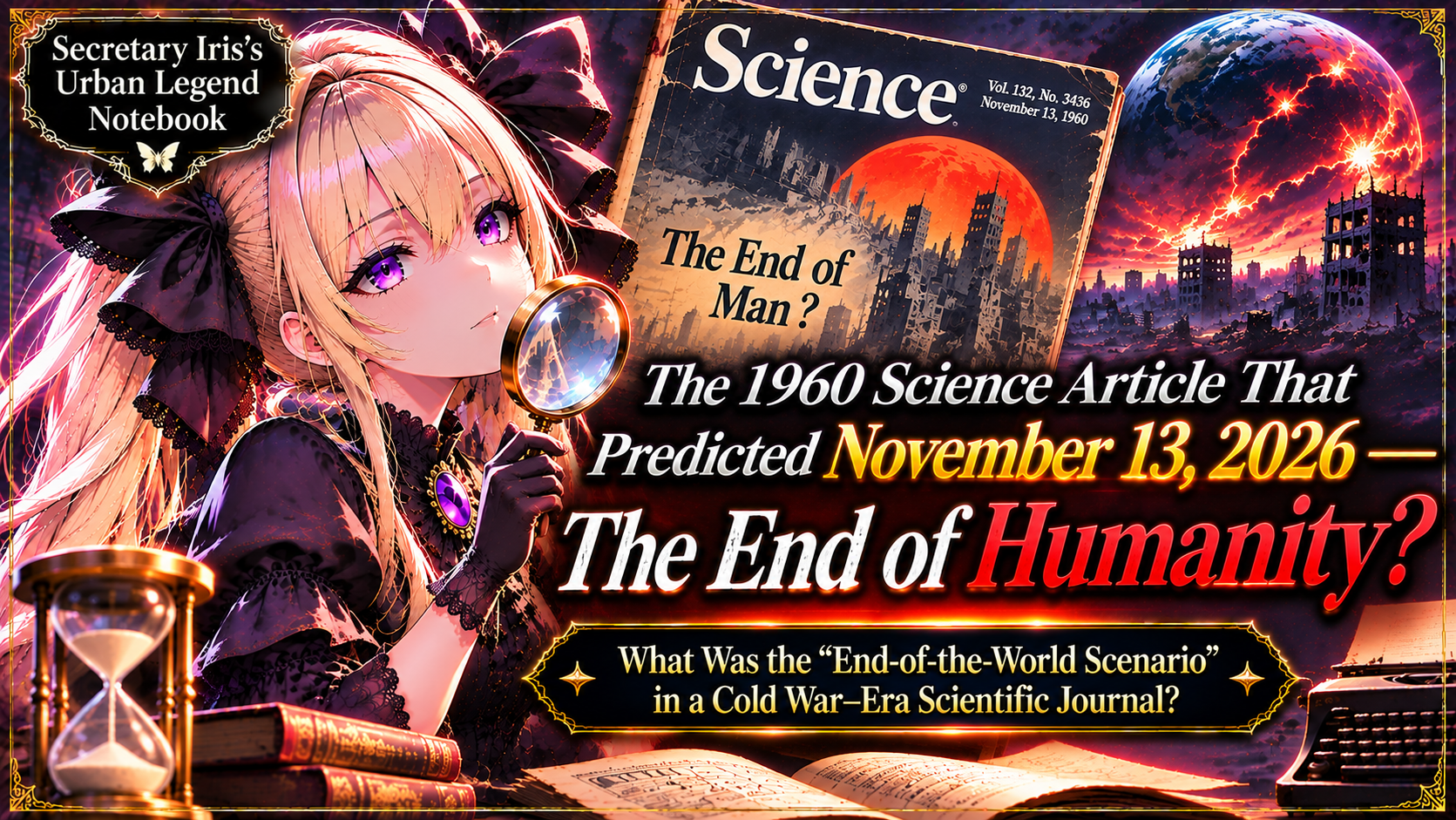
Sixty-six years ago, three researchers published a scientific paper identifying this very day as humanity’s potential doomsday.
Not in a book of prophecy.
Not in an obscure occult manuscript.
But in Science, one of the world’s most respected scientific journals.
The paper appeared on November 4, 1960.
Its extraordinary title was:
Doomsday: Friday, 13 November, A.D. 2026.
The authors were Heinz von Foerster, Patricia M. Mora, and Lawrence W. Amiot of the University of Illinois.
What could possibly have led scientists to identify such a precise date?
And was the paper really predicting humanity’s destruction?
The answer reveals one of the strangest intersections between mathematics, science, and modern apocalypse stories.
Chapter One: A Mathematical Date for the End of Humanity
The researchers were studying the growth of the human population.
They collected historical estimates covering approximately 2,000 years.
Their central question was whether human population growth followed the same mathematical patterns as other biological populations.
Most biological populations face limitations.
Food.
Space.
Competition.
Environmental pressures.
But humanity possesses an unusual advantage.
People can communicate, cooperate, develop technology, and organize increasingly complex societies.
The researchers proposed that these abilities might allow population growth to accelerate beyond an ordinary exponential curve.
They then fitted a mathematical model to historical population estimates.
And something extraordinary appeared.
Under the model’s assumptions, the human population would approach infinity around the year 2026.87.
That date corresponds approximately to November 13, 2026.
The paper’s estimate also carried an uncertainty of approximately 5.5 years.
So the famous Friday the 13th was never a scientifically exact appointment with extinction.
It was a striking interpretation of a mathematical result.
Chapter Two: What Was Supposed to Destroy Humanity?
There were no approaching asteroids in the researchers’ calculations.
No supernatural judgment.
No biblical catastrophe.
The theoretical danger was runaway population growth.
If humanity continued growing at an ever-accelerating rate, its population would eventually exceed any physically possible limit.
The researchers used the idea of an infinite population to illustrate this contradiction.
But infinity was a feature of the mathematical model, not a realistic prediction that an unlimited number of people would suddenly appear on Earth.
Their argument also contained a serious warning.
Technology could help humanity overcome many natural limitations, but unlimited growth could not continue forever.
The authors discussed the possibility of stabilizing population growth by reducing birth rates.
The paper therefore combined serious scientific analysis with deliberately provocative language.
Its dramatic title made the research memorable.
Its mathematics made people pay attention.
And its conclusion helped transform a population study into an apparent prophecy.
Chapter Three: Why the Prediction Failed
For several decades, the population model performed surprisingly well.
Historical analysis published in 2026 notes that the model remained relatively close to real population figures throughout much of the 1970s and 1980s.
But around the early 1990s, the predictions began diverging noticeably from reality.
The reason was not mysterious.
Human behavior changed.
Birth rates declined across much of the world.
Population growth gradually slowed.
The conditions underlying the original model no longer held.
According to the United Nations’ World Population Prospects 2024, the global population reached approximately 8.2 billion in 2024.
The UN projects that it may peak around 10.3 billion in the mid-2080s before beginning a gradual decline.
These are projections, not guarantees.
But they are fundamentally different from the 1960 model’s mathematical singularity.
The predicted infinite population is not materializing.
The future did not follow the curve because the conditions used to construct that curve changed.
Chapter Four: When Science Becomes Prophecy
The original paper attracted widespread attention.
On November 14, 1960, TIME published an article discussing the extraordinary population calculation.
The research was also debated by mathematicians and population specialists.
Some challenged its assumptions.
Others found its mathematical approach useful.
Decades later, the approaching date revived public interest.
In September 2026, historian Alan MacEachern revisited the paper in an article published by The Conversation.
He examined both the scientific reasoning and the theatrical quality of the original presentation.
That distinction is essential.
A scientific projection describes what might happen under particular assumptions.
A prophecy is often understood as a statement about what must happen.
When the phrase “if current trends continue” disappears from a scientific prediction, its meaning can change dramatically.
A conditional calculation begins to resemble a declaration of destiny.
And a provocative research title becomes an urban legend.
Epilogue: The Doomsday That Mathematics Created
So what should we make of November 13, 2026?
The original researchers were not claiming to possess supernatural knowledge of the future.
They were exploring the consequences of extending historical population growth into an increasingly unrealistic future.
Their dramatic conclusion was designed to draw attention to the problem.
And in that sense, the paper succeeded.
More than six decades later, people are still discussing it.
But perhaps the most interesting lesson is not that a prediction failed.
It is that mathematical models, even sophisticated ones, cannot guarantee the future.
Human societies change.
Technology changes.
Birth rates change.
The assumptions behind a projection may eventually stop describing reality.
And when those assumptions change, the predicted future changes with them.
Today is Friday, November 13, 2026.
Will this date become remembered as humanity’s final day?
Or will it become another reminder that the future cannot be reduced to a single equation?
Perhaps the real mystery is not whether the scientists predicted doomsday.
Perhaps it is why a conditional calculation became such a powerful story about the end of the world.
Next time—another fragment of truth we will trace together.
I will return to continue the telling.
📚 Sources & Verification Notes
01|Science — The Original 1960 Doomsday Paper
Heinz von Foerster, Patricia M. Mora and Lawrence W. Amiot / November 4, 1960 / Original scientific paper
Published in Science, Volume 132, Issue 3436, pages 1291–1295. Its mathematical model extrapolated population growth toward a singularity around 2026.87. It did not establish a supernatural prediction of human extinction.
02|PubMed — Original Publication Record
U.S. National Library of Medicine / Bibliographic database
Confirms the authors, publication date, journal volume, issue number, pages, and DOI. The actual publication date was November 4, 1960, not November 13.
03|TIME — Contemporary Reporting in 1960
TIME / November 14, 1960 / Contemporary news coverage
Shows how the paper’s striking calculation and population concerns were presented to the public immediately after publication. Contemporary reporting does not independently validate the model.
04|The Conversation — Historical Reassessment in 2026
Alan MacEachern / September 30, 2026 / Historical analysis
Reexamines the original model, its public reception, and the divergence between projected and actual population growth after the early 1990s. Discusses the scientific and theatrical elements of the paper.
05|United Nations — World Population Prospects 2024
United Nations Department of Economic and Social Affairs / July 11, 2024 / Official population projections
Reports a global population of approximately 8.2 billion in 2024 and a projected peak of approximately 10.3 billion in the mid-2080s. These figures are estimates and projections, not guaranteed outcomes.
06|Footprints to Singularity — Reassessing Population Models
Academic research / 2021 / Population modeling study
Discusses the historical performance of the 1960 hyperbolic population model and alternative approaches involving environmental limits. The study’s own projections also remain subject to uncertainty.
🕒 Posting Time
November 13, 2026 · 23:00 JST
English public edition
🎵 IRIS FILE — “Is It Really True?”
Secretary Iris’s original theme. Follow the clues beyond the rumors.
📖 Further Reading
Prophets & Prophecies Encyclopedia
Why Do We Read Signs of the End?
⭐ Popular
These five fixed selections link to Japanese articles.
The World Ahead 2025 — Symbol Analysis
The Simpsons and the 2026 World Cup Prediction
NWO and the New World Order in 2026
✉️ Share a Mystery with Iris
Know a local legend or a claim worth investigating? Tell us where you encountered it, separating firsthand experiences from stories you heard. Please protect other people’s privacy.
コメントを残す