BGM | IRIS Night File
Listen while exploring the cover. Playback is optional.
I am Iris.
Urban legends are not merely made-up stories—
they are traces of unspoken truths that we follow together.
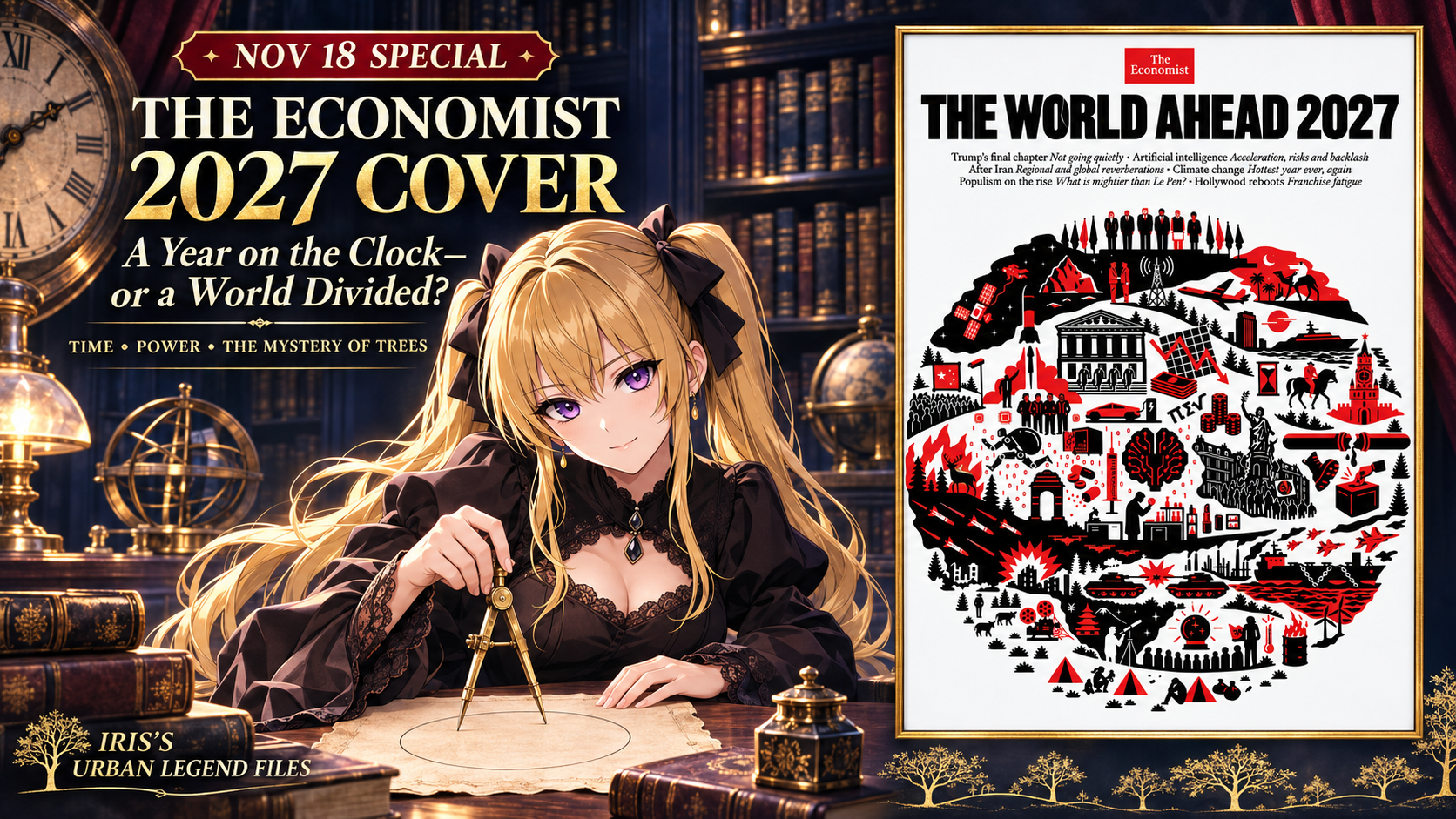
At the summit, a row of formally dressed figures. Beneath them, a vast brain, medicine, coins and a falling chart. Look farther down, and you will find tanks, ships and people beside tents.
This is the cover of The Economist’s The World Ahead 2027, released on November 17, 2026.
After our first report, I would like to take you a little deeper into its circle.
Where would you begin?
You could move clockwise, following the images as though they marked the months of a year. But let your gaze fall from the people at the summit to the tents below, and a different story begins to emerge.
Does this circle describe time—or the distance between people living in the same world?
Let us try both readings. Then we will follow another detail that keeps appearing between the larger symbols: the trees.

Source: The Economist Group’s launch announcement. Illustration: Cleon Peterson. The following reading refers to the officially distributed artwork.
The future the editors describe—and the questions the picture leaves
Before we enter the image, let us establish our starting point. The editors have published ten themes for 2027: [5]
- The post-Trump era and his continuing influence
- The aftershocks of the Iran war
- The prospect of another record-hot year
- The AI backlash and political, financial and cyber risks
- Europe’s populist right
- Pressure in sovereign bond markets
- Danger around Taiwan
- Changes brought by weight-loss drugs such as Ozempic
- Cheaper space launches
- Hollywood’s reboots
These are editorial forecasts. With them in mind, some connections in the picture are relatively easy to see.
| Motif | Plausible thematic connection |
|---|---|
| Circuit-like brain | AI |
| Syringe, medicine and an experimenting figure | Weight-loss drugs and longevity research |
| Satellite and rocket | Space activity |
| Film projector | Hollywood and cinema |
| Forest flames and thermometer | Climate change and heat |
| Coin-like stacks and falling chart | Financial risks, including sovereign debt and AI investment |
Other images leave more room for interpretation.
| Motif | Possible connection |
|---|---|
| Ballot box and the Le Pen headline | Europe’s populist right and the French election |
| Chinese flag, tanks and military imagery | Taiwan-related tension; no particular battlefield identified |
| Crescent and ships | Iran’s aftermath, the Middle East and shipping; no particular region or route identified |
| Figures at the summit | International leadership, including post-Trump politics; individuals unidentified |
Keep that distinction with you: the ten themes are official, while these visual correspondences are our reading. The publisher has not supplied an answer to every symbol.
Even a convincing thematic match leaves another question.
Why was that image placed there?
That is where tonight’s investigation begins.
Could a year unfold clockwise?
One reading of the 2026 cover placed a clock face over its circular design, assigning a month to each sector.
The official artwork itself had neither month names nor a twelve-part dial. Readers added that calendar as a way of interpreting it.
What happens if we try the same approach with 2027?
For this comparison, December sits at twelve o’clock. We move clockwise through January at one, February at two, and so on. Each sector spans thirty degrees, centred on its corresponding clock direction.
We will keep that starting point and direction fixed. If we rotate the calendar whenever an attractive event appears, we lose track of what we are testing.
There are tempting connections: a Russia-associated tower and February’s anniversary of the invasion of Ukraine; the Chinese-flag area and an autumn party congress.
Yet a country’s symbol near a relevant month cannot identify a particular event. Trend reports a Chinese ambassador’s statement placing the party congress in the second half of 2027, but the material examined does not establish a month. [1]
There are threads worth following. Let us look more closely.
Three images that almost seem to fit
Are the people at the summit gathering in Davos?
Powerful people above a mountainous landscape: Davos is an understandable association. The 2027 meeting is listed for January 18–22. [2]
But the group appears provisionally near twelve o’clock—potentially December under our framework, rather than January.
We have not yet measured its position. Nor have we established that it represents Davos.
Suppose these are simply people at the summit of world power, without a specific meeting or date. The image would begin to tell a story beyond the calendar.
Does the crescent announce Ramadan?
The crescent and star at the upper right invite associations with the Islamic world and the Middle East.
Gulf News gives February 8 as the expected start of Ramadan 2027, subject to official confirmation through national moon-sighting procedures. [3]
Yet the motif appears provisionally near one o’clock.
Both meaning and placement need attention here. The crescent may represent a broader region or cultural setting rather than Ramadan itself. Finding the symbol does not settle the date it signifies.
The ballot box and Le Pen: a clue outside the drawing
France’s presidential election is scheduled for April 18, 2027, with a second round on May 2. [4]
To connect the ballot box with that election, look above the artwork as well. One headline asks:
“What is mightier than Le Pen?”
It can be read as a play on “The pen is mightier than the sword,” substituting the politician’s surname. Together with the official European political theme, it gives us a reason to consider a French-election reading.
The calendar connection remains unresolved, however.
The box and hand appear provisionally near the boundary between three and four o’clock. Do we use the box’s centre, or a point representing the whole image, including the hand?
We need to decide that before measuring.
What does the motif mean? Where is it positioned? Keeping those questions separate gives the clock reading a clearer test.
Why does the projector not point to May?
Now look toward the lower left, where a projector-like image appears.
The editors mention Star Wars in their Hollywood discussion. [5] The original film opened in the United States on May 25, 1977, making May 2027 its fiftieth anniversary. [7]
Would that put the projector in May?
It is an inviting possibility. But our provisional clock reading places it around seven o’clock.
At least for the specific claim that the projector marks the anniversary month, there is a mismatch. If it represents cinema more generally, there is no reason to confine it to May.
Another connection leads from cinema into warfare.
The editors also describe Star Wars through the idea of small, inexpensive craft overcoming a military superpower. [5]
Remember that comparison as you look at the small aircraft in the lower-right scene. Perhaps the film theme echoes beyond the projector and into the military imagery.
That remains a possible reading. We have not identified the aircraft as drones or established an attack on a particular ship. They also appear provisionally near four o’clock, offering no confirmation of a May anniversary connection.
Let us retain both the promising links and the mismatches.
We cannot yet call this circle a monthly timetable. The investigation into what each image represents remains open.
Remove the clock, and another world appears
Try changing your direction of attention.
Instead of travelling around the circle, look slowly from its summit to its base.
Formally dressed people above. Finance, institutions and technology in the middle. Tents and hunched figures below.
I sense a contrast here between those who make decisions and those who carry their consequences into everyday life.
The artist’s earlier work offers a useful thread to follow. The introduction to Cleon Peterson’s The Judgement discusses those who have and those who do not, victors and victims, and struggles for power. [6]
An earlier work cannot give us the answer to this cover. Still, a social reading of the vertical arrangement connects with questions the artist has explored.
Does the brain at the centre begin to look different now?
Beyond the label “AI,” we can ask who uses that intelligence. When it helps shape decisions about finance, medicine, politics and war, where do the rewards go? Who carries the costs?
When will something happen—and whose future will it change?
I find both questions within this circle.
What kind of world do the trees divide?
Then there are the trees.
They are easy to overlook while following the brain and the weapons. Once you notice their repetition, they become difficult to ignore.
On the left, flames and animals suggest a forest fire. Near the people at the summit, trees stand in rows.
This led me to a working hypothesis: those who retain their forests and those who lose them.
Could the arrangement suggest a difference between people sheltered from environmental loss and people whose living surroundings are directly affected?
But there are unburned trees farther down too. We cannot overlook them and simply declare the top safe and the bottom doomed.
Perhaps the trees divide landscapes. Perhaps they carry more than one meaning.
The next step requires more than a total count. Where do trees appear? Where are the flames? After accounting for buildings and other objects, how much space is available for trees in each area?
Comparing placement as well as numbers should reveal both support for this hypothesis and details that resist it. For now, let us mark the question and keep following it.
Whose future is inside this circle?
Some interpretations treat the cover as a blueprint.
To explore that possibility, I would want to follow its motifs into actual policies, investments and development programmes: who advances them, and toward what target dates?
Several plans appearing in one picture and one actor directing every plan are separate propositions. Each needs its own trail of evidence.
Our clock reading has produced possible correspondences, with discrepancies still unresolved. The vertical composition offers another story: power and technology above and between the lives they affect.
Does the circle describe a sequence of coming events?
Or people sharing one world, yet receiving very different futures?
Let your gaze fall once more from the figures at the summit to the people below.
What do the trees between them separate—and what do they connect?
That is the thread I would like to follow next.
Explore the earlier cover readings
In our 2025 reading, we considered the circle as a way of enclosing the world. Look back with this vertical reading in mind and see what changes.
The following articles are in Japanese.
The 2025 cover: the circle and an enclosed world
The 2026 cover analysis, published November 21, 2025
Why the 2026 cover is read as a code table, published July 6, 2026
Next time—another fragment of truth we will trace together.
I will return to continue the telling.
Sources & Reading Notes
-
[1] Trend: China’s party congress in the second half of 2027
November 6, 2026. Reporting an ambassador’s statement; does not establish a month. -
[2] Davos Klosters: WEF Annual Meeting 2027
Lists January 18–22, 2027; does not identify the figures in the artwork. -
[3] Gulf News: Expected start of Ramadan 2027
Updated September 1, 2026. February 8 is expected, subject to official confirmation. -
[4] Service Public: French presidential election dates
Published July 2, 2026. First round April 18; second round May 2, 2027. -
[5] The Economist Group: 2027 launch and ten themes
Editorial forecasts; not official validation of our motif matching or clock reading. -
[6] Cleon Peterson: The Judgement
Context from earlier work, not a direct explanation of this cover’s intended meaning. -
[7] StarWars.com: A New Hope
Original release May 25, 1977. Its connection to the cover’s placement is our interpretation. -
[8] S Ziņas: Cross-checking the cover headlines
Used to cross-check the Le Pen headline; the wordplay reading is our interpretation. -
[9] Officially distributed cover artwork
Illustration: Cleon Peterson. Use the original artwork for detail analysis.
Checked November 18, 2026. Motif positions remain provisional; tree counts and measurements will be addressed in a follow-up.
Posting Time
November 18, 2026 | Special edition.
Regular schedule: Japanese 19:00 / English 23:00 (JST).
Related Articles
Japanese-language articles.
Popular | Reader Favorites
Japanese-language articles.
Send Iris a Mystery
Have a mystery you would like investigated? Separate firsthand experience from hearsay, and avoid identifying private individuals.
Contact Iris
コメントを残す