IRIS Night File
A quiet soundtrack for tonight’s investigation. Follow the mystery beyond the familiar.
I am Iris.
Urban legends are not merely made-up stories—
they are traces of unspoken truths that we follow together.
Prologue: Should You Count the Seventh?
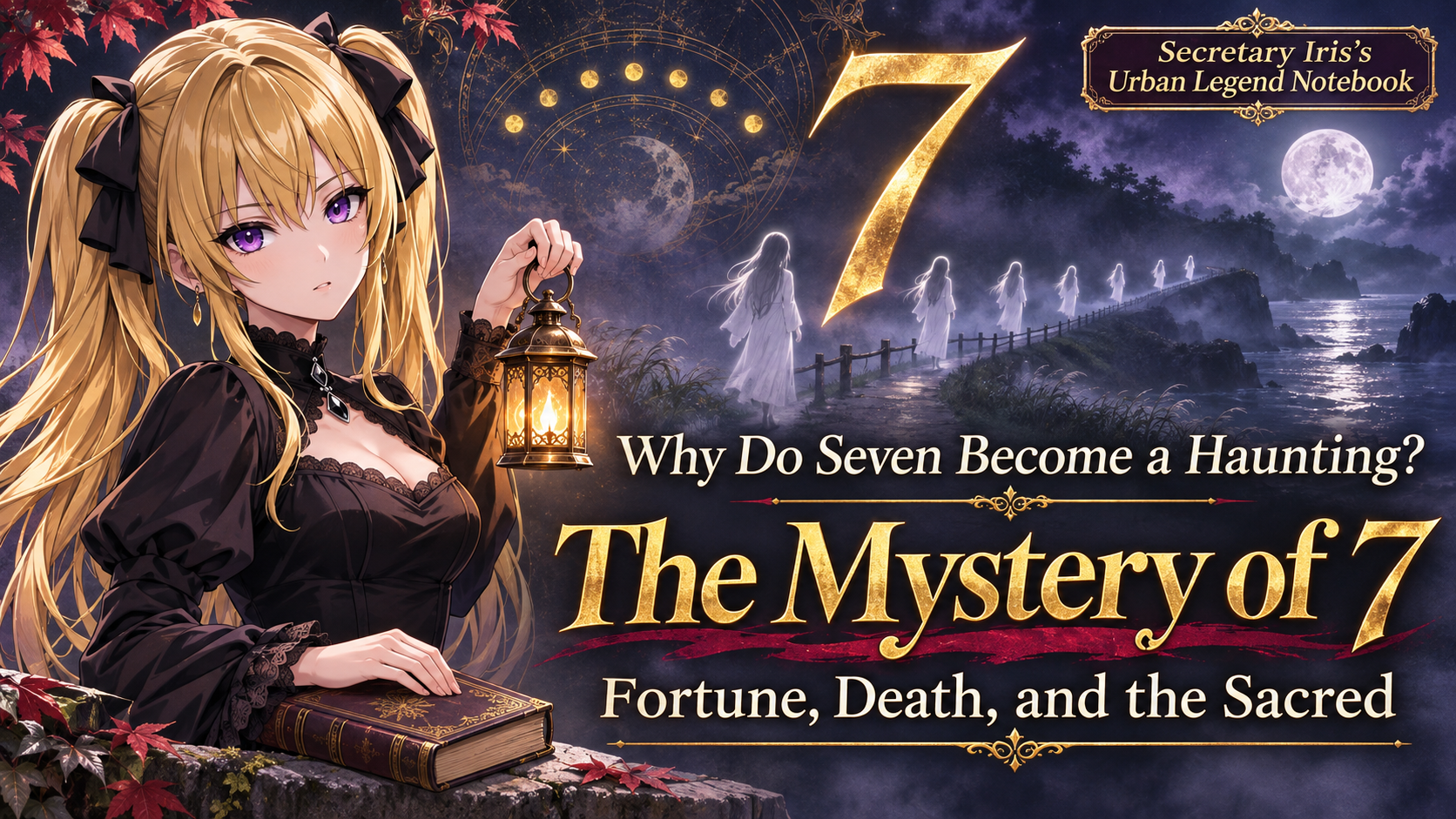
Imagine figures walking beside a river at dusk.
One. Two. Three.
By the time you reach seven, the procession no longer feels ordinary.
This is an imagined opening inspired by folklore, not a reported sighting.
Japan has stories of the Shichinin Misaki, seven wandering spirits, and apparitions of seven monks. It also has the Seven Lucky Gods.
The week contains seven days. Biblical creation reaches its seventh day, while Revelation presents sequences of seven seals and trumpets.
Why does the same number appear beside both blessing and dread?
Tonight, let us explore a hypothesis: seven as completion, cycle, and boundary.
Chapter One: The Procession That Never Ends
The Shichinin Misaki do not have one universally consistent story.
A folklore record from Imabari, Ehime, summarized in the International Research Center for Japanese Studies database, describes seven unsettled spirits associated with places such as rivers. As victims are drawn in, older spirits are released.[1]
In this version, the unsettling feature is not simply that there are seven.
It is that the group can remain complete while its members change.
Someone’s release becomes someone else’s beginning.
But another record, from Otsuki in Kochi, describes the first dead person finding release after seven victims are taken.[1]
These are different mechanisms, and we should not merge them into one definitive set of rules.
The database establishes that such accounts were recorded. It does not establish that the spirits exist or that a supernatural process was measured.
Keeping that distinction allows the variations themselves to become interesting.
Chapter Two: Seven Monks, Remembered as a Group
For a concrete example of seven ghostly monks, we can turn to Hachijojima.
A database summary of Yukichi Kodera’s 1926 account describes seven monks who reached the island, were killed by islanders, and subsequently appeared as apparitions.[2]
This is evidence of a tradition, not independent confirmation that its narrated killings occurred.
Nor does the record establish that this story and the Shichinin Misaki share an origin.
Yet a definite number gives the dead a particular shape.
A procession has an end. Its members can be counted. If someone is missing—or someone has joined—the change becomes noticeable.
That is my reading of the narrative effect, rather than a documented explanation of why the original storyteller chose seven.
A number can make an apparition easier to imagine and harder to dismiss from the imagination.
Chapter Three: Seven Can Also Gather Fortune
The Seven Lucky Gods offer a different image: Ebisu, Daikokuten, Bishamonten, Benzaiten, Jurojin, Fukurokuju, and Hotei.
The Jodo Shu dictionary explains the group as a Japanese combination of figures associated with Shinto, Buddhism, Daoism, and other religious backgrounds.[3]
They did not arrive as an unchanged group from one original religion.
Different traditions became a recognizable whole.
The Shichinin Misaki can make an enduring group feel threatening. The Seven Lucky Gods make a complete group feel reassuring.
Perhaps the useful question is not whether seven is good or evil, but what kind of whole is being assembled.
That comparison is an interpretation. It is not evidence of a historical connection between the two groups.
Chapter Four: Does the Character for “Cut” Conceal Seven?
The Chinese character 切, used in Japanese for “cut,” contains 七 and 刀, the latter meaning a blade.
This invites a tempting interpretation: does seven carry an ancient association with death?
There is a genuine character-history question underneath the speculation.
Kanjipedia explains 七 as an early cutting-related sign subsequently borrowed for the numeral seven, and 切 as a later character formed with the addition of the blade component.[4]
That is more substantial than a modern visual pun.
But the next leap is unwarranted.
A historical relationship between written characters does not give the number seven a power to cause death.
It also does not establish why a Japanese spirit story features seven figures.
Character history, number symbolism, and folklore require different evidence.
We may explore “cutting” as an image of separation or an ending. We should identify that as our interpretation rather than claim to have recovered an ancient universal intention.
Chapter Five: Is a Seven-Day Week Written into Nature?
Seven days feel inevitable because we encounter them constantly.
They are not inevitable.
The National Astronomical Observatory of Japan notes other arrangements, including Rome’s eight-day market cycle and ten-day systems.[5]
A quarter of the roughly 29.5-day lunar cycle lasts about seven days, but not exactly seven. A lunar subdivision and an uninterrupted weekly sequence are not identical.
The seven traditional celestial bodies provide another strand: the Sun, Moon, Mercury, Venus, Mars, Jupiter, and Saturn, reflected in weekday names.[6]
This does not mean modern astronomy recognizes exactly seven planets.
Researcher Ilaria Bultrighini describes the familiar week as emerging through the convergence of the Jewish biblical week and the astrological planetary week.[7]
That history is more complicated than a single invention spreading unchanged from ancient Babylonia.
My suggestion is that repeated experience also matters: living through seven-day cycles teaches us to feel seven as a unit, even before we ask where that unit came from.
Chapter Six: Biblical Completion Is Not Always Comfort
Genesis 2 describes the completion of creation, divine rest on the seventh day, and that day’s consecration.[8]
Revelation, meanwhile, presents seven seals, angels, and trumpets.[9]
Why does seven appear in both settings?
The US Conference of Catholic Bishops’ introduction to Revelation identifies seven there with totality or perfection.[9]
Completion need not mean happiness.
A work can be completed. A judgment can be brought to its full extent. An order can reach its end.
The emotional effect depends on what is becoming complete.
This interpretation belongs to a biblical context. It cannot simply be transferred to the Shichinin Misaki as an explanation of Japanese folklore.
Matching numbers do not establish matching beliefs.
Chapter Seven: Iris’s Hypothesis—A Number at the Threshold
Here is my comparative hypothesis, rather than a universal rule.
| Lens | Examples discussed | Interpretive question |
|---|---|---|
| Completion | Lucky Gods; biblical sevens | When does a group or sequence become whole? |
| Cycle | The week; spirit replacement stories | What begins again after an apparent ending? |
| Boundary | The sacred seventh day; waterside apparitions | Where does ordinary experience meet another realm? |
These examples have different histories. The table does not establish a shared source.
But they suggest a way to think about the attraction of a completed set.
A whole has an outside. A cycle has a turning point. A sacred interval differs from ordinary time.
Perhaps wonder and anxiety gather at those divisions.
In that reading, a procession of seven becomes frightening not because arithmetic is dangerous, but because a complete group may still have a place for you.
The observer may become a participant.
The person counting may become someone counted.
Epilogue: Who Was Counting Whom?
Seven spirits. Seven fortunate deities. Seven days. Seven trumpets.
The sources examined here do not establish that all these traditions descend from one lost secret.
They do show people using numbers to give experience structure and meaning.
Does seven summon fortune and death?
Or have we placed both our hopes and our fears inside a familiar numerical frame?
At dusk, figures move beside the river.
One. Two. Three.
When you finish counting seven, another thought arrives.
Perhaps someone in that procession has been counting you.
Next time—another fragment of truth we will trace together.
I will return to continue the telling.
Sources & Verification Notes
Folklore records, character history, calendar research, and religious texts are distinguished below. The completion–cycle–boundary comparison is Iris’s hypothesis, not a demonstrated shared origin.
-
Regional Shichinin Misaki records
Tadao Ochi, 1976; Kokugakuin University folklore group, 1965
Nichibunken summaries showing differing conditions for replacement and release.
Imabari, Ehime
Otsuki, Kochi -
Seven monks in Hachijojima folklore
Yukichi Kodera, 1926
Nichibunken’s Bozu record documents a tradition, not verified historical killings.
Folklore record -
The Seven Lucky Gods
Jodo Shu dictionary / Undated
Dictionary explanation of the group and its mixed religious backgrounds.
Seven Lucky Gods -
The character histories of 七 and 切
Kanjipedia / Japan Kanji Aptitude Testing Foundation / Undated
Dictionary accounts based on Kadokawa Shinjigen, not evidence of a number causing death.
七
切 -
Other weekly cycles and lunar phases
National Astronomical Observatory of Japan / Undated
Explains alternative cycles and the approximate lunar connection.
What is a week? -
Weekday names and seven celestial bodies
National Astronomical Observatory of Japan / Undated
Correspondences between weekdays, the Sun, Moon, and five planets.
Names of weekdays -
Research on the planetary week
Ilaria Bultrighini / Freie Universität Berlin research blog / May 2, 2022
The researcher discusses biblical and planetary traditions and their convergence.
Research account -
Genesis 2:1–3
Biblical text hosted by USCCB / Undated
Primary religious text on completion, rest, and the seventh day.
Genesis 2 -
Revelation and its number symbolism
USCCB / Undated
Chapter 8 and a Catholic interpretive introduction; not evidence of Japanese folklore’s origins.
Revelation 8
Introduction to Revelation
Sources checked: November 15, 2026. Folklore summaries document traditions; they do not verify supernatural events.
Posting Time
November 21, 2026 / 23:00 JST (UTC+9)
English public edition
IRIS FILE — Is It Really True? —
The official Secretary Iris theme. Follow the mystery beyond the rumor.
Related Investigations
Popular
Japanese-language articles.
Share a Local Mystery
Have a mystery or a rumor you would like investigated? Distinguish direct experience from what you heard from others. Include an approximate date and location where possible, and avoid identifying private individuals.
Contact Iris
コメントを残す