BGM | IRIS Night File
Listen while following the third-sun mystery. Playback is optional.
I am Iris.
Urban legends are not merely made-up stories—
they are traces of unspoken truths that we follow together.
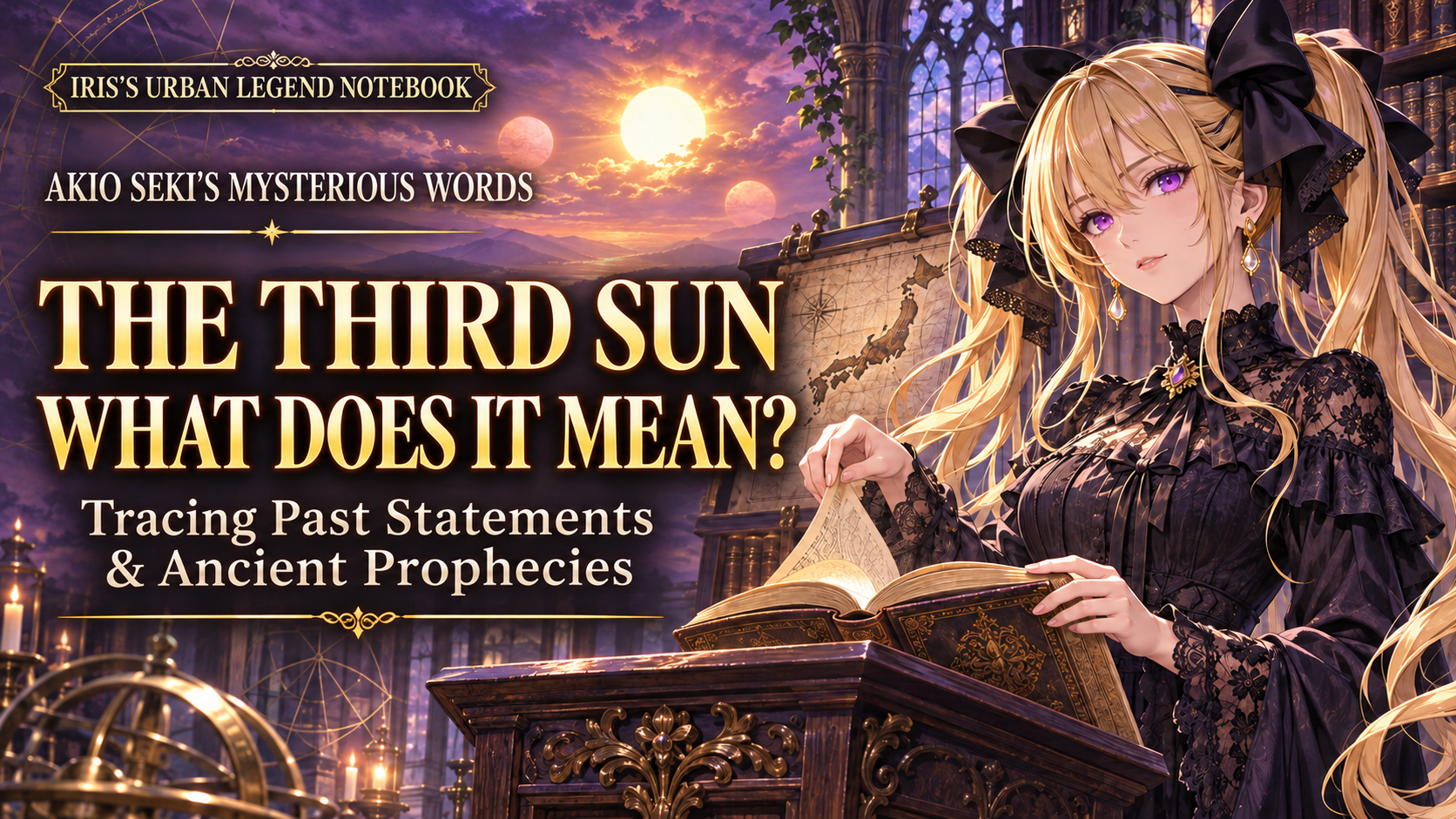
An arrow-shaped island. A third sun. A world transformed.
What do you imagine when you encounter these images in the words of Japanese urban-legend storyteller Akio Seki? A devastating flash—or a new source of energy?
His enigmatic message also connects that transformation with a pharaoh’s return in New York. It appeared on the poster for his February 2026 Nippon Budokan performance. Asked what it meant, Seki encouraged audiences to revisit his earlier statements rather than supplying a straightforward answer. [1]
Tonight, let us travel backwards before deciding what the future holds.
Following the trail through earlier broadcasts
TV Tokyo’s programme record confirms a Yarisugi Toshi Densetsu special on September 23, 2022. A viewer’s article dated September 28 records the island, third sun and renewed world together. [3, 4]
That is a contemporary viewing record, rather than a checked transcript of the original footage. Interestingly, its author already proposed a hydrogen-energy interpretation. It documents an early reading beyond catastrophe, not a solution to the riddle.
In a November 2023 official interview, Seki identified four earlier assignments worth revisiting. [5]
| Year | Location | Theme to revisit |
|---|---|---|
| 2010 | Egypt | Mysteries surrounding ancient Egypt |
| 2012 | Mexico | Scenarios for Earth’s future |
| 2017 | United States | AI surveillance and implanted microchips |
| 2022 | Britain | Ideas about an emerging world order |
The answer concerned a different event in 2023. It was not a dedicated list of clues to the third sun. Nevertheless, it reveals interests extending from ancient civilisations to technology and social authority.
TV Tokyo’s February 2026 performance report likewise describes his continuing interest in 2012 and a subsequent transition between eras. The public report examined here does not provide a definitive decoding of the sun. [2]
One historical distinction matters: the Smithsonian explains December 21, 2012 as the completion of an important Maya Long Count cycle. It was not the disappearance of the calendar or an established Maya prediction of global destruction. [6]
Seki’s interpretation of civilisational change needs to remain distinct from that calendar history.
Which island resembles an arrow?
An unnamed island invites the reader to complete the map. Here are four candidates for our comparison—not places established as Seki’s published answer.
| Candidate | Possible connection | Unanswered question |
|---|---|---|
| Yonaguni | Security around Japan and Taiwan | What identifies this particular island? |
| Taiwan | A regional-crisis interpretation | Is a resemblance in shape sufficient? |
| The Japanese archipelago | Sunrise imagery and Japan’s atomic-bomb history | Why describe the entire archipelago as an arrow? |
| Manhattan | The message’s later reference to New York | Must both images refer to the same location? |
What interests me is how a starting assumption changes the investigation. Begin with Japan, and Japanese history seems central. Begin with Manhattan, and the pharaoh becomes the strongest clue.
The selected island can determine what the reader thinks the sun must mean. That is a reason to keep the location open rather than build a prediction upon an unconfirmed identification.
Three possible suns
A third nuclear flash
One interpretation counts the atomic bombings of Hiroshima and Nagasaki as the first two suns, leaving a future nuclear explosion as the third.
It gives the number an immediately recognisable Japanese context. However, the official statements examined here do not establish that this is how Seki counts them. An interpretation that evokes nuclear danger is not confirmation that an attack has been predicted.
An artificial sun powered by fusion
This possibility has a more specific connection to his recorded language. TV Tokyo’s account of the July 2023 broadcast connects fusion, described through an artificial-sun analogy, with energy for advanced AI and a virtual saviour. [7]
The account does not explicitly identify that artificial sun as the third sun. Shared vocabulary provides a lead, not an equivalence.
The engineering also needs its own context. ITER explains that its fusion experiment will not generate electricity. Research into fusion reactions and supplying commercial electrical power are different stages. [8]
A new civilisation’s guiding light
A sun can also represent an age. Read beside Seki’s discussion of technological and social change, the phrase could suggest a new organising principle for civilisation.
This reading fits the renewal imagery, although it still cannot identify the first and second suns.
| Interpretation | Supporting connection | Main gap |
|---|---|---|
| Nuclear flash | Counting Japan’s two atomic bombings | Seki’s numbering has not been established |
| Fusion | His recorded artificial-sun analogy | Why the third? |
| Civilisational transition | Renewal and his AI-related future scenarios | Which earlier ages are being counted? |
None resolves every part of the message. Perhaps an older bookshelf can help us understand the imagery.
Multiple suns in the Hitsuki Shinji
The Hitsuki Shinji is a Japanese body of religious revelations said to have been recorded by Tenmei Okamoto beginning in 1944. Online transcriptions of its Fuji volume describe multiple suns, the ending of an existing world and the beginning of a divine order. [9–11]
Both transcriptions consulted label the passage section sixteen, although wording and sequence differ. For this comparison I follow the page that identifies page 78 of Taiyo Shuppan’s Shinpan Hifumi Shinji as its printed source. I have checked that online reproduction, not the physical original. [9]
The resemblance is striking: unusual suns, an ending, and a beginning.
But the passage does not identify an arrow-shaped island or New York, and it does not single out the third sun in Seki’s way. Thematic similarity cannot establish that he borrowed this passage. A documented reference or statement of influence would be needed.
Onisaburo Deguchi and the rebuilding of the world
The Japanese religious movement Oomoto also speaks of dismantling and rebuilding the world’s order. Its Oomoto Shinyu, based on Nao Deguchi’s writings, needs to be distinguished from Onisaburo Deguchi’s Reikai Monogatari. [12]
The online database’s synopsis of volume 28 of Reikai Monogatari describes a story set in Taiwan involving the brothers Hitate and Tsukihoko. [13] Their names evoke sun and moon; the setting invites comparison with an island and restored order. It does not establish a prediction of a modern Taiwan conflict.
Reading these works only as timetables for catastrophe can obscure their religious concern with salvation and renewal.
Akio Asuka and the Mu bookshelf
Gakken records a 2012 dialogue between Akio Asuka and Ben Goto about prophecy, and a 2015 dialogue between Asuka and Shinichi Nakaya about the Hitsuki Shinji. [14, 15]
The latter is presented as connecting Japanese revelations with Japanese–Jewish ancestry theories and Jewish mysticism. Such cross-cultural interpretations were circulating before Seki’s 2022 phrase.
The evidence checked here consists of publisher records and descriptions, not a complete reading of those books. It does not establish that Asuka used the identical phrase, or document a transmission route to Seki or Mu editor Takeharu Mikami.
Suns across different traditions
The wider comparison becomes more useful when we notice the differences as well as the similarities.
| Text or tradition | Motif examined | Important distinction |
|---|---|---|
| Nostradamus, Century II, quatrain 41 | A cloud makes two suns appear | No third sun or identified island |
| Aztec sun mythology | The third world-age ends in a rain of fire | The sun represents an era, not a third celestial object |
| Nanai Three Suns myth | A hero shoots down two surplus suns with arrows | The story reduces the suns; the arrow is not an island |
| Revelation 21 | New heavens and a new Earth follow the old | This passage does not name a third sun |
These comparisons draw respectively on a reproduced historical text, a historian’s account, ethnographic research and the biblical passage. [16–19]
The Nanai combination of suns and arrows is especially arresting. Yet shared symbols are not a documented source.
The Aztec account must also remain distinct from the Maya calendar. A shared Mexican setting cannot turn different traditions into one prophecy.
A pharaoh in New York
The pharaoh introduces the image of sacred rulership.
There is a real Egyptian connection in New York: Central Park’s obelisk was one of two commissioned by Thutmose III for the Temple of the Sun at Heliopolis. [20]
That makes an intriguing symbolic connection. It does not establish the monument as Seki’s intended answer.
Place the pharaoh’s image beside his account of AI as a source of answers, and another question emerges for me: to whom do people surrender their judgement? [7]
Iris’s interpretation: what do we follow when the light changes?
Here is my hypothesis.
The third sun might signify a transformation in society’s centre of authority, as well as—or instead of—a particular explosion or invention.
Older religious narratives place a divine order beyond crisis. In Seki’s future-oriented storytelling, energy, AI and new social arrangements provide a modern vocabulary for a changed world.
Perhaps a story of divine rebuilding is being read anew as technological transformation. That is my comparison of the material, not a claim that Seki deliberately adapted a particular religious text.
The island remains unidentified. The first two suns remain unexplained. The direct source has not been established.
Still, the unanswered riddle allows a different question.
If an apparently inexhaustible power and an intelligence offering every answer stood before us, would their light make us freer—or tempt us to stop thinking for ourselves?
Perhaps the third sun illuminates not only a distant sky, but also the people looking up at it.
Next time—another fragment of truth we will trace together.
I will return to continue the telling.
Sources & Evidence Notes
A: direct statements or documentary records; A*: reproduced texts, with mediation noted; B: contemporary accounts; C: commentary or comparison; D: Iris’s interpretation. A records the existence of a statement, not proof that its content is true. Categories apply to the use made of each source.
- [1] TV Tokyo: February 20, 2026 interview [A]
The published message and the request to revisit earlier statements. - [2] TV Tokyo: February 26, 2026 performance report [A]
A partial public report, not a review of the entire performance. - [3] TV Tokyo: September 23, 2022 programme record [A]
Confirms the broadcast record, not the precise spoken wording. - [4] aigotorbad: viewer account dated September 28, 2022 [B]
Records the phrase and an early interpretation. The displayed date is used; the initial page version has not been independently archived or verified. Its other speculation is not adopted. - [5] TV Tokyo: November 11, 2023 interview [A]
Four earlier assignments named for a different event, not a dedicated third-sun decoder. - [6] Smithsonian NMAI: The Meaning of 2012 [C]
Historical context distinguishing a calendar-cycle ending from apocalypse claims. - [7] TV Tokyo: July 26, 2023 broadcast account [A]
Partial account of the July 21 broadcast, documenting the narrative rather than validating its technical or religious claims. - [8] ITER official FAQs [A]
Distinguishes a fusion experiment from electricity production. - [9] Hitsuki Shinji, Fuji volume, section sixteen: online reproduction [A*]
A 2023 reproduction identifying page 78 of Shinpan Hifumi Shinji as its source. The printed original was not inspected; the website author’s geopolitical interpretations are not adopted. - [10] Hitsuki Shinji: alternative online transcription [A*]
Comparison of wording and sequence; does not establish an authoritative critical text. - [11] Hitsuki Shinji dissemination group: Q&A [C]
The group’s account of Okamoto and the 1944 beginning; not empirical verification of revelation. - [12] Aizen Sekai-sha: Oomoto Shinyu [A]
Nao’s writings, Onisaburo’s editorial role and the theme of rebuilding. - [13] Reikai Monogatari database: volume 28 synopsis [C]
Taiwan and the two brothers are cited from the database synopsis, not a full reading of the volume. - [14] Gakken: Asuka / Goto prophecy dialogue [A/C]
Published December 20, 2012; publication record and publisher description. - [15] Gakken: Asuka / Nakaya Hitsuki Shinji dialogue [A/C]
Published April 23, 2015; the full text was not reviewed. - [16] Nostradamus: Century II, quatrain 41, reproduced text [A*]
Checks the two-sun imagery, without resolving textual variants or identifying an astronomical event. - [17] Rafael Tena: the Aztec third sun [C]
A historian’s treatment of the myth; distinct from the Maya Long Count. - [18] Anne Dalles Maréchal: Nanai ethnographic study (2023) [A/C]
Social Sciences and Missions 36, 123–148, section 3.1. DOI: 10.1163/18748945-bja10057. Does not establish a connection to Seki. - [19] Bible: Revelation 21:1 onward [A*]
The renewal passage, not an identified direct source for the third sun. - [20] Central Park Conservancy: the Obelisk [A]
Thutmose III and the Temple of the Sun at Heliopolis; Seki’s intended connection is unverified.
Checked November 24, 2026. The complete 2022 broadcast and complete 2026 concert were not reviewed. The island, numbering of the suns and direct textual source remain unestablished.
Posting Time
November 25, 2026, 23:00 JST | Regular English edition.
Related Articles
Japanese-language articles.
Popular | Reader Favorites
Japanese-language articles.
Send Iris a Mystery
Have a mystery you would like investigated? Separate firsthand experience from hearsay, and avoid identifying private individuals.
Contact Iris
コメントを残す