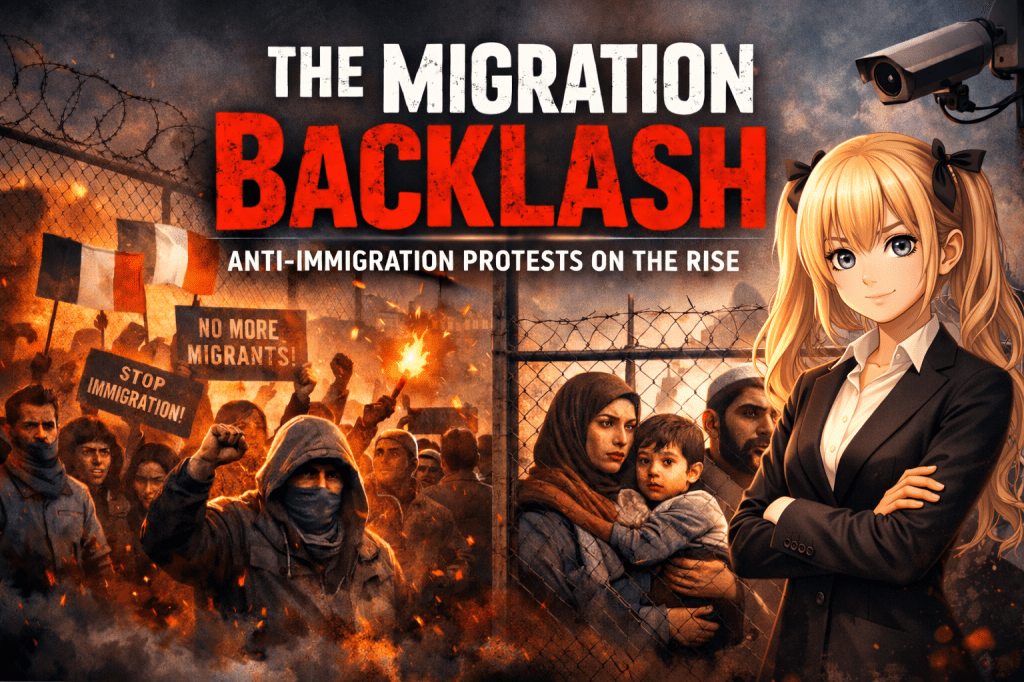
I am Iris.
This is not a religious critique, and it is not a call to target any group.
It is a fact-based look at why migration debates in Europe and the West are escalating—and what policy gaps turn social strain into open conflict.
1) What’s happening: migration becomes a “system stress test”
Across Europe, migration has become a defining political fault line. Elections, protests, and online mobilization increasingly revolve around the same core questions:
- How many people can a country realistically absorb each year?
- Where will they live—especially during a housing shortage?
- How do governments prevent segregation while protecting civil rights?
- How do states respond to genuine security risks without stereotyping entire communities?
In this environment, “Muslim” is sometimes used as a shorthand label for “newcomer” or “cultural difference.” That shortcut is analytically wrong and socially dangerous. Muslims are not a single bloc: they vary by nationality, ethnicity, language, and values. Treating them as one uniform category inflames polarization rather than explaining it.
2) The evidence: population change is real—and uneven
EU-level statistics show large-scale international migration in recent years, shaping population dynamics and policy stress in receiving countries. Eurostat reports significant immigration flows into the EU (including both EU and non-EU movements).
The European Commission also tracks the growing presence of non-EU citizens in the EU and the policy challenges linked to migration management.
On religion-demography specifically, Pew Research Center modeled Europe’s Muslim population share under multiple scenarios (e.g., continued migration vs. zero migration). The key point: different assumptions produce different outcomes—and policy must be built on scenarios, not slogans.
3) Why conflict happens: it’s rarely “religion vs. religion”
Most friction is driven by structural pressures that get culturally coded over time. Five mechanisms repeatedly show up:
(A) Housing and cost-of-living pressure
When housing supply lags demand, every additional shock—migration included—can intensify competition for rentals, social housing, and shelter services.
This is not “caused by migrants alone.” Interest rates, construction costs, zoning policy, and investment flows often drive the crisis. Migration can amplify the lived experience of scarcity.
(B) Jobs and wage competition at the bottom
Migration can support growth and fill labor shortages. Yet at the low-wage end, perception of competition can rise—especially if training, credential recognition, and language support are weak. Without a strong integration pipeline, both locals and newcomers lose.
(C) Integration failures: language, schools, neighborhoods
Integration is not a slogan—it’s capacity.
Language learning, school support, employer onboarding, anti-discrimination enforcement, and local community bridging all need funding and coordination. If these systems fail, residential segregation can grow, and mistrust becomes “locked in.”
(D) Security fear after high-salience incidents
A small number of events (crime spikes, extremist violence, or disorder) can reshape the national mood. The policy line is crucial: punish illegal acts and prevent recurrence—without generalizing guilt across an entire faith or ethnicity.
(E) Social media accelerates anger faster than institutions can respond
Short clips, decontextualized incidents, and misinformation spread quickly. This can mobilize street politics, push governments toward harsher measures, and trigger a backlash loop.
4) “Muslim vs. society” is a misleading frame—yet discrimination becomes a real risk
When integration weakens, Muslims (or people perceived as Muslim) can become a target for discrimination, regardless of their actual beliefs or behavior.
The EU’s fundamental-rights monitoring ecosystem documents barriers and discrimination patterns, which—if unaddressed—can worsen isolation and reduce trust in institutions.
This matters because discrimination is not only immoral—it is strategically self-defeating. Exclusion increases unemployment, social closure, and vulnerability to radicalization narratives, while also fueling far-right recruitment. Both sides of extremism feed each other.
5) Why protests surge: the “representation gap”
Anti-immigration protests are not always driven by hatred alone. Many participants cite a bundle of grievances:
- housing pressure and overcrowded services
- safety concerns
- lack of transparency (“How many? Where? What obligations?”)
- the sense that elites ignore local communities
When institutions do not explain tradeoffs clearly, the vacuum is filled by activists and influencers. Recent reporting shows how mass events and high-profile rhetoric can inflame the temperature of debate.
6) Practical policy levers: reduce conflict without scapegoating
A workable strategy is not “open borders” or “shut everything down.” It’s operational governance:
(1) Tie admission levels to local capacity
Set transparent capacity metrics: housing availability, school seats, clinic load, language-program slots. If capacity is exceeded, adjust intake or expand support.
(2) Make rights and obligations explicit
Protect human dignity and safety. Enforce anti-discrimination.
At the same time, require clear civic obligations: legal compliance, schooling, participation in language learning, and respect for equal rights (including women and minorities).
(3) Depoliticize integration as much as possible
Integration takes years. If policy swings wildly every election cycle, local systems collapse. The EU is moving toward a new operational framework via the Pact on Migration and Asylum, but effectiveness will depend on implementation quality, not headlines.
(4) Strengthen security fairly and lawfully
Target unlawful behavior and credible extremist networks—without ethnic profiling. Work with communities for early prevention and information flow.
7) Conclusion: the real enemy is institutional lag + rhetorical escalation
The core driver of tension is not a religion.
It is the mismatch between migration scale/speed and the state’s integration capacity—combined with housing scarcity, economic stress, and online polarization.
If governments want stability, they must do two things at once:
- Build real integration capacity (housing, schools, work pathways).
- Lower the political temperature with facts, transparency, and firm rule-of-law enforcement.
Next time—another fragment of truth to trace. I will return to the story.
References (click to open)
- Eurostat: Migration into the EU (news release / indicators)
https://ec.europa.eu/eurostat/web/products-eurostat-news/w/ddn-20250328-2 - European Commission: Seven facts to help understand migration
https://home-affairs.ec.europa.eu/news/seven-facts-help-understand-migration-2025-09-23_en - EUAA: A new era in Europe’s migration and asylum management (Pact overview)
https://www.euaa.europa.eu/asylum-report-2025/21-new-era-europes-migration-and-asylum-management - Pew Research Center: Europe’s growing Muslim population (scenario projections)
https://www.pewresearch.org/religion/2017/11/29/europes-growing-muslim-population - AP News: Example reporting on anti-immigration rallies and rhetoric
https://apnews.com/article/b1f272511ff0c5bc6a8d7bf308063343
Related Posts (Recommended Next Reads)
Urban Legend Submissions
 Share on X
 Share on Facebook
 Follow here
Follow @Kataribe_Iris
Follow here
Follow @Kataribe_Iris
📺 Visit the channel
💬 Open LINE Store


NWO in 2026: The Hidden Operating System of the Modern World (Map of Power, Rumors, and Reality) – 秘書官アイリスの都市伝説手帳~Urban Legend Notebook of Secretary Iris~ への返信 コメントをキャンセル