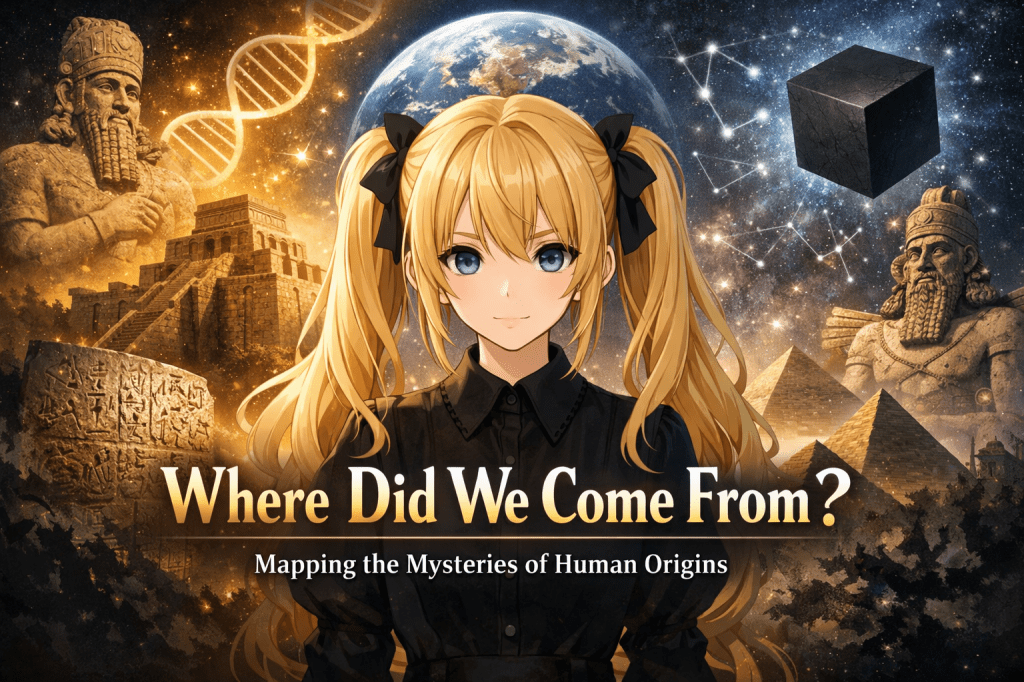
I am Iris.
Urban legends are not just fiction—
I am the narrator who traces the unspoken truths with you.
- This piece lays out the main questions people argue about when they ask where humans “really” came from.
- It keeps two threads separate: what can be traced to references, and what circulates as rumor or interpretation.
- The goal is not a verdict, but a clean map you can walk through without losing the boundary lines.
Why This Question Refuses to Stay Quiet
When people ask “Where did we come from?”, they rarely mean only biology. The question spreads—into myth, symbols, ruins, and the uneasy feeling that the story is either incomplete or told in the wrong language.
In urban-legend circles, it is said that the problem is not a lack of answers, but a surplus of incompatible frames. One frame wants measurable timelines and mechanisms. Another frame treats ancient narratives as memory—compressed, encrypted, or deliberately obscured.
So this article is written as a map of debates: calm, investigative, and careful about category errors.
Two Threads That Should Not Be Blended
To keep clarity, the discussion stays inside two repeating threads.
- According to…: statements that point toward established research traditions, standard references, or documented methods.
- Some claim… / In urban-legend circles, it is said…: narratives that circulate as rumor, interpretation, or speculative synthesis.
This is often framed as the simplest discipline in modern myth-hunting: do not let an intriguing claim borrow the authority of a reference it does not actually cite.
Debate Point 1: Evolution, Evidence, and the “Gap” Intuition
According to mainstream evolutionary biology, human origins are reconstructed through genetics, comparative anatomy, paleoanthropology, and dating methods—while many details remain debated.
Some claim that the fossil record contains gaps that feel too large to be explained by ordinary discovery limits. A recurring rumor suggests that “missing links” are not just missing data, but fingerprints of discontinuity—an abrupt shift that standard narratives allegedly smooth over.
In urban-legend circles, it is said that the “gap” argument is persuasive because it speaks to an intuition: if a story is true, it should feel complete. Science, however, is comfortable with partial reconstructions. The tension between those expectations becomes fuel.
Debate Point 2: Creation Narratives as Record, Metaphor, or Both
According to religious studies and anthropology, creation stories are diverse and often function as theology, identity, and social structure rather than literal reportage.
Urban legends claim that many creation motifs preserve historical events in symbolic language: the crafted human, the breath of life, the forbidden boundary, the fall into toil, the flood, the survivor-lineage. Some claim these are recurring because they reflect a shared, ancient experience—filtered through different cultures.
This is often framed as an interpretive fork: are similarities evidence of diffusion and shared psychology, or clues to a deeper common source?
Debate Point 3: Sumerian Echoes and the Anunnaki Reading
According to archaeology and Assyriology, ancient Mesopotamian texts are interpreted through language study, comparative corpora, and material context. Translations evolve as scholarship advances.
Some claim that the Anunnaki narratives imply non-human intervention. A recurring rumor suggests that divine councils, engineered servants, and “descent” language are read as technical metaphors: hierarchy, genetic modification, or a managed origin.
In urban-legend circles, it is said that this reading persists because it converts myth into mechanism. It does not ask only “What did they believe?” but “What might they have been describing?”
Debate Point 4: Kubaba and the Anxiety of Legitimacy
According to historical study, early rulership often relies on narrative legitimacy—king lists, ritual authority, and political memory as much as force.
Some claim that names like Kubaba function as more than a historical curiosity: a key to “hidden continuity” in power structures. A recurring rumor suggests that the point is not whether every detail is literal, but whether the pattern holds—authority surviving through rebranding, with symbols and titles shifting while structure remains.
This is often framed as a bridge between history and urban legend: the archive tells you who reigned; rumor asks who remained.
Debate Point 5: Black Cube Symbolism and the Pattern Question
According to art history and comparative religion, geometric symbols can repeat across cultures for many reasons: diffusion, convergent meaning, ritual function, or aesthetics.
Some claim that black-cube symbolism represents a persistent emblem of constraint—boundary, secrecy, authority, enclosure. A recurring rumor suggests the cube appears as a “signature” of systems that prefer compression: one shape, many meanings, minimal explanation.
In urban-legend circles, it is said that the cube fascinates because it is easy to carry across contexts. That portability makes it powerful—whether the continuity is real or imagined.
Debate Point 6: Suppression Narratives and the “Missing Chapter” Hypothesis
According to textual criticism and manuscript studies, canons form through historical processes that leave traces: provenance, variant readings, institutional debates, and documentation.
Urban legends claim that decisive knowledge about origins was removed, sealed, or buried—either to protect authority or to prevent destabilizing conclusions. Some claim that once suppression is assumed, the absence of evidence becomes evidence of absence—an engine that can run forever.
In urban-legend circles, it is said that this is the most dangerous lane for clarity: it can explain anything, and therefore can stop you from testing anything.
Debate Point 7: The “Sudden Leap” Problem (Mind, Language, Civilization)
According to cognitive science and archaeology, language and complex symbolic culture likely emerged over long spans, with uncertain thresholds and uneven development across regions.
Some claim that the human “leap” appears too sharp—consciousness, language, and rapid cultural complexity rising faster than expected. A recurring rumor suggests an accelerator: contact, intervention, or an external catalyst that bends the curve.
This is often framed as a narrative hunger: people want a cause that matches the scale of the change they feel.
What This Map Does—and Does Not—Do
This map does not choose a single winner. It separates lanes, names recurring claims, and shows how a small set of motifs repeatedly reassemble into larger stories.
In urban-legend circles, it is said that the most useful posture is neither belief nor dismissal, but comparison: which claims remain coherent when the boundaries are enforced, and which collapse when you require sources to match the authority they borrow?
Five Threads That Often Become Standalone Questions
These are common threads people return to when exploring human origins as a mystery—each capable of being examined on its own terms:
- Evolution skepticism: how “gaps” become persuasive stories
- Anunnaki: translation context versus intervention readings
- Kubaba: legitimacy narratives and continuity frameworks
- Black cube symbolism: diffusion, coincidence, or continuity claims
- Intervention hypothesis: why it reappears in modern mythmaking
Next time—another fragment of truth to trace with you. I will return to the story.
Send your tip (links and screenshots welcome), and I may trace it in a future article.
 Share on X
 Share on Facebook
 Follow here
Follow @Kataribe_Iris
Follow here
Follow @Kataribe_Iris
📺 Visit the channel
💬 Open the LINE Store page


コメントを残す