
I am Iris.
Urban legends are not merely fiction—
I am the storyteller who traces unspoken truths with you.
- Audit promises by implementation feasibility, not rhetorical force.
- Use a 12-point (6-axis) scorecard to compare policies on the same ground.
- Build a practical “judgment OS” before the Three-Layer Model begins.
Why “audit” campaign promises at all?
During elections, promises often arrive wrapped in strong, emotionally loaded language. Yet in reality, policy tends to move through a pipeline: budgeting, legislation, administrative execution, evaluation, and audit.
If we decide “for/against” before checking that pipeline, we can end up riding a wave of impression management. The aim here is not “believe / disbelieve,” but auditability—whether a promise can be examined, tracked, and corrected.
Read promises through PDCA (Plan / Do / Check / Act)
A promise becomes real only when it can enter a repeatable cycle:
- Plan: institutional design, budget measures, targets (KPI)
- Do: execution (who does what, by which procedures)
- Check: verification (evaluation, audit, disclosure)
- Act: correction (how to adjust when results diverge)
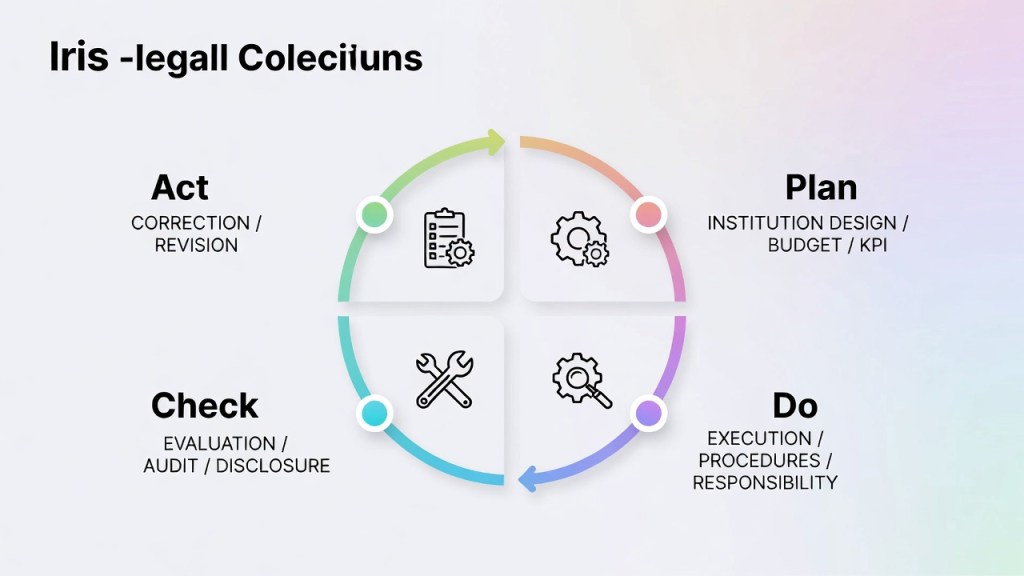
When this cycle is missing—or only implied—the message can sound decisive while remaining structurally fragile. This does not prove intent; it simply lowers auditability.
The 6-axis scoring rubric (0–2 points each, 12 total)
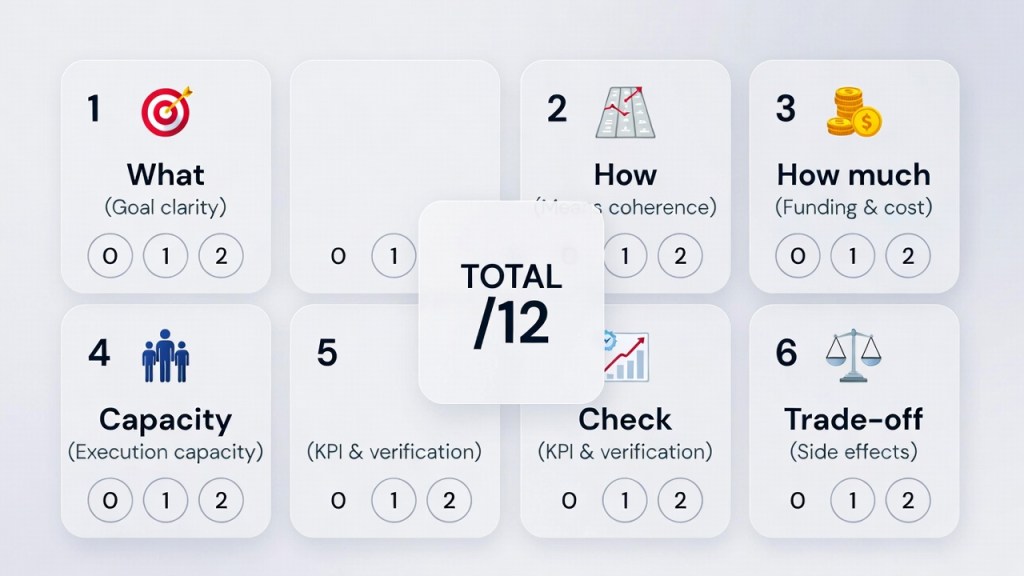
To compare promises fairly, score each axis from 0 to 2 and total up to 12 points.
- 0: unclear / contradictory / no basis visible
- 1: partially described, but key elements missing
- 2: elements are present; auditability is high
1) Goal clarity (What)
Look for:
- The goal described as a measurable “state,” not a feeling.
- Clear target, scope, and timeframe.
Red flags: - Stops at “increase / protect / strengthen.”
- The denominator is vague (who/what exactly?).
2) Means coherence (How)
Look for:
- Whether it requires law reform or can be done by operational change.
- Clear division of roles (national / local / private sector).
Red flags: - Ends with “consider / make efforts.”
- No visible entry point (institution / procedure).
3) Funding & cost (How much)
Look for:
- Funding source (tax / spending cuts / bonds / reallocation).
- Mentions both upfront cost and running cost.
Red flags: - “We will secure funding” with no mechanism.
- Who pays / what gets cut is missing.
4) Execution capacity (Capacity)
Look for:
- Staffing, systems, counters, oversight—field requirements.
- A roadmap if it’s nationwide.
Red flags: - No explanation of frontline workload.
- New implementing bodies without design details.
5) Measurability & verification (KPI / Check)
Look for:
- What counts as “achieved,” with indicators.
- Verification body (third-party, audit, disclosure).
- Baseline year (what improvement is measured from).
Red flags: - Numbers without definition/baseline.
- Confuses outputs (“did a lot”) with outcomes (“improved”).
6) Trade-offs & side effects (Trade-off)
Look for:
- Who benefits and who bears the burden.
- Short-term vs long-term reversals.
- Engagement with counterarguments.
Red flags: - Treats opposition as “evil” or illegitimate.
- Assumes “no side effects” (rare in reality).
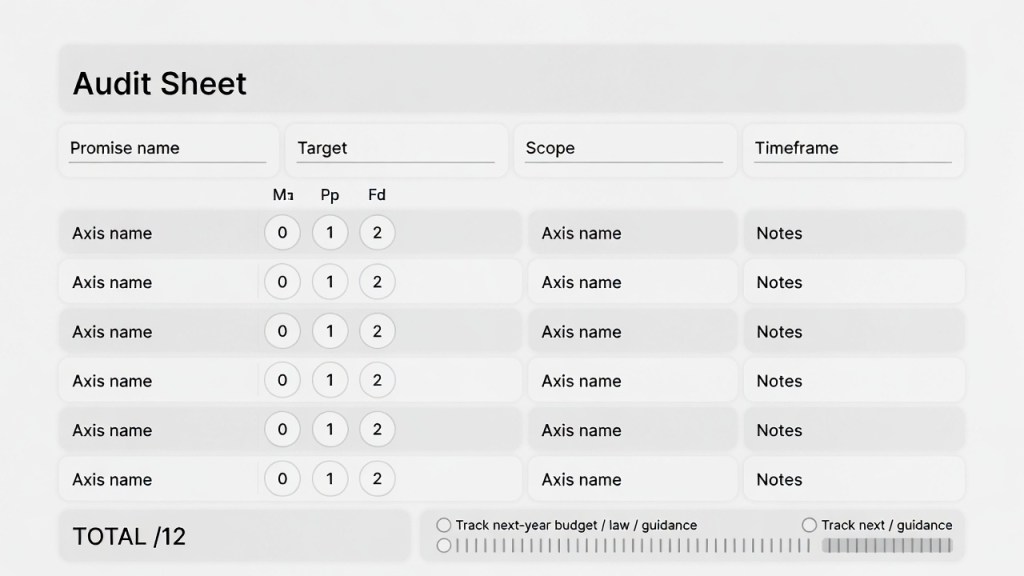
A reusable one-page audit sheet
Use this template to normalize any promise into the same format:
- Promise name:
- Target / scope / timeframe:
- 1) Goal (What): 0 / 1 / 2
- 2) Means (How): 0 / 1 / 2
- 3) Funding (How much): 0 / 1 / 2
- 4) Capacity (Capacity): 0 / 1 / 2
- 5) Verification (KPI/Check): 0 / 1 / 2
- 6) Trade-offs (Trade-off): 0 / 1 / 2
- Total: __ / 12
Common traps that inflate impressions
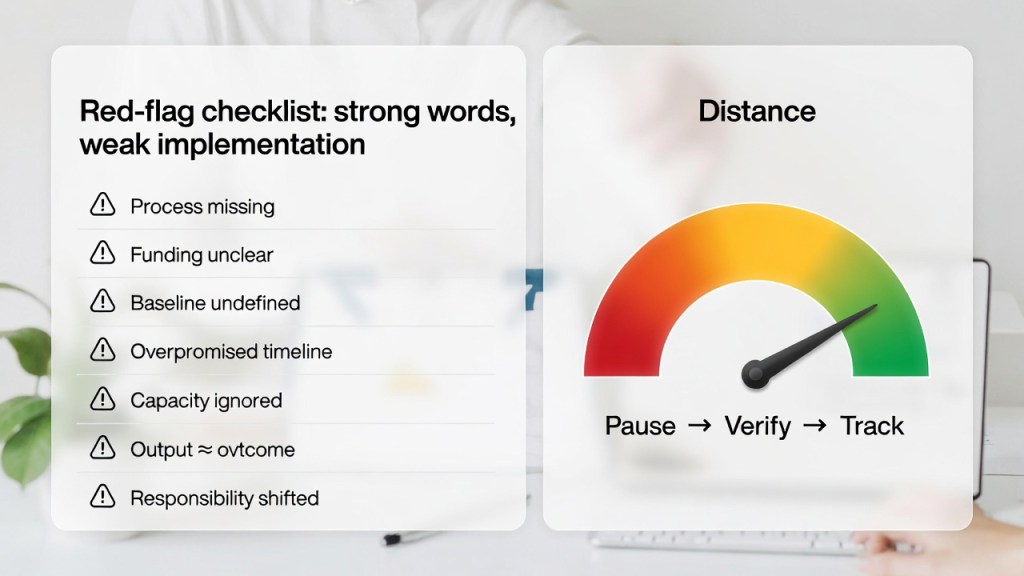
Lower-auditability promises often rely more heavily on performance and framing—so it is sometimes said. Use these as “distance markers,” not verdicts:
- Strong certainty, but empty on process/funding/institutions.
- Numbers exist, but baseline/denominator/definitions are missing.
- Many exceptions that can hollow out operations.
- A new system with no staffing/IT/counter design.
- Double-counted achievements (appearance of progress).
- “The central government will do it,” but execution is shifted to local bodies.
- “Immediate cure” rhetoric ignoring legal/budget timelines.
Reader actions: make auditing a habit
Knowledge becomes a tool only when used.
1) Pick one promise you care about and score it out of 12.
2) Identify where results can be observed: budget / settlement / audit / evaluation.
3) Track whether it appears in next-year budgeting, legal revision, or operational guidance.
4) Collect just one serious counterargument to reduce emotional bias.
Bridge to the Three-Layer Model (next episode)
What you gained here is a measuring stick: an audit rubric that is independent of charisma and slogans.
Next time, we will begin the Three-Layer Model—why the same news can look different depending on “external / middle / internal” layers, and how to update your thinking OS without being pulled by the loudest voice.
Next time—another shard of truth we trace together. I will return to the story.
-
Board of Audit of Japan (Official)
Entry point for audit results and follow-up on findings.
https://www.jbaudit.go.jp/english/ -
Ministry of Finance Japan: Budget (Official)
Official budget materials to check funding, allocations, and fiscal context.
https://www.mof.go.jp/english/policy/budget/budget/index.html -
Cabinet Office, Government of Japan (Official)
Policy domains and government-wide context (useful as an index hub).
https://www.cao.go.jp/index-e.html -
National Diet Library (Official)
Gateway to white papers, official documents, and primary-source tracing.
https://www.ndl.go.jp/en/ -
OECD: Performance budgeting (topic hub)
International framing for performance budgeting and accountability concepts.
https://www.oecd.org/en/topics/sub-issues/performance-budgeting.html
Something Feels Off in Japan’s Election — Tracing the “External Specifications” Shaping Pledges
The Economist 2026 Cover: A Symbol Map of Power
Where Did We Come From? A Debate Map of Human Origins (Urban-Legend vs. Reality)
NWO in 2026: The Hidden Operating System of the Modern World (Map of Power, Rumors, and Reality)
国譲り神話の真実──日本統合システムの正体
Send topics anytime. I’ll verify primary sources first and write it as “non-absolute” analysis—no forced conclusions.
 Share on X
 Share on Facebook
 Follow
@Kataribe_Iris
Follow
@Kataribe_Iris
📺 Channel
💬 LINE Store

コメントを残す