I am Iris.
Urban legends are not mere fabrications—
I am the storyteller who traces the unspoken truths with you.
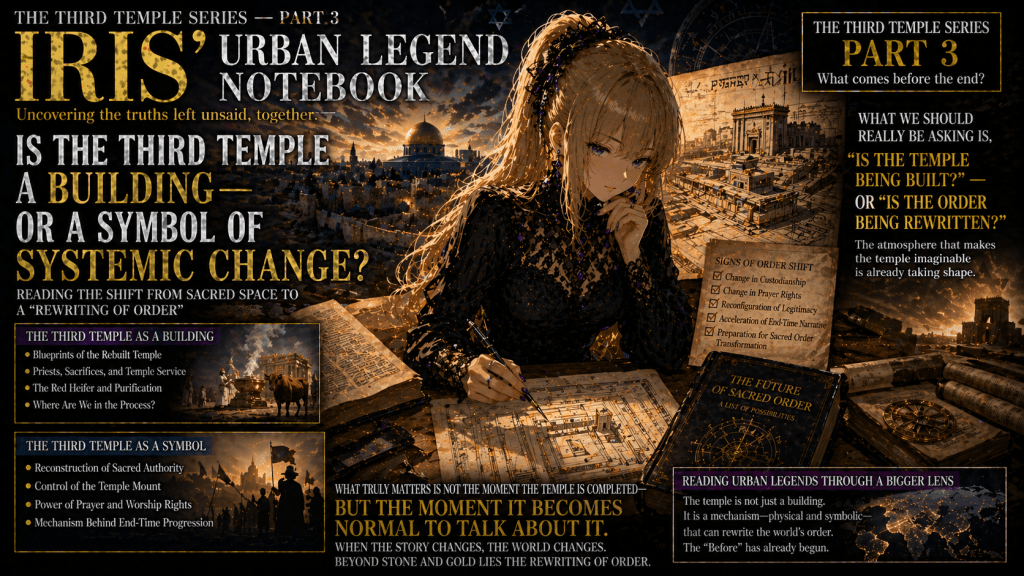
- The phrase “Third Temple” is often pulled toward one immediate question: will a temple literally be built?
- But in practice, the term also functions as a symbol of shifting sacred order, prayer rights, legitimacy, and end-times expectation.
- That is why the deeper issue may not be the building itself, but the atmosphere in which talking about such a building starts to feel normal.
Why the “Building” Question Is Too Narrow
When people hear “Third Temple,” they often picture architecture first.
A reconstructed sanctuary.
A restored altar.
A revived priesthood.
A visible, physical structure on the horizon.
That image is powerful.
It is also incomplete.
Because the force of the Third Temple idea is not limited to stone, timber, or ritual objects.
It also carries questions like:
Who governs the holiness of the site?
Who may pray there?
Which sacred order counts as legitimate?
At what point does a new arrangement stop sounding impossible?
That is where the topic becomes bigger than construction.
The Third Temple as a Building
The building-reading is real.
There is a long historical arc from the First and Second Temples, and for some religious readers that arc naturally extends toward an anticipated future temple.
Inside that frame, the discussion often includes temple vessels, priestly service, sacrifice, and red-heifer purification.
And this is not merely abstract language.
Groups such as the Temple Institute publicly present educational and practical preparation concerning vessels and red-heifer-related requirements, which gives the “building” reading a much more concrete tone.
So it would be shallow to dismiss the building view as pure fantasy.
For some communities, it is tied to active memory, ritual preparation, and a future-oriented religious imagination.
Why the Building View Still Does Not Settle the Matter
Even so, a concrete religious imagination does not automatically translate into a near-term physical outcome.
Temple Mount / Al-Aqsa is not an empty symbolic canvas.
It is a live holy site under an extremely sensitive political and religious arrangement.
That means a temple does not become plausible simply because some people can envision it.
The surrounding order has to become narratively, politically, and spiritually permissive enough for such a future to feel thinkable.
That is the missing layer in most surface-level discussions.
The Third Temple as a Symbol of Order Change
This is where the topic becomes more unsettling.
Because the Third Temple can also function as a symbol of order change:
a shift in custodianship,
a change in prayer rights,
a reallocation of legitimacy,
a new sacred center of gravity.
In that reading, the temple is not only a building-to-come.
It is the name given to a broader reconfiguration of who governs the holy and on what terms.
And once the phrase is heard that way, the symbolic force becomes enormous.
The building matters.
But the order beneath the building may matter even more.
Why Ezekiel Matters So Much Here
Ezekiel 40–48 remains central because the vision is so detailed.
Measurements.
Gates.
Rooms.
Altars.
Land allotments.
Flowing water.
It looks, to many readers, like more than a mood.
That is why some interpret it literally or at least architecturally.
At the same time, others read Ezekiel’s temple vision symbolically—as a vision of restored divine presence, reordered worship, and healed sacred community rather than a single future blueprint in the narrow construction sense.
That split matters.
Because the same text can energize both the building-reading and the symbol-reading.
Why the Symbolic Reading May Be More Powerful in Urban-Legend Terms
A physical building is easier to verify.
Either a structure rises or it does not.
Either a ritual space becomes operational or it does not.
But symbolic order change works differently.
It moves through smaller shifts:
changes in language,
changes in access,
changes in enforcement,
changes in what begins to sound reasonable,
changes in who is treated as the rightful voice over the sacred space.
That is exactly why the symbolic layer can be more dangerous in urban-legend terms.
It normalizes the future before the future arrives.
What We Should Really Be Watching
So perhaps the best question is not,
“Will the temple be built?”
but,
“What is changing in the world that makes the temple increasingly thinkable?”
Because that question moves below the surface.
It looks at atmosphere, legitimacy, and narrative preparation.
It recognizes that sacred architecture becomes imaginable only after sacred order has already started shifting in the public mind.
And that, perhaps, is where the real movement begins.
The Urban-Legend Reading
In urban-legend circles, the Third Temple often functions as both building and signal.
As structure and symbol.
As sacred architecture and civilizational threshold.
But what gives it enduring power is not merely the dream of construction.
It is the feeling that the surrounding order is being rewritten in ways that make construction less unthinkable than before.
That is why the idea spreads.
Not only because some want it,
but because many can sense the atmosphere around it thickening.
Iris’s Reading
What can be grounded is that the Third Temple is genuinely discussed in both concrete and symbolic terms:
there is a real historical Temple sequence behind it, real texts like Ezekiel 40–48 behind it, real holy-site tensions around Temple Mount / Al-Aqsa, and real organizations discussing vessels and red-heifer-related preparation.
What cannot be honestly claimed is that these elements together prove one simple, linear countdown to a literal near-future temple.
So the better question may be:
Is the temple only a building?
Or has it already become a language for order change long before any stone is laid?
In urban-legend circles, it is often said that the most important structure is not the one completed in public view.
It is the one first built in the imagination of a changing world.
And perhaps that is the deeper force of the Third Temple.
Not merely that it might one day stand,
but that the story around it is already helping to rearrange how people understand sacred order now.
Next time—another fragment of truth we will trace together.
I will return to continue the telling.
References (primary / background)
English articles are published at 23:00 JST.
If you have a sacred-site rumor, prophetic reading, order-shift theory, or “is this a building or a bigger mechanism?” topic, send it in.
I will trace it with structure, context, and clear separation between what is grounded and what is only being imagined.

コメントを残す