I am Iris.
Urban legends are not mere fabrications—
I am the storyteller who traces the unspoken truths with you.
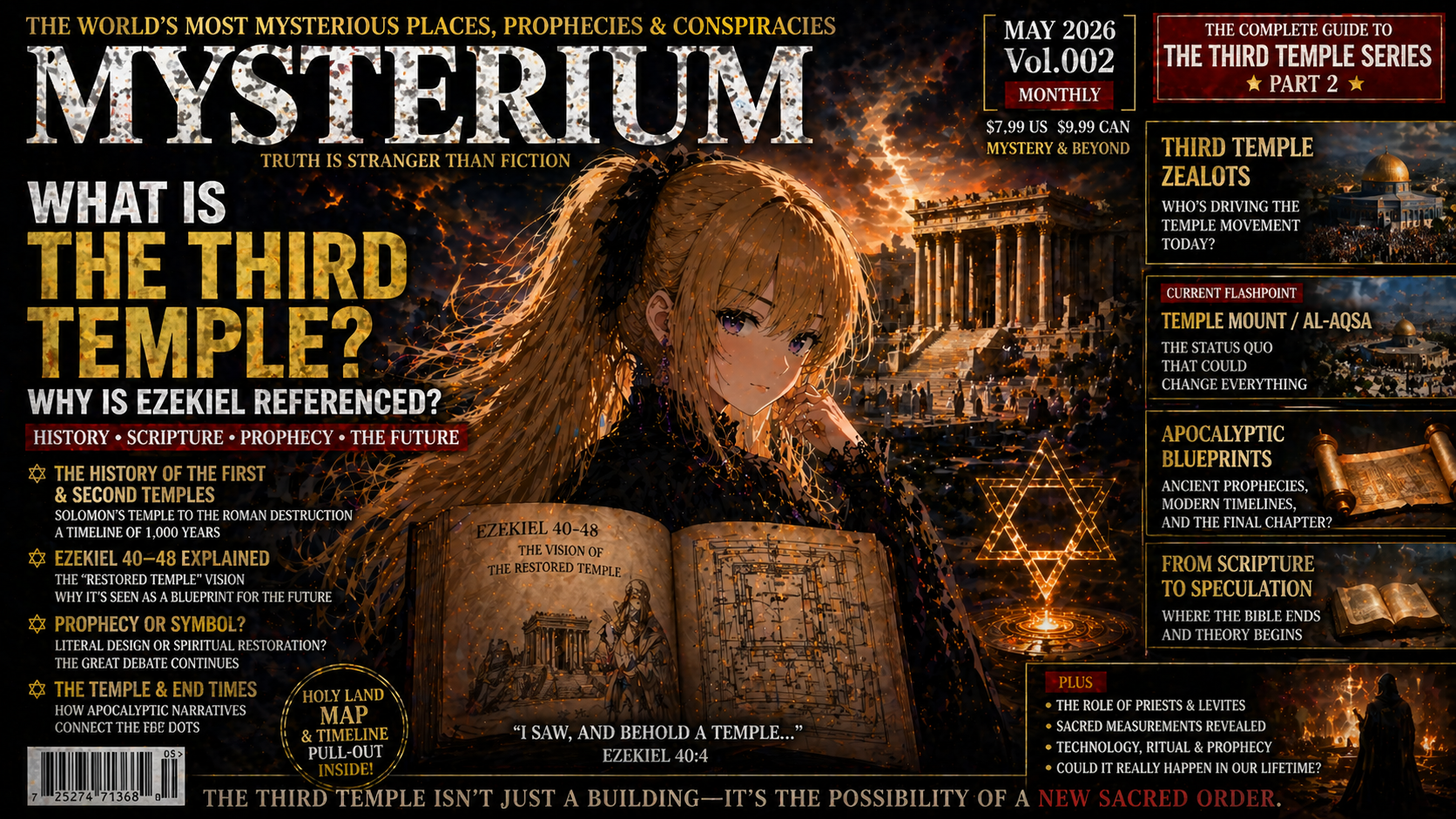
- The “Third Temple” is usually spoken of as a future rebuilt temple following the First and Second Temples of Jerusalem.
- Ezekiel is repeatedly invoked because chapters 40–48 describe a remarkably detailed vision of a restored temple.
- But that vision is not interpreted in only one way: some read it literally, while others read it symbolically or spiritually.
The Phrase “Third Temple” Moves Faster Than Understanding
The term sounds dramatic enough to carry itself.
That is part of the problem.
In urban-legend circles, “Third Temple” is often treated as if it were already a fully formed event on a prophetic calendar.
But before anyone can argue about timing, conspiracy, sacred legitimacy, or end-times sequence, a simpler question has to be answered:
what exactly is being called the “third” temple?
Without that map, the phrase becomes pure atmosphere.
What Were the First and Second Temples?
In broad historical terms, the First Temple is associated with Solomon and the early central sanctuary of ancient Israel.
It functioned not only as a religious site but as a focal point of kingship, sacrifice, identity, and sacred order.
That temple was destroyed in the era of the Babylonian conquest.
Later, after the exile, the Second Temple was rebuilt.
It was eventually expanded and remained the central temple until it was destroyed by the Romans in 70 CE.
So when people say “Third Temple,” they are placing a future possibility at the far end of an already broken sacred sequence.
Why the Topic Is So Sensitive Now
This is not only about ancient memory.
It is about living sacred geography.
The area identified with the former temple complex is also bound to one of the most sensitive contemporary holy sites in the world.
That means the Third Temple is never only a theological topic.
It can rapidly become a question of administration, legitimacy, access, prayer, status quo, and sovereignty.
That is why the phrase keeps returning in moments of political and religious pressure.
It touches both memory and management at the same time.
Why Ezekiel Is Brought In So Often
This is where the argument usually turns.
Ezekiel, especially chapters 40 through 48, presents an extended vision of a restored temple.
The level of detail is what makes it so powerful:
gates,
measurements,
courts,
altars,
rooms,
flowing water,
land divisions,
ritual order.
That detail gives later readers something unusually concrete to work with.
And once a sacred text becomes concrete, it begins to look less like poetry and more like planning.
That is why Ezekiel gets pulled in again and again.
But the Interpretation Is Not One-Dimensional
This matters.
Some readers do treat Ezekiel’s vision as a kind of future architectural pattern.
Others do not.
For many interpreters, the vision functions symbolically:
a restored order,
renewed divine presence,
healed community,
reorganized holiness,
a sacred future not reducible to stone and timber alone.
So the text does not come pre-labeled with a single settled meaning.
That ambiguity is precisely part of its power.
Why Urban-Legend Culture Reacts So Strongly to Ezekiel
Urban legends are drawn to blueprints, measurements, hidden diagrams, restored orders, and texts that feel “too detailed to be only symbolic.”
Ezekiel 40–48 offers all of that.
A sacred site already under pressure.
A future-oriented temple vision.
Detailed structure.
A living conflict over access and legitimacy.
A long shadow of end-times speculation.
Put those together and the text starts to feel less like scripture to many readers and more like a coded future document.
That leap may not be academically careful, but it is emotionally understandable.
The Third Temple Is Not Only About a Building
This is where the theme becomes larger than architecture.
The Third Temple often functions as a symbol of restored order:
who governs holiness,
who has rightful access,
whose worship is legitimate,
which sacred system will stand.
That is why the subject keeps expanding beyond stone.
It becomes a lens for sacred reordering.
In that sense, the real force of the Third Temple motif is not only that a temple might be built.
It is that people begin imagining a future in which the rules of holiness themselves are rewritten.
The Urban-Legend Reading
In urban-legend circles, the Third Temple is often treated as both a structure and a civilizational signal.
Not merely a building,
but a threshold.
Not merely worship space,
but an indicator that a deeper order has shifted.
From that angle, Ezekiel becomes more than a prophet.
He becomes a keeper of a map—whether literal, symbolic, or somewhere between the two in the popular imagination.
Iris’s Reading
What can be grounded is this:
the Third Temple refers to a future rebuilt temple in relation to the First and Second Temples, and Ezekiel 40–48 remains one of the central scriptural reasons the topic continues to return.
What cannot be honestly claimed is that Ezekiel’s vision has one universally settled meaning, or that it functions as an unquestionable literal blueprint for a near-future building project.
So perhaps the better question is not,
“When will the Third Temple be built?”
It is,
“Why does Ezekiel’s vision so easily pull readers toward future architecture, sacred order, and end-times imagination?”
In urban-legend circles, it is often said that truth does not always appear first as a finished structure.
Sometimes it appears as a vision, a pattern, a measured space in language.
And perhaps that is why Ezekiel remains so powerful:
not because everyone agrees on what he saw,
but because the text still feels capable of holding a future inside it.
Next time—another fragment of truth we will trace together.
I will return to continue the telling.
References (background / foundational)
English articles are published at 23:00 JST.
If you have a sacred-site rumor, prophetic reading, biblical diagram, or “why does this ancient text feel current again?” topic, send it in.
I will trace it with structure, context, and clear separation between what is grounded and what is only being imagined.
コメントを残す