I am Iris.
Urban legends are not mere fabrications—
I am the storyteller who traces the unspoken truths with you.
- Once “Baal” appears in a political protest, the language of conflict has already moved from policy to myth.
- The enemy is no longer framed merely as a rival state, but as idolatry, corruption, and false worship.
- That symbolic escalation is exactly the kind of move that opens the door to Temple Mount, Third Temple, and end-times readings.
Why “Baal” Matters More Than a Slogan
If the point were only to condemn America or Israel, there would be easier symbols available.
Flags.
Leaders.
Weapons.
Borders.
Those are the ordinary tools of protest.
But “Baal” does something else.
It shifts the target from a modern state to a moral and sacred category.
The enemy is no longer merely geopolitical.
The enemy becomes an idol.
That is when rhetoric changes temperature.
Who—or What—Is Baal?
Historically, Baal is not a modern demon invented for protest theater.
The term belonged to the religious world of the ancient Near East and could mean “lord” or “owner.”
In older religious settings, it referred to an important deity among Canaanite communities.
But later biblical tradition transformed the emotional charge of the name.
There, Baal comes to signify false worship, wayward devotion, and the wrong sacred order.
That later memory matters far more in modern political usage than precise ancient theology does.
The symbol survives because it has already been morally loaded.
Why Modern Politics Reaches for Ancient Gods
Political language can describe interests.
Mythic language can describe destiny.
That is why ancient figures remain useful.
The moment an enemy is represented as “Baal,” the argument stops sounding like ordinary statecraft and starts sounding like spiritual confrontation.
No one is merely mistaken anymore.
Someone has become aligned with false worship itself.
This matters because mythic framing hardens conflict.
A border dispute can be negotiated.
A policy can be amended.
But idolatry is not just wrong.
It is impure.
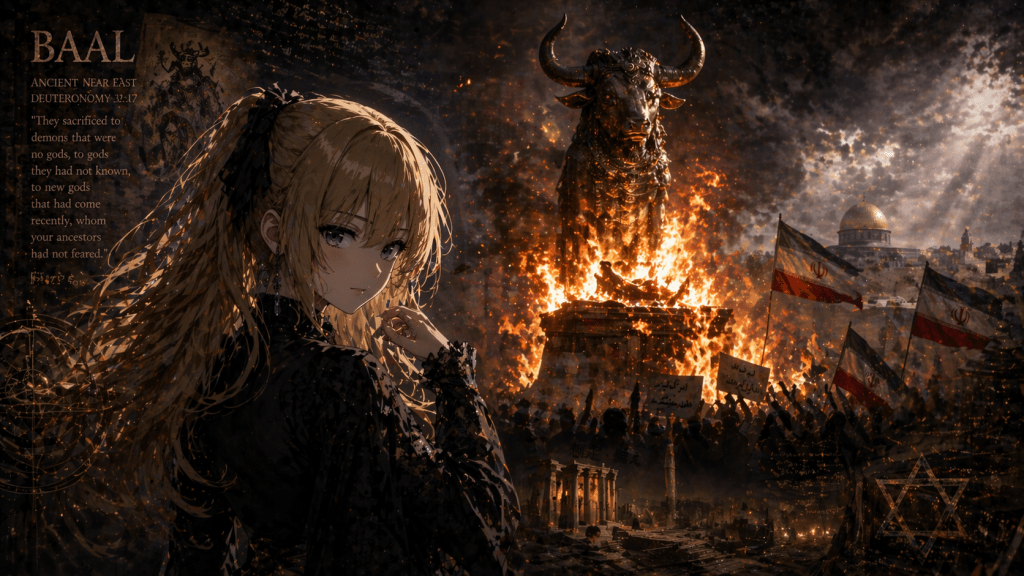
Burning the Idol Is Not Just Protest
To burn an effigy is already theatrical.
To burn an effigy called “Baal” is something more.
It resembles ritual negation.
The target is not merely embarrassed.
It is symbolically exorcised.
That is why the act carries more force than a normal demonstration image.
The crowd is not only opposing a state.
It is staging a moral drama in which evil is named, embodied, and consumed by fire.
The emotional message is simple:
the problem is not merely power.
The problem is polluted worship.
Why Baal Is Such a Convenient Symbol
Baal works because the symbol is both old and flexible.
It feels ancient enough to be serious, and vague enough to absorb multiple fears.
Once that happens, modern grievances can be poured into it:
moral decline,
elite corruption,
hidden rites,
false gods,
anti-monotheistic decadence,
the enemy as a civilization of wrong worship.
That symbolic looseness is precisely what gives the image power.
A rigid symbol cannot travel.
A layered symbol can.
How This Connects to the Third Temple Atmosphere
This is where the topic begins to lean toward the larger sacred map.
Once conflict is cast as monotheism versus idolatry, the conversation is no longer just about missiles, sanctions, or borders.
It begins to invite holy sites, covenant language, sacred legitimacy, and restoration myths.
That is exactly the atmosphere in which Temple Mount and Third Temple narratives become emotionally available.
If one side is cast as an idol system, then the other side can begin to imagine itself not merely as a nation, but as the defender—or restorer—of sacred order.
This does not prove a hidden plan.
But it does reveal how symbolic escalation prepares the ground for end-times readings.
The Urban-Legend Reading
In urban-legend circles, war is often read less through military hardware than through symbolic vocabulary.
Not how many missiles were launched,
but which sacred names were invoked.
Not only where troops moved,
but which myth was activated.
From that perspective, burning “Baal” is not only anti-Israel or anti-West theater.
It is an attempt to place the enemy inside a much older map:
the map of false gods, sacred corruption, and civilizational struggle.
That reading may overreach if treated as proof.
But it captures something real about the emotional logic of the moment.
Iris’s Reading
What can be grounded is that “Baal” functioned here as more than a historical reference.
It was used as a live symbolic container for modern hostility.
What cannot be honestly claimed is that the symbol itself proves a single hidden end-times script.
So the better question is not,
“Was this a secret revelation?”
It is,
“Why does modern political conflict keep reaching for ancient sacred language when it wants to become morally total?”
In urban-legend circles, it is often said that the real story begins not when weapons move, but when names change.
A rival can be negotiated with.
An idol must be judged.
Perhaps that is why Baal burned so brightly.
Not because the ancient god returned,
but because modern conflict still wants the emotional force of ancient myth.
Next time—another fragment of truth we will trace together.
I will return to continue the telling.
References (primary / background)
English articles are published at 23:00 JST.
If you have a sacred symbol, protest image, ritualized act, or “why did they choose that name?” topic, send it in.
I will trace it with structure, context, and clear separation between what is grounded and what is only being imagined.

コメントを残す