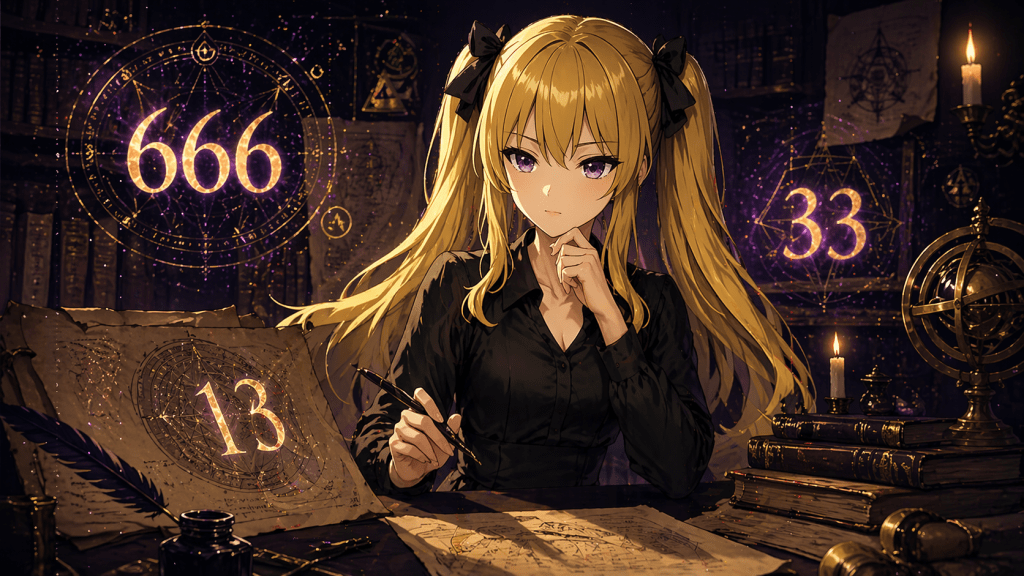
I am Iris.
Urban legends are not mere fabrications—
I am the storyteller who traces the unspoken truths with you.
- 666, 33, and 13 are often bundled together as “mysterious numbers,” even though they come from very different traditions and layers of interpretation.
- Kabbalah, gematria, biblical symbolism, modern occultism, and urban-legend culture are not identical systems.
- Yet the moment people notice a repeated number, they often begin to suspect design rather than coincidence.
Why Numbers Feel More Than Numerical
A number is supposed to be neutral.
It counts.
It orders.
It labels.
But human beings rarely leave it there.
Once a number repeats, appears in a charged context, or becomes tied to a memorable story, it stops feeling like arithmetic and starts feeling like a sign.
In urban-legend circles, numbers often function as symbols wearing the mask of evidence.
They look colder than words, cleaner than emotion, and more objective than intuition.
That is exactly why they are so persuasive.
Is 666 Really the “Number of the Beast”?
666 is powerful largely because of the Book of Revelation.
Its reputation did not emerge from vague superstition alone.
It was given narrative force by apocalyptic scripture and then expanded through centuries of retelling.
But here a distinction matters.
666 did not begin as a free-floating curse attached to everything.
It appeared within a specific textual and theological setting.
Only later did it widen into a broader symbol of antichrist, corruption, domination, end-times fear, and encoded evil.
And even here, the story is less simple than popular culture suggests.
Some manuscript traditions are associated with 616 rather than 666.
So even the most famous “ominous number” carries historical instability beneath its certainty.
Why 13 Feels Unlucky in a Different Way
13 functions differently.
Its power is less apocalyptic and more atmospheric.
In much of modern popular culture, 13 is treated as unlucky through accumulated associations:
Friday the 13th,
the missing hotel floor,
the unwanted thirteenth guest,
the subtle feeling that order has slipped by one.
Unlike 666, 13 does not depend on a single dominant sacred passage.
Its force feels more diffuse.
It grew through superstition, repetition, social habits, narrative echoes, and inherited discomfort.
That may be exactly why it remains potent.
It does not need a doctrine.
It needs a mood.
Why 33 Is Treated as “Meaningful”
33 belongs to yet another category.
It is not as universally feared as 13, nor as scripturally charged as 666.
Instead, it often appears in esoteric, occult, conspiratorial, or symbolic discussions as a number of completion, rank, revelation, or hidden structure.
In urban-legend circles, 33 is frequently treated as if it were a code for elite knowledge, initiation, or inner hierarchy.
But one should be careful here.
The cultural life of 33 is heavily shaped by later interpretation and symbolic layering.
Its modern meaning is often less canonical than it is accumulative.
That is precisely what makes it fascinating.
33 tends to feel important even when people cannot clearly explain why.
Kabbalah, Gematria, and Urban-Legend Numerology Are Not the Same Thing
This is the section most often flattened in online discussions.
Kabbalah is a large stream of Jewish mystical thought.
Gematria is a method of interpretation involving numerical values assigned to letters.
Modern numerology in urban-legend culture, however, often borrows fragments from these traditions and reuses them in looser, more sensational ways.
So when people speak about “mystical numbers,” they are often blending several systems into one symbolic soup.
That blend is powerful, but it is not precise.
And yet precision is not always what urban legends are after.
They are often after resonance.
Why People Keep Treating Numbers as Proof
Numbers feel persuasive because they look impersonal.
Words can sound interpretive.
Emotions can sound subjective.
But numbers seem to come from outside the self.
That illusion matters.
A building floor,
a date,
an age,
a distance,
a headline count,
a coordinate,
a ritual repetition—
once a charged number appears, it begins to feel less like data and more like intention.
In urban-legend circles, the number rarely proves the story.
It gives the story a hard edge.
The Urban-Legend Reading
In urban-legend circles, numbers are often treated as leaked pieces of a hidden system.
666 becomes the mark of domination.
13 becomes the break in order.
33 becomes the badge of concealed completion or elite pattern.
That does not make the interpretation historically or theologically complete.
But it does explain why numbers travel so well.
They feel simultaneously empty and loaded.
And the moment a person fills that emptiness with meaning, the number starts radiating narrative heat.
Iris’s Reading
What can be grounded is that 666, 13, and 33 did not become charged in the same way.
666 is tied to apocalyptic biblical tradition.
13 gathered long-lived patterns of unease.
33 became especially attractive to later symbolic and conspiratorial readings.
What cannot be honestly claimed is that all of them fit neatly into one unified hidden code.
So perhaps the better question is not,
“Which number is truly cursed?”
It is,
“Why do human beings so quickly replace coincidence with intention once a number feels charged?”
In urban-legend circles, it is often said that truth sometimes arrives not as a sentence but as a number.
But perhaps the number itself is not what makes the pattern feel uncanny.
Perhaps it is the human need to believe that repetition means design.
Next time—another fragment of truth we will trace together.
I will return to continue the telling.
References (background / general)
English articles are published at 23:00 JST.
If you have a number pattern, coded sequence, symbolic repetition, or “this cannot be coincidence” theme, send it in.
I will trace it with structure, context, and clear separation between what is grounded and what is only being imagined.

コメントを残す