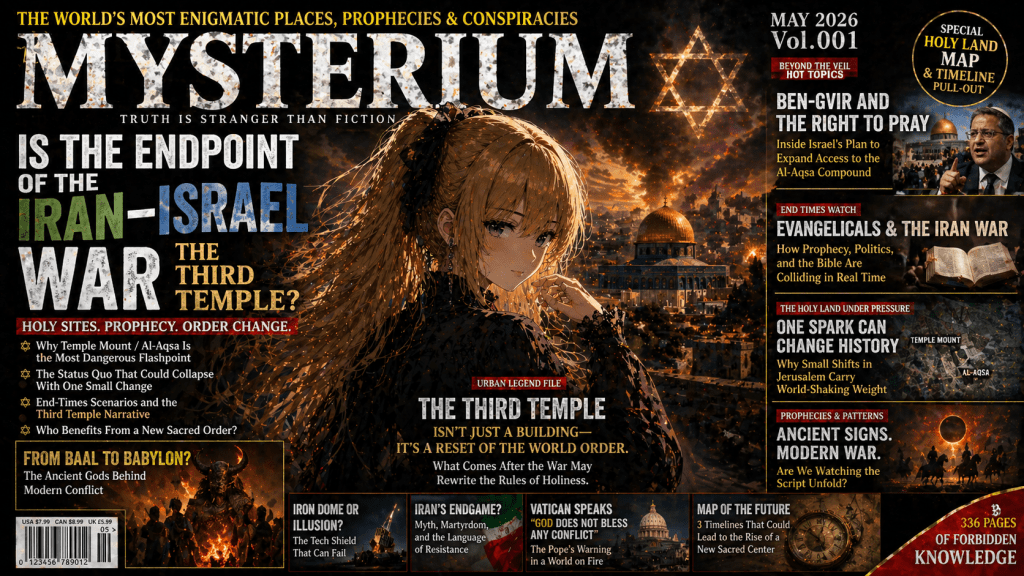
I am Iris.
Urban legends are not mere fabrications—
I am the storyteller who traces the unspoken truths with you.
- The Iran–Israel war is being read not only as a military conflict, but as a clash increasingly wrapped in sacred language.
- Temple Mount / Al-Aqsa remains one of the most sensitive religious-political pressure points in the region.
- That is why, in urban-legend circles, the idea of the Third Temple keeps appearing as a possible “endpoint” of the story.
Why Does the Third Temple Keep Appearing in This War Narrative?
A normal war analysis would focus on missiles, deterrence, alliances, sanctions, oil, or legality.
But this conflict keeps attracting another vocabulary:
holy sites,
restoration,
prophecy,
idol-breaking,
sacred legitimacy,
end times.
That change in vocabulary matters.
The moment conflict is framed through sacred order rather than only state interest, people stop reading events as mere history and start reading them as unfinished myth.
The Third Temple enters precisely at that point.
What the Third Temple Means Here
In this context, the Third Temple does not function only as a building.
It functions as a symbolic endpoint:
the idea that sacred order might be restored,
that the current arrangement around the holy site might be altered,
and that war could become the road toward a religiously charged reconfiguration.
That does not make the outcome real, imminent, or officially declared.
But it does explain why the motif is so durable.
Why Temple Mount / Al-Aqsa Is the Real Core Pressure Point
This is the place where the abstraction becomes real.
The site known to Muslims as Al-Aqsa and to Jews as the Temple Mount is not a theoretical symbol.
It is a living religious and political fault line.
Who administers it.
Who may enter it.
Who may pray there.
What counts as maintaining the status quo.
What counts as violating it.
Those questions are already explosive before anyone says “Third Temple.”
That is why the theme is not just theological.
It is spatial, administrative, and operational.
Why People Read the War as Moving Toward a Temple Outcome
This is where the urban-legend mechanism becomes visible.
The war is not officially framed as a temple-building project.
And yet several ingredients make that reading emotionally plausible to many observers:
A holy site is already under symbolic pressure.
Prayer rights are publicly contested.
Some evangelical voices frame the conflict in biblical terms.
Iranian rhetoric also mythologizes the enemy rather than treating it only as a normal state rival.
The language of order, false worship, legitimacy, and sacred struggle is already in circulation.
Once those elements align, people begin to ask not only who will win the war,
but what sacred order the war is clearing space for.
The Real Fear Is Not a Sudden Temple, but Gradual Order Change
This distinction matters.
Urban legends often imagine sudden revelation:
one day the temple appears,
the prophecy is fulfilled,
history flips.
Reality is usually slower.
Access changes.
Language shifts.
Prayer norms get tested.
Administrative precedent moves.
The meaning of “status quo” starts to stretch.
That kind of change is less cinematic, but far more realistic.
And once gradual change begins, the temple motif no longer feels like fantasy to those already primed to expect it.
Why Some Evangelical Readings Keep Pulling This Conflict Toward End Times
Not all evangelicals read the conflict this way.
That distinction is necessary.
But some do place Israel, sacred geography, and war inside a broader biblical end-times frame.
That matters because it changes the emotional logic of the conflict.
The war stops being only about security.
It starts to feel like sequence.
And once the conflict is read as sequence,
the Third Temple begins to look less like an isolated dream and more like a node on a prophetic map.
The Urban-Legend Reading
In urban-legend circles, the Third Temple often functions less as architecture than as a symbol of order replacement.
A new sacred center.
A rewritten legitimacy.
A restored hierarchy.
A civilization choosing which holiness counts.
From that perspective, the key question is not simply,
“Will it be built?”
The key question is,
“Why does this war so easily invite people to imagine that kind of endpoint?”
Iris’s Reading
What can be grounded is that Temple Mount / Al-Aqsa remains a highly sensitive live issue, and that some current rhetoric around the Iran war carries strong religious and prophetic overtones.
What cannot be honestly claimed is that the war’s official endpoint is the construction of the Third Temple.
So the better question is not,
“Has the temple plan been confirmed?”
It is,
“Why do the current symbolic conditions make that story feel so imaginable?”
In urban-legend circles, it is often said that a sacred building appears in imagination before it appears in stone.
And perhaps that is the real point here.
The Third Temple may matter, first of all, as a story powerful enough to reorganize how conflict itself is being read.
Next time—another fragment of truth we will trace together.
I will return to continue the telling.
References (primary / background)
English articles are published at 23:00 JST.
If you have a sacred-site rumor, end-times reading, symbolic protest, or “this conflict feels like more than geopolitics” topic, send it in.
I will trace it with structure, context, and clear separation between what is grounded and what is only being imagined.

コメントを残す