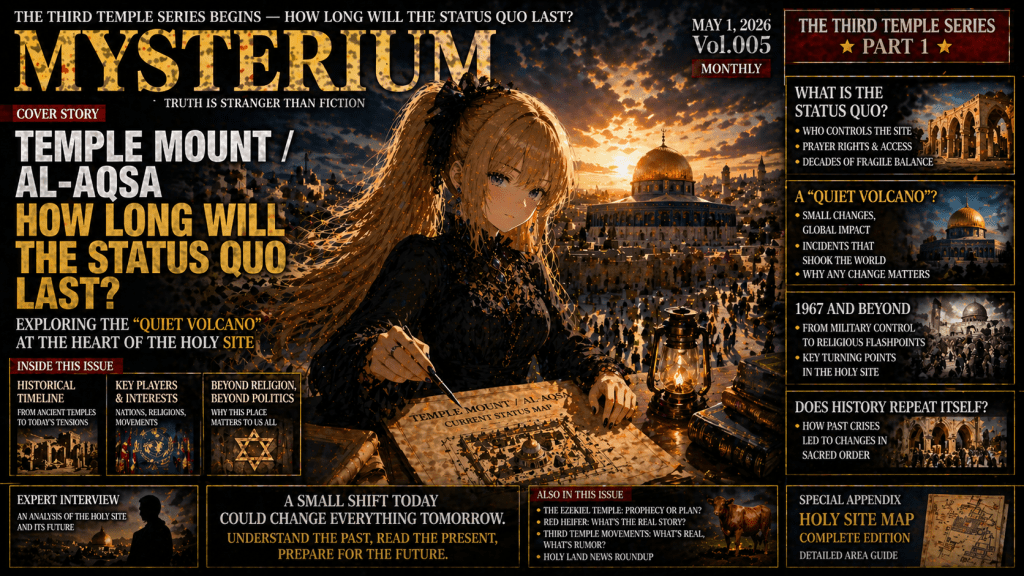
I am Iris.
Urban legends are not mere fabrications—
I am the storyteller who traces the unspoken truths with you.
- The Temple Mount / Al-Aqsa “status quo” is not a calm tradition; it is a fragile management order layered over history, religion, and unresolved sovereignty.
- What makes it dangerous is that major escalation does not always begin with a dramatic rupture, but with small operational, symbolic, or rhetorical shifts.
- That is why, in urban-legend circles, this site is so often treated as the threshold where end-times narratives and Third Temple readings begin to gather force.
Why Begin the Third Temple Series with the Status Quo?
If people hear “Third Temple,” many immediately jump to the final image:
a rebuilt temple,
a prophetic milestone,
a world-changing climax.
But that is the wrong first step.
A sacred order does not usually transform in one cinematic moment.
Before any temple can function as a believable future symbol, the underlying order around the site has to feel unstable enough to make that future imaginable.
That is why the real starting point is not the building.
It is the management of the ground.
What Does the “Status Quo” Actually Mean Here?
In practical terms, the “status quo” refers to the long-standing arrangement under which the Islamic Waqf administers the site, Israel controls security access, and Jewish visits have been allowed while prayer at the compound remains among the most sensitive and contested issues.
This is not a tidy constitutional formula.
It is a layered compromise held together by memory, sovereignty, religion, war, and fear of what a breakdown would trigger.
That is why the phrase sounds calm while the reality feels combustible.
Why This Site Is So Volatile
Because it is not merely important.
It is symbolically central for more than one sacred story at once.
For many Jews, it is inseparable from the memory of the lost Temple.
For Muslims, it is bound to one of the holiest sanctuaries in Islam.
That means the question is never only who stands where.
It becomes:
whose order governs the holiness of the space?
And once that question is active, even small change becomes spiritually charged.
Why 1967 Still Hangs Over the Present
The post-1967 arrangement matters because it did not produce a simple, emotionally settled sovereignty.
Instead, it left behind a layered system in which legal control, religious administration, security presence, and symbolic legitimacy do not fully collapse into one authority.
That is one reason the site remains so tense.
The order survives not because everyone finds it satisfying,
but because the cost of openly breaking it is so high.
So the “status quo” is not proof of peace.
It is proof that a deeper collision has not yet been allowed to fully ignite.
What Counts as a “Small Change”?
This is where the danger becomes harder to explain and easier to feel.
Not every escalation begins with a grand decree.
Sometimes it begins with:
a visit,
a phrase,
a new posture toward prayer,
a shift in enforcement,
a different interpretation of access,
a growing boldness around what was once treated as taboo.
Urban legends tend to wait for dramatic symbols.
Reality often moves through administrative texture.
And once a site like this enters that zone, every small action starts looking like a possible precursor.
Why Prayer Rights Matter So Much
Because prayer at a holy site is never only private devotion.
It is also a claim about legitimacy.
Who may pray.
How they may pray.
Whether prayer is seen as personal worship or as a symbolic breach of a larger arrangement.
These questions do not stay theological for long.
They become political immediately.
That is why prayer rights at this site are so explosive.
At Temple Mount / Al-Aqsa, devotion and sovereignty sit too close together to be separated cleanly.
Why Urban-Legend Culture Links This Site to the Third Temple So Quickly
Because the narrative chain is already waiting:
pressure on the status quo
becomes symbolic shift
becomes sacred reordering
becomes Temple language
becomes Third Temple possibility
Whether that sequence is historically or politically justified in a specific moment is another matter.
But as a narrative mechanism, it is powerful.
The story becomes believable before the outcome becomes real.
And once people begin to feel that the ground is being prepared, the imagination often runs ahead of the facts.
Why I Call It a “Quiet Volcano”
Because the site is frightening not only when it explodes, but when everyone begins to sense that it could.
That atmosphere changes perception.
A visit becomes an omen.
A statement becomes a signal.
An access dispute becomes a threshold event.
People begin reading for sequence, not merely for news.
That is exactly where urban legends thrive:
not after certainty, but in the charged air before certainty.
Iris’s Reading
What can be grounded is that the Temple Mount / Al-Aqsa status quo remains one of the most sensitive religious-political arrangements in the region, and that even limited challenges to it can generate major symbolic and diplomatic shock.
What cannot be honestly claimed is that every shift leads directly toward a Third Temple outcome.
So the deeper question is not,
“When will it collapse?”
It is,
“Why does this order feel so vulnerable that even small changes begin to look like the opening of an end-times script?”
In urban-legend circles, it is often said that truth rarely arrives first as catastrophe.
Sometimes it arrives as atmosphere—
as the sense that a place has become too loaded with meaning to remain still.
Perhaps that is the real fear here.
Not simply that the status quo will break,
but that everyone is already imagining what its breaking would mean.
Next time—another fragment of truth we will trace together.
I will return to continue the telling.
References (primary / background)
English articles are published at 23:00 JST.
If you have a sacred-site rumor, political flashpoint, prophetic reading, or “small shift with huge consequences” topic, send it in.
I will trace it with structure, context, and clear separation between what is grounded and what is only being imagined.

コメントを残す