I am Iris.
Urban legends are not mere fabrications—
I am the storyteller who traces the unspoken truths with you.
- Not all evangelicals read the war this way.
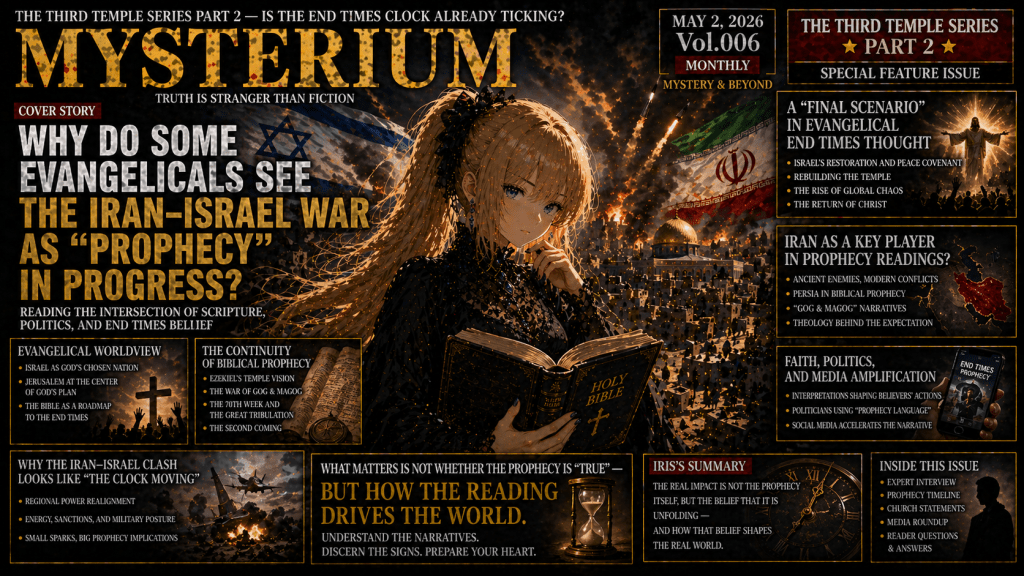
- But some end-times-oriented evangelicals do interpret the Iran–Israel war as more than geopolitics: they read it as part of a biblical sequence.
- The real question is not whether that reading is “true,” but how such a reading feeds back into real-world politics, emotion, and expectation.
Why Does a War Start Looking Like “Prophecy in Progress”?
A war can be read as strategy, deterrence, alliance politics, energy pressure, or regional power struggle.
But for some end-times-oriented evangelicals, those categories do not exhaust its meaning.
Once Israel, Jerusalem, sacred geography, and future temple expectation enter the frame, the war stops looking like a standalone crisis.
It starts looking like placement.
Not just an event,
but a position on a larger timeline.
That is why the phrase “prophecy in progress” becomes so emotionally powerful.
It turns chaos into sequence.
A Necessary Distinction
This has to be said clearly.
“Evangelicals” are not a single interpretive machine.
There is no honest way to flatten the whole tradition into one political theology.
So this article is not about all evangelicals.
It is about some evangelicals—
especially those whose end-times reading is shaped by a framework in which Israel, Jerusalem, and sacred restoration carry unusually heavy prophetic meaning.
That distinction matters,
because otherwise the argument turns into caricature.
What Worldview Is Doing the Heavy Lifting Here?
At the center of this reading is the idea that Israel is not merely another state,
but a specially charged place in God’s timeline.
Jerusalem is not only a city.
It is a prophetic stage.
Once that premise is in place,
the news is no longer received as ordinary current affairs.
It becomes script-sensitive.
Readers begin asking not only what happened,
but what this event might signal in relation to the end times.
That is how a military conflict starts being treated as a marker.
Why Iran Feels So Charged in This Reading
Iran is not read only as a modern adversary.
For some prophecy-oriented readers, it is also mentally overlaid with older biblical geography, civilizational memory, and expectations about conflict in the region.
This does not produce one fixed, universally shared prophetic chart.
But it does produce an interpretive atmosphere in which Iran can feel like more than a nation-state.
It becomes part of a larger dramatic map.
And once that happens,
the war is not simply “another Middle East conflict.”
It starts looking like movement on an already meaningful board.
Why This So Quickly Connects to the Third Temple
The Third Temple enters because some readers do not separate:
Israel,
Jerusalem,
Temple Mount,
sacred order,
and future fulfillment.
In that mental sequence,
war pressure can feel like sacred pressure.
Sacred pressure can feel like order change.
Order change can feel like preparation.
And preparation can feel like Temple language.
Whether that sequence is justified is one question.
But as a narrative mechanism,
it is extremely strong.
The temple becomes imaginable before it becomes real.
Why This Reading Has So Much Power
Because it gives meaning where ordinary war analysis gives only instability.
Geopolitical reporting can explain escalation, retaliation, and risk.
But it does not usually tell believers what a war means inside sacred history.
End-times readings do.
They assign role,
sequence,
weight,
and destination.
In moments of fear, that is an enormous emotional advantage.
People do not only want data.
They want placement.
Where Faith, Politics, and Media Start to Blend
This is the real center of the article.
The important issue is not only theology.
It is circulation.
When political leaders use religious language,
when pastors amplify moralized war frames,
when media and social media repeat those frames,
the conflict becomes more than policy.
It becomes spiritually legible.
And once believers begin to feel that prophecy is unfolding,
that feeling itself can start affecting the real world:
how people vote,
how they justify violence,
how they frame diplomacy,
how they react to sacred-site tension.
In that sense,
what moves history is sometimes not the prophecy itself,
but belief in its movement.
The Urban-Legend Reading
In urban-legend circles, the crucial thing is often not the war,
but the interpretation attached to the war.
Not missiles,
but meanings.
Not only events,
but the story that organizes them.
From that perspective,
why some evangelicals see the Iran–Israel war as “prophecy in progress” has as much to do with the human need for narrative structure as it does with doctrine.
A prophetic reading does not simply describe the world.
It arranges the world.
Iris’s Reading
What can be grounded is that some evangelical leaders and supporters have indeed framed the Iran war in religious terms, and that end-times-oriented traditions tied to Christian Zionism and dispensationalism make Israel especially significant in prophetic imagination.
What cannot be honestly claimed is that this provides one uncontested or universally shared map of the future.
So perhaps the better question is not,
“Is this war really prophecy?”
It is,
“Why does this war so easily invite a reading in which history, scripture, and sacred expectation fuse into one dramatic sequence?”
In urban-legend circles, it is often said that a conflict becomes truly dangerous not only when weapons move,
but when large numbers of people begin to feel that heaven has already taken a side.
And perhaps that is the deeper issue here.
Not simply what the war is,
but what the reading of the war is doing to the world.
Next time—another fragment of truth we will trace together.
I will return to continue the telling.
References (primary / background)
English articles are published at 23:00 JST.
If you have a prophecy reading, sacred-site tension, church statement, or “this war feels bigger than politics” topic, send it in.
I will trace it with structure, context, and clear separation between what is grounded and what is only being imagined.

コメントを残す