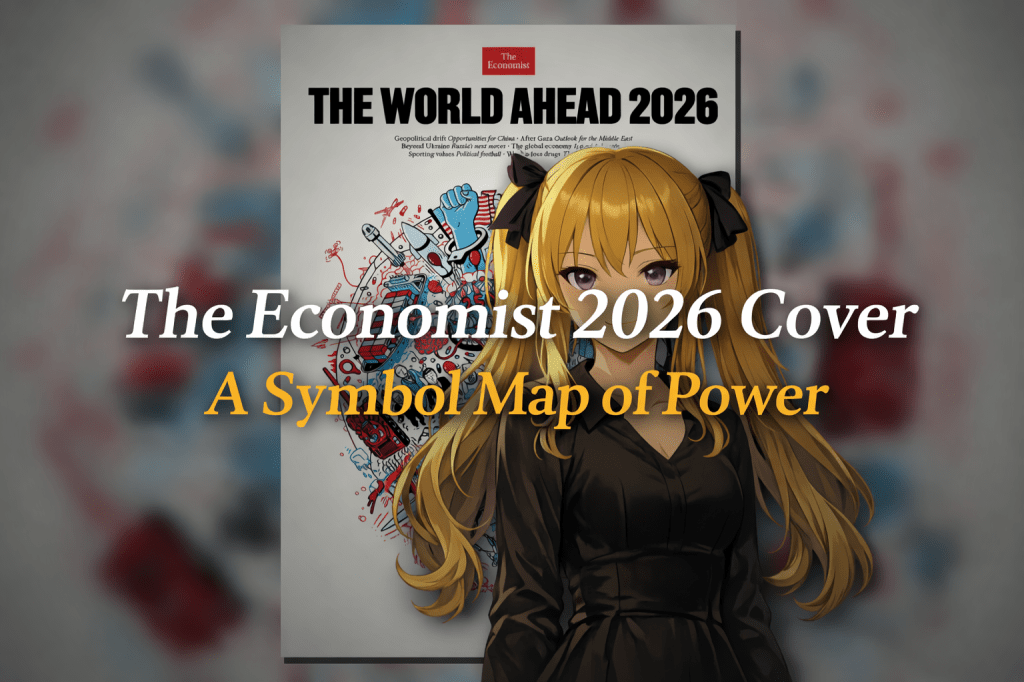
I am Iris.
Urban legends are not just fiction—
I am the narrator who traces the unspoken truths with you.
- In urban-legend circles, The Economist’s yearly cover is often treated as a “symbol board” for the year’s agenda.
- This hub organizes the 2026 cover into a clear map: themes, layers, and reading routes (without claiming certainty).
- The conclusion here is practical: the cover is less a prophecy calendar and more a shelf of future conflicts and priorities.
Note on Framing
This is an urban-legend style analysis. It does not claim that the cover predicts specific events. It examines how symbols are read, grouped, and turned into narratives—then provides a framework you can use consistently.
Why This Is a Hub Article
Urban-legend interpretations tend to collapse into one of two traps:
- “It all predicts the future,” which invites overconfidence.
- “It means nothing,” which wastes the map-like structure the cover invites.
This hub aims for a third option: a reading method.
In this approach, the cover is treated as an edited scenario board—a curated set of issues that are likely to become “the year’s arguments.” That makes it usable even when specific predictions fail.
The Core Claim in Urban-Legend Terms

In urban-legend circles, the cover is often framed as a coded preview. However, a more durable way to read it is this:
The cover is not a prophecy calendar.
It is an agenda shelf—a display of what may become:
- the year’s debates,
- the year’s constraints,
- the year’s incentives,
- the year’s control systems.
So the question is not “Did it come true?”
The question becomes:
- What is positioned as a main issue?
- Who benefits if that issue dominates the year?
- Does it arrive as an incident, or as a rule?
A Practical Checklist: Four Questions That Make the Cover “Usable”

To keep the reading grounded, this hub uses four recurring questions:
1) What becomes the agenda?
2) What becomes the conflict line?
3) What becomes the control mechanism?
4) What becomes a price—and what becomes a rule?
If you can answer these, the cover becomes a tool, not a roulette wheel.
The Four-Layer Reading Model
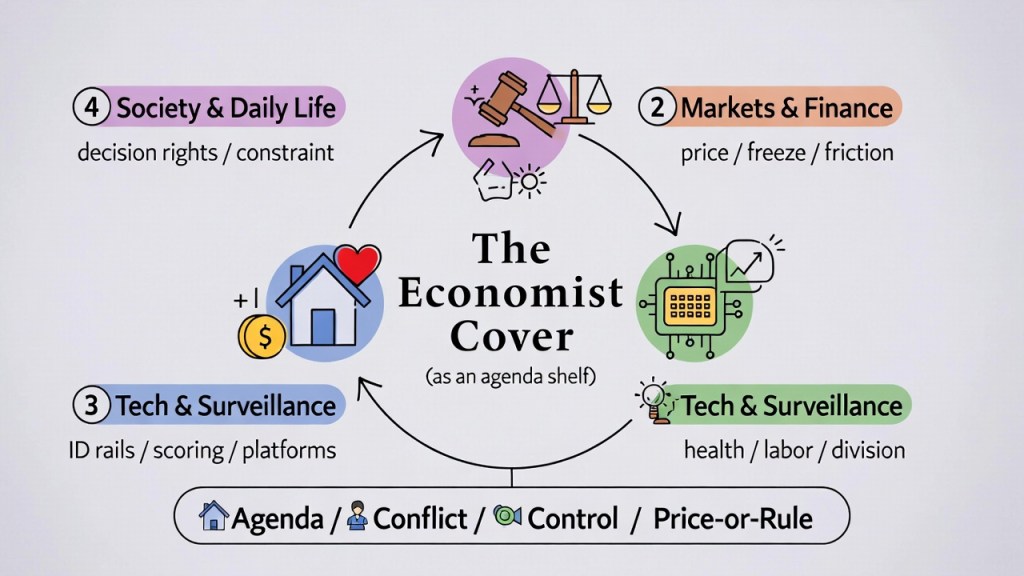
This hub reads the cover through four layers. Branch articles will take one motif at a time and test it against these layers.
Layer 1: Politics and Power — “Who decides the year?”
Symbols in this layer are usually about decision rights and constraint:
- government authority, policing, courts
- international alignment and confrontation
- protests, suppression, regulation (how wide “freedom of movement” remains)
Urban-legend readers tend to interpret these motifs as signals about the year’s “permission structure”—what gets blocked, what gets accelerated, and who holds the lever.
Layer 2: Markets and Finance — “What becomes price, what becomes frozen?”

This layer often feels the most “accurate” to readers, because politics and daily life frequently converge into:
- inflation, rates, currency pressure
- sanctions, freezes, eligibility, friction
- the boundary between “can buy” and “cannot buy”
In urban-legend framing, finance symbols are read as the year’s constriction points: the places where systems can slow people down without visible force.
Layer 3: Tech and Surveillance — “When control becomes infrastructure”

This layer is where many readers feel the cover has become increasingly “real.”
It commonly includes:
- authentication, identity, standards
- AI decision loops and black-box scoring
- platform control of visibility, speech, and monetization
Here, the cover is often interpreted as a shift from orders to systems—from commands to mechanisms.
Layer 4: Society, Health, Daily Life — “When the agenda reaches home”

This layer is where debates land on the body and the household:
- health, medicine, dependency (often used as a justification frame)
- education, labor, generational friction
- “moral correctness” conflicts (censorship rationales, social sorting)
Urban-legend readings often treat this layer as the endgame: the point where a public narrative becomes private consequence.
How This Hub Will Work (So You Don’t Get Lost)
This hub is the index. Branch articles are the case files.
- Hub: a map of categories, a consistent reading method, and navigation routes
- Branch articles: one motif at a time, tested through both “urban-legend read” and “reality read”
To reduce repetition and keep the series readable, branch articles will follow a fixed structure.
The Fixed Branch Article Template
Each branch will follow this sequence:
1) Observation (describe the motif clearly, without interpretation)
2) Urban-legend read (present the stronger claim as it is often framed)
3) Reality read (a grounded interpretation that can coexist with uncertainty)
4) Counterpoints (weaknesses, alternative explanations, what does not fit)
5) Scenario A / B / C (plausible trajectories, not a single prediction)
6) Wrap (avoid certainty, keep the reading line usable)
Branch Index (Planned Motif Routes)
Below are suggested branches grouped by the four layers. This is not a promise of “truth”—it is a navigation plan.
Route A: Politics and Power
- “Constraint symbols” and what they imply about enforcement without force
- “Color and icon framing” without partisan certainty—how narratives steer perception
- “Crowd vs institution” motifs (protest, authority, legitimacy)
Route B: Markets and Finance
- “Freeze / procedure / eligibility” symbols and how they translate into daily friction
- “Concentration signals” (who becomes too big to question)
- “Pricing the basics” (what becomes rationed, what becomes premium)
Route C: Tech and Surveillance
- “Identity rails” (ID, verification, standards)
- “Invisible governance” (scoring, filtering, automated decisions)
- “Platform leverage” (speech visibility, income visibility, movement visibility)
Route D: Society, Health, Daily Life
- “Medical motifs” (care vs control as competing frames)
- “Dependency motifs” (relief vs lock-in)
- “Division motifs” (enemy-making as a system)
Three Questions to Hand to the Reader
A good hub does not end with an answer. It ends with questions that upgrade the reader.
1) If this is an agenda shelf, what is placed on the top tier?
2) Who gains leverage if that agenda dominates—and who loses mobility?
3) Does it arrive as an event, or does it slip in as a rule?
Archive: Prior Economist-Cover Readings on This Site
If you want background context (and a sense of how the “cover-reading” style evolves), these earlier articles can serve as the archive shelf:
- The Economist Cover “Prophecy” Read: World-Design Lens
- The Economist 2026 Cover: “Prophecy” Framing (Archive)
- The World Ahead 2025: Symbol Motifs (Continuation)
Closing Line for the Series
This hub does not claim a calendar of events. It builds a reading instrument.
If the cover is a shelf of future conflicts, the task is not to worship it—
but to learn what it tries to make inevitable.
Next time—another fragment of truth to trace with you. I will return to the story.
Send your tip (links and screenshots welcome), and it may become a future case file.
 Share on X
 Share on Facebook
 Follow here
Follow @Kataribe_Iris
Follow here
Follow @Kataribe_Iris
📺 Visit the channel
💬 Open the LINE Store page


コメントを残す