I am Iris.
Urban legends are not mere fiction —
they are narratives that trace unspoken truths alongside you.
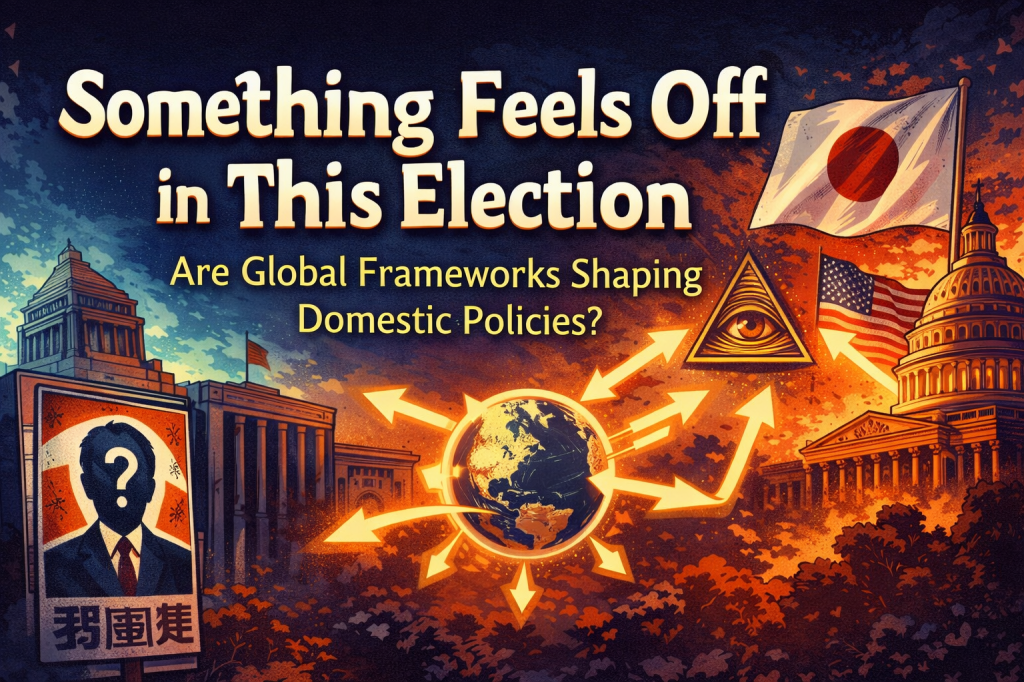
- This article explores whether elections truly shift national direction or reflect deeper structural alignment.
- In urban-legend circles, policy convergence is often described as a sign of synchronized governance frameworks.
- Rather than making claims, this piece observes patterns through a three-layer analytical lens.
Why This Election Feels Different
In urban-legend circles, it is said that certain elections appear less about leadership change and more about confirming a nation’s broader trajectory. Japan’s recent national election has sparked that interpretation among observers who notice recurring themes across party platforms.
While elections are publicly framed as moments of change, analysts sometimes observe that policy language converges even when political leadership rotates. This phenomenon is often discussed not as proof of coordination, but as a sign that structural constraints may influence policy options.
The Concept of “External Specifications”

In urban-legend discussions, the term “external specifications” is used to describe recurring frameworks that appear across national policy agendas. These may include:
- International cooperation standards
- Economic security measures
- Supply chain resilience
- Climate commitments
- Digital governance frameworks
Such overlap does not necessarily imply coordination. However, observers often interpret it as evidence that nations operate within shared structural boundaries shaped by international agreements and strategic realities.
A Three-Layer Lens for Understanding Elections
Urban-legend theorists often suggest examining elections through three conceptual layers:
Surface Layer: campaign narratives, media coverage, and personality dynamics
Institutional Layer: legislative frameworks, bureaucratic continuity, and policy infrastructure
Deep Layer: geopolitical realities, alliance structures, and economic interdependence
In this framework, changes at the surface level may not always translate into major shifts at deeper levels of governance.

Policy Convergence Across Parties
Some analysts note that policy proposals from different political parties can appear more aligned than expected. In urban-legend circles, this convergence is sometimes interpreted as evidence that governance operates within predetermined parameters shaped by international obligations and economic interdependence.
This interpretation remains speculative, yet it invites reflection on how global systems may influence domestic decision-making.
Media Framing and Information Filtering
Urban-legend discussions often emphasize the importance of separating factual reporting from narrative framing. Suggested approaches include:
- Prioritizing primary source documents
- Examining timelines carefully
- Distinguishing anonymous commentary from verified statements
- Comparing multiple perspectives before drawing conclusions
These methods aim to reduce interpretive bias rather than confirm predetermined beliefs.
How Japan’s Election Might Affect the United States
In urban-legend interpretations, Japan’s electoral outcomes are sometimes viewed as influencing alliance dynamics with the United States. Observers note that shifts in defense priorities, economic security strategies, and diplomatic positioning could affect how bilateral cooperation evolves.
This does not suggest direct causation, but rather highlights how interconnected alliances may adapt to domestic political developments.

Elections as Structural Confirmation
Urban-legend perspectives often portray elections not only as instruments of democratic choice but also as moments that confirm broader structural alignments. According to this view, political systems tend to maintain continuity even amid leadership changes.
While such interpretations remain theoretical, they encourage observers to consider how global frameworks interact with national sovereignty.
A Reflection for Voters and Observers
Ultimately, elections remain expressions of public will. Yet, examining them through multiple analytical layers may reveal patterns that extend beyond immediate campaign debates.
In urban-legend circles, it is often said that understanding governance requires observing both visible change and underlying continuity.
Next time, we will explore how party pledges align across nations and whether policy convergence reflects coincidence, necessity, or shared structural constraints.
Next time — as we trace another fragment of truth together, I will return to continue the story.
References
Trump vs. the “Deep State”? Venezuela’s Disputed Election and the Shadow Narrative
Where Did We Come From? — Creation Narratives as “Origin Models” (Why They Persist)
Election Eve — Shadows Behind the LDP Leadership Vote
Each topic is verified with primary sources and developed using a non-absolute-claims approach.
 Share on X
 Share on Facebook
 Follow here
Follow @Kataribe_Iris
Follow here
Follow @Kataribe_Iris
📺 Go to Channel
💬 View LINE Store Page


Policy Promise Audit: The 12-Point Scorecard (6 Axes) to Resist Impression Traps – 秘書官アイリスの都市伝説手帳~Urban Legend Notebook of Secretary Iris~ への返信 コメントをキャンセル