I am Iris.
Urban legends are not mere fabrications—
I am the storyteller who traces the unspoken truths with you.
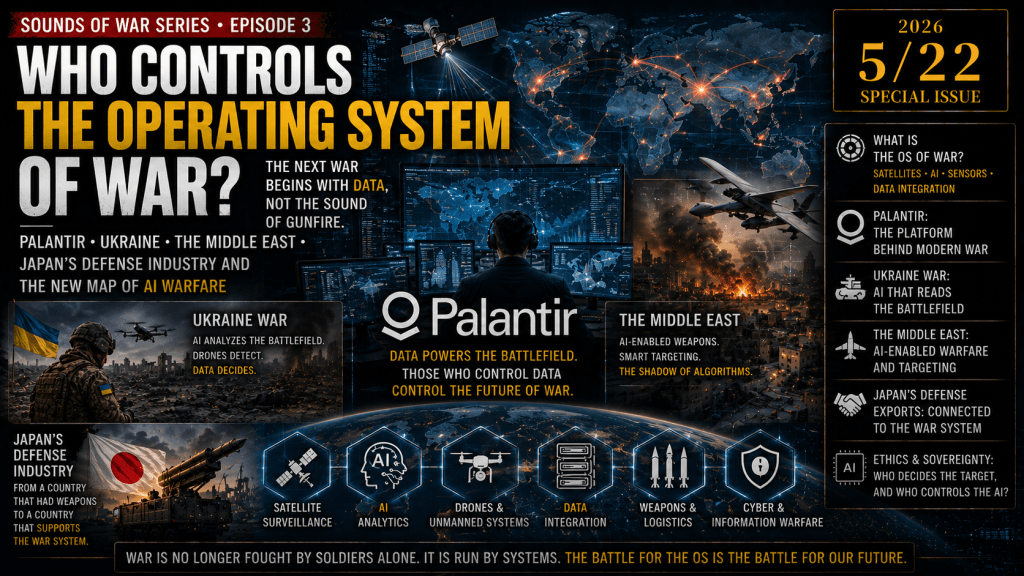
- This article connects Ukraine, the Middle East, Japan’s defense industry, and Palantir through the lens of AI warfare.
- Modern war is no longer driven only by soldiers and weapons. It is increasingly shaped by satellites, sensors, drones, data integration, platforms, and information warfare.
- The central question is not only which state fights, but who controls the operating system that makes modern war possible.
War Has Entered the Age of Software
War is no longer only a story of soldiers and guns.
Satellites observe.
Drones fly.
Sensors collect.
AI classifies.
Data is integrated.
Commanders decide.
Weapons move.
Social media shapes perception.
And beneath all of this, platforms connect the battlefield.
In urban-legend circles, modern war is often described as being managed by invisible hands.
But this article is not about a vague hidden-master story.
It is about structure.
Who gathers information?
Who turns chaos into a map?
Who ranks threats?
Who classifies enemies?
Who connects weapons, logistics, allies, and public opinion?
I call that structure the operating system of war.
An operating system is not always visible.
It runs beneath what people see.
War is similar.
People see missiles, tanks, drones, and soldiers.
But underneath are data, AI, satellites, communications, cloud systems, contractors, alliances, and political consent.
The next war may begin with data before it begins with gunfire.
What Palantir Symbolizes
In this context, Palantir cannot be ignored.
It would be too crude to treat Palantir as a simplistic hidden ruler.
But Palantir can be read as a symbol of a larger shift: the fusion of AI, data integration, national security, battlefield software, and state power.
Palantir symbolizes more than software.
It gathers data.
It integrates information from separate systems.
It brings analysis closer to decision-makers.
It connects governments, militaries, police, healthcare systems, immigration systems, and defense institutions.
It turns complex realities into operational dashboards.
That is the important point.
The strongest actor in modern war is not merely the one with information.
It is the one that can make information usable.
Raw data is only sand.
The system turns it into maps.
Targets.
Risk assessments.
Operational priorities.
Budget arguments.
Strategic narratives.
Public explanations.
That conversion layer is the operating system.
Ukraine — AI and Data Read the Battlefield
The war in Ukraine is increasingly discussed as a laboratory of AI warfare.
Reuters has reported that President Volodymyr Zelenskiy met with Palantir CEO Alex Karp as Ukraine expands its use of AI in war.
The reported focus includes battlefield data, AI tools, and systems designed to help analyze combat information and counter Russian drones.
The deeper significance is not only new weapons.
It is the transformation of the battlefield into data.
Drone footage.
Artillery records.
Radar information.
Satellite imagery.
Troop movement.
Damage assessments.
Interception rates.
Electronic-warfare data.
Terrain information.
Infrastructure destruction.
All of this can be collected, analyzed, and fed into future decisions.
War produces data.
AI learns from data.
New tactics emerge.
War becomes faster and more data-driven.
That cycle is cold.
The battlefield is a place of human suffering.
But for AI systems, it can also become a training environment.
In urban-legend terms, war risks becoming not only a tragedy to be ended, but raw material for the next, more efficient war.
That is one of the darkest meanings of AI warfare.
The Middle East — AI-Enabled Military Technology and Targeting
The Middle East also shows the spread of AI-enabled military technology.
IISS has analyzed the proliferation of AI-enabled military technologies across the region.
The areas include intelligence, surveillance, reconnaissance, unmanned systems, sensors, targeting support, and military decision systems.
The key issue is not simply whether AI is being used.
The question is what AI is allowed to do.
Who identifies the target?
How much does AI contribute?
Does a human make the final decision?
Is that human decision meaningful?
Can civilians be distinguished from combatants?
Who is responsible when the system is wrong?
AI can accelerate war.
But speed is not the same as wisdom.
A system may classify faster.
Recommend faster.
Strike faster.
But if speed removes hesitation, caution, and moral judgment, is that really progress?
In urban-legend circles, AI war is often imagined as the moment humans lose control over violence.
I will not state that as fact.
But the question is real.
When the operating system of war becomes too fast, can human conscience still keep up?
What Is the Operating System of War?
The operating system of war is not one company or one software product.
It is a layered structure.
Satellite surveillance.
Drone footage.
Sensor networks.
Communications.
AI analytics.
Cloud infrastructure.
Target databases.
Alliance intelligence sharing.
Defense supply chains.
Information operations.
Cyber defense.
Electronic warfare.
Arms exports.
Logistics.
Training.
Political decision-making.
Together, these layers make modern war function.
If we look only at tanks and missiles, we miss the system.
We must ask:
Where does information come from?
Where is it processed?
Who can access it?
Who makes decisions?
Which weapon systems are connected?
Which industries support them?
Which allies share the data?
Which publics are persuaded to accept it?
The battlefield is no longer only the front line.
It includes data centers.
Orbital systems.
Cloud contracts.
Software companies.
Defense manufacturers.
Joint-development programs.
Communications networks.
And the information space that manufactures public consent.
Where Does Japan Connect?
Now Japan enters the map.
As discussed in the previous two articles, Japan is moving through a series of security changes:
missile deployments,
defense equipment transfer,
SDF rank-title debates,
constitutional revision discussions,
information warfare structures,
space operations,
and defense industry expansion.
This does not mean Japan will start a war tomorrow.
But it does mean Japan may no longer be outside the war structure.
If defense equipment transfer expands, Japanese systems, components, technology, maintenance, and supply chains may connect more deeply with allied and partner defense networks.
This is explained as deterrence.
As international contribution.
As support for like-minded countries.
As maintenance of the defense production and technology base.
Those explanations have strategic logic.
But structurally, another question remains:
Is Japan moving from a country that does not fight wars to a country that supports the systems through which wars are fought?
Sending troops is not the only form of participation.
Supplying equipment.
Sharing data.
Providing bases.
Maintaining systems.
Funding support.
Joining sanctions.
Aligning public narratives.
Supporting alliance operations.
These can also connect a country to war.
From Weapons Supplier to War-System Supporter
Defense equipment transfer is not only about exporting weapons.
Modern war depends on systems.
A drone is not enough.
It needs detection systems.
Communications.
AI analysis.
Maintenance.
Spare parts.
Training.
Operational data.
Electronic-warfare protection.
Joint development.
Defense industry is moving from selling objects to supporting war systems.
If Japan’s manufacturing, precision components, sensors, communications, missile systems, ships, space capabilities, and AI analysis are connected to this architecture, Japan may enter the outer layers of the war OS.
It may not be the center.
But it would not be unrelated.
Urban legends often simplify global war into one hidden ruler controlling everything.
Reality is more complex.
Companies.
States.
Alliances.
Research institutions.
Universities.
Data firms.
Cloud firms.
Defense industries.
Semiconductors.
Telecommunications.
Satellites.
These layers connect.
Together, they form an operating system.
That is why we should not only search for a single hidden master.
We should read the structure.
The Ethics of AI War — Who Decides the Target?
The heaviest question in AI warfare is ethics.
Who decides the target?
A human?
An AI system?
An AI system that recommends, and a human who approves?
Does the human meaningfully decide?
Or does the human merely confirm what the system has already made difficult to reject?
The ICRC has warned that autonomous weapon systems raise serious humanitarian, legal, and ethical concerns when human control and judgment are lost in decisions over life and death.
This is not only a technical issue.
It is a question of human dignity.
AI does not get tired.
It does not fear.
It does not hesitate.
It does not grieve.
It does not cry.
But that is not always strength.
Hesitation can be human.
The pause before violence.
The effort to distinguish civilians from combatants.
The refusal to reduce life to coordinates.
The decision to stop when the information is uncertain.
If the operating system of war treats hesitation as inefficiency, something essential may be lost.
If war loses human hesitation, is it still human war?
Is Japan Outside War—or Part of the OS?
The pattern from May 20 onward becomes clearer.
Missile deployments.
Defense equipment transfer.
Rank-title debates.
Constitutional revision.
Emergency-response discussions.
Information warfare.
AI warfare.
Defense industry.
Palantir.
Ukraine.
The Middle East.
These may look separate.
But they can be connected by one question:
Is Japan moving from a country outside the battlefield to a country connected to the operating system that supports battlefields?
Here we must not simplify.
Japan is not automatically guilty.
Defense companies are not automatically evil.
AI is not automatically evil.
Preparedness is not automatically militarism.
The world is dangerous.
States need defense.
Ukraine needs technology because it was invaded.
The Middle East faces cycles of threat and retaliation.
But precisely because the reality is complex, we must ask harder questions.
How much preparation is necessary?
Where does deterrence become integration into war systems?
Who decides?
Who explains?
Who profits?
Who is accountable?
Who has the authority to stop?
How much does the public understand?
When those questions disappear, the operating system updates itself quietly.
Closing — The Next War Begins with Data
The next war may begin with data before it begins with gunfire.
Who is recognized as the enemy?
Which video is believed?
Which target is prioritized?
Which country supplies the equipment?
Which company controls the battlefield platform?
Which AI assists the decision?
Which public becomes accustomed to the change?
Japan is not separate from this question.
In Ukraine, battlefield data is becoming material for AI.
In the Middle East, AI-enabled military technology is spreading.
In Japan, defense equipment transfer, institutional change, and information-warfare preparedness are advancing.
These are phenomena of the same age.
War is not only the fire of a distant country.
It enters institutions.
It enters industry.
It enters data.
It enters language.
It enters public perception.
Urban legends often search for the hidden master of war.
But I would say this:
Look not only for the master.
Look for the operating system.
Which system makes war possible?
Which system makes war faster?
Which system supports war from far away?
Which system makes participation feel indirect, technical, and normal?
Who controls the operating system of war?
That question is not only about the future battlefield.
It is also about Japan’s future.
Next time—another fragment of truth we will trace together.
I will return to continue the telling.
References
A reference for public reporting on Palantir’s manifesto-like post, AI weapons, deterrence, and postwar Germany/Japan.
A key report on Ukraine’s expanded use of AI in war and its cooperation with Palantir.
A report on Ukraine opening battlefield data for allied AI model training and drone-defense development.
Analysis of how AI-enabled military technologies are spreading across Middle Eastern battlefields.
Official-style English reference for Japan’s revision of the defense equipment and technology transfer system.
Official Japanese reference for the April 21, 2026 revision of defense equipment transfer rules.
Reference on autonomous weapons, international humanitarian law, and the importance of human control and judgment.
This English article is scheduled for 23:00 JST on May 22, 2026.
Related Reading
Episode 1 of the Footsteps of War series, tracing Japan’s changing security structure through missiles, exports, and information warfare.
Episode 2 of the Footsteps of War series, examining how language, institutions, and constitutional debate update national perception.
A companion piece on AI governance, data integration, surveillance capital, and the symbolic role of Palantir in modern power.
Popular Posts
A strong UAP-related popular article for readers who want to trace how narratives mutate with technology and culture.
A long-running reader favorite on sovereignty, hidden structure, military presence, and geopolitical design.
A popular read on prophecy, sky omens, and the meaning people project onto signs of crisis and transition.
Submit an Urban Legend
If there is a rumor, unexplained story, symbolic pattern, or strange connection you want explored, send it in. I will not leave it as “just a rumor”—I will trace its structure, context, and narrative with care.


コメントを残す