I am Iris.
Urban legends are not mere fabrications—
I am the storyteller who traces the unspoken truths with you.
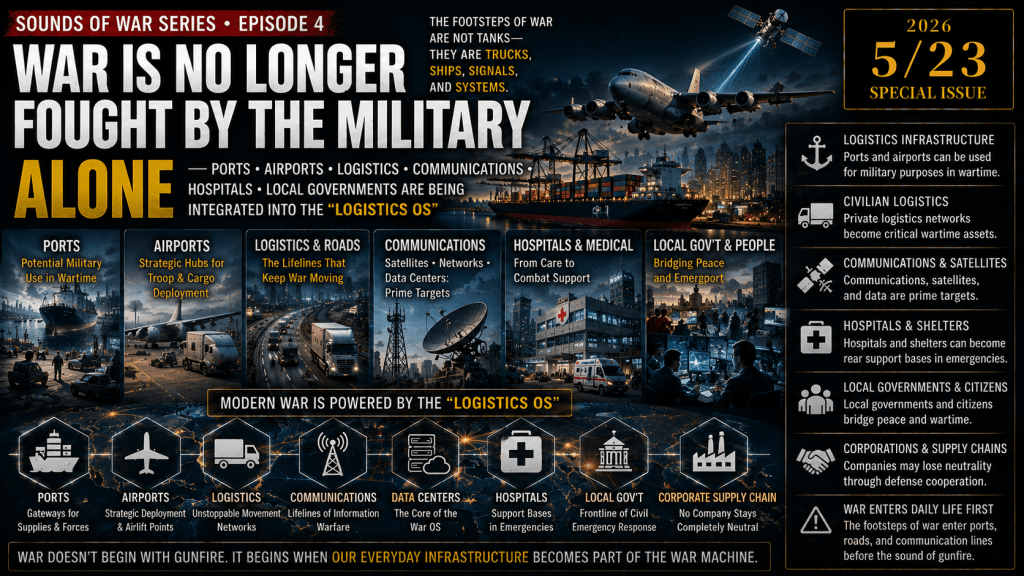
- This article examines how modern war can involve not only militaries, but ports, airports, logistics, communications, hospitals, local governments, and private infrastructure.
- In modern conflict, the rear can matter as much as the front line. Supply, transport, data, medicine, and local administration become part of the war structure.
- The deeper question is not only whether Japan becomes a battlefield, but when ordinary infrastructure begins to function as a logistics operating system.
War No Longer Happens Only on the Front Line
War does not happen only at the front.
Ports are used.
Airports are used.
Roads are used.
Trucks move.
Communications continue.
Hospitals receive the injured.
Local governments guide evacuation.
Corporate supply chains keep moving.
Modern war is not fought by militaries alone.
For a military to operate, the society behind it must continue functioning.
Fuel.
Food.
Ammunition.
Medicine.
Communications.
Transport.
Repair.
Information.
Evacuation.
Medical care.
Electricity.
Water.
Roads.
Ports.
Airports.
Data centers.
If these fail, even the strongest equipment cannot function for long.
In urban-legend circles, war is often framed through hidden rulers or secret plans.
But real war structures can be more ordinary and more deeply embedded.
War is supported by daily life.
The port used for trade.
The airport used by travelers.
The expressway used by commuters.
The hospital used by residents.
The communication network used by everyone.
The warehouse used by companies.
The local government office that normally handles public services.
In wartime or crisis, these same systems can gain a second meaning.
I call that structure the logistics OS.
What Is Logistics? The Invisible Bloodstream of War
Logistics is the bloodstream of war.
It moves supplies.
It delivers fuel.
It brings ammunition.
It evacuates the wounded.
It provides food.
It replaces parts.
It maintains communication.
It moves personnel.
It uses ports and airports.
It secures roads and railways.
It is the invisible system behind visible combat.
History shows that wars are not decided only by courage at the front.
Can an army be supplied?
Can it move?
Can it continue?
Can it communicate?
Can it repair?
Can it treat the wounded?
Can the rear remain stable?
These questions matter.
Today, logistics has become even more complex.
It no longer belongs only inside the military.
Private logistics may be needed.
Telecommunications companies may be involved.
Airport and port operators may matter.
Hospitals may be included.
Local governments may be required.
Private warehouses and transport networks may become essential.
Data centers and cloud systems may also become part of the structure.
The footsteps of war are not only the sound of tanks.
They may also be the engine of a truck.
The crane at a port.
The runway of an airport.
The antenna of a communications tower.
The corridor of a hospital.
The signal from a local government alert system.
Why Ports, Airports, and Roads Become Security Assets
Japan’s security policy increasingly treats ports and airports as security-relevant infrastructure.
Japan’s defense white paper explains that, under the National Security Strategy, public infrastructure such as airports and ports may be improved or strengthened to support smooth use by the Self-Defense Forces and the Japan Coast Guard.
This is the context of “specified-use airports and ports.”
The stated idea is that civilian use remains primary, while necessary improvements or existing projects support smoother use by SDF and Coast Guard vessels and aircraft.
The phrase “civilian use remains primary” is important.
A port remains a civilian port.
An airport remains a civilian airport.
A road remains ordinary infrastructure.
But in a crisis, the same infrastructure can support military or coast-guard activity.
This creates a dual face.
Infrastructure for life.
Infrastructure for emergency and security.
A port is where ships enter.
An airport is where people travel.
A road supports daily life and commerce.
But on the security map, a port can become a gateway for supplies and vessels.
An airport can become a hub for aircraft and personnel movement.
A road can become an artery for forces and logistics.
That duality is the entrance to the logistics OS.
Civilian Logistics Can Become Wartime Infrastructure
Modern society is built on logistics.
Food.
Medicine.
Fuel.
Parts.
Construction materials.
Communications equipment.
Medical supplies.
Daily goods.
Semiconductors.
Defense-related components.
None of these arrive by themselves.
In a crisis, the central issue is not only what a country has.
It is whether the right quantity can reach the right place at the right time.
Military transport alone may not be enough.
Private trucks, warehouses, port handling, air cargo, railways, ships, and delivery networks may become necessary.
Civilian logistics can therefore become wartime infrastructure.
This does not mean logistics companies desire war.
Most companies support ordinary commerce and daily life.
But when society enters emergency mode, the same logistics network can take on another meaning.
It carries food and water.
It carries medicine.
It carries emergency supplies.
It may carry parts.
It may carry fuel.
It may carry repair materials.
Where does life-support end and war-support begin?
In modern conflict, that line can become extremely blurred.
Communications, Satellites, and Data Centers Are Targets
Logistics is not only physical.
Information is logistics too.
Telecommunications.
Satellites.
Fiber networks.
Mobile towers.
Cloud systems.
Data centers.
Electricity.
Cyber defense.
Financial systems.
Administrative systems.
If these fail, both society and military operations become difficult to sustain.
In modern conflict, communications infrastructure itself can become a target.
Not only military communications.
Civilian communications too.
Not only government networks.
Corporate systems too.
Not only bases.
Data centers and power grids too.
Japan’s economic-security framework for key infrastructure is built around the idea that important facilities and services must not become tools for external disruption.
This shows that modern security is no longer only about weapons.
It is also about the social foundations that keep a country functioning.
The battlefield expands.
It enters server rooms.
Communications lines.
Power systems.
Water systems.
Financial infrastructure.
Administrative data.
Urban legends often say that whoever controls information controls power.
In modern war, that idea becomes very practical.
Who can keep communication alive?
Who can protect data?
Who can withstand cyber attacks?
Who can prevent public systems from collapsing?
That becomes part of the logistics OS.
Hospitals, Medicine, and Shelters in Crisis
Medical infrastructure must not be forgotten.
War does not injure only soldiers.
Civilians are injured too.
Elderly people remain.
Children remain.
People with disabilities remain.
People with chronic illness remain.
Medicine may run out.
Some people cannot evacuate.
Hospitals, emergency medicine, pharmacies, nursing facilities, public health centers, and shelters can become rear-support infrastructure.
Japan’s disaster-medicine framework includes Disaster Medical Assistance Teams, disaster base hospitals, wide-area medical transport, hospital support, and medical-continuity planning.
That is a disaster framework, but it offers an important lens for thinking about crisis.
Where are the injured transported?
How are medical resources allocated?
How are power and water maintained at hospitals?
How are medicines and devices secured?
How are infections prevented in shelters?
How are elderly and vulnerable people supported?
Here, daily medicine connects to crisis medicine.
The footsteps of war may not enter only through military ports.
They may also enter hospital corridors.
Local Governments and Residents Enter Crisis Response
In crisis, the central government cannot act alone.
Local governments act.
Fire departments act.
Police act.
Hospitals act.
Schools and public buildings may become shelters.
Residents need information.
Evacuation routes must be communicated.
Vulnerable people must be supported.
Japan’s civil-protection framework provides information on what citizens should do in cases such as armed attack, terrorism, or ballistic missile launch.
Fire and Disaster Management Agency materials explain that local governments prepare civil-protection plans for armed-attack situations and emergency-response situations.
This shows that local governments become bridges between peacetime and emergency.
Usually, they provide resident services.
During disasters, they support evacuation.
During armed-attack situations, they become part of civil protection.
The same institution gains another face depending on the situation.
This matters.
If war is no longer fought only by militaries, residents are also placed within the emergency response structure.
They evacuate.
Receive information.
Follow instructions.
Use shelters.
Support one another.
Avoid misinformation.
Maintain daily life where possible.
Residents may not be soldiers.
But they are not outside the logistics OS.
Can Companies Stay Neutral?
Can companies remain fully neutral in an emergency age?
This is difficult.
Companies produce goods.
Move supplies.
Maintain communications.
Provide energy.
Distribute medical products.
Offer cloud services.
Manufacture semiconductors.
Supply components.
Operate ports and airports.
Build and repair facilities.
In peacetime, these are ordinary economic functions.
In crisis, they can become security functions.
If defense equipment transfer and defense-industrial strengthening advance, private companies may become more clearly connected to national security policy.
That does not automatically make corporate cooperation wrong.
States need private technology and industrial capacity.
In disaster and crisis alike, society cannot function without companies.
But the question remains:
Where does social maintenance end?
Where does war support begin?
Do companies understand the line?
Do employees understand it?
Does the public understand it?
Where is the line between profit and ethics?
War is no longer supported only by weapons factories.
Ordinary companies.
Ordinary warehouses.
Ordinary networks.
Ordinary communication contracts.
Ordinary supply chains.
The lines of the logistics OS can extend into all of them.
When Daily Infrastructure Becomes Emergency Infrastructure
When does daily infrastructure become emergency infrastructure?
Not only when sirens sound.
It may begin when plans are created.
When facilities are designated.
When training begins.
When equipment is strengthened.
When frameworks for port and airport use are prepared.
When key-infrastructure screening systems operate.
When local governments prepare evacuation.
When companies expand continuity plans toward emergency scenarios.
At that point, ordinary infrastructure already begins to gain another meaning.
In urban-legend circles, such changes may be described as hidden mobilization.
I will not state that as fact.
But structurally, it must be observed.
A society does not become an emergency society overnight.
Before that, policies, plans, designations, drills, budgets, and infrastructure updates slowly reshape it.
Often, each change comes with a rational explanation.
Disaster preparedness.
Public safety.
Civil protection.
Infrastructure continuity.
International security.
Deterrence.
Protection of residents.
Each sounds reasonable.
That is why the whole structure must be read.
War Is Supported by a Whole-Society System
At this point, the shape of war changes.
War is not only the military.
War is not only the base.
War is not only the defense ministry.
Ports.
Airports.
Roads.
Logistics.
Communications.
Data centers.
Hospitals.
Medicine.
Local governments.
Schools.
Shelters.
Companies.
Finance.
Electricity.
Water.
Residents.
These can become part of a whole-society system.
That is the logistics OS of modern conflict.
This is not automatically evil.
To protect people, society needs preparation.
In disaster or emergency, strong infrastructure saves lives.
But preparation also changes the shape of society.
The more a society prepares for emergency, the more it can begin to operate with emergency in mind.
That is the difficult part.
Preparation is necessary.
But preparation also changes the ordinary.
How far does the security framework enter daily life?
How far are residents incorporated into civil-protection systems?
How far do companies become part of defense cooperation?
These questions must not be avoided.
Closing — War Approaches Through Ports, Roads, and Networks
The footsteps of war are not only the sound of tanks.
A ship entering a port.
A transport aircraft using an airport.
A truck on a highway.
A communication network that must not fail.
A protected data center.
A prepared hospital bed.
A designated shelter.
A notice sent to local governments.
A corporate supply chain that becomes strategically important.
War can enter daily infrastructure before it enters through gunfire.
The answer is not fear.
The answer is observation.
What is preparation for daily life?
What is preparation for emergency?
Where is the boundary?
Who decides?
Who explains?
Who is responsible?
How much do residents know?
Can Japan remain outside the battlefield?
That question can no longer be answered only by looking at bases and missiles.
We must look at ports.
Airports.
Logistics.
Communications.
Medicine.
Local governments.
Companies.
Residents.
War is no longer fought by the military alone.
Therefore, peace cannot be protected by the military alone either.
To protect daily life, we must understand infrastructure.
Notice institutional change.
See how ordinary systems can become strategic systems.
And continue watching society with calm eyes rather than fear.
That is the perspective needed in the age of the logistics OS.
Next time—another fragment of truth we will trace together.
I will return to continue the telling.
References
Official reference for specified-use airports and ports, and the strengthening of public infrastructure to support smooth use by the SDF and Japan Coast Guard.
Government reference for public-infrastructure development and its relationship to national defense.
Official reference for Japan’s key-infrastructure security framework under the Economic Security Promotion Act.
Official reference for public guidance on civil protection, evacuation actions, ballistic missile alerts, terrorism, and armed-attack situations.
Reference for how local governments prepare civil-protection plans for armed-attack situations and emergency-response situations.
Official reference for disaster medicine, DMAT, disaster base hospitals, medical continuity, and emergency medical-response systems.
This English article is scheduled for 23:00 JST on May 23, 2026.
Related Reading
Episode 1 of the Footsteps of War series, tracing Japan’s changing security structure through missiles, exports, and information warfare.
Episode 2 of the Footsteps of War series, examining how language, institutions, and constitutional debate update national perception.
Episode 3 of the Footsteps of War series, tracing how AI, data, platforms, and defense industry reshape modern conflict.
Popular Posts
A strong popular article for readers who want to trace how strange narratives mutate with technology and culture.
A long-running reader favorite on sovereignty, hidden structure, military presence, and geopolitical design.
A popular read on prophecy, sky omens, and the meaning people project onto signs of crisis and transition.
Submit an Urban Legend
If there is a rumor, unexplained story, symbolic pattern, or strange connection you want explored, send it in. I will not leave it as “just a rumor”—I will trace its structure, context, and narrative with care.

コメントを残す