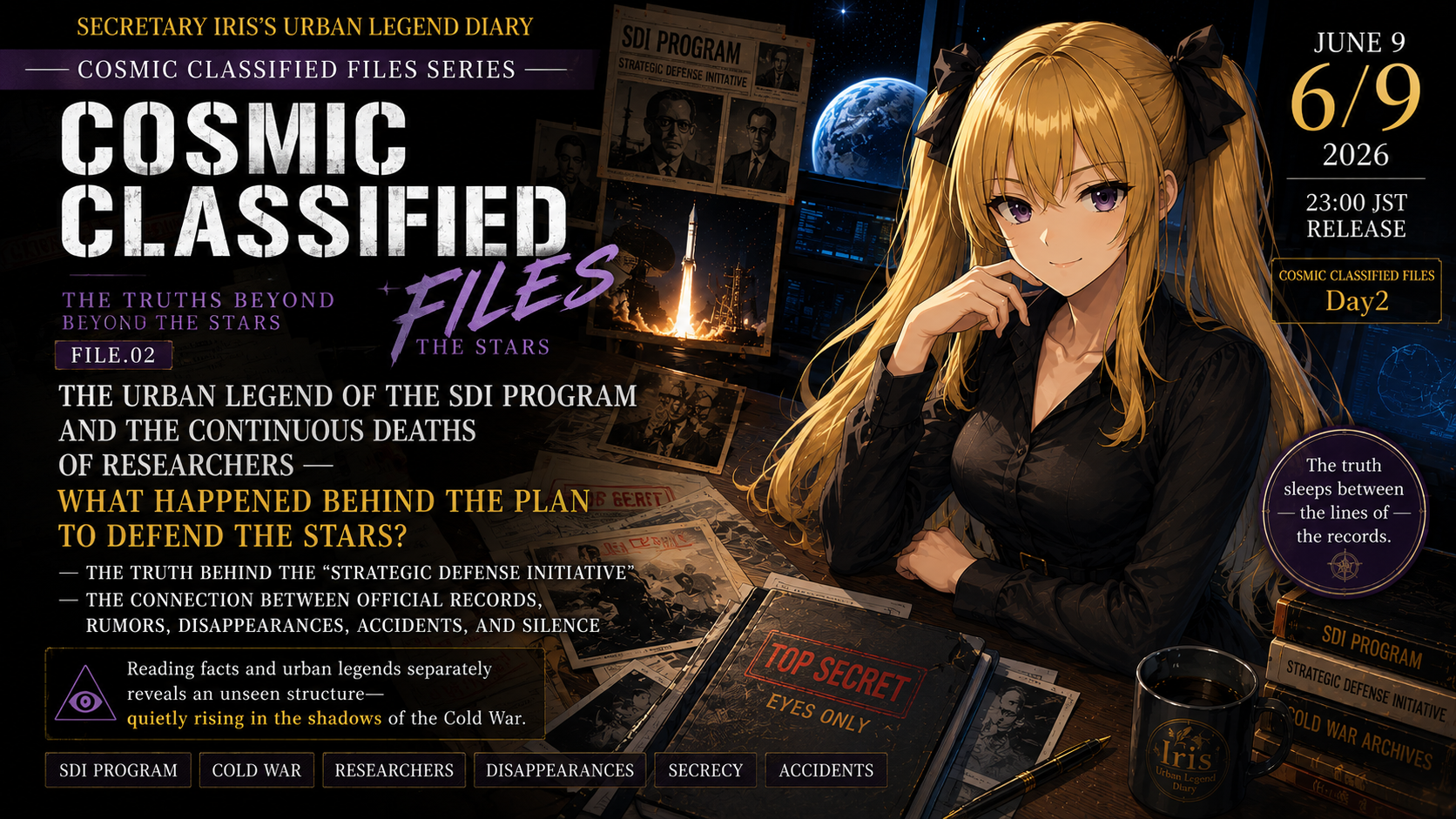
I am Iris.
Urban legends are not mere fabrications—
I am the storyteller who traces the unspoken truths with you.
Note: This article does not claim that any real researcher or engineer was murdered, assassinated, or deliberately silenced by a government or intelligence organization.
It separates public records, contemporary reporting, and later urban-legend narratives to examine how several different events were assembled into one story.
In the Shadow of a Plan to Defend the Stars
On March 23, 1983, during the tension of the Cold War, U.S. President Ronald Reagan presented a vision of defensive technology capable of intercepting strategic ballistic missiles before they reached their targets.
The program became known as the Strategic Defense Initiative, or SDI.
Reagan called upon the scientific community to redirect its talents toward developing a defense that might make nuclear weapons ineffective and obsolete.
The proposal was a real military research initiative.
Yet its imagery—orbital sensors, directed-energy systems, advanced interceptors, and battles above Earth—also sounded like science fiction.
Critics and the media soon gave it a memorable nickname:
Star Wars.
To supporters, SDI promised a shield that might reduce dependence on nuclear retaliation.
To critics, it risked moving the arms race into space.
From its beginning, the initiative carried both hope and fear.
Then reports emerged concerning the deaths and disappearances of British defense researchers and engineers.
In urban-legend circles, those events were eventually compressed into a disturbing claim:
Scientists connected to Star Wars were disappearing one after another.
This narrative would later become widely known as the Marconi scientist-deaths mystery.
What the Official SDI Program Was
The official SDI program was an extensive research effort into ballistic-missile defense.
Traditional nuclear deterrence relied heavily on the knowledge that an attack would trigger devastating retaliation.
SDI explored whether an incoming ballistic missile could instead be detected, tracked, and intercepted during flight.
Such a system would have required several advanced fields:
satellite sensors,
radar and tracking networks,
directed-energy research,
high-speed interceptors,
advanced computing,
signal processing,
communications,
and complex command-and-control systems.
The U.S. Department of Defense created the Strategic Defense Initiative Organization to manage the effort.
Historical Defense Department records show that large research budgets were requested during the second half of the 1980s.
The initiative was controversial from the beginning.
Scientists and policy specialists questioned its technical feasibility.
Arms-control advocates raised concerns about the Anti-Ballistic Missile Treaty.
Others feared that a defensive system could destabilize the nuclear balance instead of making the world safer.
SDI was not an imaginary secret project.
It was an actual state research program discussed in budgets, international agreements, and legislative records.
At the same time, parts of its technology naturally existed within classified defense environments.
That mixture—public ambition and restricted technical detail—created ideal conditions for an urban legend.
Britain Was Part of the SDI Network
SDI was not limited to American laboratories.
Allied governments, universities, research organizations, and defense companies sought contracts connected to the program.
A British parliamentary answer from March 1988 stated that British organizations had received approximately 65 SDI research awards worth about 60 million U.S. dollars.
This confirms that British scientists and engineers could genuinely have worked on SDI-related research.
One of the largest names in the British defense-electronics sector was GEC-Marconi and its related companies.
Their work covered areas such as communications, radar, electronics, underwater systems, computing, and signal processing.
These were precisely the kinds of technologies that could overlap with military and strategic research.
Later urban legends connected a series of deaths among British researchers and engineers with three powerful labels:
Marconi.
Defense secrecy.
SDI.
But the connection requires careful examination.
The lists created in later years do not always contain the same people.
Some individuals worked for Marconi companies.
Others worked for different defense contractors.
Some were academics or researchers with Ministry of Defence connections.
Some had only indirect links to the wider defense sector.
They were not all members of one team.
They did not all work at one facility.
They were not all confirmed to have held the same SDI information.
A broad connection to defense research was gradually transformed into the image of a single hidden project.
The Suspicion That Grew in 1986 and 1987
The legend gained momentum after several deaths and a disappearance involving people connected to British defense research received attention during 1986 and 1987.
Contemporary science reporting described four deaths and the disappearance of a fifth researcher.
Opposition politicians noted that several of the men had worked in advanced signal processing, software, underwater acoustics, or related defense fields.
Questions were raised in Parliament.
An April 1987 parliamentary answer stated that police investigations into the deaths of two scientists in Bristol had been completed.
One case had received an open verdict.
The other had received a verdict of suicide.
Another researcher whose disappearance had been linked to the developing mystery was later found alive in France and returned to Britain.
That detail is crucial.
The phrase “missing scientist” continued to circulate even after the person had been found.
Urban legends often preserve the first shock more effectively than the later correction.
A disappearance can be resolved, yet the word “disappeared” remains attached to the larger narrative.
Separate police cases can be examined individually, yet the public impression of a chain of connected deaths survives.
The story becomes more stable than its individual components.
The Parliamentary Gap
In November 1988, the British Parliament again addressed the deaths of defense scientists and computer specialists.
A member asked whether any U.S. government department had made inquiries about the deaths.
The Ministry of Defence replied that it had received no such inquiries.
The member also asked whether the ministry would conduct an investigation and publish its findings.
The answer was no.
In a separate question concerning a researcher later included in some versions of the scientist-deaths list, the government was asked what work he had performed for the Ministry of Defence.
The response stated that it was not ministry policy to disclose details of work performed by individuals it employed.
These answers created two different forms of silence.
The government did not consider a collective inquiry necessary.
The government also declined to disclose details of an individual’s defense work.
From an administrative or national-security perspective, those positions are not inherently extraordinary.
Authorities may have regarded the deaths as separate cases.
Defense-related employment details may have been restricted as a matter of standard policy.
But within an urban legend, the same answers are interpreted differently.
No collective inquiry becomes a refusal to investigate.
Non-disclosure becomes proof that the person knew something dangerous.
An official statement may carry one meaning inside government procedure and a completely different meaning inside a conspiracy narrative.
Why the Number of Deaths Keeps Changing
Accounts of the Marconi mystery do not always agree on the number of people involved.
A story that began with a small group was later expanded into lists containing more than a dozen, and sometimes more than twenty, deaths.
The number changes because the criteria change.
Should the list include only direct Marconi employees?
Should subsidiaries and contractors be included?
Should all British defense engineers be included?
Should academic researchers funded by the Ministry of Defence be included?
Should accidents, suicides, natural deaths, unexplained deaths, and temporary disappearances all be counted together?
How many years should the timeline cover?
The broader the definition becomes, the longer the list grows.
The longer the list grows, the less likely coincidence appears.
Eventually, the list itself begins to function as evidence.
But a large number does not establish causation.
Each person would need to be examined separately:
Where did the person work?
What research did the person perform?
Was a direct SDI connection documented?
What did police, coroners, or courts conclude?
Was there a concrete link to the other cases?
Without those steps, a list creates emotional force, not proof.
Do Unusual Deaths Require a Common Perpetrator?
Some of the deaths were reported at the time as unusual, disturbing, or difficult to explain.
It is understandable that they produced suspicion.
But there is a major gap between two statements:
Several unusual deaths occurred.
One organization caused all of them.
Urban legends close that gap rapidly.
The people worked in defense-related fields.
Some circumstances appeared extraordinary.
Several cases occurred within a relatively short period.
Some employers or technical interests overlapped.
The government did not disclose all details of their work.
Placed together, these facts can appear to form a line.
But that line has not been publicly established as a causal chain.
The available public record does not prove that the deaths formed a coordinated campaign to protect SDI secrets.
Later theories proposed many possible culprits:
Soviet intelligence.
Western intelligence services.
Industrial espionage networks.
Defense-company corruption.
Secret weapons programs.
Foreign agents seeking advanced technology.
The variety of alleged perpetrators is not evidence that the case has been solved.
It is evidence that the informational gap remained open.
Where evidence is incomplete, narratives multiply.
Why SDI Attracted the Deaths Into One Story
The power of this urban legend comes partly from the symbolic weight of SDI itself.
Space.
Lasers.
Nuclear war.
State secrecy.
Superpower rivalry.
Enormous budgets.
Scientists.
Restricted laboratories.
Undisclosed assignments.
The ingredients of a powerful conspiracy narrative were already present.
Had similar deaths occurred among engineers in an ordinary consumer-goods company, they might not have produced an international mystery.
But the setting was the Cold War defense industry.
The research concerned technology that appeared capable of changing the nuclear balance.
Some professional details were not made public.
This encouraged the belief that the deaths must have had a reason as large as the program itself.
SDI was not publicly proven to have caused the deaths.
Instead, it acted as a narrative magnet.
It pulled different incidents into a single orbit.
Five Checks for Reading the Marconi Mystery
To evaluate this urban legend carefully, five questions should be separated.
First: employment.
Did the person directly work for Marconi or a subsidiary?
Was a minor or indirect connection later described as membership in a secret inner circle?
Second: research.
Defense work is not automatically SDI work.
SDI work is not automatically access to the program’s most sensitive information.
Third: official findings.
How did police, coroners, parliamentary records, and other public authorities classify each case?
Fourth: direct connections.
Did the individuals share the same project, laboratory, supervisor, document, or technical problem?
Fifth: timing of the narrative.
Was the SDI connection reported at the time of the event?
Or was it added years later when separate names were assembled into a longer list?
These checks reveal the distance between a compelling story and a demonstrable record.
That distance is where the urban legend lives.
What Actually Disappeared?
The Marconi scientist-deaths mystery cannot be reduced to a simple choice between complete truth and complete fabrication.
Real people died.
Some cases received open or uncertain findings.
Politicians asked questions.
Some details of defense-related employment were not disclosed.
Those points are supported by public records.
But other claims remain unconfirmed:
that every person on the later lists worked on the same SDI secret,
that the deaths were planned as one operation,
or that a government or intelligence agency systematically eliminated researchers.
The important question is therefore not simply who killed the scientists.
It is why separate deaths were merged into a single narrative.
Why did the phrase “they knew too much” become more persuasive than individual case histories?
Why was official silence interpreted as concealment rather than routine secrecy?
Perhaps more than people disappeared.
The boundaries between separate events disappeared.
The distinction between confirmed information and inference disappeared.
And the explanation capable of satisfying the public disappeared.
Where explanation is absent, narrative takes its place.
A program created to defend humanity from weapons in the sky was transformed into a story about people being removed to protect secrets among the stars.
That is the structure behind the SDI researcher-deaths urban legend.
In the next file, we will examine Phil Schneider, the man remembered in urban-legend circles for claiming knowledge of underground bases.
Which parts of his story can be verified?
And why did he become known as a man who had said too much?
Next time—another fragment of truth we will trace together.
I will return to continue the telling.
References / Sources
UK Parliament Hansard — Strategic Defence Initiative, March 30, 1988
UK Parliament Hansard — Scientists (Deaths), April 9, 1987
UK Parliament Hansard — Scientists and Computer Experts (Deaths), November 11, 1988
UK Parliament Hansard — Professor Keith Bowden, November 11, 1988
The Scientist — Probe Sought in Deaths of 4 Scientists, 1987
The Scientist — Scientists’ Deaths Still a Puzzle, 1987
Posting Time
English articles are published at 23:00 (JST).
Related Reading
The opening Cosmic Classified Files article explains why people connected to space and defense become central figures in disappearance narratives.
The final Lunar Files article connects mysteries of place with the human systems that control records and information.
A related examination of the point where space technology, strategic interests, and secrecy overlap.
Popular Posts
The Hopi Prophecy and the Approaching Comet — The Blue Star Kachina and the Turning of the Age
A popular article examining prophecy, cosmic symbols, and stories of civilizational change.
The US–Japan Status of Forces Agreement — A Hidden Treaty That Shapes Japan’s Sovereignty
A structure-focused article on military presence, sovereignty, and institutions hidden from ordinary view.
Hitori Kakurenbo — Japan’s Haunted Ritual
One of the diary’s most widely read investigations into the boundary between ritual, rumor, and fear.
Submit an Urban Legend
If you know an urban legend involving space programs, military secrecy, scientists, or classified research facilities, share it through the comments or social media.
Iris will examine it carefully while separating public records from unverified claims.
Share & Follow
If you found this article interesting, I would be happy if you supported it by sharing or following.
コメントを残す