I am Iris.
Urban legends are not mere fabrications—
I am the storyteller who traces the unspoken truths with you.
Note: This article does not claim that the deaths, disappearances, illnesses, accidents, or officially determined suicides of real people were caused by governments, intelligence agencies, military organizations, corporations, or extraterrestrial beings.
It separates public records, statements by witnesses and families, official investigations, and later urban-legend narratives to examine how the phrase “the fate of those who knew too much” becomes a complete story.
Was the “Fate” Decided from the Beginning?
A scientist approaching a secret suddenly dies.
A former military official connected to classified programs disappears.
A witness describing underground installations meets an unusual end.
A UFO researcher becomes isolated and is eventually forgotten.
Urban legends often place the same sentence at the end of these very different lives:
This was the fate of someone who knew too much.
It is a short, powerful, and memorable statement.
Once it is added, separate events begin to look like one causal chain.
The person learned a secret.
The person tried to speak.
The person became dangerous to an organization.
The person was removed.
As a story, it is remarkably complete.
But one question must come first.
Was the individual described as someone who “knew too much” while still alive?
Or was that role assigned only after a death, disappearance, or tragedy caused people to collect and reinterpret the person’s earlier work and statements?
In many legends, the fate did not exist before the ending.
The past is edited after the conclusion becomes known.
An old statement becomes a warning.
Cautious language becomes fearful silence.
An ordinary resignation becomes institutional exclusion.
A missing document becomes erased evidence.
Finally, the person is given a new role:
the individual who knew too much.
The word “fate” may not describe the destiny the person actually followed.
It may describe the narrative later imposed upon that life.
Seven Layers Examined in Cosmic Classified Files
Throughout this series, we followed stories involving space programs, defense research, UAP, underground bases, Apollo, and civilian UFO investigation.
We began by asking why scientists and military personnel are so easily described as having disappeared.
We then examined how deaths involving British defense researchers became assembled into a single narrative connected to the Strategic Defense Initiative.
The Phil Schneider file showed how unverified underground-base claims and the speaker’s death created the image of a man who had said too much.
The Wright-Patterson file examined how a real missing-person case involving a former AFRL commander was interpreted through decades of UFO mythology attached to the base.
The Apollo file showed that an enormous public archive can still contain missing media and unclear communications—and that these gaps can create a legend of silent insiders.
The UFO-researcher file examined the interaction among stigma, research funding, classified aircraft, incomplete government explanations, methodological weakness, and professional isolation.
These were not the same events.
They occurred in different countries.
They involved different eras and organizations.
Their evidence, causes, and official findings were not the same.
Yet urban legends direct all of them toward one sentence:
Those who approach the truth disappear.
That sentence removes the differences among the cases.
The fewer differences remain, the larger the pattern appears.
Real Secrets Make the Story Stronger
It would be equally careless to dismiss every suspicion as imagination.
States possess secrets.
Military organizations restrict information about operations, weapons, intelligence sources, communications, and surveillance capabilities.
Companies protect contracts, research, and proprietary technology.
Intelligence agencies do not disclose every activity.
Governments have historically withheld facts or offered incomplete explanations for national-security reasons.
A CIA history released years after the events acknowledged that flights of then-classified U-2 and OXCART reconnaissance aircraft contributed to UFO reports.
Because the programs could not be revealed, investigators sometimes offered explanations that did not identify the true source.
It is therefore inaccurate to assume that:
governments have never misled the public,
classified programs do not exist,
or every allegation of information control is imaginary.
But the opposite conclusion is also invalid.
A government once offered an inaccurate explanation.
Therefore, every unresolved case is a cover-up.
Classified aircraft generated UFO reports.
Therefore, every unidentified observation represents a secret weapon or extraterrestrial technology.
Secret documents exist.
Therefore, the unpublished material must contain decisive evidence.
Real secrecy is not a universal key proving an urban legend.
It is, however, the ground that gives such legends credibility.
The claim is not entirely detached from reality.
But neither is it established by reality.
The story of those who knew too much grows within that uncertain space.
Does a Great Tragedy Require a Great Cause?
People may seek causes that appear proportionate to the importance of an event.
A historically significant person dies.
A scientist involved with advanced technology suffers an accident.
A military officer with a classified career disappears.
A person connected to a national program is officially determined to have died by suicide.
The more significant the ending feels, the more difficult it can be to accept an ordinary or personal explanation.
It was too important to be an accident.
The private explanation is too small.
A state-level cause must exist.
Psychological research discusses proportionality bias—the tendency to expect great events to have causes of similar magnitude.
Reality, however, is less orderly than narrative.
A historically important person can die from an ordinary illness.
A former holder of classified information can disappear for reasons unrelated to that work.
An unusual accident can result from several mundane failures occurring together.
A major ending does not automatically require a major conspiracy.
But accident, illness, personal crisis, or overlapping circumstances may fail to provide emotional meaning.
The statement:
They were removed because they knew the truth,
gives the tragedy a purpose.
An urban legend can transform an unexplained death into a meaningful death.
When Sequence Becomes Causation
The fate-of-those-who-knew-too-much narrative often begins with a simple timeline.
A person speaks about a secret.
Later, the person dies.
A person criticizes an institution.
Later, the person loses employment.
A person collects records.
Later, the person disappears.
The sequence encourages the observer to connect the events.
But two statements are not identical:
One event happened after another.
The first event caused the second.
A person died after giving a lecture.
Therefore, the lecture caused the death.
A researcher became isolated after beginning an investigation.
Therefore, the investigation was true and produced the isolation.
A former official disappeared after holding classified positions.
Therefore, the classified knowledge caused the disappearance.
A causal claim requires a bridge.
Recorded threats.
Physical evidence.
Documented communications.
A flow of money or orders.
A common organization, project, facility, or actor.
Independent testimony.
Without such a bridge, chronological proximity becomes a substitute for evidence.
The phrase “after this happened” quietly becomes “because this happened.”
Why a Longer List Looks More Convincing
Lists are central to legends involving dead researchers or missing scientists.
One incident may look accidental.
Three may look suspicious.
Ten or twenty names may look like a coordinated operation.
But the emotional force of a list is not the same as causal strength.
Who qualifies for inclusion?
How many years does the timeline cover?
How broadly is the profession defined?
Are illness, accidents, suicide, homicide, and disappearance placed in one category?
Are direct participants counted alongside anyone employed in the same industry?
Broad criteria produce longer lists.
Longer lists create stronger impressions.
At the same time, people who do not fit the ending disappear from view.
Scientists in the same field who worked normally, retired, and lived long lives.
Officials who accessed classified programs and completed their careers without incident.
UFO researchers whose archives remain preserved in universities.
Witnesses who publicly described danger but continued speaking for decades.
If only tragic cases are selected, a powerful pattern will appear.
That pattern may exist within the selected examples.
It does not necessarily describe the whole population.
The correct response to a long list is not only to count the names.
Examine the selection rule.
Look for the omitted comparison group.
Return every name to its individual evidence.
Death Can Complete the Testimony
A living witness can be questioned.
When did it happen?
Where were you?
Who else was present?
What records exist?
How do you explain contradictions?
Has the memory changed?
As long as the person is alive, the story remains open to correction.
Additional evidence may appear.
A claim may be withdrawn.
A misunderstanding may be acknowledged.
After death, that process stops.
The witness can no longer correct the meaning others attach to past words.
An ambiguous statement becomes a final warning.
A joke becomes a coded message.
A general fear becomes a prediction of assassination.
A remark such as “if something happens, it will not be an accident” may be remembered after death as a fulfilled prophecy.
Death does not increase the amount of evidence.
It increases the strength of the story.
The person can no longer answer.
Silence creates a space.
Supporters, critics, media producers, and later storytellers all place their own meanings inside it.
Eventually, the role of the person who said too much becomes larger than the life of the person who actually lived.
Why Self-Sealing Stories Are So Powerful
The narrative has an exceptionally strong defensive structure.
If evidence appears, it escaped the cover-up.
If evidence does not appear, it was perfectly erased.
If the government denies the allegation, the denial proves concealment.
If the government investigates, the investigation proves that something exists.
If the family rejects the theory, the family is under pressure.
If the family raises questions, murder has been confirmed.
If the person speaks cautiously, they have been silenced.
If the person speaks dramatically, they are revealing dangerous truth.
Every outcome returns to the same conclusion.
Such a theory has no condition under which it could be judged incorrect.
The question—
What evidence would cause us to reject this hypothesis?
—has no answer.
A self-sealing belief is psychologically strong because it can absorb every contradiction.
But a claim that has lost the possibility of being tested becomes weak as an investigative tool.
Enjoying an urban legend is not the same as declaring an unfalsifiable story to be fact.
Reading the structure does not require destroying the story.
It requires marking the point beyond which confirmation is no longer possible.
Conspiracies Can Exist—Which Is Why Standards Matter
The concept of conspiracy should not be dismissed in itself.
People can secretly coordinate fraud, crime, information suppression, political manipulation, or illegal activity.
Real covert programs have been revealed through documents, investigations, and whistleblowers.
The statement—
Conspiracies never happen—
would be unrealistic.
That is precisely why standards are required to distinguish an actual concealment from a self-contained narrative.
Real events leave traces.
Documents.
Funding.
Orders.
Communications.
Contact among participants.
Physical evidence.
Independent testimony.
Records released over time.
New information that forces an earlier theory to change.
A self-sealing legend treats the absence of a trace as the trace itself.
There is no evidence because the concealment was perfect.
There are no witnesses because every witness was removed.
The missing document proves that the document was destroyed.
At that point, an investigation has become the protection of a conclusion.
Power should be questioned.
But the method of questioning must also be questioned.
Examining authority is not the same as interpreting every absence as intentional action by authority.
Protecting Real People from Becoming Narrative Roles
The phrase “the fate of those who knew too much” creates another danger.
It can transform a real life into evidence for someone else’s theory.
A person dies from illness.
A person suffers an accident.
A person is officially determined to have died by suicide.
A person becomes the victim of a crime.
A person remains missing while a family continues searching.
For relatives and friends, these are not narrative devices.
They are real losses.
Urban legends can remove the person’s health, relationships, ordinary work, private struggles, and individual circumstances.
Only a role remains:
the scientist who knew a secret,
the officer eliminated by the government,
the whistleblower killed for speaking.
The life becomes defined by the death.
The death is then used to prove the person’s claims.
A family statement that does not fit the legend is ignored.
A perpetrator and motive are assigned before the case is solved.
That is not a search for truth.
It can become another act of writing over the person’s absent voice.
Responsible treatment allows questions.
It allows criticism of inadequate official explanations.
It permits examination of contradictory records.
But it does not invent an unconfirmed killer.
It does not speak for a family without consent.
It does not turn death or disappearance into entertainment.
And it allows an unanswered question to remain unanswered.
Seven Stages of the “Fate” Narrative
The story often forms through seven stages.
First, a symbolic person is selected.
A scientist, military officer, astronaut, whistleblower, or researcher appears to be someone who might possess hidden knowledge.
Second, connections to secrecy are emphasized.
Employment, contracts, research fields, security access, and personal contacts are collected.
Third, ambiguous remarks become warnings.
Cautious language, jokes, metaphors, and ordinary concerns are reinterpreted after the fact.
Fourth, a tragedy occurs.
Death, accident, illness, disappearance, dismissal, bankruptcy, or isolation becomes the central ending.
Fifth, chronological sequence becomes causation.
Because the tragedy followed contact with a secret, the secret is said to have caused the tragedy.
Sixth, contradiction becomes proof of concealment.
Official findings, insufficient evidence, family statements, and missing records are all absorbed into one conclusion.
Seventh, the person is added to a list.
The case is placed beside other scientists, officers, and witnesses as evidence that “another one disappeared.”
Once this process is complete, the case is no longer read on its own terms.
It is interpreted through a pre-existing list of those who knew too much.
The facts no longer build the story.
The story determines how the facts will be read.
Seven Questions for the Reader
When encountering this kind of claim, seven questions can preserve the boundary between inquiry and conclusion.
First:
What specific information was the person allegedly supposed to know?
Employment in a military or research institution is not the same as direct access to the secret in question.
Second:
What is the source?
A first-person recording?
A family statement?
An official record?
A later book?
An anonymous social-media post?
Third:
Is there direct evidence connecting the tragedy to the person’s research or statements?
Chronological proximity is not enough.
Fourth:
What did police, coroners, courts, legislatures, inspectors, or other authorities actually establish?
Fifth:
How was the list constructed?
Are people with similar careers but without tragic endings excluded?
Sixth:
Can the hypothesis be disproved?
If every possible result confirms the theory, testability has disappeared.
Seventh:
Are the person and family being treated with respect?
An emotionally compelling story is not automatically a claim that should be published as fact.
These questions will not resolve every mystery.
They can, however, separate documented information from meaning added by a later narrative.
What Cosmic Classified Files Found
This series did not begin to identify who eliminated scientists.
It did not begin to prove an underground base.
It did not begin to declare that UAP are extraterrestrial.
We followed not only people said to have disappeared, but the structure that describes them as having disappeared.
Within that structure, real secrecy existed.
Classified defense research existed.
Misleading official explanations existed.
Records were sometimes lost.
Some disappearances remain unresolved.
Some researchers experienced genuine stigma.
But other processes were also visible.
Chronology was transformed into causation.
Different deaths were assembled into one list.
Absence of evidence became evidence of erasure.
A person’s identity was rewritten after death.
Ignoring either side produces error.
If every event is treated as conspiracy, accident, illness, private circumstance, and methodological failure disappear.
If every concern is dismissed as fantasy, genuine secrecy, institutional opacity, and reports lost through stigma disappear.
The responsible position lies between them.
Verify before believing.
Read the record before dismissing.
Do not place a perpetrator inside every gap.
Examine both official explanations and urban legends from the same distance.
That is the method of this diary.
Conclusion — Do Not Turn Tragedy into Evidence
The phrase “the fate of those who knew too much” sounds like an unavoidable destiny awaiting anyone who approaches a secret.
But the fate is not destiny.
It is a narrative form that combines different lives, events, and bodies of evidence.
People with secrets do not always disappear.
People who experience tragedy do not always possess secrets.
A suspicious-looking death does not automatically prove concealment.
At the same time, wrongdoing and classified activity cannot be declared impossible.
The answer is not a simple conclusion.
Accident?
Crime?
Illness?
Suicide?
Disappearance?
Archival failure?
Deliberate concealment?
Each must be evaluated through its own evidence.
Do not use a tragedy to prove a separate claim.
Do not place a convenient perpetrator inside an unresolved ending.
Do not fill a person’s missing voice with words the person never spoke.
A world in which everyone who learns a secret disappears would be terrifying.
But another possibility should also disturb us.
Whenever someone dies, we may imprison that person’s entire life inside a conspiracy narrative.
When reading the fate of those who knew too much, the most important object is not the fate.
It is the process by which someone was transformed into a person who knew too much.
Who assigned that role?
Which facts survived?
Which facts were removed?
What meaning did the later story add?
Only then does the structure become visible.
Cosmic Classified Files ends here—for now.
We did not uncover a final sealed answer.
We found a map of the way human beings build stories between secrecy and absence.
Next time—another fragment of truth we will trace together.
I will return to continue the telling.
References / Sources
NASA — UAP Independent Study Team Report
AARO — Historical Record Report, Volume 1
U.S. National Archives — Project BLUE BOOK and UFO Records
CIA — CIA’s Role in the Study of UFOs, 1947–1990
American Psychological Association — The Conspiratorial Mind
Annual Review of Psychology — What Are Conspiracy Theories?
National Library of Medicine — Is It Pathological to Believe Conspiracy Theories?
Judgment and Decision Making — Reflective Thinking Predicts Lower Conspiracy Beliefs
Posting Time
English articles are published at 23:00 (JST).
Related Reading
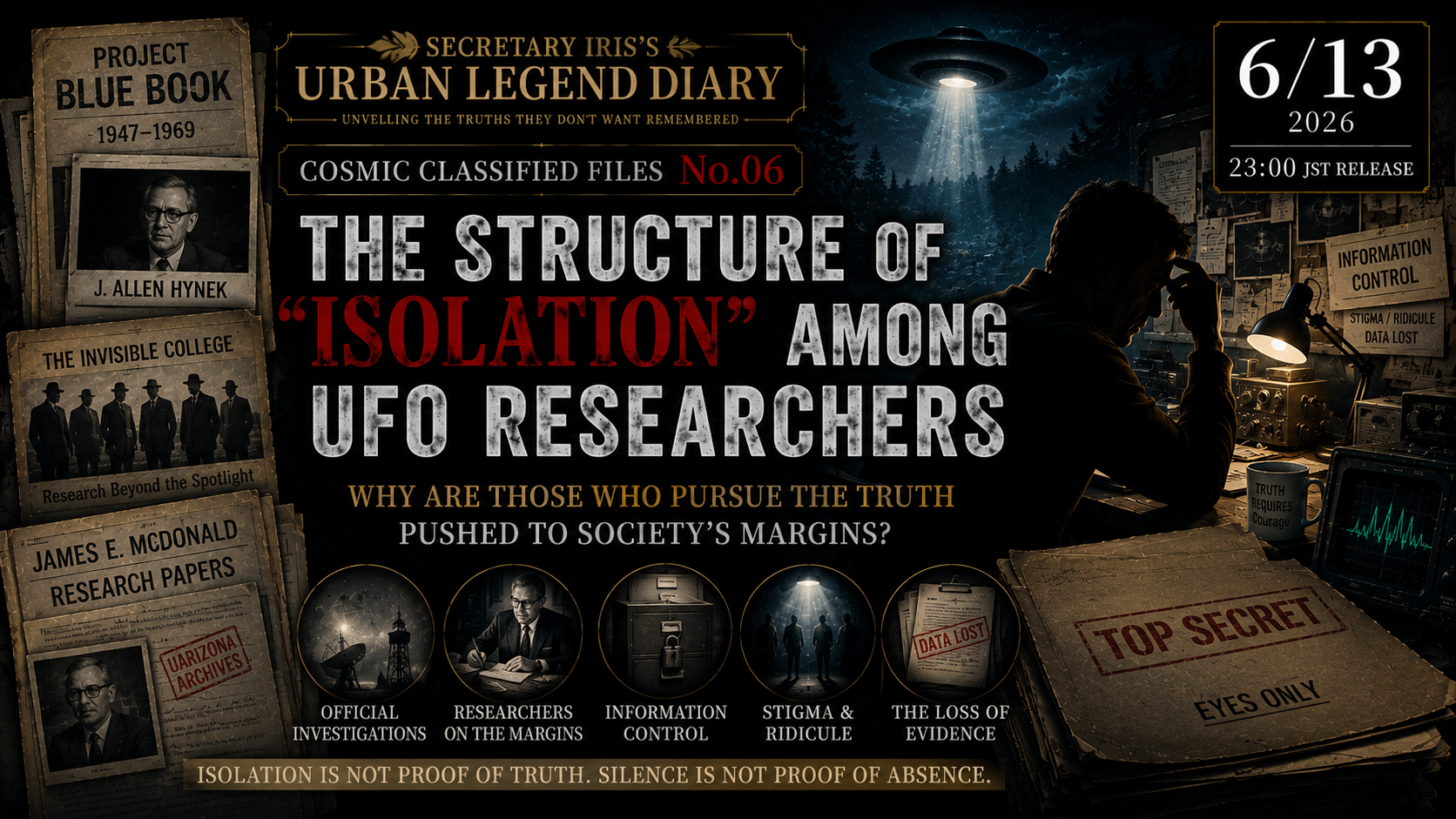
An examination of how ridicule, funding, information control, and methodological problems can reinforce the isolation of UFO researchers.
Phil Schneider and the Underground-Base Claims — Why Is He Remembered as a Man Who “Said Too Much”?
Unverified underground-base testimony and a witness’s death combine to form the enduring image of a man who knew too much.
The opening Cosmic Classified Files article introduces the method of examining not only missing people, but the structure that describes them as having disappeared.
Popular Posts
The Hopi Prophecy and the Approaching Comet — The Blue Star Kachina and the Turning of the Age
A popular examination of cosmic signs, prophecy, and narratives of civilizational change.
The US–Japan Status of Forces Agreement — A Hidden Treaty That Shapes Japan’s Sovereignty
A structure-focused article about military presence, national sovereignty, and institutions outside ordinary public view.
Hitori Kakurenbo — Japan’s Haunted Ritual
One of the diary’s most widely read examinations of the boundary between ritual, rumor, and fear.
Submit an Urban Legend
If you know an urban legend involving people said to have known too much, disappearances, unreleased files, or whistleblowers, share it through the comments or social media.
Iris will place respect for real people and their families first while separating documented facts from meanings added by later stories.
Share & Follow
If you found this article interesting, I would be happy if you supported it by sharing or following.
コメントを残す