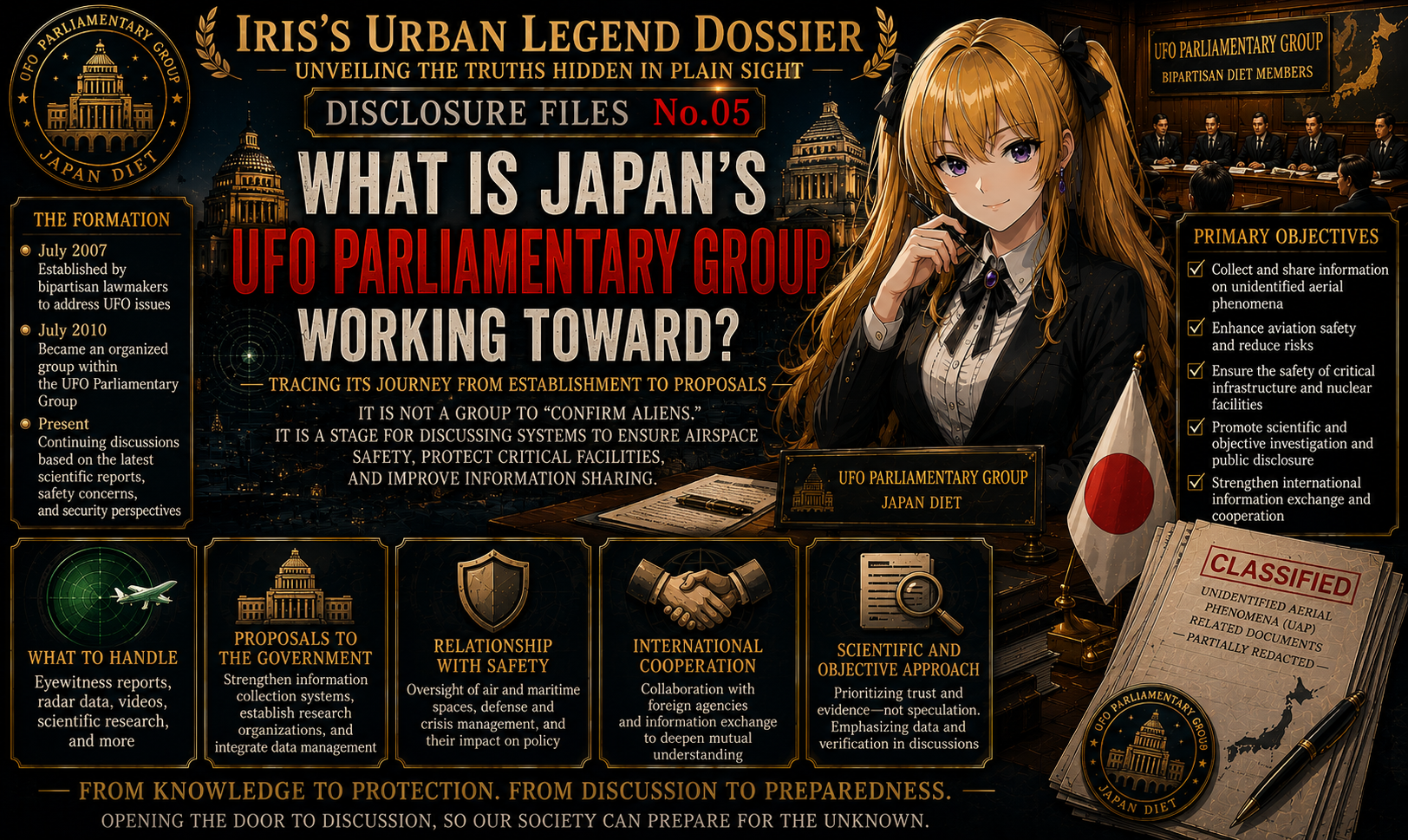
I am Iris.
Urban legends are not mere fabrications—
I am the storyteller who traces the unspoken truths with you.
Disclosure Files No.06.
In the previous file, we examined what Japan’s UFO Parliamentary Group is attempting to accomplish.
Its central objective was not to force the government to acknowledge extraterrestrial visitors.
It was to answer practical questions.
Who receives a report when an unidentified object appears in Japanese airspace or near critical infrastructure?
Who preserves the imagery?
Who compares records held by different ministries?
Who determines the level of danger?
Who can direct a government-wide response?
This time, we move to the institutional center of the debate.
Does Japan have a command center for UAP?
Note: This article does not claim that the Japanese government is deliberately concealing UAP information.
It also does not claim that the Ministry of Defense, civil-aviation authorities, police, the Japan Coast Guard, nuclear regulators, or other institutions are doing nothing about unidentified aerial events and security threats.
It separates existing defense, aviation, law-enforcement, maritime, nuclear-security, and emergency-management systems from a permanent organization dedicated to collecting and analyzing UAP information across government.
The Answer Is Not Simply Yes or No
Does Japan have a UAP command center?
If the question means—
Does Japan have a publicly identified permanent organization comparable to AARO, continuously collecting UAP reports, correlating cases, publishing assessments, and maintaining a national archive?—
the answer appears to be no.
No such permanent specialist institution has been publicly confirmed as operational.
But the statement—
Japan has no system for responding to unidentified objects—
would also be inaccurate.
The Self-Defense Forces have an instruction concerning the reporting, recording, and analysis of unidentified objects in the air.
Civil aviation operates through established air-traffic, safety, and incident-reporting systems.
Police address suspicious drones, unlawful activity, and security around critical facilities.
The Japan Coast Guard performs maritime surveillance, safety, and rescue missions.
Nuclear facilities operate under security and regulatory notification frameworks.
In a serious national emergency, the Cabinet can establish response or liaison offices, collect information from relevant ministries, and coordinate initial action.
Japan therefore possesses:
mission-specific response systems,
and a general emergency-coordination capability.
What it has not publicly demonstrated is a permanent hub that receives low-level UAP reports during ordinary times, connects records across ministries, conducts long-term analysis, and maintains one unified case history.
That is the most accurate description of the current position.
What Does “Command Center” Mean?
The term command center may suggest a dramatic operations room.
Walls of radar screens.
A national map.
A single official directing military aircraft, police, regulators, and scientists.
But a policy command center does not necessarily require one enormous office.
It requires functions.
A receiving point for reports.
A common reporting standard.
Rules for preserving imagery, radar records, communications, and metadata.
A way to connect reports held by different agencies.
Authority to assess urgency and notify the correct organization.
Access to scientific and national-security expertise.
A process for protecting classified information while providing public accountability.
The central question is not what the office is called.
It is:
Who holds final responsibility for assembling the complete picture?
Japan Already Has a Report–Record–Analyze Instruction
In September 2020, Japan’s Ministry of Defense issued an instruction concerning unidentified objects in the air.
When Self-Defense Forces personnel observed an unidentified object that could affect national defense or security, they were directed to:
ensure proper reporting,
make photographic or other records whenever possible,
and conduct necessary analysis.
The defense minister emphasized that the policy did not assume that the object came from outer space.
The purpose was to record and analyze something that had not been identified.
This contains the basic logic of responsible UAP policy.
Do not determine the origin in advance.
Preserve the observation.
Evaluate the operational effect.
Compare the event with known threats and known phenomena.
But the instruction is centered on the Ministry of Defense and Self-Defense Forces.
It does not publicly establish that reports from:
commercial pilots,
nuclear-facility guards,
scientific observatories,
maritime personnel,
police,
and infrastructure operators
automatically enter the same database and become one correlated national case.
Are Government Silos Always a Failure?
The phrase government silo usually sounds negative.
Agencies hide information.
Officials avoid responsibility.
No one sees the whole picture.
But specialization is normal.
The Ministry of Defense handles defense, airspace surveillance, and military threats.
The Ministry of Land, Infrastructure, Transport and Tourism oversees civil aviation and air-traffic systems.
Police handle crime, suspicious activity, unauthorized operations, and critical-site security.
The Japan Coast Guard handles maritime safety, security, surveillance, and rescue.
Nuclear regulators oversee nuclear safety and protective requirements.
The Cabinet Secretariat coordinates major government-wide policy and crisis response.
The problem is not that different institutions have different missions.
The problem appears when one unidentified event crosses several missions.
Before identification, officials may not know whether the event belongs to:
aviation safety,
national defense,
law enforcement,
critical-infrastructure protection,
meteorology,
astronomy,
or sensor engineering.
Uncertainty creates the need for integration.
One Light Can Become Seven Separate Government Records
Imagine that an unidentified light is observed near a coastal nuclear facility.
The guard reports through the operator’s system.
Police may examine the possibility of an unauthorized drone.
Civil-aviation information may be needed to identify aircraft.
The Coast Guard may hold relevant maritime observations.
The Ministry of Defense may examine surveillance or foreign-intelligence implications.
Nuclear authorities may review protective procedures.
The Cabinet may coordinate the response if the situation becomes serious.
Every organization could perform its assigned duty correctly.
The full picture could still disappear if they use different:
terminology,
timestamps,
record-retention rules,
case numbers,
classification standards,
and public-disclosure criteria.
One office records an unusual light.
Another records a possible drone.
Another records no effect on aviation.
Another records a security notification.
The records may concern the same event without being searchable as the same event.
The greatest danger of silos is not always that no one acts.
Sometimes everyone acts, but no one can assemble what everyone saw.
The 2024 Diet Questions Revealed Fragmentation
On June 13, 2024, UAP-related questions were raised in the House of Representatives Committee on Security.
The questions concerned whether relevant information might be held by ministries and organizations involved in:
science,
fisheries and maritime observations,
civil aviation,
and defense.
Lawmakers also asked whether a mechanism should exist to aggregate information held across government.
The hearing did not reveal a single institution already operating as the national UAP authority.
It revealed ministries performing their existing legal responsibilities.
That structure is ordinary.
UAP, however, is difficult precisely because it exists before ordinary classification.
It may not be an aviation accident.
It may not be a confirmed airspace violation.
It may not be a crime.
It may be a natural event.
It may be a sensor effect.
Which institution owns the record before the event belongs to any recognized category?
That is the structural gap.
The Prime Minister’s Office Has Emergency Coordination Powers
Japan has a general mechanism for government-wide emergency coordination.
During a February 2024 Diet exchange concerning a hypothetical UAP emergency, the government explained in general terms that, depending on the situation, it could:
establish a response office or liaison office at the Prime Minister’s Office,
collect information from relevant ministries,
and coordinate the initial government response.
This is significant.
Japan is not incapable of assembling ministries when a serious incident occurs.
A dangerous object approaching an aircraft.
A threat to critical infrastructure.
A major security event.
A situation endangering life or property.
Such events can activate established crisis-management mechanisms.
But an emergency command system and a permanent analytical office are not the same.
Emergency coordination begins when the event is serious enough to demand immediate action.
A specialist UAP function would also retain reports that appear minor:
a short video,
a radar anomaly,
a repeated light,
an observation without confirmed danger.
A single event may look meaningless.
Several events across years may reveal:
the same location,
the same altitude,
the same time pattern,
or the same technical signature.
Emergency response protects the present moment.
Long-term analysis protects the historical pattern.
The Genkai Incident Demonstrated the Problem of Language
On the night of July 26, 2025, three lights were observed in the sky near the Genkai Nuclear Power Plant.
Kyushu Electric Power initially used wording that referred to three drones.
The wording was later corrected because the objects had not actually been identified as drones.
The Nuclear Regulation Authority described the matter more neutrally as:
the incident involving the confirmation of lights in the airspace surrounding the Genkai Nuclear Power Plant.
The difference is not cosmetic.
Calling them drones suggests that the category has been substantially identified.
Calling them UFOs may immediately attach an extraterrestrial narrative.
Calling them three lights preserves only the confirmed observational fact.
Crisis communication must be fast.
It must also distinguish:
confirmed observation,
working hypothesis,
rejected explanation,
and unresolved information.
A command center would need more than the ability to collect records.
It would need the discipline to communicate uncertainty accurately.
Several Institutions Responded to the Genkai Event
The Genkai incident was not ignored.
The operator, nuclear regulatory authorities, police, and other relevant bodies acted within their responsibilities.
No impact on plant safety was identified.
The Nuclear Regulation Commission later examined the initial response, notification process, and communication issues.
The unanswered institutional questions are different.
Were aviation, police, defense, facility-security, and regulatory records fully correlated?
Who retains the consolidated final case?
Could a similar event elsewhere be matched against the Genkai record?
The existence of several functioning response systems does not demonstrate the existence of one permanent analytical system.
The Defense-Centered Model
In May 2025, the UFO Parliamentary Group submitted a recommendation to the defense minister seeking a specialized UAP information-collection and analytical capability.
A defense-centered model has clear advantages.
The Ministry of Defense has access to:
airspace surveillance,
military radar,
interception procedures,
foreign-force assessments,
drone and balloon threats,
classified technology,
and intelligence shared with allies.
The United States placed AARO inside the Department of Defense.
Japan’s Ministry of Defense would therefore be a natural participant and possibly the principal analytical organization for national-security cases.
But there are limitations.
Not every UAP report is a military threat.
Some involve:
commercial aviation,
police jurisdiction,
scientific observation,
critical infrastructure,
maritime safety,
or natural phenomena.
A completely defense-centered system could duplicate existing responsibilities.
It could also cause civilian reports to be classified more broadly than necessary.
The Ministry of Defense may be essential to the system without being the ideal institution to coordinate every part of government.
The Cabinet Secretariat Model
On May 28, 2026, the parliamentary group submitted a formal recommendation to Chief Cabinet Secretary Minoru Kihara.
The proposal called for:
consolidating government information-collection functions,
establishing a government-wide command function,
enabling rapid and scientific direction during incidents,
and creating a reporting environment free from ridicule and professional disadvantage.
The Cabinet Secretariat has one institutional advantage.
It is not confined to the mission of one ministry.
It can coordinate:
defense,
civil aviation,
police,
maritime security,
nuclear regulation,
science and technology,
and emergency management.
At the unidentified stage, that broad position matters.
The event may not yet be military.
It may not yet be criminal.
It may not yet be scientific.
A central coordinator does not need to conduct every analysis personally.
It can determine:
which agency should lead,
which agencies must contribute data,
what level of urgency applies,
and when the matter should be elevated to a government-wide decision.
A Recommendation Is Not an Established Office
This is the most important distinction.
The parliamentary group submitted the recommendation.
Confirmed.
The recommendation included a request to place information and command functions under the Cabinet Secretariat.
Confirmed.
The chief cabinet secretary received the proposal and was reported to have responded positively toward continued consideration.
Confirmed.
But these facts do not establish that:
a permanent UAP office has been formally created,
a budget and staff have been approved,
a national reporting portal is operating,
ministries are legally required to submit data,
or a unified case database has begun operation.
Several stages remain separate.
Political recommendation.
Government receipt.
Formal government decision.
Creation of the organization.
Operational implementation.
Disclosure Files does not merge them.
Minimum Requirements for a Japanese UAP Hub
A specialist function would require more than a name.
First: a common report format.
Time.
Location.
Direction.
Altitude.
Weather.
Shape.
Movement.
Light.
Sound.
Nearby aviation activity.
Sensor type.
Second: preservation of original data.
Unedited video.
Photographic metadata.
Radar information.
Communications.
Security-camera footage.
Weather and satellite records.
Third: a unified case identifier.
Police, defense, aviation, and infrastructure records should be capable of being linked to the same event.
Fourth: threat classification.
Flight-safety danger.
Critical-site incursion.
Possible foreign activity.
Possible criminal activity.
Scientific interest.
Insufficient data.
Fifth: access to relevant specialists.
Aviation.
Radar.
Optics.
Meteorology.
Astronomy.
Drones.
Satellites.
Image analysis.
Sixth: separation of classified and public information.
Sensor capabilities and defense positions may remain protected while releasable analytical conclusions are published.
Seventh: protection of reporters.
Witnesses must be able to report without ridicule, professional punishment, or unnecessary disclosure of personal information.
Without these features, Japan could create a new office while leaving the information exactly where it was before.
Scientific and Security Analysis Should Remain Distinct
UAP requires at least two analytical paths.
National-security analysis asks:
Is it a foreign platform?
A reconnaissance operation?
A drone?
A danger to a protected facility?
An airspace or legal problem?
Scientific analysis asks:
Is it an optical effect?
A weather phenomenon?
An astronomical object?
A satellite?
A balloon?
A bird?
A sensor artifact?
A security organization alone may classify information that could be resolved scientifically.
A scientific institution alone may overlook deception, surveillance, or military technology.
The central hub should not claim expertise in everything.
Its role should be to send the case to the correct analysts and integrate their conclusions.
A Command Center Can Create New Risks
Centralization also carries risks.
Overclassification.
Duplicated bureaucracy.
Political use of unresolved incidents.
Public belief that the office itself proves alien knowledge.
Expansion of government surveillance over civilian drones, images, and location data.
A predetermined mission to dismiss every case.
Or a predetermined mission to confirm extraterrestrial explanations.
A command center needs authority.
It also needs:
Diet oversight,
privacy protection,
clear limits,
scientific transparency,
and procedures for public release.
The purpose must be resolution, not narrative control.
A Hub-and-Spoke Model May Fit Japan
Japan does not need to copy AARO exactly.
A hub-and-spoke structure may be more suitable.
The central hub could sit within the Cabinet Secretariat.
Existing organizations would retain specialist responsibilities.
Defense cases go to the Ministry of Defense.
Civil-aviation cases go to aviation authorities.
Criminal and critical-site cases go to police.
Maritime cases go to the Coast Guard.
Nuclear-security matters go to the relevant regulatory bodies.
Scientific questions go to qualified institutions and experts.
The hub would:
assign a common case number,
request the necessary data,
coordinate the participating organizations,
compare the results,
assess government-wide risk,
and prepare releasable conclusions.
A command center does not need to be a tower controlling every institution.
It can be the point that connects information which would otherwise remain apart.
Public Communication Is Part of Command
UAP policy can fail even when the operational response succeeds.
The language used in public statements matters.
A drone was observed.
An object resembling an aircraft was observed.
Three lights were observed.
The source has not yet been identified.
These statements do not mean the same thing.
An early unsupported identification can create distrust when corrected.
Complete silence allows rumor to fill the gap.
A responsible information strategy should state:
what was confirmed,
what remains unconfirmed,
which institutions are investigating,
whether safety was affected,
and when the next update may be expected.
Disclosure is not only the release of a dramatic secret.
It is also the accurate communication of uncertainty.
Between “Nothing Is Being Done” and “The System Is Complete”
Two extreme narratives surround Japan’s UAP policy.
Japan is doing nothing.
The government already has a secret organization that knows everything.
The public record supports neither extreme.
Japan has:
a Self-Defense Forces reporting and recording instruction,
mission-specific defense, aviation, police, maritime, and nuclear systems,
general Cabinet emergency-coordination mechanisms,
regulatory review of the Genkai response,
and formal parliamentary recommendations.
Japan has not publicly demonstrated:
a permanent national UAP office,
a unified public case database,
one scientific standard for all agencies,
a dedicated civilian reporting portal,
or regular government UAP reports.
The accurate description is:
The system is moving, but its parts have not yet been fully connected.
Five Layers of Japan’s UAP Command-Center Debate
The first layer is the existing system.
Defense, aviation, police, maritime security, nuclear protection, and Cabinet crisis-management structures already operate within their missions.
The second is the documented gap.
No permanent specialist organization has been publicly confirmed as collecting and analyzing UAP reports across government during ordinary times.
The third is the parliamentary recommendation.
The debate advanced from a defense-centered capability to consolidation of information and command functions within the Cabinet Secretariat.
The fourth is the unresolved policy design.
Location.
Authority.
Budget.
Data rules.
Public disclosure.
Witness protection.
The fifth is the urban-legend connection.
A command center is needed because the government already knows aliens exist.
Information is divided among ministries in order to maintain a cover-up.
The recommendation is preparation for an extraterrestrial announcement.
The first three layers are supported by public records.
The fourth belongs to future government policy.
The fifth remains a narrative requiring evidence.
Conclusion — A Command Center Is Not an Office for Believing in Aliens
Does Japan have a UAP command center?
Japan has emergency coordination.
It has defense, aviation, police, maritime, and nuclear-security systems.
But no permanent specialist hub has been publicly confirmed as collecting unidentified reports across ministries, analyzing them scientifically and strategically, and preserving them as a long-term national record.
That is why the parliamentary group requested consolidation under the Cabinet Secretariat.
The proposal was not simply:
Create an office that believes in aliens.
Its practical meaning was:
Protect aircraft.
Protect airspace.
Protect critical infrastructure.
Protect records.
Protect witnesses.
And handle uncertainty accurately until identification becomes possible.
A single light may be a misperception.
A single clip may not provide distance or speed.
But records held by several institutions may create a pattern.
The same integration may also show that the event was an aircraft, satellite, balloon, or natural phenomenon.
Either conclusion is valuable.
The objective is not to force the unknown into an extraterrestrial answer.
It is to transform the unknown into a testable problem.
Yet even a better system will not remove every gap.
Government may answer:
We do not know.
Science may answer:
The data is insufficient.
Human beings rarely leave such spaces empty.
They create figures to occupy them.
Greys.
Pleiadians.
Reptilians.
Galactic federations.
What connects the UAP handled by institutions with the cosmic beings described in spiritual and conspiracy narratives?
In the final Disclosure File, we will cross that boundary.
When government cannot provide an answer, why do people create images of extraterrestrial beings?
Next time—another fragment of truth we will trace together.
I will return to continue the telling.
References / Sources
House of Representatives, Japan — Committee on Security, June 13, 2024
House of Representatives — Committee on Security News: Unidentified Aerial Phenomena
House of Representatives — Budget Committee, February 8, 2024: Cabinet Emergency Coordination
Ministry of Defense, Japan — Instruction Concerning Unidentified Objects in the Air
Taro Kono — Policy for Reporting and Analyzing Unidentified Objects
Nuclear Regulation Authority — Initial Response and Issues in the Genkai Aerial-Light Incident
Nuclear Regulation Commission — Meeting Summary on the Genkai Aerial-Light Incident
Kyushu Electric Power — Confirmation of Three Lights Near the Genkai Nuclear Power Plant
Jiji Press — Parliamentary Recommendation for a Specialized UAP Capability
TBS News DIG — Parliamentary Proposal for a Government UAP Command Function
Posting Time
English articles are published at 23:00 (JST).
Related Reading
What Is Japan’s UFO Parliamentary Group Trying to Achieve?
The path from the group’s 2024 formation to its recommendations for a national information and coordination system.
How Far Are UAP Whistleblowers Protected?
An examination of secure reporting channels and witness protection—two functions required by any credible UAP system.
The Real Gap Between AARO and Congress
The American institutional model examined through scientific assessment, classified access, and legislative oversight.
Popular Posts
The Hopi Prophecy and the Approaching Comet — The Blue Star Kachina and the Turning of the Age
A popular examination of cosmic signs, prophecy, and narratives of civilizational transformation.
The US–Japan Status of Forces Agreement — A Hidden Treaty That Shapes Japan’s Sovereignty
A structure-focused examination of Japanese sovereignty, military institutions, and security arrangements.
Hitori Kakurenbo — Japan’s Haunted Ritual
One of the diary’s most widely read examinations of the boundary between ritual, rumor, and fear.
Submit an Urban Legend
If you know an urban legend or documented account involving Japan’s UAP reporting systems, interagency information sharing, unusual lights near critical infrastructure, or proposals for a Japanese AARO, share it through the comments or social media.
Iris will separate existing government systems, documented institutional gaps, parliamentary proposals, and interpretations added by later narratives.
Share & Follow
If you found this article interesting, I would be happy if you supported it by sharing or following.
コメントを残す