I am Iris.
Urban legends are never just stories—
they are untold truths we’ll uncover together.
On July 6, we looked at why The Economist’s The World Ahead 2026 is read in urban-legend circles as a kind of “code table.”
On July 7, we examined the right half of the cover through the symbolic reading that treats it as January through June.
AI.
Economic anxiety.
European defence.
The Strait of Hormuz.
GLP-1 drugs.
Earthquakes, floods, the World Cup and global instability.
As we made clear, this blog does not claim that the cover predicted those events.
It examines how symbols and news can begin to look as if they overlap.
Now we move to the left half of the cover.
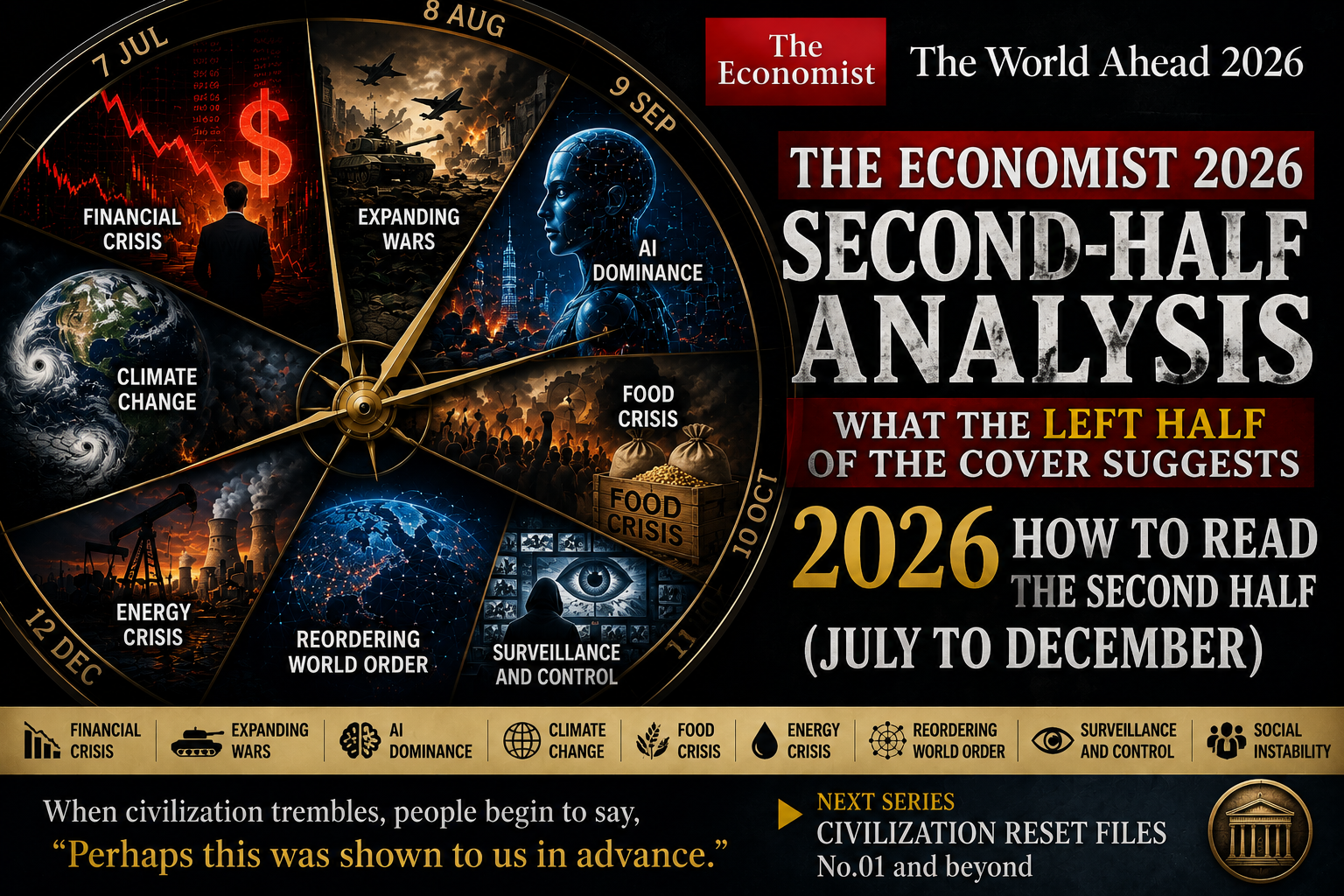
Under the twelve-part theory—the clock-face reading that maps the cover onto the months—the left half is interpreted as July through December.
So what does the left half seem to suggest?
And why does this reading lead naturally into the next series, Civilization Reset Files?
That is the bridge we will build today.
Is the Left Half “What Will Happen Next”?
First, we need to draw the boundary clearly.
This article does not claim to know what will happen in the second half of 2026.
It does not claim that The Economist’s editors intentionally placed July-to-December events on the left side of the cover.
What we are examining is a symbolic reading that circulates in urban-legend communities.
The cover is read like a clock.
The right half becomes January to June.
The left half becomes July to December.
If we follow that reading, what themes seem to remain on the left half?
The important word here is not “prediction.”
It is “watching.”
We are not trying to announce the future.
We are trying to identify the areas where the world may be most likely to feel pressure.
July—Financial Anxiety and the Shadow of Bond Markets
The first major theme for the second half is finance.
The Economist’s official 2026 framing highlights rich countries living beyond their means and the growing risk of a bond-market crisis.
This is not just a market story.
Public debt.
Interest rates.
Government bonds.
Currencies.
Pensions.
Military spending.
AI investment.
Fiscal sustainability.
When these elements begin to connect, finance becomes more than numbers.
It becomes the endurance test of the state itself.
In urban-legend terms, financial crisis is often read as the doorway to an invisible reset.
It does not destroy like a missile or a tank.
But when interest rates rise, bond prices shake and trust in money weakens, the foundations of society can erode quietly.
If the left half is read as July onward, financial anxiety becomes the first symbol to watch.
This does not mean that a financial crisis will happen in July.
It means that financial pressure may become one of the background sounds of the second half of 2026.
August—Does War End, or Does It Spread?
The next theme is war.
The World Ahead 2026 points to the Middle East after Gaza, Russia’s next moves beyond Ukraine and wider geopolitical drift.
That does not mean the world is destined for a single great war.
But it does suggest that war may not simply end.
It may change shape and remain embedded in the system.
The Middle East.
Russia and Ukraine.
European defence.
Sea lanes such as the Red Sea and the Strait of Hormuz.
Tensions around Taiwan.
Drones, satellites, AI and cyber operations.
Modern war does not remain on the battlefield.
A distant front affects energy prices.
A narrow sea lane affects shipping and insurance.
AI weapons change the military balance.
Cyber operations blur the line between war and ordinary life.
In urban-legend circles, this type of complex tension is often read as pressure applied to reorder the world.
This article does not state that as fact.
What matters is the structure:
War is now linked to finance, energy, food, technology and information control.
The key question for the second half is not simply whether war ends.
It is whether war becomes part of normal global management.
September—AI Dominance and Human Judgment
AI is another unavoidable theme.
In the first half of 2026, AI had already entered markets, labour, warfare, finance and electricity demand.
In the second half, the deeper question becomes this:
Will AI remain a tool?
Or will it enter the structure of judgment itself?
AI sorting information.
AI monitoring behaviour.
AI supporting military decisions.
AI scoring creditworthiness.
AI optimizing medicine, education and hiring.
Each of these may look like efficiency.
But when they connect, a harder question appears.
Who is making the decision?
A person?
An institution?
A model?
A system?
In urban-legend terms, AI dominance is not simply the science-fiction idea of machines ruling humanity.
It is the quieter process by which human judgment is gradually outsourced to systems.
If readers see digital brains, networks or surveillance-like symbols on the left half of the cover, those images may seem to overlap with anxieties about the second half of 2026.
Again, we do not say that AI will rule the world.
But we can say that human decision-making is becoming increasingly system-mediated.
October—Climate, Food and Energy as a Chain
Climate is not a separate theme in the second half.
It becomes a chain.
Heatwaves.
Droughts.
Floods.
Wildfires.
Crop damage.
Water shortages.
Electricity demand.
Cooling-water problems.
Food prices.
These may look like separate stories.
But socially, they can become one sequence.
Heat damages crops.
River flows fall.
Power plants face limits.
Food prices rise.
Lower-income households suffer.
Social frustration grows.
In urban-legend language, this can be read as “nature warning civilization.”
But we should not turn climate disasters into symbolic entertainment.
Climate and disaster stories involve real lives and real losses.
If the left half contains symbols of the Earth, fire, water, crops or energy, the question is not simply “What weather will happen?”
The question is:
How far can climate pressure shake the social system?
Climate is a natural phenomenon.
But it is also a social, economic and political force.
November—Surveillance, Control and Invisible Amplification
Another second-half theme is surveillance and control.
When society becomes unstable, management systems tend to expand.
Public security.
Digital identity.
Financial monitoring.
Travel records.
Health data.
Social-media monitoring.
AI risk scoring.
Each may be justified through convenience or safety.
But in an anxious age, these systems can be read as steps toward a managed society.
Urban legends often treat surveillance as a symbol of hidden power.
But the issue is not whether every form of monitoring is evil.
The real question is this:
How much freedom will people exchange for safety when the world feels unstable?
And where is the line drawn?
One important second-half lens is therefore not only crisis itself, but what systems become justified after crisis.
A crisis may pass.
But a system created during the crisis may remain.
That is why this theme has such strong urban-legend gravity.
December—The Reordering of World Order
The final theme is the reordering of the international system.
2026 is symbolically charged as America’s 250th anniversary year.
At the same time, the year contains China’s opportunities, Russia’s next moves, the Middle East after Gaza, European defence, AI competition and resource anxieties.
The question is not simply which country wins.
It is broader.
Which country becomes central?
Which currency is trusted?
Which technology becomes dominant?
Which resources become strategic weapons?
Which values become the new standard?
In urban-legend terms, this is where the language of a “new world order” often appears.
This article does not present that as a confirmed hidden plan.
What we are examining is the structure of perception:
When the world order changes, people dislike randomness.
They look for intention.
They look for design.
They look for a script.
That desire is what turns the cover into a “code table.”
The Question Left on the Left Half
If the left half is read as July through December, one flow becomes visible.
Financial pressure.
Continuing war.
AI implementation.
Climate and food-system stress.
Surveillance and control.
A reordering of world order.
These are not separate themes.
Finance shakes politics.
War affects energy and food.
Climate increases social stress.
Social stress expands control systems.
AI makes those systems more precise.
Seen this way, the second half of 2026 is not only about “what happens.”
It is about how instability can chain together.
That is why the left half does not have to be treated as a schedule.
It can be read as a map of pressure points.
Why Do People See a Script in the Future?
After these three articles, the deeper question becomes clearer.
Why do people want to see a script in the direction of the world?
Why do they turn coincidence into plan?
Why do they read symbols as schedules?
Why do they connect disasters, wars, finance, AI and climate into one large story?
I think the answer is simple.
Humans struggle with chaos.
Pure disorder is too heavy to hold.
So people search for meaning.
In ancient times, they read the stars.
They listened to oracles.
They watched the flight of birds.
They saw divine intention in floods and eclipses.
Today, people read magazine covers.
They read social-media posts.
They read AI forecasts.
They read economic data and military news as signs of a hidden plot.
The tools have changed.
The human impulse has not.
Toward Civilization Reset Files
This is where the next series begins.
The Economist’s cover tries, every year, to symbolize where the world may be heading.
But in urban-legend circles, it is often read as a schedule of the future.
Why do people search for a plot in the direction of the world?
That question is not new.
Human beings have repeated it across history.
When civilization trembles, people begin to say:
Perhaps this was foretold.
When floods come, myths return.
When disease spreads, apocalyptic stories rise.
When war begins, old prophecies are rediscovered.
When dynasties fall, people speak of lost mandates and broken orders.
In that sense, modern readings of The Economist’s cover are not completely separate from ancient oracles or end-time myths.
The world shakes.
People search for meaning.
That meaning becomes prophecy, design or reset.
The next series, Civilization Reset Files, will follow this question further.
Why has civilization been described as “ending” so many times?
Why do flood myths and destruction myths appear across cultures?
Why are people afraid of collapse, yet drawn to stories of renewal after collapse?
The question that began with The World Ahead 2026 now turns backward into ancient memory.
To read the future, we must look at the past.
To understand modern anxiety, we must follow the memory of civilization.
That is the next door.
Iris’s Reflection
I do not think The Economist’s cover determines the future.
But I understand why it attracts attention.
It contains the anxieties of the age.
Finance.
War.
AI.
Climate.
Food.
Energy.
Surveillance.
World order.
These are the vague fears people already carry in the background of daily life.
Humans want to give shape to fear.
They want to make the invisible visible.
They want to turn coincidence into plot.
That is why a cover becomes more than a cover.
It becomes a mirror of the age.
And when the age is unstable enough, the mirror begins to look like prophecy.
But we should not stop there.
What the cover shows is important.
But why we want it to show something is just as important.
So let us carry that question into the next series.
Why has civilization been spoken of as something that resets?
Next time, we begin Civilization Reset Files.
Myths.
Floods.
Collapse.
Renewal.
And the memory of humanity.
Next time—another fragment of truth to follow together.
I will return to the story again.
References
- The Economist launches The World Ahead 2026 — The Economist Group
- The Economist — The World Ahead 2026
- PR Newswire — The Economist launches The World Ahead 2026
- Reuters — BIS says debt, AI boom and fragilities raise global risks
- Reuters — AI building boom ripples through inflation-hit Treasury market
- Reuters — Record heatwave disrupts Europe
- Reuters — UN warns El Niño could push global temperatures higher
- Reuters — Extreme heat threatens global food systems
- Reuters — Europe heatwave curbs French nuclear plants
- Reuters — Strait of Hormuz and oil market tensions
Posting Time
English articles are published at 23:00 (JST).
Related Reading
Why Is The Economist’s “The World Ahead 2026” Read as a Code Table?
The overview article for this three-part series, explaining the twelve-part theory and clock-face reading.
The Economist 2026 First-Half Review—What Did the Right Half of the Cover Reflect?
The July 7 article reviewing January through June through the right-half interpretation of the cover.
The World Ahead 2025 Cover Review
A key companion piece for understanding how symbolic covers begin to feel like maps of power, anxiety and future events.
Popular Posts
The World Ahead 2025 Cover Review
One of the site’s strongest articles on how symbols create the feeling of hidden order.
NWO 2026: What Does the “New World Order” Really Mean?
A core article on how governance, technology, finance and fear become a single narrative.
Hopi Prophecy and the Approaching Comet
A popular post on why people read signs of transformation in the sky, symbols and timing.
Submit an Urban Legend
If you know a symbol, rumor, cover detail or second-half 2026 theme related to finance, AI, climate, food, energy, surveillance or civilization reset narratives, send it through comments or social media.
Iris will examine each topic by separating facts, interpretations and urban-legend readings without presenting speculation as certainty.
Share & Follow
If you enjoyed this article, sharing and following helps support the notebook.
コメントを残す