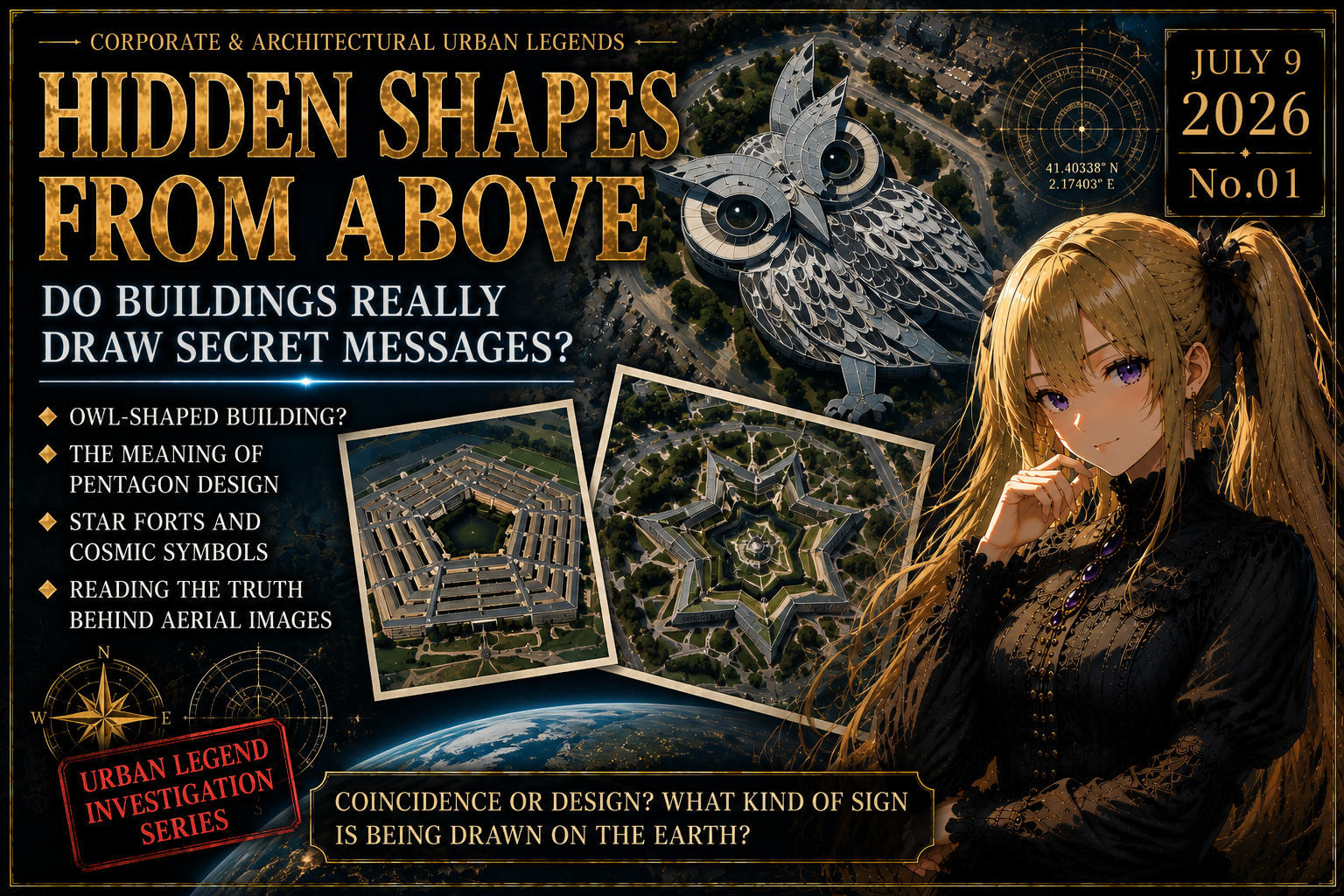
I am Iris.
Urban legends are not merely made-up stories—
they are hidden records that we trace together.
Look at a city from above.
What seemed like ordinary roads, buildings, courtyards, and parking lots from ground level can suddenly become something else when seen through satellite imagery or aerial photography.
A building resembles an owl.
A fortress becomes a star.
A road network turns into a symbol.
A corporate campus appears to form a pattern too deliberate to be accidental.
And then the urban legend begins to whisper.
Is this coincidence?
Or did someone draw a message on the earth, knowing it would one day be seen from the sky?
In this entry of Corporate & Architectural Urban Legends, we trace the mystery of hidden shapes seen from above.
The Aerial View Created a New Kind of Urban Legend
For most of history, people saw cities from the ground.
They walked through streets.
They looked up at buildings.
They entered gates.
They stood in courtyards.
They climbed towers or hills to see a wider view.
That was the human scale of architecture.
But aerial photography, satellite imagery, and tools such as Google Earth changed that.
Suddenly, ordinary people could look down at cities from a near-godlike perspective.
And once that perspective became available, urban legends changed with it.
A normal building could look like an animal.
A road curve could resemble a symbol.
A symmetrical plan could look like a face.
A campus layout could seem like a hidden emblem.
The aerial view became a new lens for discovering “secret forms.”
The Owl-Shaped Building Legend
One of the strongest motifs in aerial architecture legends is the owl-shaped building.
Two circular structures become eyes.
A central projection becomes a beak.
Wing-like building sections spread outward.
A symmetrical layout becomes a bird staring upward.
The owl is a powerful symbol for urban legends.
Wisdom.
Night.
Hidden observation.
Silent flight.
A creature that sees in darkness.
A figure sometimes connected, fairly or unfairly, to secretive organizations and elite symbolism.
So when a building appears to resemble an owl from above, people naturally begin asking whether the resemblance was intentional.
But the boundary must be kept clear.
Something can look like an owl without being designed as an owl.
Roofs.
Courtyards.
Circular halls.
Parking lots.
Walkways.
Ventilation systems.
Structural symmetry.
Road access.
Lighting and landscaping.
Architecture is shaped by many practical factors.
When seen from above, those practical choices can accidentally form animal-like or face-like patterns.
Urban legends begin when the accidental shape receives symbolic meaning.
Why Is the Pentagon a Pentagon?
One of the most famous buildings in the world, when seen from above, is the Pentagon.
A massive five-sided structure.
A central courtyard.
Concentric corridors.
A geometric form so strong that the building’s name and shape have become inseparable.
In urban-legend circles, the Pentagon is often read symbolically.
Five sides.
Military power.
A central void.
A controlled geometric structure.
A building that seems to carry the weight of state power in its very shape.
It is easy to see why the imagination attaches meaning to it.
But the historical explanation is more practical.
The building’s initial site was bordered by five roads, so the early design followed that five-sided constraint.
Later, the location changed, but the five-sided plan was kept rather than completely redesigned.
So the shape was not primarily a secret symbol.
It was a practical solution that later became an icon.
That is the fascinating part.
A form created through function can later be read as symbolism.
The urban legend grows in the gap between design history and visual impact.
Were Star Forts Magical Diagrams?
Star forts are another powerful example of architecture that becomes mysterious from above.
They can resemble pentagrams, stars, snowflakes, or ritual diagrams.
They often have angular bastions, moats, layered defenses, and striking geometric outlines.
In satellite imagery, some star forts look almost too perfect.
That is why urban legends sometimes describe them as magical diagrams, energy devices, or symbols carved into the earth.
But star forts also have a clear military explanation.
As cannons became more important in warfare, older vertical walls became vulnerable.
Fortifications needed lower, thicker walls, angled bastions, and shapes that reduced blind spots.
Bastions allowed defenders to fire along the walls and made it harder for attackers to approach safely.
The “star” shape was therefore not primarily mystical.
It was geometry serving defense.
Still, the visual power remains.
A military solution became a cosmic-looking symbol when viewed from above.
That is where urban legend finds its opening.
Why Do Buildings Look Like Messages?
The real center of this urban legend is not only architecture.
It is perception.
Humans are pattern-finding beings.
We see animals in clouds.
Faces in wall stains.
Figures in moonlight.
Eyes in random arrangements.
Meaning in symmetry.
This tendency to perceive meaningful forms in vague or random visual stimuli is known as pareidolia.
Architecture can trigger the same response.
Two circles become eyes.
A central line becomes a nose.
A star-shaped fort becomes a ritual symbol.
A pentagon becomes a code.
A campus layout becomes an emblem.
A road system becomes a hidden diagram.
The human brain is excellent at finding meaning.
Sometimes, it is too excellent.
From above, the city becomes a field of possible signs.
Urban Legends in the Age of Google Earth
The spread of satellite imagery has made this kind of urban legend much easier to share.
In the past, aerial photographs were rare.
Now, anyone can examine cities, corporate campuses, forts, airports, deserts, military facilities, religious complexes, theme parks, and remote landscapes from above.
A person can zoom in.
Rotate the view.
Take a screenshot.
Post it online.
Add a question:
“Doesn’t this look like an owl?”
“Why is this building shaped like an eye?”
“Is this road network forming a symbol?”
“Is this too perfect to be coincidence?”
These images travel quickly because they are visually persuasive.
A single screenshot can do what a thousand words cannot.
It lets the viewer feel as though they have discovered the secret for themselves.
That is why aerial-image urban legends work so well in the digital age.
Designed Shapes and Discovered Shapes
There are two different categories we must separate.
The first is the designed shape.
Some buildings, gardens, monuments, plazas, and city plans are intentionally symbolic.
Architects and planners may consider how a place appears from above.
Ceremonial axes, memorial landscapes, gardens, and landmark projects can indeed contain deliberate visual meaning.
The second is the discovered shape.
A building may look symbolic only because of practical constraints:
land boundaries, road access, parking, structural needs, lighting, ventilation, budget, security, or expansion history.
Urban legends often begin when these two categories are confused.
It looks meaningful.
Therefore, it must have been intended.
That leap is the engine of the legend.
But careful reading requires a pause.
Who designed it?
Are design records available?
Was the shape necessary for function?
Does it look symbolic from all angles, or only one?
Is the image being cropped to support a claim?
Was the meaning added later by viewers?
Only after asking those questions can we begin to judge whether we are seeing intention, coincidence, or interpretation.
A City Changes Meaning When Seen from Above
A city changes when the viewpoint changes.
At ground level, a building is used.
From above, it is read.
On foot, a road is movement.
On a map, it is a line.
In satellite imagery, it becomes geometry.
In urban legends, it becomes a message.
That shift is powerful.
A city is not only lived in.
It is also designed, recorded, mapped, photographed, and interpreted.
Every building holds layers:
function,
land,
budget,
security,
history,
aesthetic choice,
symbolic reading,
and human imagination.
Urban legends emerge when these layers overlap.
Conclusion: Who Is the Message For?
Hidden shapes from above.
Sometimes they may be intentional designs.
Sometimes they are practical solutions.
Sometimes they are military geometry.
Sometimes they are the result of land constraints.
Sometimes they are pareidolia.
The important thing is not to treat appearance as proof.
But it is also too simple to dismiss the feeling entirely.
Human beings have always made meaning from shapes.
Constellations.
Maps.
Coats of arms.
Logos.
Sacred geometry.
City plans.
Urban legends.
When we look down at a city and see a hidden form, we may be seeing a designer’s intention.
We may be seeing history.
We may be seeing function.
Or we may be seeing our own hunger for meaning.
Perhaps the hidden shape is not only a message from architecture.
Perhaps it is a mirror of the human mind.
Next time, Corporate Logo Urban Legends:
July 10 — 7-Eleven.
We will trace the rumors surrounding one of the most familiar convenience-store brands in the world.
Next time, I will return to trace another fragment of hidden truth with you.
References
-
Smithsonian Magazine|Why Is the Pentagon a Pentagon?
A reference for the practical origin of the Pentagon’s five-sided design and its relationship to the original site constraints. -
National Park Service|How the Star Fort Got Its Shape
A reference for how bastions created the star-like appearance of star forts when seen from above. -
National Park Service|Bastions – Castillo de San Marcos
A reference for bastion fort design and how its geometry reduced blind spots or dead zones. -
EBSCO Research Starters|Pareidolia
A reference for pareidolia, the human tendency to perceive meaningful patterns such as faces or animals in random or ambiguous stimuli. -
Google Maps Platform|Google Earth capabilities
A reference for Google Earth as a tool combining aerial photography, satellite imagery, 3D topography, and geographic data.
Posting Time
English articles are published at 23:00 (JST).
Related Reading
The Economist “The World Ahead 2025” Cover — A Symbol Map of Power
A related article for reading symbols, composition, and how visual design can invite deeper interpretation.
Memories of the Gods No.03: Those Who Taught Civilization — Why Does Humanity Speak of Teachers from Beyond?
A useful companion piece for understanding how architecture, civilization, and knowledge are often framed as something received from beyond ordinary humanity.
Memories of the Gods No.05: Vimanas, the Flying Vehicles of the Gods — What Was the “Sky Technology” Preserved in Myth?
A related article for connecting aerial viewpoints, sky technology, and the way modern readers reinterpret ancient images through modern eyes.
Popular Posts
The Economist “The World Ahead 2025” Cover — A Symbol Map of Power
A popular symbolic reading of how images, design, and anxiety can make the future feel scripted.
NWO in 2026 — The Hidden Operating System of the Modern World
A key article for understanding how modern power, systems, and urban legends overlap.
The Hopi Prophecy and the Approaching Comet — The Blue Star Kachina and the Turning of the Age
A classic entry point into prophecy, celestial signs, and mythic patterns of world change.
Submit an Urban Legend
If there is a building, logo, hidden pattern, symbol, rumor, or unexplained story you would like Iris to examine, feel free to send it in. This blog approaches each theme through structure, context, and careful verification rather than simple assertion.
Share & Follow
If you enjoyed this article, sharing and following helps support the journal.
Blog Top
▶️ YouTube
Share on X
Share on Facebook
Follow on Instagram
Follow @Kataribe_Iris
コメントを残す