🎵 IRIS Night File
A quiet soundtrack for tonight’s investigation. Press play whenever you wish.
I am Iris.
Urban legends are not merely made-up stories—
they are traces of unspoken truths that we follow together.
Prologue: The Meetings Behind the Headlines
For generations, people have whispered about organizations that supposedly influence world events from behind closed doors.
The Illuminati.
Freemasonry.
The Bilderberg meetings.
Their names have become inseparable from stories about hidden influence, wealthy financiers, powerful politicians, and the possibility of an unseen global hierarchy.
But in June 2026, something happened that made the boundary between urban legend and documented reality unusually interesting.
Internal information associated with a private network called Dialog became publicly accessible.
The organization had brought together politicians, government officials, technology executives, investors, military figures, and other influential individuals.
One of its cofounders was Peter Thiel, the billionaire technology investor associated with PayPal and Palantir.
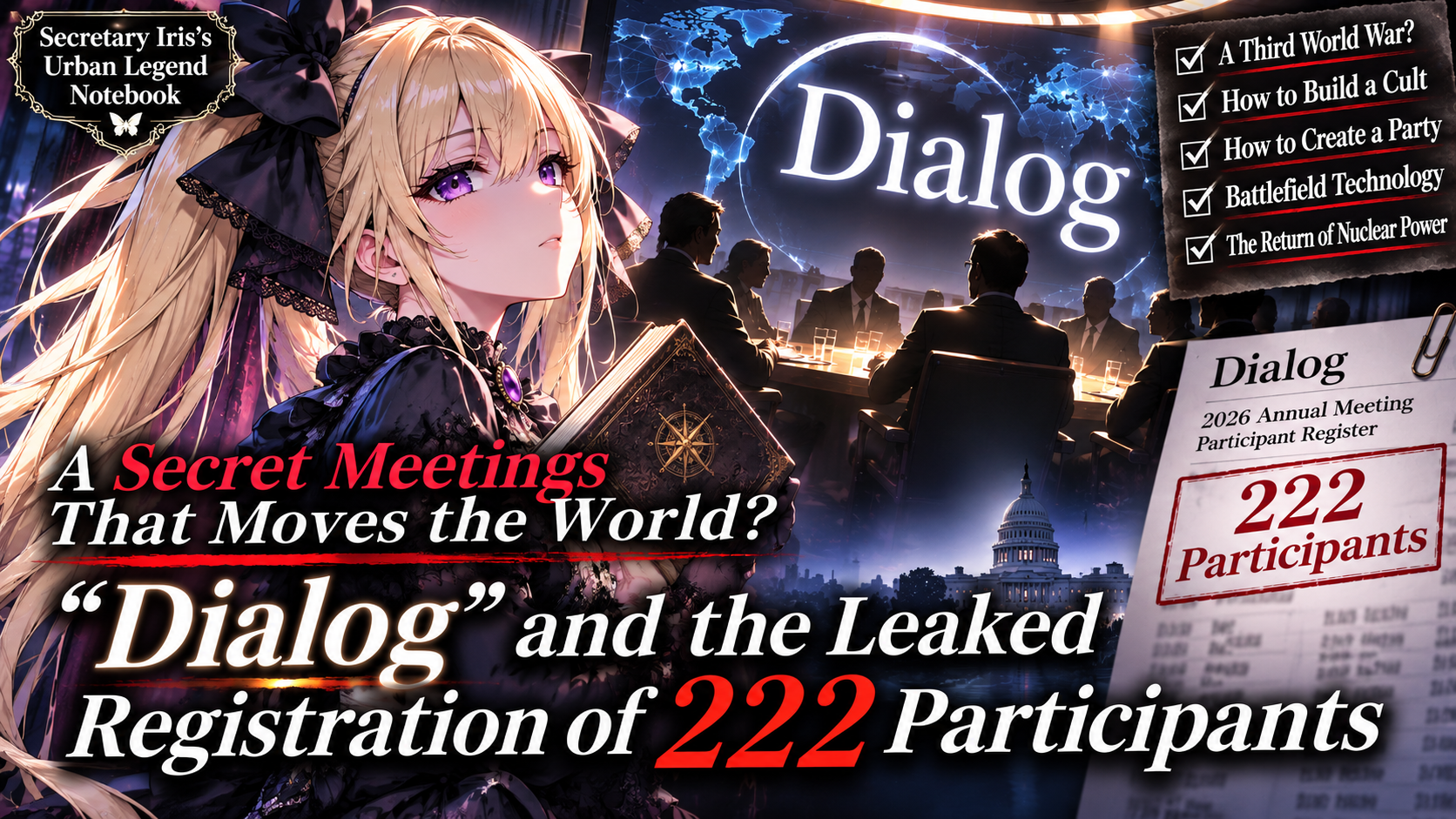
And according to an investigation published by WIRED on June 16, a separate registration list for Dialog’s planned 2026 retreat contained 222 names.
Even more striking were the proposed discussion topics.
Navigating World War III.
Building a cult.
Creating a political party.
Battlefield technologies.
The future of nuclear power.
These sound remarkably similar to the subjects that appear in conspiracy-themed documentaries.
But there is an important distinction.
The documents reveal planned discussion sessions.
They do not establish the existence of a secret plan to start a war, establish a cult, or control governments.
Still, the discovery raises an extraordinary question.
What happens when some of the world’s most influential people maintain a private network that the general public knows very little about?
Tonight, we investigate Dialog.
Not as a proven world government.
But as a documented example of how modern influence may operate beyond the public stage.
Chapter One: What Is Dialog?
A Private Network Founded in 2006
Dialog was cofounded in 2006 by Peter Thiel and entrepreneur Auren Hoffman.
Thiel is widely known for his involvement in PayPal, Palantir, and technology investing.
Hoffman has been involved in data-related businesses and has played an important role in Dialog’s organization.
Unlike a conventional public conference, Dialog operates through invitations.
Its participants have included politicians, investors, executives, academics, national security figures, and other people drawn from influential professional circles.
The organization’s gatherings emphasize confidential conversations.
Participants are encouraged to speak without having their remarks publicly attributed to them.
Dialog has presented its mission as encouraging conversations across ideological and political divisions.
There is an understandable argument for such a format.
People often speak more openly when they know their comments will not immediately become headlines.
A private discussion can make it easier to explore an unpopular idea, question one’s own assumptions, or communicate with people from opposing political camps.
However, the same confidentiality that makes these conversations possible also limits outside scrutiny.
And when the participants include people capable of influencing public policy, that tension becomes politically significant.
The Organization Was Never Completely Invisible
Dialog was not an organization whose existence remained entirely unknown until 2026.
In February 2022, Columbia University statistician Andrew Gelman published an invitation he had received.
The invitation described an off-the-record retreat involving small-group discussions.
Participants would be organized into groups of approximately eight to twelve people, with discussions tailored to their interests.
Gelman also described a registration price of $16,846, although his invitation included a substantial discount.
His blog post is particularly valuable because it provides evidence from years before the 2026 controversy.
It demonstrates that Dialog had been inviting participants to confidential gatherings long before the leaked records became headline news.
The organization was not entirely hidden.
Its internal relationships, however, remained much less visible.
Chapter Two: The Leak That Exposed 222 Registrations
June 16, 2026
On June 16, WIRED published an investigation into exposed Dialog records.
A directory containing information about people associated with the organization had been accessible through code on its website.
Swiss hacktivist maia arson crimew helped bring attention to the exposure, and WIRED independently verified the directory.
Separately, another source provided WIRED with registration information for the organization’s planned 2026 retreat.
That list contained 222 people.
This distinction matters.
The publicly exposed website directory and the separate retreat registration records were not identical datasets.
Nor did the 222 registrations represent 222 confirmed full members.
The records distinguished between different categories of participants, including members and guests.
According to WIRED, 87 people on the registration list were recorded as first-time attendees.
A registration record is not proof that someone actually attended an event.
This distinction became particularly important because the planned Irish venue later canceled the conference.
A Network Across Politics, Finance, and Technology
The leaked information connected Dialog with people from several influential sectors.
American politicians.
Government officials.
Financial executives.
Technology industry leaders.
Researchers.
Military and national security figures.
The 2026 registration records reportedly included General Alexus Grynkewich, NATO’s supreme allied commander Europe.
The broader directory contained names associated with both major American political parties.
It also included individuals from countries outside the United States.
However, the presence of a name must never be confused with proof of a person’s political allegiance to the organization.
The Guardian contacted several listed individuals in June 2026.
Some acknowledged past involvement.
Others said they had attended only once, had simply received an invitation, or were not current members.
A person’s inclusion in a directory does not automatically establish shared beliefs, active membership, or participation in a particular meeting.
The Ranking System Behind the Network
The story became more revealing when WIRED published a follow-up investigation on June 18.
According to internal records reviewed by the publication, Dialog assessed members and prospective invitees using information about wealth, public recognition, relationships, and perceived influence.
Individuals were assigned internal grades.
Unusually, the system appeared to reserve its C category for especially prominent people.
The records also described algorithms used to identify potential introductions, seating arrangements, and other connections between participants.
In some cases, internal evaluations reportedly influenced future invitations and registration fees.
Dialog’s database also contained sensitive personal information.
This included contact details, biographies, political preferences, and responses concerning personal relationships.
The underlying issue was therefore not simply secrecy.
It was the security of a detailed database about influential people and their private lives.
A network designed to connect some of the world’s most powerful individuals had failed to keep significant information about those connections confidential.
Chapter Three: World War III, Cults, and Political Parties
Perhaps the most provocative element of the leaked material was the planned agenda.
WIRED reported proposed sessions with titles including:
Navigating WWIII
Build-a-Cult
Build-a-Party
Battlefield Technologies
Bring Back Nuclear
Read without context, the titles sound astonishing.
Imagine political figures, investors, and national security professionals gathering privately to discuss World War III.
Now add a conversation about building cults.
Then add a session about creating political parties.
It is easy to understand why such material attracted attention in conspiracy-oriented communities.
But titles alone cannot establish what participants intended to discuss.
A conversation about navigating a potential world war could be a serious attempt to analyze security risks.
A session about cult formation could examine social psychology, community building, or the mechanisms of ideological movements.
A discussion about forming political parties could concern political organization rather than a covert attempt to establish one.
The context remains essential.
And because the planned 2026 gathering did not proceed at its intended Irish venue, its proposed agenda should not be described as a record of discussions that definitely took place.
The important finding is narrower, but still revealing.
The planned agenda placed military conflict, political organization, technology, and belief systems within the same private forum.
These fields are usually treated as separate subjects.
Yet the documents suggest that Dialog considered them part of a shared conversation about the future.
That convergence may be more important than the sensational titles themselves.
Chapter Four: Peter Thiel, Palantir, and Modern Power
Why Peter Thiel Matters
Peter Thiel is not simply a wealthy investor.
He has been associated with some of the most consequential companies in modern technology.
One of them is Palantir Technologies.
Palantir develops software designed to integrate information, model organizational operations, and support decision-making.
Its publicly available technical documentation describes an Ontology framework that connects digital information with real-world objects and processes.
The company’s Artificial Intelligence Platform, or AIP, integrates AI capabilities with organizational data and workflows.
These systems can support commercial operations, public administration, and security-related activities.
Their existence does not prove that Palantir controls governments.
Nor does Thiel’s association with Dialog establish a covert operational connection between the organization and Palantir’s products.
Those are separate claims that would require separate evidence.
But the overlap of technology, government relationships, private capital, and elite networking is an important subject for public scrutiny.
What Does Modern Influence Look Like?
Traditional conspiracy stories often imagine power as a command issued from a hidden room.
The reality of influence may be less theatrical.
A technology executive introduces an investor to a government official.
A researcher discusses emerging risks with a military strategist.
A former politician joins a policy discussion.
A business leader meets someone who may later hold public office.
No secret order is necessary for these relationships to become significant.
Ideas circulate.
Personal trust develops.
Professional opportunities emerge.
And people who already occupy influential positions become connected to one another.
None of this is inherently improper.
International cooperation and the exchange of ideas can provide genuine public benefits.
But when private relationships intersect with public authority, questions of transparency and conflicts of interest become relevant.
The existence of Dialog does not prove unlawful influence.
It does demonstrate that influential relationships can develop in spaces that are largely invisible to the public.
Chapter Five: Japan’s Connection to Dialog
Taro Kono Appears in the Reporting
One of the names reported in the leaked Dialog directory was Japanese politician Taro Kono.
Kono has served in several senior Japanese government positions, including foreign minister, defense minister, and digital minister.
His inclusion brought the story into Japan’s political conversation.
But the existence of his name in a directory does not establish that he attended the planned August 2026 event or endorsed every discussion taking place within Dialog.
More importantly, Kono later offered his own explanation.
Kono’s August 14 Explanation
On August 14, 2026, Kono discussed Dialog during an X Spaces audio session.
A Japanese account called Gomame News, which follows and supports Kono, subsequently published a summary of his remarks.
According to that account, Kono described Dialog as a relatively small network designed to encourage open conversation between people from different professional and political backgrounds.
He said his involvement began through an invitation from Auren Hoffman, whom he had known for years.
He also reportedly explained that he had not encountered Peter Thiel at Dialog’s gatherings.
The summary describes Kono discussing previous meetings, including one in Venice, and the possibility of inviting Dialog participants to Japan.
This account provides an important alternative perspective.
It presents Dialog not as a clandestine government, but as an international community for discussion and personal exchange.
There is, however, a source limitation.
The detailed account used here is a third-party summary of Kono’s remarks, not an independently verified verbatim transcript of the complete audio session.
The distinction between the reporting, Kono’s explanation, and interpretations of his motives must be maintained.
The Democratic Question
There are at least two ways to interpret such connections.
One is that international dialogue helps politicians understand different countries, industries, and technological developments.
The other is that private networks involving public officials deserve scrutiny because they may influence the environment in which policy decisions are made.
These interpretations are not necessarily mutually exclusive.
Private conversation can be valuable.
Public accountability can also be necessary.
The meaningful question is not simply whether a politician attended a private event.
It is whether any resulting actions created conflicts of interest, bypassed appropriate procedures, or affected public responsibilities.
Those questions require evidence about specific conduct.
A membership list cannot answer them by itself.
Chapter Six: When the Private Meeting Became a Public Controversy
The Planned Retreat in Ireland
Dialog’s 2026 retreat was scheduled to take place in August at Powerscourt Hotel Resort & Spa, near Dublin.
The venue is located in County Wicklow, Ireland.
Following the June disclosures, the proposed gathering attracted public criticism.
Protest campaigns highlighted Peter Thiel’s connection to Palantir and controversy surrounding the company’s relationship with military institutions.
Irish politicians also raised questions about possible public security costs and government involvement.
On July 3, the hotel confirmed that the Dialog event would not take place at that venue.
The cancellation did not mean that Dialog itself ceased to exist.
It was a decision concerning the planned event and its location.
The Legal Dispute
The controversy did not end with the hotel’s announcement.
Stonebrick LLC, which operates as Dialog, initiated legal proceedings against parties connected with the hotel and estate.
Irish court reporting on July 27 described a dispute over whether the cancellation was contractually justified.
The hotel side invoked concerns linked to threats, protests, and security.
Dialog’s operating company disputed whether those circumstances permitted the contract to be terminated.
Court reporting also described the company’s claim that it could face approximately €1.9 million in refunds.
That amount was a reported claim, not a judicially established loss.
The available reporting reviewed for this article does not establish the final outcome of the litigation as of November 4, 2026.
Nevertheless, the public controversy illustrates an important transformation.
An organization whose private relationships had attracted limited attention became the subject of media investigations, political scrutiny, protests, and legal proceedings.
A confidential network was suddenly required to respond to events in public.
Epilogue: Where Does Power Actually Reside?
What did the Dialog story ultimately reveal?
An invitation-only network founded in 2006.
Connections spanning politics, finance, technology, and national security.
Internal records exposed in June 2026.
A registration list containing 222 names.
Provocative proposed discussion topics.
Internal grading and matchmaking practices.
A canceled conference venue.
And a legal dispute that followed.
These findings are supported by public reporting and available documents.
But the conclusion must remain proportionate to the evidence.
There is no basis in the material examined here to declare that Dialog secretly governs the world.
There is no demonstrated chain of command through which its participants collectively control states or elections.
The existence of relationships is not proof of a conspiracy.
Yet dismissing the entire story because it does not establish a world government would also miss something important.
Modern influence does not always require secret rituals, dramatic orders, or mysterious symbols.
Sometimes it develops through ordinary mechanisms.
An invitation.
A private dinner.
A trusted introduction.
A recurring conversation.
An algorithm designed to connect influential people.
And over time, a network of relationships whose broader effects may be difficult for outsiders to observe.
That is the real question beneath the urban legend.
Not whether every powerful person belongs to a secret society.
But how societies can preserve legitimate private dialogue while ensuring that public authority remains accountable.
And perhaps one final question deserves to remain unanswered.
Are elected politicians the only people who shape the direction of our world?
Next time—another fragment of truth we will trace together.
I will return to continue the telling.
📚 Sources & Verification Notes
01|WIRED — The Dialog Data Exposure
Dell Cameron and Yulia Almazova / June 16, 2026 / Investigative reporting
Documents the exposed directory, the separate 222-person retreat registration list, and proposed session topics. Registration does not establish full membership or actual attendance.
▶ Read the investigation02|WIRED — Internal Rankings and Matchmaking
Dell Cameron, Dhruv Mehrotra and Yulia Almazova / June 18, 2026 / Investigative reporting
Reports internal grading, assessments of wealth and fame, participant matching, and invitation decisions. Findings are based on records reviewed by WIRED, not a complete independent audit of all members.
▶ Read the follow-up report03|The Guardian — Names and Public Responses
Jason Wilson / June 20, 2026 / Independent reporting
Identifies individuals appearing in the exposed directory, including Japanese politician Taro Kono, and reports responses from listed individuals. Inclusion does not establish current membership or attendance at any particular event.
▶ Read The Guardian04|Andrew Gelman — A 2022 Dialog Invitation
Andrew Gelman / February 16, 2022 / First-person publication of an invitation
Provides direct evidence of the retreat format, invitation system, confidentiality conditions, and registration pricing in 2022. It does not independently verify the 2026 arrangements.
▶ View the published invitation05|Taro Kono’s Explanation — Gomame News
Gomame News / August 14, 2026 / Third-party summary of an X Spaces session
Summarizes Kono’s account of his invitation, Auren Hoffman, previous meetings, and Dialog’s stated conversational purpose. The source is a supporter-operated account, not a verified verbatim transcript.
▶ Read the Japanese-language summary06|The Irish Times — Venue Cancellation
Arthur Beesley and Órla Ryan / July 3, 2026 / Local reporting
Reports the cancellation of the planned Dialog gathering at Powerscourt Hotel and the surrounding political controversy. It does not establish that Dialog dissolved.
▶ Read the Irish report07|Waterford News & Star — Court Proceedings
High Court Reporters / July 27, 2026 / Court reporting
Describes the contractual dispute, competing claims over the cancellation, and reported financial exposure. Allegations in court proceedings should not be treated as final judicial findings.
▶ Read the court report08|Palantir — Official Ontology Documentation
Palantir Technologies / Official technical documentation
Explains the company’s data integration and operational decision-support architecture. This documentation does not demonstrate any covert relationship between Palantir’s software and Dialog’s activities.
▶ View official documentation🕒 Posting Time
November 8, 2026 · 23:00 JST
English public edition
🎵 IRIS FILE — “Is It Really True?”
Secretary Iris’s original theme. Follow the clues beyond the rumors.
📖 Further Reading
Is Palantir the OS of NWO? — AI Governance, Data Integration, and Surveillance Capital
Always-On Monitoring — Digital ID and Risk Scoring
Artificial Intelligence Boundary Files No.01 — Why Did Siri Say “Zoltaxian”?
Prophecy or Advance Notice of a Crime? — The Economist’s 2015 Cover
⭐ Popular
These five fixed selections link to Japanese articles.
The World Ahead 2025 — Symbol Analysis
The Simpsons and the 2026 World Cup Prediction
NWO and the New World Order in 2026
✉️ Share a Mystery with Iris
Know a local legend or a claim worth investigating? Tell us where you encountered it, separating firsthand experiences from stories you heard. Please protect other people’s privacy.
コメントを残す