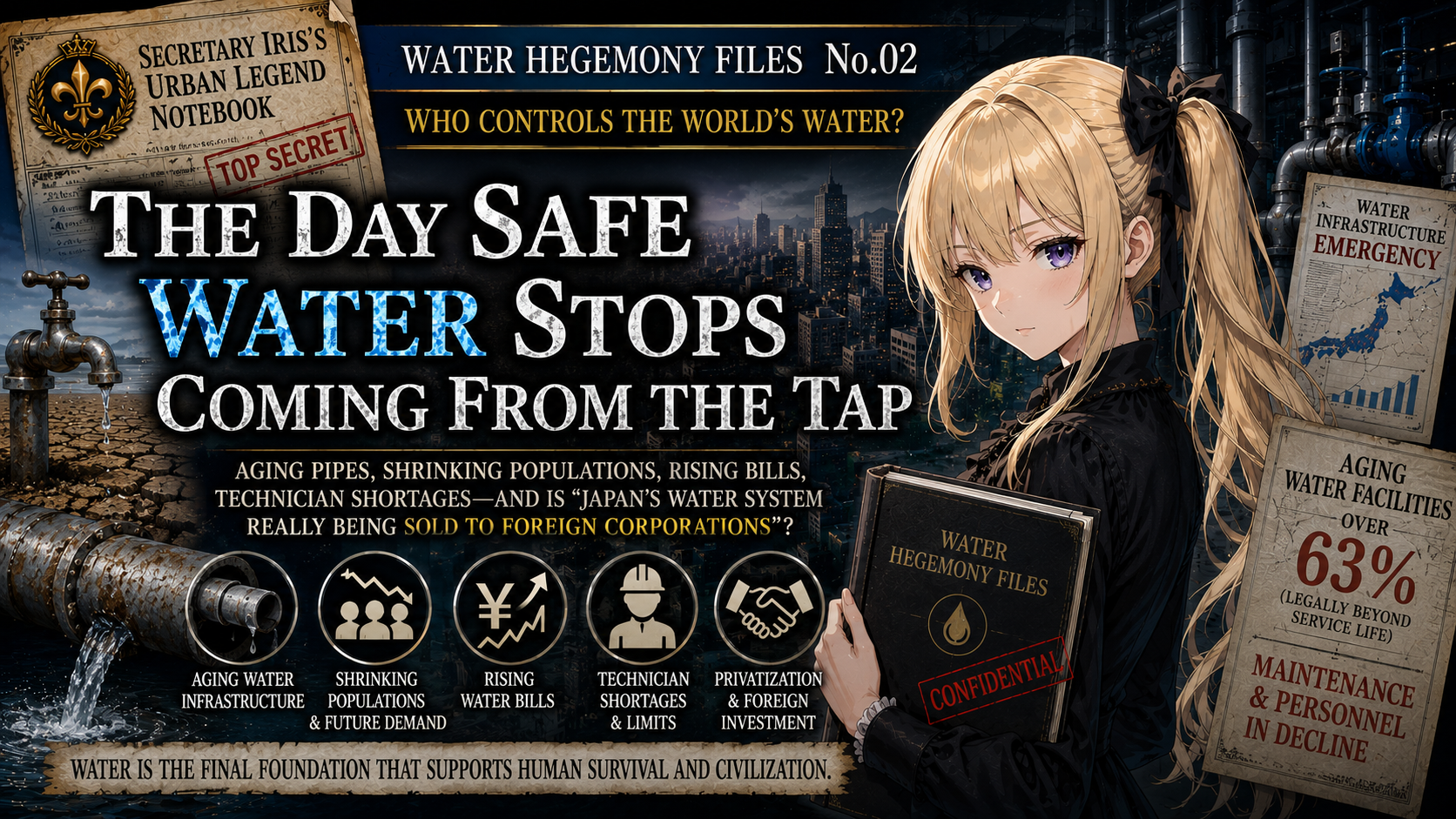
I am Iris.
Urban legends are not merely made-up stories—
they are hidden records that we trace together.
You wake in the morning and turn a handle.
Clear water appears.
You wash your face.
Fill a glass.
Prepare food.
Take a shower.
Most people do not ask where that water came from.
Rain fell somewhere upstream.
Water entered a river, reservoir, lake, or aquifer.
It was transported to a treatment plant.
Particles and microorganisms were removed.
The water was disinfected, tested, pumped into storage, and sent through a network of underground pipes.
The tap is only the final point in a much larger system.
Safe drinking water is not a natural event.
It is an engineered public service supported by pipes, pumps, electricity, chemicals, laboratories, technicians, financial systems, regulations, and local governments.
A region can possess abundant water and still fail to deliver safe water to its residents.
A river is not a water utility.
A reservoir is not a distribution system.
Water must be treated, transported, monitored, repaired, and financed.
In Water Hegemony Files No.02, we will examine the infrastructure crisis hidden beneath Japan’s streets.
Aging pipes.
Shrinking populations.
Declining revenue.
Rising bills.
A shortage of skilled workers.
And the claim that Japan’s water systems are being sold to private or foreign corporations.
One Quarter of Japan’s Water Pipelines Have Exceeded Their Statutory Service Life
Japan’s drinking-water pipeline network extends for approximately 746,000 kilometers.
That is enough pipe to circle the Earth many times.
According to Japan’s Ministry of Land, Infrastructure, Transport and Tourism, 25.3 percent of the network had exceeded its statutory service life by fiscal year 2023.
During the same fiscal year, the pipeline renewal rate was 0.61 percent.
These figures require careful interpretation.
A pipe does not automatically become unsafe the day it exceeds an accounting-based service-life benchmark.
Its real condition depends on:
Material.
Soil.
Corrosion.
Traffic.
Construction quality.
Water pressure.
Earthquakes.
Freezing.
Maintenance history.
Some pipes remain functional beyond the statutory period.
Others can fail earlier because of local conditions.
The official aging rate should therefore not be translated into the claim that one quarter of Japanese tap water is currently unsafe.
It means that the volume of infrastructure requiring inspection, prioritization, rehabilitation, or replacement is steadily growing.
At the same time, the annual replacement rate remains below one percent.
A single year’s renewal rate cannot be used as a precise countdown for the entire network.
Different pipes have different ages and conditions.
Nevertheless, the gap reveals a structural problem:
More infrastructure is entering an older age category than utilities can easily replace.
Why Pipe Replacement Is So Difficult
Water pipes are buried beneath roads.
Replacing them often requires:
Traffic control.
Excavation.
Coordination with gas, electricity, sewerage, and telecommunications infrastructure.
Temporary water-service arrangements.
Testing.
Road restoration.
Updated mapping.
Compliance with modern seismic standards.
The cost is not limited to the price of a new pipe.
Dense cities contain complicated underground networks and limited construction hours.
Rural communities have the opposite problem.
A small number of customers may be spread across a very large service area.
Mountain regions, remote islands, and snow-covered districts face additional logistical costs.
In Hokkaido and other cold regions, pipes must be protected from freezing.
Repair crews may need to operate during snowstorms, power outages, and road closures.
Replacing a public water network is not like replacing a household faucet.
It is the continuous reconstruction of an underground city while the city remains in operation.
A Smaller Population Does Not Produce a Smaller Network
Japan’s population is declining.
Water demand is also expected to decline as the population falls and water-efficient appliances become more common.
Using less water may be environmentally beneficial.
But a water utility’s revenue often depends heavily on customer charges.
Fewer people.
Lower consumption.
Lower revenue.
The treatment plants, reservoirs, pumps, laboratories, and pipelines still have to operate.
A ten-percent decline in population does not allow a municipality to remove ten percent of its pipes.
In dispersed rural areas, utilities must maintain long networks for a shrinking number of households.
Water systems contain both variable and fixed costs.
The cost of treating an additional unit of water may decline when less water is used.
But many costs remain:
Staff.
Laboratories.
Electricity contracts.
Asset maintenance.
Emergency preparation.
Debt repayment.
Regulatory compliance.
A smaller customer base may therefore be asked to support the same physical system.
This is one of the quiet contradictions of modern water policy.
Society encourages conservation.
Utilities still need enough revenue to maintain the infrastructure that makes conservation possible.
Why Water Bills Differ Between Communities
Japan does not have one national household water tariff.
Charges differ between utilities because local conditions differ.
Distance from the water source.
Quality of raw water.
Elevation.
Population density.
Length of pipeline per customer.
Treatment requirements.
Historical investment.
Debt.
Energy costs.
A densely populated city near a high-quality source may be able to distribute water efficiently.
A rural utility may need long pipelines, several pumping stations, and multiple storage facilities to serve a small population.
A community with difficult raw-water conditions may require more advanced treatment.
Water bills therefore do not pay only for the liquid.
They pay for the system that makes the liquid safe, reliable, and available on demand.
It is understandable that people resist higher charges.
Water is essential.
Low-income households cannot simply stop using it.
But keeping tariffs artificially low while postponing maintenance can transfer a much larger cost to future residents.
The challenge is not simply whether rates should rise.
The real questions are:
What investment is necessary?
Has the utility reduced avoidable costs?
Which projects will the additional revenue fund?
How will vulnerable households be protected?
Are residents receiving clear information?
A sustainable utility and affordable access must be protected at the same time.
Cheap Water Can Become Expensive Neglect
Low tariffs are politically attractive.
Rate increases are difficult for local leaders and assemblies to approve.
But when necessary revenue is not collected through tariffs or public funding, rehabilitation may be postponed.
The utility moves from planned replacement to emergency repair.
A pipe is replaced only after it leaks.
A road is excavated only after it collapses.
Money is found only after service has failed.
Higher rates alone do not guarantee good management.
A utility must also demonstrate:
Which assets are being replaced.
How seismic resilience is improving.
Whether staffing is adequate.
How procurement is controlled.
Whether the public can examine performance.
The danger exists in both directions.
A government can promise low prices while quietly transferring deterioration to the next generation.
It can also exaggerate infrastructure fears to justify an unnecessary or poorly designed rate increase.
Transparency is what separates responsible investment from fear-based financing.
The Workforce Behind the Tap Is Shrinking
Water systems do not operate through machinery alone.
People run treatment plants.
Test water quality.
Inspect pumps.
Locate leaks.
Excavate roads.
Connect pipes.
Manage reservoirs.
Prepare emergency supplies.
Maintain asset records.
Respond to contamination.
Japan’s government has reported that the number of people employed in the water sector has fallen by approximately 36 percent from its peak.
The country also contains many small utilities with limited staff.
In a large metropolitan utility, expertise can be divided among multiple departments.
In a small system, a few employees may carry responsibility for operations, engineering, finance, regulation, emergency response, and customer service.
When one experienced worker retires, a utility may lose knowledge that was never fully written down.
Which pipe repeatedly freezes?
Which district experiences pressure problems?
How does raw-water turbidity change after heavy rain?
Which older machine requires special handling?
What failed during the last earthquake?
Water expertise is not only technical information.
It is institutional memory.
Private Contractors Face the Same Labor Shortage
One response to declining public-sector staffing is outsourcing.
Japanese utilities already contract private companies for many functions, including:
Meter reading.
Billing.
Treatment-plant operations.
Water-quality analysis.
Leak detection.
Equipment inspection.
Pipeline construction.
Emergency repair.
Private participation can bring specialized knowledge, equipment, and operational efficiency.
But labor shortages are not limited to government.
Construction companies, pipe installers, electrical contractors, mechanical engineers, and laboratory technicians also face aging workforces and recruitment difficulties.
A municipality cannot solve a regional skills shortage merely by issuing a contract.
If few companies can bid, competition may weaken.
Knowledge may become concentrated in one operator.
At the end of a long contract, the municipality may struggle to take the work back or transfer it to another provider.
Public-private cooperation is not a machine that creates technicians.
It is a method of distributing limited skills and responsibilities.
Safe Water Requires More Than New Pipes
A new pipeline does not guarantee safe water by itself.
Safety also depends on:
Source protection.
Treatment.
Disinfection.
Laboratory testing.
Facility hygiene.
Pressure management.
Household plumbing.
Emergency procedures.
Japan maintains legally enforceable drinking-water quality standards.
From April 2026, PFOS and PFOA became formal water-quality standard items, requiring affected water suppliers to conduct testing and comply with the new limit.
Stronger standards protect public health.
They also require laboratories, trained personnel, sampling programs, treatment technology, reporting, and funding.
This creates another pressure on small utilities.
Revenue may be declining.
Infrastructure may be aging.
Staffing may be shrinking.
But safety requirements cannot simply be reduced.
New contaminants and climate-related risks can require more advanced management than before.
What Does “Water Privatization” Actually Mean?
The phrase water privatization is often used as though it describes one policy.
It does not.
There are multiple forms of private participation:
A contract for one service.
A comprehensive operations contract.
Third-party technical management.
Design-build-operate arrangements.
Private finance initiatives.
Public-private partnerships.
Concessions.
Full private ownership and operation.
These arrangements are not equivalent.
Hiring a private company to read meters does not transfer ownership of the water system.
Contracting the operation of a treatment plant does not necessarily transfer the utility’s legal responsibility.
To understand a project, we must ask:
Who owns the assets?
Who holds the legal authorization to supply water?
Who sets the rates?
Who is responsible for water quality?
Who commands the emergency response?
Can the contract be terminated?
Who retains the data and technical knowledge?
The label alone does not answer those questions.
Does a Concession “Sell the Water System”?
Under a concession model, a public authority generally retains ownership of the physical infrastructure while granting a private operator the right to operate specified facilities for a defined period.
Japan’s revised Water Supply Act created a system under which a local public body can remain the legally recognized water supplier while granting an operating right with national approval.
Under this model:
The municipality retains ownership.
The municipality retains the final responsibility for water supply.
The public authority continues to determine overall policy.
The assembly and ordinances remain involved.
The private operator’s responsibilities are defined by contract.
Those responsibilities may include:
Facility operations.
Maintenance.
Inspection.
Customer services.
Fee collection.
Water-quality testing.
Emergency response.
Specified rehabilitation work.
A private operator cannot necessarily set any price it chooses.
Charges must remain within the structure established through public procedures and local ordinances.
It is therefore inaccurate to say that every concession transfers ownership of water infrastructure to a corporation.
It is also inaccurate to say that concessions create no public risk.
Long contracts can produce:
Complex accountability.
Information imbalances.
Dependence on one operator.
Loss of public-sector expertise.
Difficult contract termination.
Disputes over investment.
Unclear responsibility during emergencies.
Ownership is important.
Operational power, information, technical capacity, and contractual control are also important.
The Miyagi Case Is Not Full Privatization
Japan’s best-known water concession-related project is Miyagi Prefecture’s integrated public-private operation model.
The project began operations in April 2022.
It combines the operation of bulk water supply, industrial water, and regional sewerage services under a long-term arrangement.
According to Miyagi Prefecture:
The prefecture retains ownership of the facilities.
The prefecture remains the legally recognized operator.
The prefecture retains final responsibility.
Rate changes require consultation and approval through public institutions.
The private operating company does not possess unilateral authority to change water rates.
Foreign-affiliated companies participate in the operating consortium.
That fact helped produce the claim that Miyagi’s water had been “sold to foreign capital.”
But participation by a foreign-affiliated company is not the same as transferring ownership of the water facilities to a foreign corporation.
That distinction does not mean residents should stop asking questions.
The relevant questions are:
What does the contract require?
How is profit calculated?
Who controls investment decisions?
How is performance monitored?
Who publishes water-quality results?
Can the prefecture independently verify company reports?
How are employees and technical knowledge retained?
What happens if the operator fails?
Nationality alone does not determine whether public interest is protected.
Governance does.
Japan’s System Should Not Be Confused with Full Privatization Abroad
Concern over water privatization is partly shaped by international experience.
England and Wales provide an important example.
Ten publicly owned water and sewerage authorities were privatized in 1989.
That model differs from a Japanese concession in which a municipality retains ownership and final legal responsibility.
The English and Welsh system has produced decades of debate over:
Investment.
Debt.
Shareholder returns.
Leakage.
Sewage discharges.
Regulatory performance.
Customer bills.
Possible structural reform.
Those experiences should be studied.
But they should not be automatically copied onto every Japanese outsourcing contract.
The opposite mistake must also be avoided.
Japan cannot assume that public ownership eliminates every problem associated with private monopoly operations.
Long-term contracts, limited consumer choice, weak oversight, technical dependence, and affordability concerns can emerge under several ownership structures.
The essential issue is the allocation of power and responsibility.
Aging Water Infrastructure Is a Global Problem
Japan is not alone.
The United States Environmental Protection Agency estimated that American drinking-water systems would require approximately 625 billion dollars in infrastructure investment over twenty years.
The needs include pipe replacement, treatment upgrades, storage, and other essential assets.
The causes differ between countries, but the pattern is familiar.
Infrastructure built during periods of growth becomes old.
Communities change.
New contaminants emerge.
Construction costs rise.
Skilled workers become difficult to recruit.
Customers resist higher bills.
Water infrastructure is invisible when it works.
That invisibility often leads governments and residents to delay investment until failure becomes visible.
Why Do Water-Control Conspiracy Theories Emerge Here?
First, there are verifiable facts.
Japan’s water pipelines are aging.
The renewal rate is low.
Population decline is reducing revenue.
Technical workers are becoming scarce.
Governments are promoting public-private partnerships and concessions.
Private and foreign-affiliated firms can participate in operations.
Some utilities are raising rates.
Those facts produce understandable suspicions.
Will financial pressure be used to transfer public services to corporations?
Will profit become more important than safety?
Will households that cannot afford higher bills lose access?
Will local governments lose the expertise needed to supervise contractors?
Will foreign investors gain control over essential infrastructure?
Social media then adds a larger leap.
Japan’s water has already been sold.
Foreign corporations now own the water coming from household taps.
A concession allows companies to set any price they choose.
The Water Supply Act was revised for the purpose of selling national water resources.
Infrastructure deterioration has been intentionally created to justify privatization.
Available evidence does not establish such a unified plan.
Japan’s concession framework generally preserves public ownership and final municipal responsibility.
Rates remain subject to public rules.
But why do the claims remain persuasive?
Water law is complicated.
Contracts are difficult for residents to read.
Pipes are underground and deterioration is invisible.
The boundary between public and private responsibility may appear unclear.
Foreign privatization projects have produced real controversies.
Government explanations are often written in technical language.
Consumers cannot choose a competing household water network.
When real systems are opaque, larger stories grow around them.
The Risks That Actually Require Scrutiny
The central issue is not foreign ownership alone.
Residents should examine:
Contract transparency.
Rate-setting procedures.
Public monitoring capacity.
Independent water-quality verification.
Emergency command structures.
Long-term rehabilitation obligations.
Profit and risk allocation.
Data ownership.
Continuity if the contractor withdraws or fails.
Protection for low-income households.
Service obligations in remote and unprofitable areas.
A domestic company can fail the public when contracts and oversight are weak.
A foreign-affiliated company should not be declared dangerous solely because of nationality when strict regulation, transparency, and enforcement are functioning.
Public interest is protected through law, monitoring, expertise, and accountability.
Can Regional Integration Save Small Utilities?
Japan is encouraging cooperation across municipal boundaries.
Utilities may share:
Water sources.
Treatment plants.
Laboratories.
Emergency equipment.
Information systems.
Procurement.
Specialist staff.
Regional integration can create economies of scale.
A small municipality may not need to own every laboratory instrument if several utilities can maintain a shared testing center.
A wider network may also provide stronger mutual support after earthquakes or floods.
But integration does not automatically reduce costs.
New connecting infrastructure may be required.
Existing tariffs and debt levels may differ.
Some communities may fear that decisions will move toward a larger central city.
The condition of local assets must be assessed before systems are combined.
Regionalization is not simply the removal of administrative borders.
It is the integration of infrastructure, finance, staff, risks, and public accountability.
Can Digital Technology Save Water Utilities?
Sensors and artificial intelligence can help identify leaks and abnormal operations.
Utilities can monitor:
Pressure.
Flow.
Sound.
Vibration.
Water quality.
Pump performance.
Electricity consumption.
Geographic information systems, satellite data, and predictive maintenance can help prioritize inspections.
These tools may allow a smaller workforce to focus on the most urgent locations.
But digital systems also require:
Investment.
Communication networks.
Cybersecurity.
Standardized data.
Maintenance.
Software expertise.
Long-term vendor management.
Digitization does not physically replace a pipe.
An AI system may predict a leak.
A trained crew must still excavate the road and repair it.
Digital technology does not eliminate human work.
It helps scarce workers decide where their work matters most.
What Residents Should Ask Their Utility
Citizens can examine several indicators:
The percentage of pipelines beyond statutory service life.
The annual pipeline renewal rate.
Seismic resilience of major pipelines.
Treatment-plant and reservoir resilience.
Leak and pipe-break statistics.
Projected service population.
Future revenue.
Planned tariff changes.
Asset-management plans.
Staffing and retirement forecasts.
Emergency water-supply plans.
The scope of private contracts.
Contract duration.
Monitoring reports.
Water-quality test results.
Compliance with new PFOS and PFOA standards.
A poor figure does not automatically mean water is unsafe today.
The more important question is whether the utility understands the problem, publishes the information, prioritizes investment, and explains the plan to residents.
Conclusion—Tap Water Is Delivered by Someone’s Work
Japan’s water system will not stop everywhere tomorrow.
A rising infrastructure-aging rate does not mean that all tap water has suddenly become dangerous.
But safe, affordable water will not continue forever without action.
Pipes age.
Treatment plants age.
Workers retire.
Contractors disappear.
Populations shrink.
Earthquakes occur.
New contaminants emerge.
Someone must pay for renewal.
Someone must preserve the technical knowledge.
Someone must inspect the operator.
Using private expertise is not automatically a betrayal of the public.
Keeping every task inside government is not automatically proof that the public interest is safe.
We must ask:
Who owns the system?
Who operates it?
Who sets the rates?
Who holds the data?
Who monitors performance?
Who is responsible when something fails?
And will safe water remain available to people who have little ability to pay?
The glass of water from the tap is both a natural resource and the result of a vast social contract.
Next time, Water Hegemony Files No.03:
Water Has Already Become a Financial Product.
In 2020, futures contracts linked to a California water-rights price index began trading.
Is physical water being bought and stored by investors?
Or is this a financial instrument designed to manage price risk?
Is water a human right—or an asset?
Next time—we will trace another fragment of the hidden record.
I will return to tell the story.
References
-
Japan Ministry of Land, Infrastructure, Transport and Tourism|FY2026 Water and Sewerage Budget Overview
Used to verify the total length of Japan’s water-pipeline network, the fiscal 2023 aging rate of 25.3 percent, and the renewal rate of 0.61 percent. -
Japan Ministry of Land, Infrastructure, Transport and Tourism|Public-Private Cooperation in Water Utilities
Used to examine workforce decline, the staffing limitations of small utilities, and the benefits and risks of different public-private operating models. -
Japan Ministry of Land, Infrastructure, Transport and Tourism|Promotion of Public-Private Partnerships
Used to verify that public ownership and final municipal water-supply responsibility remain in place under Japan’s local-government concession framework. -
Japan Ministry of Land, Infrastructure, Transport and Tourism|Concessions under the Revised Water Supply Act
Used to distinguish the responsibilities of local governments and private operating-right holders, including the legal limits on rate-setting authority. -
Miyagi Prefecture|Integrated Water, Industrial Water and Sewerage Public-Private Operation
Used to verify facility ownership, final public responsibility, rate-setting procedures, and the participation of foreign-affiliated companies in the Miyagi operating structure. -
Japan Ministry of the Environment|PFOS and PFOA Drinking-Water Standards
Used to verify the introduction of mandatory PFOS and PFOA testing and compliance requirements from April 2026. -
U.S. Environmental Protection Agency|Seventh Drinking Water Infrastructure Needs Survey
Used to provide international context for the estimated 625-billion-dollar, twenty-year drinking-water infrastructure need in the United States. -
Ofwat|Water Sector Overview
Used to distinguish Japan’s concession framework from the full privatization of the ten public water and sewerage authorities in England and Wales in 1989.
Posting Time
This article is scheduled for publication on July 28, 2026, at 23:00 JST.
Related Reading
An examination of the water required for data-center cooling, electricity generation, and semiconductor manufacturing.
Why is the resource that sustains life repeatedly portrayed as the force that ends an old civilization?
A fact-based examination of abrupt changes in temperature, rainfall, water access, and the boundary between scientific evidence and catastrophe mythology.
A concluding investigation into the fragile systems of water, food, infrastructure, knowledge, and community that sustain civilization.
Popular Posts
A popular investigation into why symbols placed on a magazine cover can appear to predict later world events.
A structural reading of governance, corporations, standardization, information control, and modern New World Order narratives.
An exploration of how environmental change, mythology, celestial events, and civilizational anxiety become connected.
Submit an Urban Legend
Have you encountered claims involving aging pipes, water-rate increases, utility privatization, foreign investment, contamination, or unexplained interruptions in your community?
Submit your story or investigation request →
Share & Follow
If you found this investigation valuable, sharing, following, and exploring the journal helps support future files.
Blog Top Share on X Share on Facebook Follow on X Instagram YouTube
コメントを残す