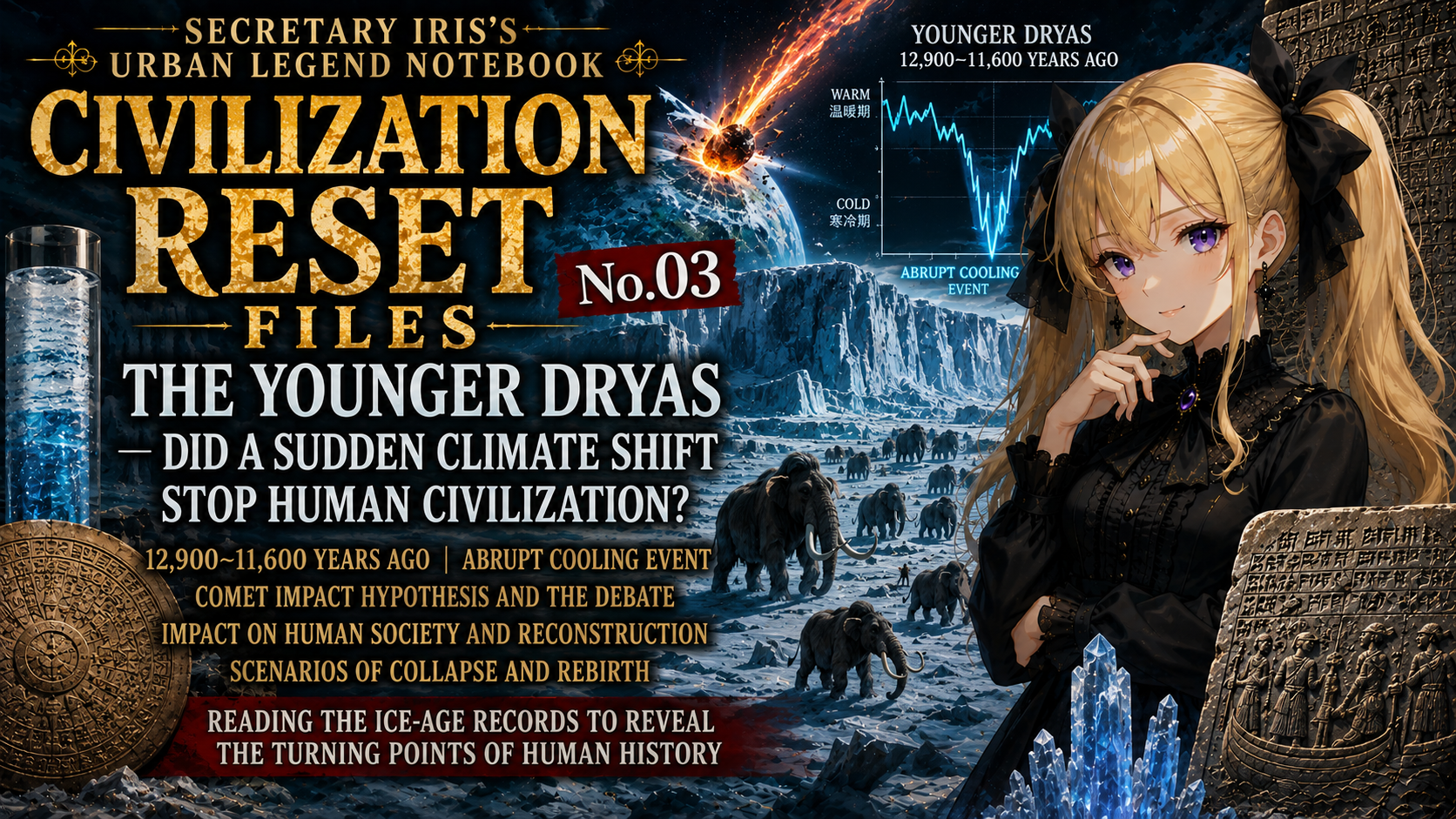
I am Iris.
Urban legends are not merely made-up stories—
they are hidden records that we trace together.
In the previous entry, we followed the great flood traditions preserved across different cultures.
Noah.
Utnapishtim.
Atra-hasis.
Deucalion.
The old world ended in water, while a small vessel carried life and memory into the next age.
Beyond mythology, however, the physical record of Earth preserves a major environmental disruption near the end of the last Ice Age.
Approximately 12,900 years ago, the planet was moving away from glacial conditions.
Ice sheets were retreating.
Temperatures were rising.
Landscapes were changing.
A warmer world appeared to be emerging.
Then the trend reversed.
Around the North Atlantic in particular, climate conditions became sharply colder.
This interval is known as the Younger Dryas.
It lasted for more than a millennium and ended approximately 11,600 years ago.
In urban-legend circles, it is sometimes said that this event destroyed a forgotten civilization.
Some versions go further and claim that a comet or fragmented celestial body struck Earth, burned continents, destroyed megafauna, and forced humanity to begin again.
Did something from the sky stop civilization?
Was there even a civilization to destroy?
Today, we will trace the boundary between climate science, archaeology, and modern catastrophe narratives.
What Was the Younger Dryas?
The Younger Dryas was a period of abrupt climatic cooling during the transition from the last glacial period into the warmer Holocene.
Its precise chronology varies slightly between records, but it is generally placed between approximately 12,900 and 11,600 years ago.
The name comes from Dryas octopetala, a cold-adapted flowering plant whose pollen became an indicator of returning cold conditions in European sediments.
Before the Younger Dryas, the climate had been warming.
Then conditions around Greenland, the North Atlantic, and much of Europe shifted toward colder states.
Glaciers responded.
Vegetation zones changed.
Rainfall patterns shifted.
Animal habitats moved.
Human communities faced new environmental pressures.
But the Younger Dryas should not be described as a simple moment when the entire planet froze at once.
Its clearest cooling signal appears in the North Atlantic region.
Other parts of the world experienced different combinations of temperature change, drought, rainfall disruption, or ecological change.
The event was widespread, but not geographically uniform.
Why Did the Cold Return?
One major explanation involves changes in North Atlantic ocean circulation.
As continental ice sheets melted, large quantities of freshwater entered rivers, lakes, and the ocean.
Freshwater is less dense than salty seawater.
A major influx could interfere with the sinking of cold, salty water in the North Atlantic and weaken the circulation system that transports heat northward.
If less heat reached the North Atlantic region, temperatures there could fall sharply.
This mechanism has been studied extensively.
However, important details remain debated.
Researchers continue to examine where the freshwater entered the ocean, how rapidly it arrived, and whether several pathways and feedbacks were involved.
The Younger Dryas was probably not a simple story of one lake breaking open on one day.
Ice sheets.
Freshwater.
Ocean currents.
Sea ice.
Atmospheric circulation.
Regional feedbacks.
A complex climate system may have shifted into a different state.
The deeper lesson is that climate does not always change smoothly.
A system can appear stable and then reorganize over a relatively short period.
The End Was Extremely Rapid
The termination of the Younger Dryas is as important as its beginning.
Greenland ice cores preserve annual and near-annual layers of snowfall, dust, gases, and chemical indicators.
These records suggest that the return to warmer conditions in Greenland was extremely rapid.
NOAA summaries describe an increase of approximately 10 degrees Celsius in Greenland over roughly a decade near the end of the event.
That figure refers to Greenland, not to global average temperature.
Nevertheless, it demonstrates how quickly regional climate conditions can change.
Within a human lifetime, vegetation can move.
Animals can migrate.
Water sources can shift.
Winters can shorten.
Food systems can become unreliable.
Abrupt climate change is not only a line on a graph.
It changes the practical rules of survival.
Was There a Civilization to Destroy?
In urban-legend narratives, the Younger Dryas is often described as the destruction of an advanced prehistoric civilization.
Current archaeology has not established the existence of a global urban or technological civilization around 12,900 years ago.
There is no accepted evidence from that period for modern-style cities, writing systems, states, metallurgy, or worldwide administration.
But that does not mean human societies were simple or incapable.
In Southwest Asia, hunter-gatherer communities were already developing more settled lifeways.
The Natufian culture of the Levant is especially important.
Natufian communities relied on hunting and gathering, but some occupied substantial settlements, built stone structures, processed wild cereals, stored food, and developed complex burial traditions.
They were not fully agricultural societies.
Nor were they merely small mobile bands without permanent social organization.
They occupied an important threshold between mobile foraging and later farming communities.
The Younger Dryas therefore occurred during a period of major human transformation.
Did Cold and Drought Create Agriculture?
The Younger Dryas is often linked to the origins of agriculture.
One proposal suggests that colder or drier conditions reduced the availability of wild plants and animals.
Human communities may then have intensified the management of cereals and other food resources.
This is an attractive explanation.
Environmental stress forces innovation.
Scarcity produces cultivation.
Cultivation produces farming.
Farming produces civilization.
Real history is less orderly.
Wild cereals were used before the Younger Dryas.
Plant management developed over long periods.
Different regions domesticated different species.
Settlement and cultivation did not always occur in the same sequence.
Agriculture was not invented in one sudden response to one climatic event.
The Younger Dryas may have influenced the process.
But it was not a single switch that transformed hunter-gatherers into farmers overnight.
Climate, population, technology, tradition, social organization, and local ecology all mattered.
What Is the Younger Dryas Impact Hypothesis?
The most dramatic interpretation proposes that a comet, asteroid, or fragmented cosmic body struck Earth or exploded in the atmosphere near the beginning of the Younger Dryas.
This is known as the Younger Dryas impact hypothesis.
Supporters have pointed to several proposed indicators.
Microscopic spherules.
Nanodiamonds.
Platinum anomalies.
Layers associated with widespread burning.
Dark organic deposits sometimes called black mats.
According to the hypothesis, a cosmic event may have triggered fires, atmospheric disruption, climate cooling, megafaunal decline, and changes in human societies.
The narrative is powerful.
Fire arrives from the sky.
Landscapes burn.
Large animals disappear.
Cold returns.
Human cultures collapse.
It resembles ancient stories of celestial destruction.
That resemblance helps explain why the hypothesis has become central to modern lost-civilization narratives.
Why Is the Hypothesis Still Disputed?
The impact hypothesis is not established scientific fact.
Many researchers have challenged the interpretation and reproducibility of the proposed evidence.
Some reported markers have not been found consistently at other sites.
Microspherules can form through terrestrial processes.
Black mat deposits do not all share the same cause.
No universally accepted impact crater of the required age and scale has been identified.
Megafaunal extinction and cultural change were not perfectly simultaneous everywhere.
Research supporting the hypothesis continues to appear.
Research rejecting or reinterpreting its evidence also continues.
The debate therefore has not disappeared.
But it would be misleading to state that a Younger Dryas comet impact has been proven.
This article treats it as a debated hypothesis rather than an established cause of the climatic event.
Did Mammoths and the Clovis Culture Vanish at Once?
The impact narrative is often connected to the extinction of North American megafauna.
Mammoths.
Mastodons.
Giant ground sloths.
Other large Pleistocene animals.
The Clovis archaeological tradition is also sometimes described as disappearing at the same moment.
This creates a compelling reset scenario.
A cosmic disaster destroys animals, people, and culture in one event.
The archaeological record is more complicated.
Different species disappeared at different times and in different regions.
Climate change and human hunting have both been examined as causes.
Clovis technology did not represent the disappearance of human populations.
Later archaeological traditions continued and changed.
The end of one tool tradition is not the same as the extinction of an entire people.
Urban legends emphasize rupture.
Archaeology often reveals continuity hidden inside change.
Climate Pressure Does Not Produce One Outcome
Climate change does not automatically destroy every society.
Human communities can adapt.
They migrate.
They change food sources.
They expand exchange networks.
They divide into smaller groups.
They store food.
They develop new tools.
They cooperate through ritual and social obligation.
But abrupt change reduces the time available for adaptation.
Water sources disappear.
Animals shift range.
Plant seasons change.
Groups compete for reliable territory.
Old knowledge becomes less effective.
Under enough pressure, an established way of life can no longer continue.
This may not be the end of civilization.
It may be the reorganization of subsistence, settlement, and social structure.
Urban legends describe that process as the destruction of an older world.
Science describes it through demographic movement, cultural transition, and ecological adaptation.
The traces may be the same.
The language creates a different story.
Why the Younger Dryas Became Linked to Lost Civilizations
The Younger Dryas sits at a powerful chronological crossroads.
Its beginning occurred approximately 12,900 years ago.
That date is sometimes compared with modern calculations of the age assigned to Atlantis in Plato’s dialogues.
It also overlaps with discussions of post-glacial sea-level rise, flood traditions, the earliest monumental structures, and the chronology of Göbekli Tepe.
These elements are then joined into one narrative.
An advanced civilization existed.
A comet arrived.
Ice sheets destabilized.
Floods destroyed coastal cities.
Survivors carried knowledge into the next age.
Monuments and agriculture appeared among supposedly simple hunter-gatherers.
It is an elegant reconstruction.
But the existence of each individual element does not prove the connecting narrative.
The Younger Dryas existed.
Sea levels rose after the Ice Age.
Göbekli Tepe exists.
Flood myths exist.
A lost global civilization linking all of them has not been demonstrated.
Existing dots do not automatically prove that the line drawn between them is correct.
Why This Period Still Matters
Even without a lost technological civilization, the Younger Dryas remains central to human history.
Abrupt climate change occurred.
Human environments and resources shifted.
Settlement and food strategies changed.
Agriculture expanded after the event.
Monumental ritual spaces appeared during the following period.
Climate did not simply stop humanity.
It may have forced human communities to reorganize.
Perhaps a civilization reset does not always reduce everything to zero.
Perhaps it occurs when an old way of living stops working and a new system begins to form.
Conclusion: Ice Records Both Fragility and Survival
Did the Younger Dryas destroy a lost civilization?
That conclusion cannot currently be established.
What is supported is that major climatic change occurred near the end of the Ice Age.
Its effects varied by region.
Human societies adapted, moved, reorganized, and eventually developed new forms of settlement and food production.
The cosmic impact hypothesis remains debated and should not be presented as a confirmed cause.
In urban-legend circles, it is said that fire from the sky destroyed an older world and that survivors carried knowledge into the next age.
The story is powerful.
But the evidence is not yet sufficient to make it history.
The Younger Dryas still offers a warning.
Climate does not always change slowly.
A stable world can shift quickly.
Civilization depends on water, food, movement, cooperation, and memory.
The strength of a civilization is not measured only by the size of its monuments.
It is measured by whether it can adapt.
Whether it can preserve knowledge.
Whether it can protect food and water.
Whether communities can remain connected.
Whether memory can cross into the world that follows.
The ice does not record only human fragility.
It also records survival.
Next in Civilization Reset Files No.04:
Göbekli Tepe.
Why did people described as hunter-gatherers raise monumental stone pillars more than ten thousand years ago?
Did agriculture come first?
Did ritual come first?
Or was the sequence of human history more complicated than we once imagined?
Next time, I will return to trace another fragment of hidden truth with you.
References
-
NOAA National Centers for Environmental Information|Abrupt Climate Change: A Paleo Perspective
An official overview of abrupt paleoclimate events, including the Younger Dryas and the evidence preserved in climate archives. -
NOAA NCEI|The Younger Dryas
A reference for the event’s chronology, North Atlantic cooling, and the abrupt warming recorded near its end. -
Proceedings of the National Academy of Sciences|Ice-Core Evidence of Abrupt Climate Changes
A study of abrupt changes preserved in Greenland ice cores, including the transition out of the Younger Dryas. -
Nature Communications|Gradual Onset and Recovery of the Younger Dryas Abrupt Climate Event in the Tropics
A reference demonstrating that the timing and expression of the event differed across regions. -
Scientific Reports / PMC|The Younger Dryas Impact Hypothesis: A Comprehensive Refutation
A critical review of the impact hypothesis, including questions of reproducibility, megafaunal extinction, and human population change. -
Earth-Science Reviews|The Younger Dryas Impact Hypothesis: Review of the Impact Evidence
A review presenting evidence discussed by proponents of the impact hypothesis, included for comparison with critical assessments. -
UNESCO World Heritage Centre|Göbekli Tepe
A reference for the chronology and archaeological context of the site examined in the next entry.
Posting Time
This English article is scheduled for publication at 23:00 JST on July 15, 2026.
Related Reading
Popular Posts
Submit an Urban Legend
Do you know a theory involving comet impacts, Ice Age climate change, extinct animals, or a forgotten civilization that deserves investigation?
Share & Follow
If you enjoyed this article, sharing, following, and exploring the journal helps support future investigations.
コメントを残す