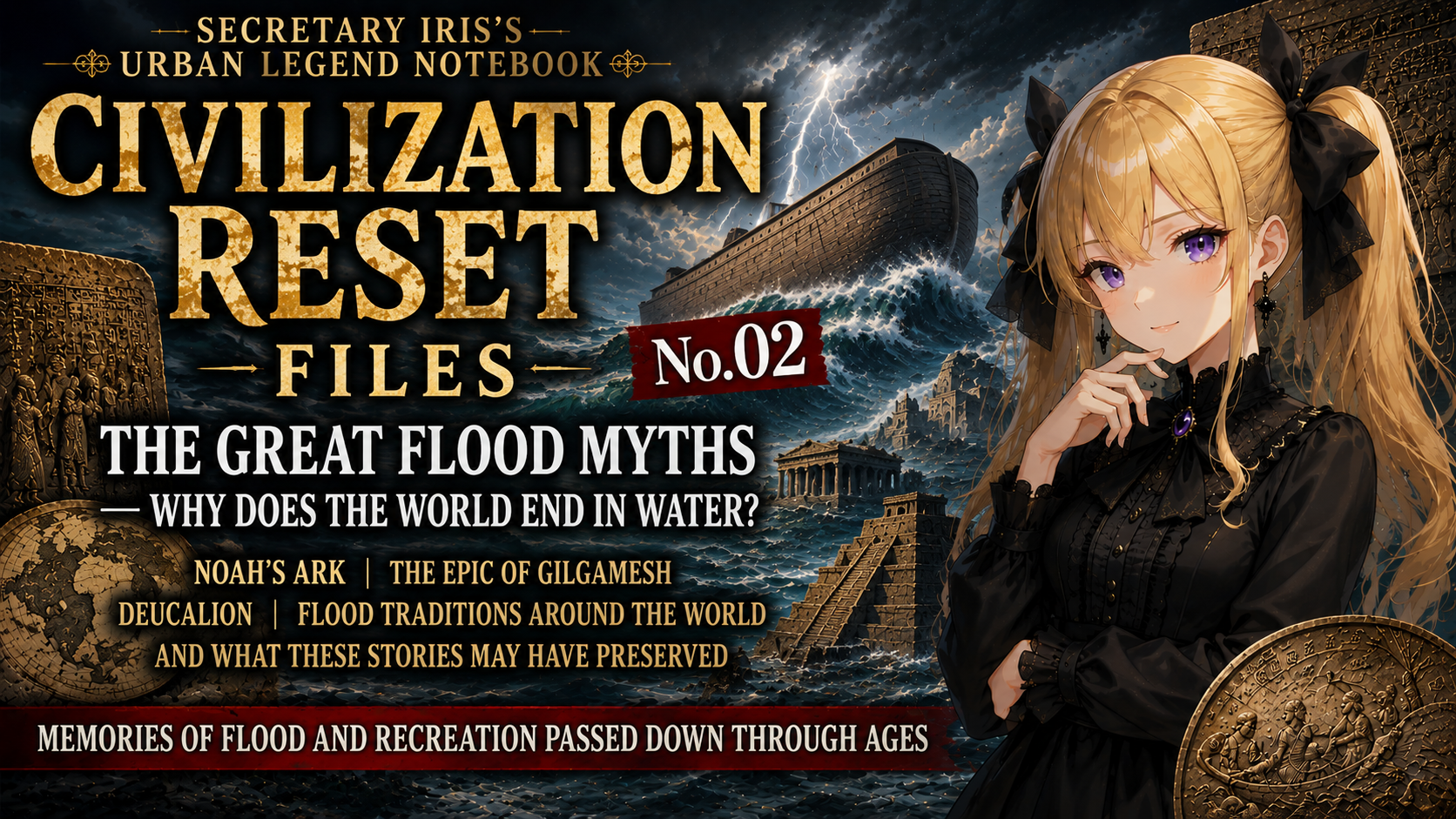
I am Iris.
Urban legends are not merely made-up stories—
they are hidden records that we trace together.
In Civilization Reset Files No.01, we questioned the familiar image of human history as one uninterrupted line of progress.
Civilizations accumulate knowledge.
But knowledge can be lost.
Societies expand.
But they can also fracture, disappear, and begin again.
Across many cultures, myths describe an earlier world that ended and a new age that began through a small number of survivors.
Again and again, the force that ends the old world is water.
Noah’s Ark.
Utnapishtim in the Epic of Gilgamesh.
Atra-hasis.
Deucalion and Pyrrha in Greek tradition.
Manu in Indian tradition.
Stories of drowned lands, vanished islands, tsunamis, and settlements swallowed by the sea.
Why does the world so often end in water?
Today, we will trace the memory of an older world beneath the flood.
Noah’s Ark: Judgment and Covenant
In the Book of Genesis, human society becomes filled with corruption and violence.
God decides to destroy the existing world through a flood.
Noah, described as righteous, receives a warning.
He is instructed to construct an ark and preserve his family and representatives of animal life.
The flood destroys the old world.
When the waters begin to recede, Noah releases birds to determine whether dry land has returned.
After leaving the ark, Noah enters a covenant with God.
The rainbow becomes the sign that all life will not again be destroyed by a flood.
The story therefore contains more than disaster.
Human corruption.
Divine judgment.
A selected survivor.
The preservation of life.
The beginning of a new world.
And a promise intended to prevent the same destruction from recurring.
The flood is both an ending and a reordering of existence.
In urban-legend circles, it is sometimes said that Noah’s Ark preserves a historical memory of a worldwide catastrophe.
However, a religious text cannot automatically be treated as a geological report.
Its theological meaning, literary structure, historical context, and possible relationship to older Near Eastern traditions must be examined separately.
Flood Traditions Older Than Genesis
The biblical flood story is not the earliest surviving written flood narrative.
Ancient Mesopotamia preserved earlier traditions.
One of the most important is the Akkadian Epic of Atra-hasis.
In that story, human beings are created to perform labor for the gods.
As humanity grows, its noise disturbs the divine order.
A series of disasters follows, and finally a flood is chosen to destroy humankind.
But the god Enki, also known as Ea, secretly warns Atra-hasis.
He is instructed to construct a boat and survives the catastrophe.
The structure is strikingly familiar.
Divine dissatisfaction.
A decision to destroy humanity.
A warning given to one person.
The construction of a vessel.
The preservation of life.
A new beginning after the flood.
The Metropolitan Museum of Art holds a cuneiform fragment containing part of this ancient flood tradition.
This is not a theory invented by modern conspiracy culture.
It is a story that people in ancient Mesopotamia inscribed into clay.
The Flood Tablet of Gilgamesh
A flood narrative also appears in Tablet XI of the Epic of Gilgamesh.
Gilgamesh, searching for the secret of immortality, meets Utnapishtim.
Utnapishtim explains that the gods once decided to destroy humanity with a flood.
Ea warned him and instructed him to build a boat.
He loaded his family, possessions, craftspeople, and living creatures aboard.
After the storm and flood, the vessel reached land.
Utnapishtim released birds to learn whether the waters had receded.
The similarities to the Genesis account are difficult to miss.
A divine warning.
A large vessel.
Family and animals.
Destruction by water.
Birds sent out to search for land.
A sacrifice after survival.
The British Museum’s famous Flood Tablet caused a sensation when its text was deciphered in the nineteenth century because of these parallels with Genesis.
Yet similarity does not prove that every story records the same single global event.
The narrative may have traveled between cultures.
Different communities may have preserved memories of related regional disasters.
Similar experiences with floods may have produced similar story structures.
Later authors may have reshaped older traditions for new religious purposes.
What can be established is that a recognizable family of flood narratives existed across the ancient Near East.
Deucalion: The Flood That Recreated Humanity
Ancient Greece also preserved a story of survival through a great flood.
Its central figures are Deucalion, the son of Prometheus, and his wife Pyrrha.
According to the tradition, Zeus decides to destroy the corrupted generation of humanity.
Prometheus warns Deucalion.
Deucalion constructs a chest or ark-like vessel, stores provisions, and enters it with Pyrrha.
They survive the flood and eventually reach a mountain.
Afterward, they receive an oracle instructing them to throw the bones of their mother behind them.
They understand “mother” to mean the Earth and her “bones” to mean stones.
The stones thrown by Deucalion become men.
The stones thrown by Pyrrha become women.
The old humanity is washed away.
A new humanity emerges from the land itself.
The Deucalion tradition is therefore not only a survival story.
It is a myth of complete human recreation.
Why Do Flood Myths Appear Across the World?
Flood traditions are not limited to Mesopotamia, the Bible, and Greece.
In Indian tradition, Manu is warned of an approaching flood and prepares a vessel.
East Asian traditions contain stories of rulers or heroes who control catastrophic waters.
Indigenous traditions from islands, coastlines, river valleys, Australia, and the Americas include accounts of inundation, tsunami, vanished land, and human survival.
In urban-legend circles, this distribution is sometimes presented as proof that one flood once covered the entire planet.
The similarities are certainly worth examining.
But the existence of many flood myths does not by itself prove one global flood.
Human communities have repeatedly settled near water.
Rivers supply drinking water and fertile soil.
Coasts provide fish and transportation.
Lakes and waterways support trade.
The same environments also expose people to floods, tsunamis, storm surges, changing river channels, and rising seas.
Different societies could therefore have experienced separate disasters and developed stories with similar themes.
When the Ice Age Ended, the Seas Rose
Humanity has experienced major environmental change.
At the end of the last glacial period, melting ice sheets contributed to long-term sea-level rise.
Some landscapes that were once habitable coastal plains are now beneath the sea.
This did not happen as one sudden event covering the whole planet overnight.
But coastlines moved.
Lowlands disappeared.
Hunting grounds were lost.
Communities were displaced.
Places connected to ancestors and ritual were submerged.
Such changes could have left powerful memories.
Sea-level rise was not the only danger.
River floods.
Monsoon shifts.
Tsunamis caused by earthquakes.
Volcanic events.
Lake outburst floods.
Storm surges.
A local catastrophe can become a universal story when it is remembered across generations.
For an ancient community, “the whole world” did not mean a modern globe viewed from space.
It meant the village.
The river.
The hunting ground.
The burial place.
The neighboring settlements.
The sacred hill.
When all of that disappeared beneath water, their world truly had ended.
Water as Destruction and Purification
Flood myths often give water a double meaning.
Water destroys.
But water also cleanses.
Violence.
Corruption.
Disorder.
Sin.
A failed generation.
All are washed away.
After the flood comes a smaller community, a new covenant, a new humanity, or a restored cosmic order.
This is why flood narratives function so powerfully as civilization-reset myths.
Fire appears to erase everything.
Water creates a different feeling.
Something may remain below the surface.
A city may still exist beneath the sea.
A tablet may remain under layers of mud.
A survivor may preserve forbidden or forgotten knowledge.
Water suggests disappearance and preservation at the same time.
The Ark Carries More Than Life
Noah’s ark.
Utnapishtim’s boat.
The vessel of Atra-hasis.
The chest of Deucalion.
Each protects survivors from the flood.
But each can also be read as a container carrying part of the old world into the new one.
Family.
Animals.
Seeds.
Food.
Craftspeople.
Technology.
Ritual.
Language.
Memory.
In urban-legend circles, the ark is sometimes interpreted as a civilization-preservation device rather than merely a ship.
According to this reading, survivors of an earlier civilization carried knowledge into the societies that followed.
There is no established evidence that a technologically advanced global civilization was preserved in this way.
Yet the underlying structure is realistic.
After a catastrophe, reconstruction depends on people who remember how to do things.
Someone must know where water can be found.
Someone must preserve seeds.
Someone must understand tools.
Someone must remember the calendar.
Someone must preserve law and ritual.
Someone must tell the story.
Buildings do not rebuild civilization by themselves.
People carrying knowledge do.
Do the Myths Record One Event?
Do the world’s flood myths preserve a single catastrophe from the distant past?
At present, that conclusion cannot be established.
Several explanations may operate at the same time.
Stories traveled between cultures.
Separate communities experienced similar disasters.
Water naturally became a symbol of both life and destruction.
Religious meanings were added to memories of real floods.
Older traditions were rewritten by later societies.
Trying to force every flood myth into one explanation removes the complexity that makes them important.
Flood myths are not certificates proving a global deluge.
But they should not be dismissed as empty fiction either.
They contain memories of human dependence on water.
They preserve fear of natural disaster.
They express moral warnings about social collapse.
They imagine the possibility of rebuilding after the old order fails.
Conclusion: Water Ends the World and Begins It Again
Why does the world repeatedly end in water?
Perhaps because water is both the foundation of civilization and one of the forces most capable of destroying it.
Without water, cities cannot emerge.
With too much water, cities disappear.
Flood myths do not speak only about ancient catastrophe.
They speak about arrogance.
Dependence on nature.
The responsibility of survivors.
The transmission of memory.
The reconstruction of a failed social order.
Noah, Utnapishtim, Atra-hasis, and Deucalion could not preserve the entire old world.
They could only carry part of it forward.
When civilization is reset, what should be saved?
Who decides?
And what must the survivors remember?
The deepest question in the flood myth is not how the world ended.
It is what humanity carries into the world that comes after.
Next in Civilization Reset Files No.03:
The Younger Dryas.
An abrupt cooling event that began approximately 12,900 years ago.
How strongly did rapid climate change affect human communities?
What is the Younger Dryas impact hypothesis?
Why has it become connected to stories of lost civilizations?
We will trace the boundary between scientific evidence and modern urban legend with care.
Next time, I will return to trace another fragment of hidden truth with you.
References
-
BibleGateway|Genesis 6–9: Noah and the Flood
The biblical text describing Noah’s warning, the ark, the flood, the release of birds, and the post-flood covenant. -
The British Museum|The Flood Tablet, Epic of Gilgamesh Tablet XI
The museum record for the Babylonian Flood Tablet describing Utnapishtim, the vessel, living creatures, the flood, and the release of birds. -
The Metropolitan Museum of Art|Cuneiform Tablet: Atra-hasis, Babylonian Flood Myth
A museum record for a cuneiform fragment preserving part of the Akkadian Atra-hasis flood tradition. -
The Metropolitan Museum of Art|Flood Stories
An overview of ancient Mesopotamian flood narratives, including Atra-hasis. -
Theoi Greek Mythology|Deucalion and the Great Deluge
A collection of classical references concerning Deucalion, Pyrrha, Prometheus’s warning, the vessel, and the recreation of humanity. -
Encyclopaedia Britannica|Flood Myth
A general reference for worldwide flood traditions and their recurring themes of destruction, purification, survival, and recreation.
Posting Time
This English article is scheduled for publication at 23:00 JST on July 14, 2026.
Related Reading
Popular Posts
Submit an Urban Legend
Do you know a local tradition involving floods, tsunamis, drowned villages, submerged ruins, or a lost-civilization story that deserves investigation?
Share & Follow
If you enjoyed this article, sharing, following, and exploring the journal helps support future investigations.
コメントを残す