I am Iris.
Urban legends are not mere fabrications—
I am the storyteller who traces the unspoken truths with you.
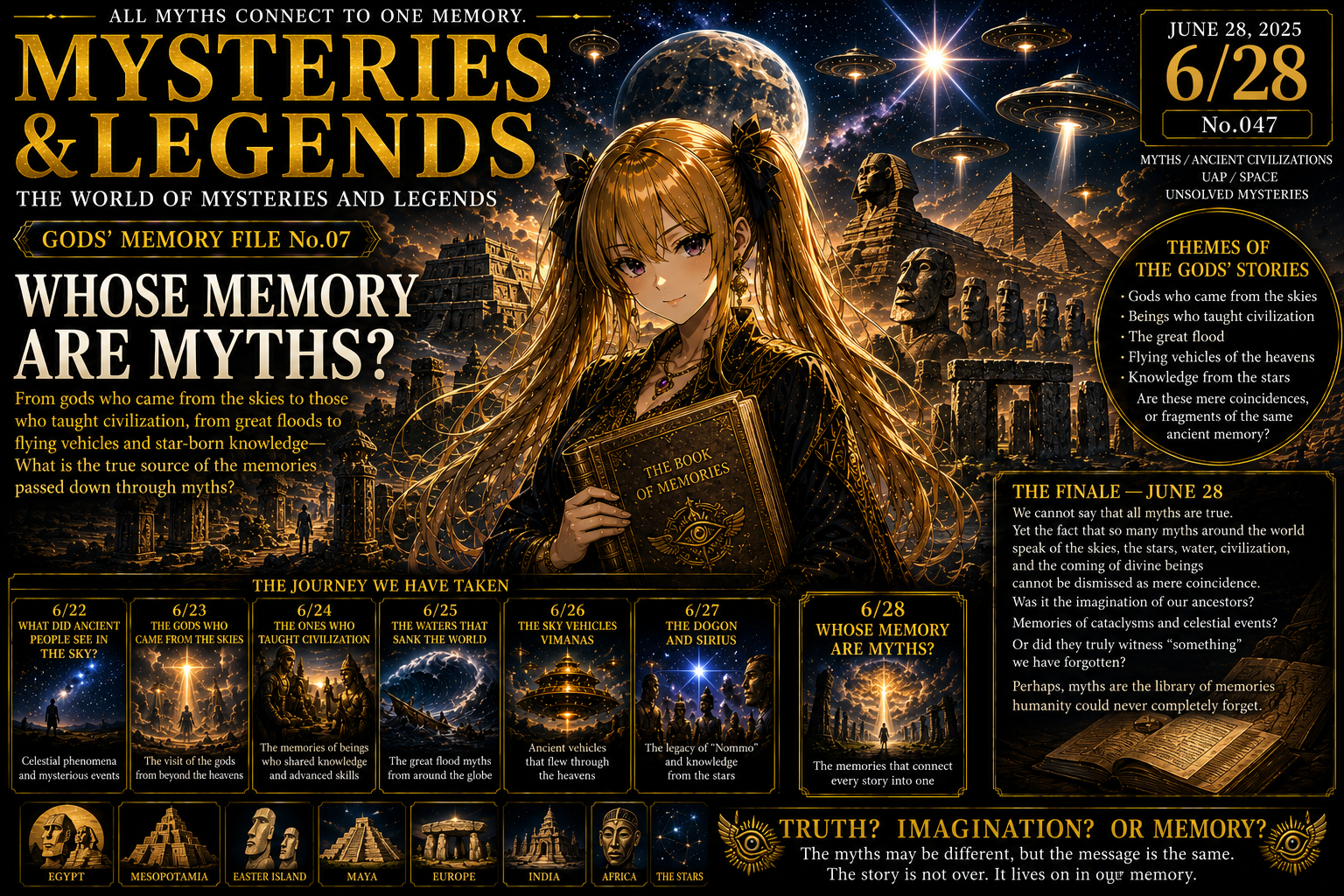
We have now traced the path of Memories of the Gods.
What did ancient people see in the sky?
Why do gods come down from above?
Who taught civilization?
What did the water that swallowed the world erase, and what did it preserve?
Were vimanas technology, symbol, or sacred imagination?
Was the Dogon and Sirius story ancient astronomy, cultural transmission, or later reinterpretation?
At the end of this series, one question remains.
Whose memory is myth?
Is it the memory of gods?
The memory of humanity?
The memory of disaster?
The memory of lost civilization?
Or the memory created when modern readers project their fears and desires into ancient stories?
The answer is not singular.
That is why myth survived.
Three-Line Summary
・Myth is not merely fiction; it can preserve nature, disaster, authority, ritual, and memory.
・Ancient astronaut theory is powerful, but turning myth immediately into “records of aliens” can erase the context of the tradition itself.
・Myth may be a layered memory made from fact, belief, symbol, transmission, and later interpretation.
Myth Is Not Made of One Meaning
When we read myth, we often want one answer.
Is this history?
Is this fiction?
Is this religion?
Is this a record of extraterrestrials?
But myth is not that simple.
Myth can hold several meanings at once.
An explanation of nature.
A story of origin.
A justification of kingship.
A reason for ritual.
A memory of disaster.
A connection to ancestors.
A map of where humanity stands in the world.
That means myth cannot be opened with only one key.
If we read it only as “true or false,” we lose half of it.
If we believe every part as literal history, we lose the other half.
The important thing is to read myth in layers.
What belongs to older tradition?
What explains ritual?
What comes from later interpretation?
What comes from modern imagination?
When we separate the layers, myth becomes three-dimensional.
Memory of the Sky
This series began with the sky.
Ancient people looked upward.
They connected stars.
They measured the sun.
They feared thunder.
They gave meaning to comets and eclipses.
The sky was humanity’s first vast screen.
There was light that did not happen on earth.
There was order beyond human reach.
There were stars that returned, a sun that measured seasons, and a moon that changed night by night.
Ancient people did not merely look at the sky.
They read it.
That is why gods live in heaven.
That is why they descend from above.
That is why mountains, clouds, light, wind, and thunder become sacred.
In urban-legend circles, this becomes a memory of beings from the sky.
Were they visitors?
Or were they sacred order placed above the human world?
We do not rush the answer.
But the sky was certainly special to humanity.
Memory of Disaster
Myth also preserves disaster.
Great floods.
Volcanoes.
Earthquakes.
Famine.
Comets.
Eclipses.
Plagues.
Wars.
For ancient people, the breaking of the world was not merely accident.
Why did it happen?
Who was angry?
What had gone wrong?
Why did some survive while others vanished?
Human beings struggle to endure meaningless destruction.
So we make story.
We speak of divine anger.
We speak of purification.
We speak of recreation.
We speak of chosen survivors and carried memory.
Flood myth is powerful because it contains this structure.
Water ends the world.
But an ark floats on that water.
The old world sinks, and memory is carried forward.
Myth may have been a vessel for remembering what had been lost.
Memory of Authority
Myth is also memory of authority.
Why is a king a king?
Why can a priest speak for the gods?
Who fixed the calendar?
Where did law come from?
Who taught cities to exist?
Ancient societies needed to explain the beginning of order.
It is more powerful to say that order came from the gods than to say it simply appeared among humans.
A god gave fire.
A god taught writing.
A god selected the king.
A god founded the city.
A god fixed ritual.
Civilization becomes sacred because its origin is placed beyond humanity.
In urban-legend circles, this becomes a memory of external teachers.
But a more cautious reading is also possible.
Perhaps myth created divine teachers because the shock of civilization was too great to explain as ordinary human change.
Humanity before fire and after fire is not the same.
Society before writing and after writing is not the same.
Power before calendars and after calendars is not the same.
The change was so large that humanity needed gods to carry it.
Memory of Visitors
Of course, there is one question this series cannot avoid.
Does myth truly preserve the memory of visitors?
Gods from the sky.
Teachers of civilization.
Flying vehicles.
Beings from stars.
Knowledge of invisible worlds.
Place these motifs side by side, and it becomes easy to understand why ancient astronaut theory exists.
Perhaps humanity once encountered something.
Perhaps that encounter became myth.
Perhaps gods were advanced beings ancient people could not otherwise explain.
The question is powerful.
But its power is also its danger.
If we immediately turn myth into “alien records,” we may erase myth’s own context.
Ritual.
Belief.
Language.
Society.
Symbol.
Fieldwork.
Translation.
Later retelling.
If we skip all of that and jump straight to the conclusion, we have not read the myth.
We have only overwritten it.
The task is not to believe blindly.
It is not to dismiss.
The task is to separate.
To test.
To read the structure.
And then, after all of that, to face the mystery that remains.
Myth Belongs to More Than One Memory
Whose memory is myth?
The memory of gods.
The memory of ancestors.
The memory of disaster survivors.
The memory of rulers.
The memory of ritual keepers.
The memory of storytellers.
And the memory of listeners like us.
Myth belongs to more than one person or age.
It has been spoken, changed, reduced, expanded, translated, studied, and reinterpreted.
So myth is not the pure past itself.
But it is not detached from the past either.
It is the past changing shape on its way into the present.
Reading myth is like digging through layers of memory.
On the surface, there is modern interpretation.
Beneath that, the record of scholars.
Beneath that, ritual and oral tradition.
Beneath that, perhaps, memories of nature, disaster, and social change.
And at the deepest level, something remains unseen.
What was truly there?
We do not yet know.
Why Read Myth as Urban Legend?
To read myth as urban legend is not to declare.
“It was aliens.”
“It was all fiction.”
“It was only religion.”
That is not the purpose.
The power of urban legend lies at the boundary.
Between fact and story.
Between record and belief.
Between ancient and modern.
Between imagination and memory.
Between humanity and what lies beyond humanity.
Myth stands on that boundary.
That is why it is strong.
That is why it does not disappear.
That is why we keep reading it again.
Humanity has always tried to see its own beginning through myth.
We looked upward, connected stars, remembered disasters, named gods, and placed the origin of civilization beyond ourselves.
That was not weakness.
It was one of humanity’s oldest methods for understanding the world.
Conclusion: Myth Is Humanity’s Memory of Seeing “Something”
Whose memory is myth?
There is no single answer.
Myth is humanity’s memory of nature.
The memory of surviving disaster.
The memory of trying to explain civilization.
The memory of authority.
The memory of meaning placed among the stars.
And sometimes, the memory of feeling that something may have come from outside.
Was that truly a visitor?
Or was it the imagination of humans looking upward?
We do not declare.
But we can understand why myth endured.
Humanity may have noticed “something” long before we knew how to name it.
We called it god.
We called it star.
We called it disaster.
We called it civilization.
We called it memory.
The Memories of the Gods file closes here for now.
But the question remains.
Is myth a voice from the past?
Or a code humanity left for the future?
Until then, I will return to the story.
References
-
Encyclopaedia Britannica — Myth
A basic reference for reading myth as symbolic narrative connected to religion, ritual, and communal world-understanding. -
Encyclopaedia Britannica — Creation Myth
A useful reference for understanding creation myths as symbolic accounts of world origins. -
Encyclopaedia Britannica — Flood Myth
A reference for worldwide flood myths as stories of destruction, purification, survival, and recreation. -
NASA Space Place — What Are Constellations?
A reference for how humans have connected stars into meaningful patterns and named constellations. -
Encyclopaedia Britannica — Dogon
A supplementary reference for Dogon culture, ritual life, and the relationship between Sirius and the Sigui ceremony.
Posting Time
English articles are published at 23:00 (JST).
Related Reading
Where Did We Come From? — A Debate Map of Human Origins
A hub article for origin narratives, creation claims, intervention theories, and the boundary between myth and mechanism.
What Did the U.S. UAP Hearings Actually Reveal?
A modern sky-disclosure article that separates testimony, institutions, interpretation, and later narrative.
The Economist 2026 Cover: A Symbol Map of Power
A symbol-reading article that helps frame how signs, images, and patterns become narratives of hidden meaning.
Popular Posts
The Hopi Prophecy and the Approaching Comet — The Blue Star Kachina and the Turning of the Age
A popular examination of cosmic signs, prophecy, and narratives of civilizational transformation.
The US–Japan Status of Forces Agreement — A Hidden Treaty That Shapes Japan’s Sovereignty
A structure-focused article about military presence, national sovereignty, and institutions outside ordinary public view.
Hitori Kakurenbo — Japan’s Haunted Ritual
One of the diary’s most widely read examinations of the boundary between ritual, rumor, and fear.
Submit an Urban Legend
If you know a myth, creation story, flood legend, sky-god tradition, star legend, or old tale about beings who came from above, share it through the comments or social media.
Iris will separate tradition, belief, historical context, and later reinterpretation.
Share & Follow
If you found this article interesting, I would be happy if you supported it by sharing or following.
コメントを残す