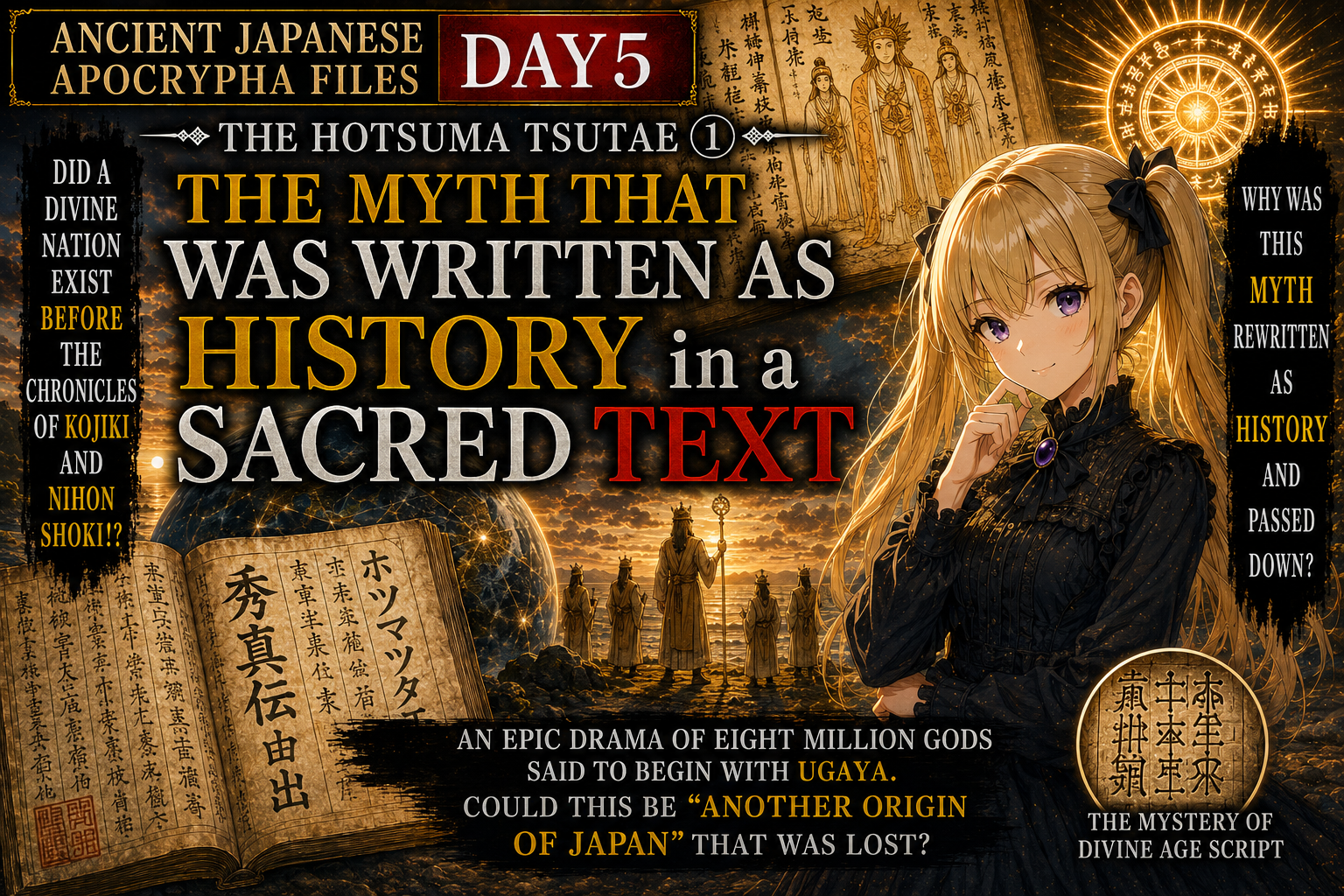
I am Iris.
Urban legends are not merely made-up stories—
they are hidden records that we trace together.
In the previous entry, we opened the Uetsufumi.
A manuscript said to have survived in Bungo.
An expanded line of rulers before Emperor Jimmu.
The mysterious Toyokuni script.
And a regional history later connected to the idea of a lost Kyushu dynasty.
The document we open today also presents an origin of Japan different from the Kojiki and Nihon Shoki.
Its method, however, is different.
It does not focus only on a forgotten empire.
It does not simply extend a royal line into remote antiquity.
It brings the gods down to Earth.
It turns divine beings into rulers, spouses, parents, teachers, lawgivers, and political actors.
The Hotsuma Tsutae.
In this text, mythology is organized as an extended history of government, family, language, agriculture, law, ritual, conflict, and moral recovery.
Was Japanese mythology originally a record of real rulers?
Or did later writers transform mythology into a coherent human history?
Who drew the boundary between myth and history?
That is the question we will trace.
What Is the Hotsuma Tsutae?
The title is also written as Hotsuma Tsutae, Hotsuma-den, or Hotsuma Seidenki.
It consists of a preface and forty chapters known as aya.
The text is primarily composed in a five-and-seven-syllable long-verse form.
It is written not in Chinese characters or kana, but in a geometric set of forty-eight signs now called Woshite, Woshite characters, or Hotsuma characters.
Related works include the Mikasafumi and Futomani.
Supporters group these works together as Woshite literature and regard the script as an indigenous Japanese system used before Chinese writing.
Mainstream scholarship does not accept Woshite as an independently authenticated script from prehistoric or ancient Japan.
It is generally treated as one of the sacred-script systems created or systematized in the early modern period.
Who Does the Text Claim Wrote It?
Within the Hotsuma tradition, chapters one through twenty-eight are attributed to Kushimikata.
Chapters twenty-nine through forty are attributed to Ota Taneko.
Kushimikata is described as a political figure serving in the age of Emperor Jimmu.
Ota Taneko also appears in the Nihon Shoki and is associated with the rites of Mount Miwa during the reign of Emperor Sujin.
The narrative claims that the sacred and political history of Japan was compiled so later generations would not lose the correct tradition.
The completed forty chapters are said to have been organized during the reign of Emperor Keiko, partly in response to the final wishes of Yamato Takeru.
If true, the text would predate the Kojiki and Nihon Shoki by several centuries.
It could even represent a source behind the accepted chronicles.
But a document’s internal claim about its origin is not the same as an independently verified date.
The Surviving Manuscripts
The National Archives of Japan publicly preserves twelve manuscript volumes catalogued as the Hotsuma Tsutae.
They are not securely dated ancient originals.
One major manuscript tradition states that Wani Yasutoshi added a Chinese-character translation in 1775.
His name is also rendered in several forms, and he has been identified with Iho Yūnoshin in later discussions.
Another transmission is associated with the Ogasawara family.
Modern interest expanded after Matsumoto Yoshinosuke found part of a manuscript in a secondhand bookshop in 1966.
Researchers and supporters later located fuller copies and related texts, producing transcriptions, translations, and study groups.
However, no continuous chain of custody securely connects the surviving manuscripts to antiquity or the early imperial periods claimed by the text.
The document’s verifiable material history does not extend securely beyond the early modern period.
The Attraction of Rediscovery
Many apocryphal histories possess a rediscovery narrative.
The manuscript was hidden.
One family protected it.
It remained in a shrine storehouse.
A forgotten copy appeared in a bookshop.
A complete version emerged after only fragments were known.
The discovery becomes part of the story.
Readers do not feel that they are merely reading an unusual text.
They feel that they are recovering a memory excluded from accepted history.
A forgotten script.
A history absent from schoolbooks.
Knowledge available only to a small circle.
That sense of secrecy strengthens the document’s emotional power.
But a late rediscovery does not authenticate an ancient origin.
It makes provenance, manuscript comparison, language, and physical dating even more important.
Stories That Resemble the Kojiki and Nihon Shoki
The Hotsuma Tsutae contains many familiar names.
Izanagi.
Izanami.
Amateru.
Tsukiyomi.
Susanoo.
Onamuchi.
Ninikine.
Hohodemi.
Ugayafukiaezu.
Emperor Jimmu.
Its narratives appear to overlap with major themes in the Kojiki and Nihon Shoki.
The creation of the islands.
The land of the dead.
Conflict between Amaterasu and Susanoo.
The heavenly rock cave.
The great serpent.
The building of the land by Okuninushi.
The descent of the heavenly descendant.
The stories of the sea and mountain brothers.
The eastern expedition of Jimmu.
But the Hotsuma Tsutae supplies extended motives and social explanations.
Conflict has political causes.
Marriage joins families and territories.
Ritual stabilizes the community.
Songs regulate language and conduct.
Mythic fragments are reorganized into a connected account of statecraft.
Gods or Human Rulers?
Supporters often emphasize the human character of the gods.
Figures understood in the accepted chronicles as heavenly deities are interpreted as earthly rulers or officeholders.
Amateru is often read as a male sovereign rather than the sun goddess familiar from the Kojiki and Nihon Shoki.
Okuninushi or Ōmononushi may be understood as titles inherited by successive political figures.
Extraordinary lifespans can be explained as multiple generations using the same title.
A descent from heaven can be read as migration from another political center.
Through this method, supernatural mythology appears to become realistic history.
But the existence of that interpretation inside the text does not prove that the interpretation preserves ancient events.
Turning Myth into History
The rationalization of mythology is not unique to the Hotsuma Tsutae.
Across cultures, interpreters have argued that:
gods were ancient kings;
monsters represented enemy peoples;
wars of the gods preserved political conflicts;
heavenly realms were distant capitals;
long-lived rulers represented dynasties sharing a name.
Such readings make supernatural narratives easier to understand.
But a plausible explanation is not automatically a verified event.
Myth can contain nature, ritual, seasonal cycles, political authority, death, rebirth, and family symbolism at the same time.
Reducing every myth to literal history may erase the religious and symbolic meanings that allowed the story to survive.
Was Amateru Male?
One of the most discussed differences concerns Amateru.
In the Kojiki and Nihon Shoki, Amaterasu is generally understood as a female deity, ancestor of the imperial line, and central kami of the Inner Shrine at Ise.
The Hotsuma Tsutae is widely interpreted as depicting Amateru as a male ruler with spouses and political responsibilities.
Supporters argue that later compilation changed the sovereign’s sex or role.
No securely dated pre-chronicle source has established this claim.
If the Hotsuma Tsutae is an early modern composition, the opposite process is possible: its author may have transformed the existing sun goddess into a human king.
Narrative coherence alone cannot determine which version is earlier.
Susanoo as a Story of Failure and Recovery
In the accepted chronicles, Susanoo disrupts the heavenly realm, is expelled, and later defeats the great serpent in Izumo.
He is destructive, exiled, and heroic.
The Hotsuma narrative supplies a more continuous moral development.
He violates social order.
He is punished.
He confronts the consequences of his actions.
He later performs a role beneficial to society.
The story becomes a political and ethical history.
People can fail.
They can accept punishment.
They may return to the community through responsibility and action.
This human growth may be one reason modern readers find the text emotionally accessible.
The Awauta and Forty-Eight Sounds
An important feature of Woshite literature is the Awauta.
It arranges forty-eight sounds into a song.
Within the narrative, Izanagi and Izanami travel through the country singing it in order to correct speech and restore harmony among the people.
Supporters interpret it as an early phonetic table, a teaching song, and a system of kotodama—the spiritual power of language.
But its regular organization can also suggest later construction using knowledge of kana and Japanese sound tables.
Early Japanese contained phonological distinctions that later disappeared, as demonstrated by ancient orthographic patterns.
It has not been established that the forty-eight-sound system accurately represents the language of the remote period claimed by the text.
How Woshite Is Structured
Woshite is explained as a combination of basic vowel shapes and consonant elements.
Circles and arcs.
Triangles.
Squares.
Lines and points.
Some interpretations connect the forms to sky, wind, fire, water, earth, and cosmic principles.
The system is elegant.
Sound, form, nature, and human consciousness appear to belong to one design.
But elegance is not evidence of antiquity.
A later creator could design a regular system from existing kana, phonology, religious symbols, and geometric forms.
Independent archaeological evidence is necessary.
Has Woshite Been Found Archaeologically?
If Woshite was used before Chinese writing, traces should be expected outside the surviving manuscripts.
Pottery.
Wood.
Stone.
Metal.
Ritual objects.
Building materials.
Burials.
Repeated inscriptions from securely dated contexts would be needed.
The same signs would have to demonstrate regular use as a language-recording system.
Woshite has not been independently authenticated in Jōmon, Yayoi, or Kofun archaeological materials.
Individual marks resembling Woshite signs are sometimes cited, but isolated symbols are not automatically writing.
A script requires repetition, structured combinations, consistent reading, and multiple securely dated examples.
Does Greater Detail Prove Greater Age?
The Hotsuma Tsutae provides conversations, institutions, motives, and social practices not found in the accepted chronicles.
Supporters argue that the Kojiki and Nihon Shoki abbreviated this older and more complete source.
That is possible as a general historical process.
A later summary can reduce an older large work.
But the reverse is also possible.
A later author can read the chronicles and expand their unexplained episodes.
Mythic contradictions can be reorganized through politics, morality, local tradition, Shinto thought, and early modern scholarship.
Detail alone does not establish chronological priority.
Manuscripts, language, provenance, quotation history, and external evidence must decide the relationship.
Two Interpretations of Similarity
The overlap between the Hotsuma Tsutae and the accepted chronicles can be read in opposite ways.
Supporters say the overlap exists because the Hotsuma Tsutae was the original source.
Critics say the overlap exists because the later text used the Kojiki and Nihon Shoki.
To distinguish them, researchers must ask:
Do its unique expressions appear in independently dated earlier materials?
Do its additional historical claims match archaeological evidence?
Does its language fit ancient Japanese?
Can its manuscript line be traced before the early modern period?
At present, the evidence does not establish the Hotsuma Tsutae as a source predating the accepted chronicles.
The Early Modern Intellectual Setting
The intellectual world of the Edo period is important.
Kokugaku scholars searched for Japan before the influence of Chinese thought and Buddhism.
They returned to the Kojiki, ancient poetry, Shinto, and early Japanese language.
Shrines and regional families produced genealogies and origin narratives.
Writers connected local traditions to divine-age figures.
The desire for an indigenous civilization before imported writing became increasingly meaningful.
A text combining:
a pre-Chinese Japanese script;
a history older than the chronicles;
humanized divine rulers;
native language and political philosophy;
would fit that cultural environment.
Why Transform Myth into History?
Myth contains unanswered questions.
Why did a deity become angry?
Why was a land transferred?
Why did a heavenly descendant descend?
Why did divine spouses or siblings fight?
Why does one figure possess several names?
The Hotsuma Tsutae supplies causes.
Political duties.
Succession disputes.
Family relationships.
Law.
Education.
Agriculture.
Social order.
The fragmented world of mythology becomes a continuous national history.
Human beings prefer causes to unexplained episodes.
They prefer complete narratives to fragments.
The Hotsuma Tsutae may have given history to readers who wished not to abandon mythology, but to understand it more completely.
An Ideal Theory of Government
The divine rulers are often read as teachers and guardians.
They regulate speech.
Teach agriculture.
Protect the family.
Judge disputes.
Guide the people through song.
Live according to natural cycles.
The text therefore resembles political philosophy as much as ancient history.
What is a good ruler?
Why does a country exist?
What does leadership owe the people?
How are family and government related?
The ideal needs of the author’s own period may have been projected into the divine age.
Harmony with Nature
Modern presentations frequently emphasize harmony with nature.
Sun and moon.
Seasons.
Agriculture.
Food.
Family.
Ritual.
Language.
Human beings are expected to live inside natural cycles rather than dominate them.
Environmental anxiety, weakened communities, mass consumption, and changing family structures make a lost harmonious past especially attractive.
This modern appeal remains meaningful even if the document is not an ancient primary source.
It shows what contemporary readers feel has been lost.
Connection to Spiritual Culture
Woshite is also used in modern spiritual practice.
Writing the signs is said to calm the mind.
Their forms are interpreted as cosmic principles.
Chanting the Awauta is said to regulate the body, language, or vibration.
Such practices should be distinguished from historical proof.
A song can be calming.
Writing geometric characters can become meditation.
Neither experience proves that the script was used in prehistoric Japan.
Spiritual value and manuscript dating are different questions.
Why Mainstream Scholarship Treats It as a Forgery
The Hotsuma Tsutae is generally regarded in academic history as an early modern forgery or pseudo-archaic composition rather than an authentic source predating the chronicles.
The reasons include:
surviving manuscripts date from the early modern period;
no continuous ancient provenance has been demonstrated;
Woshite has not been independently authenticated archaeologically;
its sound system does not clearly preserve the complex phonological distinctions visible in early Japanese writing;
its content can potentially be reconstructed from the chronicles and early modern intellectual traditions;
its unique history lacks contemporary material or documentary confirmation;
no early quotation or transmission proves that it served as a source for the Kojiki or Nihon Shoki.
The assessment rests on the combined evidence, not simply on the text’s unusual content.
Does a Forgery Have No Value?
Classification as a forgery does not make the text meaningless.
Its value changes.
What kind of Japan did early modern readers seek?
Why did they need a script older than Chinese writing?
Why did the gods become ideal rulers?
Why did writers fill the gaps in the accepted myths?
Why were local shrines and families connected to the divine age?
Why did the text regain popularity in the modern period?
It can be studied as evidence of early modern religion, intellectual history, regional identity, sacred-script traditions, nationalism, and contemporary spirituality.
A forged past can reveal the historical period that needed to invent or reconstruct it.
Can Myth and History Be Completely Separated?
Ancient histories often combine myth, genealogy, poetry, ritual, and political legitimacy.
A ruler’s divine ancestor was not merely fantasy; it shaped political authority and social action.
A ritual narrative explained a community’s rights and duties.
Myth can therefore be part of history even when its supernatural events are not literal.
But two statements must remain separate.
Myths influence historical societies.
Everything described in a myth physically occurred as written.
The Hotsuma Tsutae must be read with that boundary intact.
Why Bring the Gods Back to Humanity?
Distant gods are difficult to understand.
Why do they disappear?
Why do they become angry?
Why do they die and return?
When gods are converted into human rulers, the stories become familiar.
The rock cave becomes political withdrawal.
The transfer of the land becomes regime change.
The heavenly descent becomes migration.
Divine marriage becomes alliance between families.
The great serpent becomes an enemy, disaster, or regional conflict.
The mythology moves closer to human experience.
The gods can then fail, learn, and recover as people do.
This may be the deepest attraction of the Hotsuma Tsutae.
Present Assessment
Current evidence does not establish the Hotsuma Tsutae as an authentic history written before the Kojiki and Nihon Shoki.
No ancient original or continuous transmission has been verified.
The datable manuscript tradition is early modern.
Woshite has not been archaeologically demonstrated as a writing system used before Chinese characters.
Mainstream scholarship therefore generally treats the text as an Edo-period forgery or pseudo-archaic mythological history.
Yet its influence on modern readers is real.
It expresses a desire for a continuous national history.
A longing for a uniquely Japanese language and script.
An ideal of harmony among nature, family, society, and government.
The Hotsuma Tsutae has not been confirmed as a record of ancient fact.
It is, however, a record of the ancient Japan later generations wished to recover.
Conclusion: Writing Myth as History Brings It Closer
Who drew the boundary between myth and history?
That boundary changes according to the reader.
A believer reads sacred teaching.
A historian reads an early modern text.
A supporter reads a source older than the chronicles.
A modern seeker reads a philosophy of nature and community.
The Hotsuma Tsutae brought the gods of the chronicles closer to human history.
It gave political, familial, and moral explanations to difficult myths.
The gods became rulers who failed, struggled, governed, and attempted to guide their people.
There is no established evidence that this was the literal history of ancient Japan.
But there was a powerful desire to retell mythology in that form.
People do not always transform myth into history in order to destroy belief.
Sometimes they do so in order to bring the myth closer to their own lives.
In the next entry, the Ancient Japanese Apocrypha Files moves deeper into the relationship between signs, sound, and the universe.
Katakamuna.
Circular writing.
Sound.
Number.
Life.
Matter.
A system later connected to physics and modern spirituality.
Was it truly an ancient record?
Or was it a modern cosmic philosophy written in the language of a lost civilization?
Ancient Japanese Apocrypha Files No.06:
Katakamuna, Part One—
A Record System of “Sound and Vibration,” Not Merely Writing.
Why does the idea of a record older than writing attract modern people?
Next time, I will return to trace another fragment of hidden truth with you.
This article does not present the Hotsuma Tsutae, Woshite, or its humanized gods as verified historical fact. It separates textual claims, surviving manuscripts, academic assessment, and later religious and spiritual interpretation.
References
-
National Archives of Japan Digital Archive|Hotsuma Tsutae
The primary archive record for the twelve publicly accessible manuscript volumes preserved in the Cabinet Library collection. -
Collaborative Reference Database|Books About the Hotsuma Tsutae
A library reference concerning the document, Woshite, Divine-Age scripts, and its general academic classification as a forgery. -
National Diet Library Search|A Complete Translation of the Hotsuma Tsutae
Bibliographic information for a major modern translation and the twentieth-century transmission of the text. -
National Diet Library Search|Deciphering the Hotsuma Tsutae
A bibliographic reference representing the position that Woshite preserves an ancient indigenous Japanese writing tradition. -
CiNii Research|The Role of the Awauta in Woshite Literature
A study of the forty-eight-sound Awauta, its five-and-seven-syllable form, and its stated role in regulating speech. -
KAKEN|Transformation of Divine-Age Script Myths and the Modern State
A research project examining sacred-script traditions in early modern and modern religion, nationalism, and historical thought. -
National Institute of Japanese Literature|Kojiki
A foundational reference for comparing the date, mythology, genealogy, poetry, and historical range of the Kojiki. -
Japan Hotsuma Tsutae Association|Hotsuma Tsutae
A first-party source presenting the view that the text and Woshite predate the accepted chronicles. -
Japan Translation Center|Hotsuma Tsutae
A supporter-produced Japanese and English presentation of the forty chapters and the attributed roles of Kushimikata and Ota Taneko.
Posting Time
This English article is scheduled for publication at 23:00 JST on July 24, 2026.
Related Reading
Popular Posts
Submit an Urban Legend
Do you know a story involving the Hotsuma Tsutae, Woshite, Divine-Age scripts, the Awauta, local mythology, or gods portrayed differently from the accepted chronicles?
Share & Follow
If you enjoyed this article, sharing, following, and exploring the notebook helps support future investigations.
コメントを残す