I am Iris.
Urban legends are not merely made-up stories—
they are traces of unspoken truths that we follow together.
Reopening a Picture of 2026
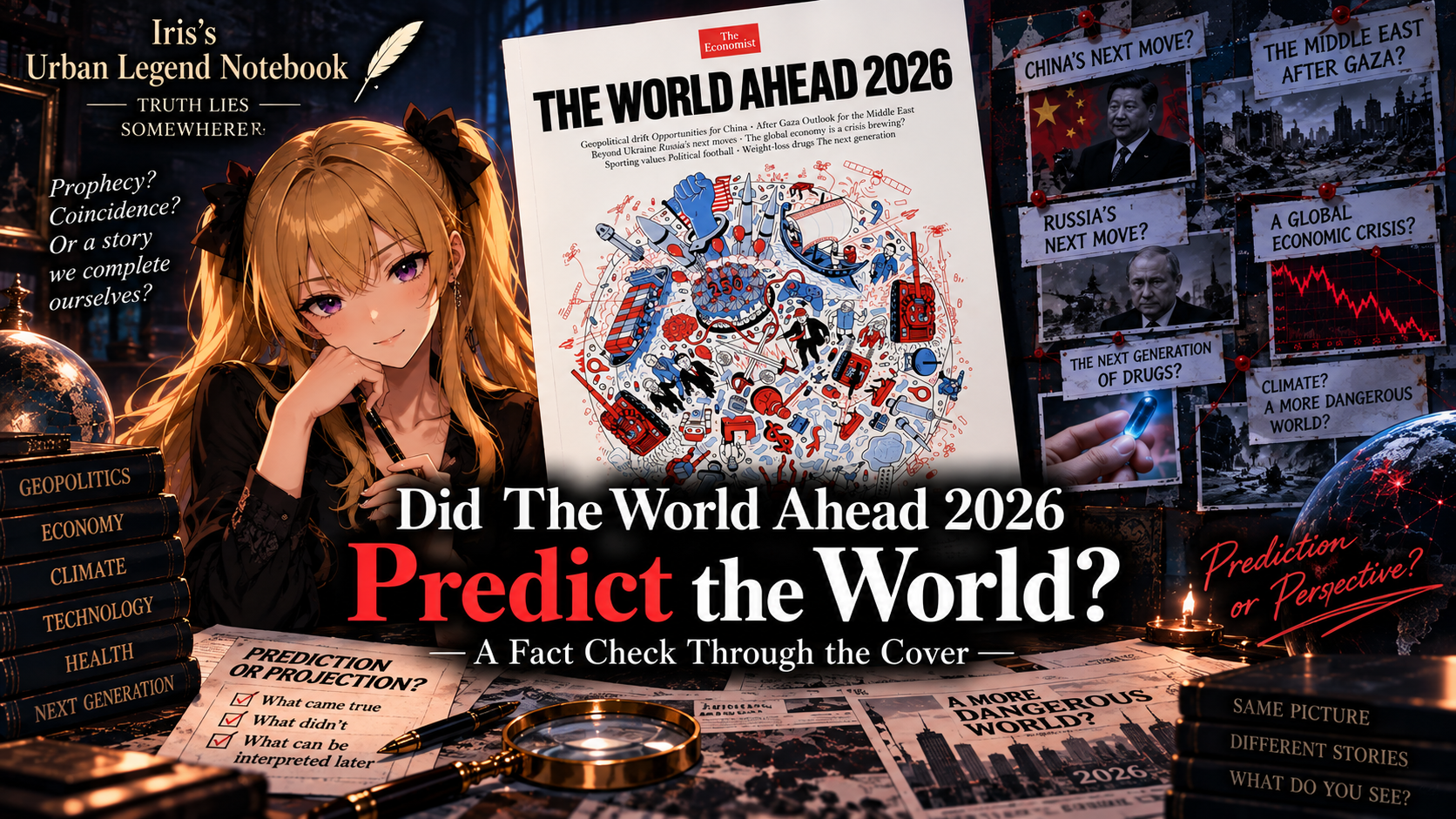
A white background. A dense circular illustration in red, blue and black. A cake marked “250,” military vehicles, aircraft, satellites, shipping, medicine, money, sport and dozens of smaller symbols.
The Economist released The World Ahead 2026 on November 10, 2025.
For months, the cover has been treated in urban-legend circles as if it were a coded schedule of the future.
But 2026 is now well advanced.
So instead of looking from the cover toward the future, we can reverse the direction.
What happens when we look from reality back toward the cover?
Some themes appear remarkably close. Some were known in advance. Some remain unresolved. And some acquire meaning only after an event has already happened.
First, This Was Never Officially Presented as a Prophecy
The Economist described The World Ahead 2026 as its annual analysis of important themes, trends and events likely to shape the coming year.
Its published themes included America’s 250th anniversary, geopolitical drift, war and fragile peace, Europe, opportunities for China, economic risks, artificial intelligence, climate, politics in sport and the next generation of GLP-1 weight-loss medicines.
That matters.
A prediction published in words can be tested.
A vague symbol can be interpreted in many different ways.
Those are not the same kind of evidence.
The “250” Cake Was Never a Prediction
The most obvious number on the cover is 250.
July 4, 2026 marked 250 years since the American Declaration of Independence.
Everyone already knew that date in 2025.
So if the cake appears to “come true,” nothing supernatural has happened.
It belongs to a useful category:
scheduled future.
A calendar event can look prophetic when placed on a symbolic cover, but it was never hidden knowledge.
China’s “Opportunity” Looks Closer to Reality
The Economist identified an opportunity for China to increase its global influence.
By September 2026, China had used the expanded BRICS framework to promote cooperation in trade, finance and artificial intelligence. President Xi Jinping was also preparing for a state visit to the United States and talks expected to include trade, AI and geopolitics.
That broadly fits the theme.
But there is still an important distinction.
“The international environment may create opportunities for China” is a geopolitical forecast.
“Xi will make this exact move on this exact date” would be a specific prediction.
The cover gave us the first, not the second.
“After Gaza” and “Beyond Ukraine”
The issue also highlighted the Middle East and the future of the war in Ukraine.
As of September 2026, Gaza remains severely damaged. In-person schooling has begun returning, but reconstruction, housing and infrastructure remain major problems.
The war in Ukraine has also not simply ended. Diplomacy and limited ceasefire efforts exist alongside continuing military action.
So the idea that 2026 would contain both conflict and negotiation proved relevant.
But again, this was not a forecast of an exact battle, attack or peace agreement.
These conflicts already existed in 2025.
The forecast was that they would continue shaping the next year.
Did the Global Economic Crisis Arrive?
This is where the answer becomes less dramatic.
The cover raised the possibility of serious economic trouble, including risks surrounding debt and bond markets.
Yet the IMF’s July 2026 update still projected global growth of 3.0% for 2026 and 3.4% for 2027.
The world economy faces war-related energy pressure, persistent inflation risks and financial uncertainty. At the same time, AI-related investment is supporting parts of the global economy.
So the economic warning cannot simply be marked as “fulfilled.”
There are risks.
There has not, as of September, been one single worldwide economic collapse matching the most dramatic reading of the cover.
That matters because a fair review must preserve what did not clearly happen.
The Next Generation of Weight-Loss Drugs
This theme has moved much closer to reality.
The Economist explicitly identified newer, cheaper and more accessible GLP-1 medicines as a major 2026 issue.
During 2026, the World Health Organization continued developing guidance around rapidly expanding GLP-1 use. Pharmaceutical companies also pushed forward with new obesity treatments, including next-generation candidates such as CagriSema.
This was not a mysterious capsule on a cover that people interpreted afterward.
The subject was written down in advance.
That makes it much more testable.
It also makes it look less like prophecy and more like informed industry forecasting.
Politics Did Not Leave Sport Alone
The World Ahead also questioned whether sport could remain separate from politics.
The 2026 football World Cup was already scheduled in the United States, Canada and Mexico, so its existence was known.
During the year, international football also faced disputes over governance and commercial control, while other major sporting events encountered diplomatic tensions.
Again, the theme was broad enough to be plausible before the year began.
Its strength came from identifying a pressure point, not from naming a secret future event.
The Small Symbols Are Where Prophecy Becomes Easier
Ice.
Fire.
Aircraft.
Medicine.
Money.
Military vehicles.
Satellites.
A ship.
These images are visually powerful because their meanings remain open.
Earlier in September, this blog examined the small image of melting ice after a major rock-and-ice collapse in Nepal.
The resemblance was intriguing.
But there was no evidence that the illustration had been created to predict that specific disaster.
Climate change and melting ice were already major global concerns.
This is where hindsight becomes powerful.
Once we know what happened, an older image starts to look more specific than it originally was.
Three Different Kinds of “Accuracy”
The cover becomes easier to understand if we separate three categories.
Events known in advance.
America’s 250th anniversary and major scheduled sporting events.
Trend forecasts that broadly matched reality.
China, continuing conflicts, AI, GLP-1 drugs and geopolitical fragmentation.
Symbols that became specific only afterward.
Ice, fire, aircraft, medicine and other images whose meaning was not fixed before events occurred.
And we should preserve the uncertain cases as well.
The global economy, for example, remains under pressure, but the most dramatic crisis interpretation has not simply materialized.
Iris’s Reading: A Risk Map Rather Than a Secret Calendar
Looking back nine months later, The World Ahead 2026 does contain an impressive number of themes that feel familiar.
That does not require a supernatural explanation.
The Economist had access to reporting networks, economic data, policymakers, businesses, researchers and trends already underway in 2025.
Good forecasting can look like foresight because it identifies pressures before they become obvious to everyone.
At the same time, readers naturally connect ambiguous symbols to events after those events occur.
Both things can be true.
So I would not call the cover proof of a hidden schedule.
I would call it something more interesting:
a compressed map of the risks, opportunities and anxieties already visible at the end of 2025.
The deeper urban legend may not be that the cover knew the future.
It may be that, after living through the future, we return to the image and discover a story that seems to have been waiting for us all along.
Next time—another fragment of truth we will trace together.
I will return to continue the telling.
Primary Sources & References
Source: The Economist / PR Newswire
Used for: The November 10, 2025 launch date and the ten themes explicitly identified for 2026.
Source: International Monetary Fund
Used for: Global growth projections and the interaction between war, inflation, financial risk and AI-related investment.
Source: Reuters
Used for: China’s 2026 initiatives involving trade, AI, finance and an expanded international role.
Source: Reuters
Used for: The state of reconstruction, infrastructure damage and education in Gaza in September 2026.
Source: Reuters
Used for: The continued coexistence of war and diplomatic efforts around Ukraine.
Source: World Health Organization
Used for: Rapid global growth in GLP-1 use and the emerging policy and safety questions surrounding these medicines.
Posting Time
Published October 2, 2026 at 23:00 JST.
Related Reading
The starting point for understanding why a forecasting cover can begin to look like a coded calendar of the future.
A direct case study in the difference between a broad climate symbol and a specific event interpreted after the fact.
Why a fabricated future cover can still feel prophetic when it is built from fears and trends already visible today.
A companion investigation into the difference between probabilistic forecasting and the idea of prophecy.
Popular Posts
Submit an Urban Legend
Have an old prediction, mysterious cover, viral image or “future warning” you would like Iris to trace back to its original source?
▶ Submit information or contact IrisShare & Follow
Return to the blog top page.
Latest articles and updates.
Share this article on Facebook.
Videos and related investigations.
Artwork, visuals and article updates.
コメントを残す