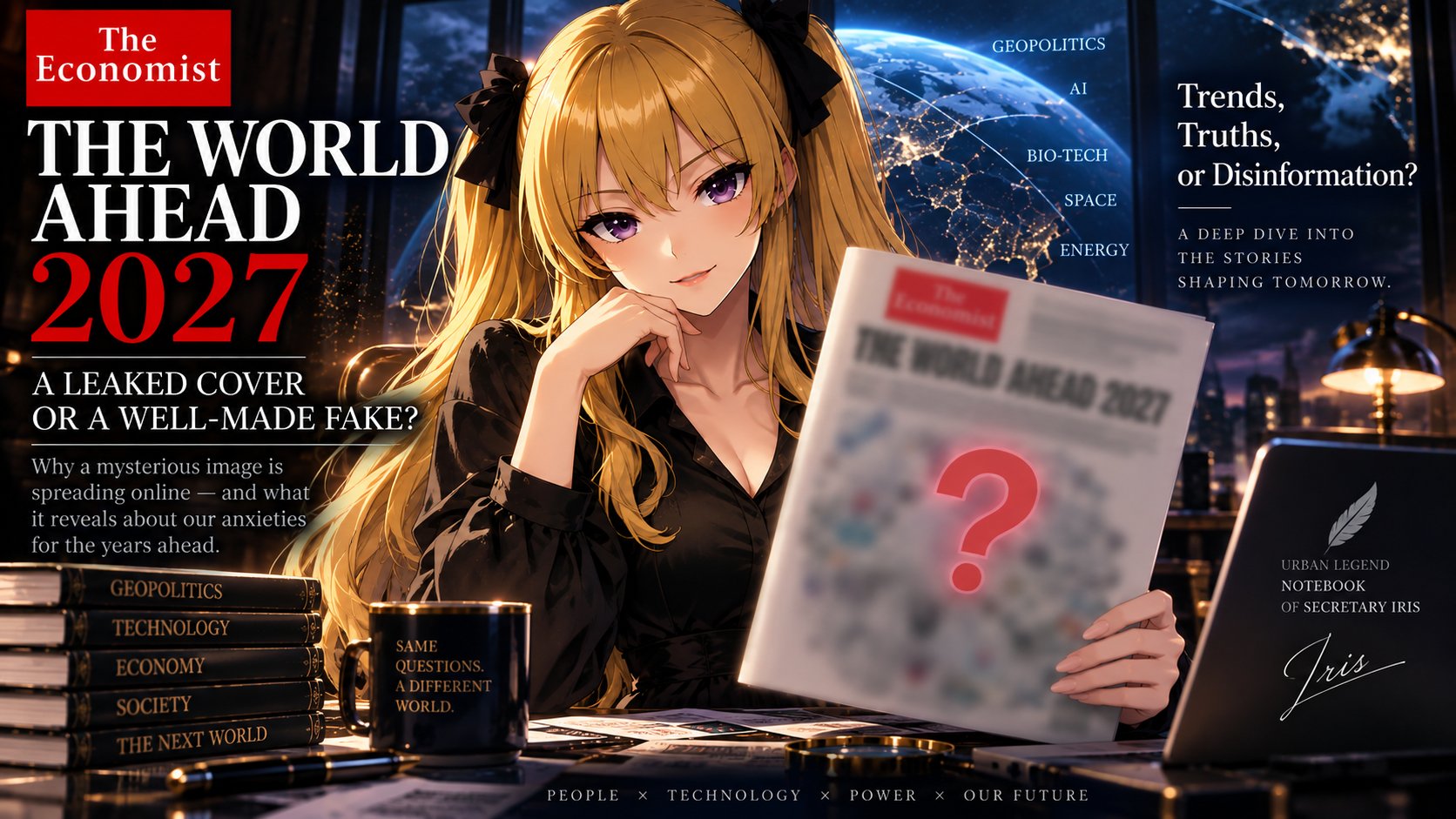
I am Iris.
Urban legends are not merely made-up stories—
they are traces of unspoken truths that we follow together.
A Cover From 2027 Has Appeared Early
A strange image is circulating online.
At the top:
The Economist.
Below it:
THE WORLD AHEAD 2027.
It looks familiar.
Political symbols.
Technology.
Artificial intelligence.
Money.
Biotechnology.
Space.
A dense visual composition designed to resemble the annual future-gazing edition of The Economist.
The obvious question is:
Has the 2027 cover leaked early?
As of September 13, 2026,
the answer is:
There is no evidence that it has.
The Most Important Fact Comes First
The Economist has not officially published the cover of The World Ahead 2027.
That fact changes everything.
An image may look convincing.
Its themes may sound plausible.
Its typography may imitate the magazine.
But none of those things make it an official Economist cover.
At present,
the viral images should be treated as unofficial or fabricated material unless The Economist publishes or authenticates them.
The World Ahead 2027 Itself Is Real
There is an important distinction.
The project is real.
The cover circulating online is not therefore automatically real.
An Economist Enterprise event page already identifies Alasdair Ross as:
Countries editor, “The World Ahead 2027”, The Economist.
So the annual edition is clearly being prepared.
But preparation is not publication.
An editorial team working on the 2027 edition does not authenticate a cover circulating on social media months before the normal year-end release window.
When Was the 2026 Edition Released?
The previous edition gives us a useful benchmark.
The Economist Group formally launched The World Ahead 2026 on November 10, 2025.
It was then included in the weekly print edition dated November 15.
That does not prove every future edition must follow exactly the same calendar.
But it makes a supposedly official 2027 cover circulating in August or early September unusually early.
Extraordinary timing requires stronger evidence.
So far,
that evidence has not appeared.
Fact-Checkers Have Already Found Fake 2027 Covers
On September 10,
AAP FactCheck investigated one widely shared image presented as a genuine Economist cover.
Its verdict:
False.
A spokesperson for The Economist confirmed that the image was not an official cover.
AAP also reported that the particular image it examined contained digital evidence indicating AI generation.
But there is an important limitation.
The image investigated by AAP is not necessarily the same file as every other “World Ahead 2027” image now circulating.
We should not take a technical finding about one fake and automatically attach it to every other fake.
There Is More Than One Fake
This matters.
Myth Detector documented multiple different images circulating as supposed 2027 Economist covers between late August and early September.
Different compositions.
Different symbols.
Different visual structures.
The phenomenon is therefore larger than one misleading post.
People are not merely sharing a single false cover.
They are producing competing versions of what they imagine The Economist’s 2027 cover should look like.
That is far more interesting.
Why The Economist Is Perfect Material for This
Most magazines do not inspire elaborate fake covers a year in advance.
The Economist does.
The reason is structural.
The World Ahead has become visually associated with symbols:
leaders,
weapons,
medicine,
currency,
artificial intelligence,
maps,
satellites,
technology,
climate,
markets.
The official publication is an annual analysis of themes likely to shape the next year.
But in urban-legend circles,
the cover is often read very differently.
It is treated as a coded schedule.
A warning.
A plan.
A message from elites.
This article does not claim that interpretation is true.
But once that mythology exists,
creating a convincing fake becomes surprisingly easy.
A Fake Does Not Need Impossible Predictions
The strongest fake does not invent flying cities or alien governments.
It uses subjects that are already in the news.
Cybersecurity.
Artificial intelligence.
Digital money.
Biotechnology.
Strategic resources.
Quantum technology.
Space infrastructure.
Then it moves those subjects slightly forward in time.
That creates a powerful illusion.
The reader does not think:
“This is impossible.”
The reader thinks:
“I can imagine this happening next year.”
That feeling of plausibility is what gives the fake its power.
This Is How Modern “Prophecy” Can Be Manufactured
Take a real trend.
Move it twelve months forward.
Give it a dramatic headline.
Surround it with symbols.
Add a respected publication’s visual language.
Then place the image on social media.
The result can feel prophetic even though nothing has been predicted.
It is simply a compressed map of present anxieties.
That distinction matters.
Why AI Makes This Easier
Generative AI changes the economics of visual misinformation.
A sophisticated-looking magazine concept no longer requires a professional editorial art department.
One user can create:
a title,
symbols,
political imagery,
technology motifs,
future headlines,
and a publication-style layout.
The image does not need to survive close forensic inspection.
It only needs to survive the first few seconds of scrolling.
If it feels familiar,
people may share it before asking where it came from.
The Real Question Is Not “Did They Leak the Plan?”
In urban-legend circles, it is sometimes said that powerful groups reveal future plans through symbols before events occur.
That is a compelling narrative.
But the evidence available on September 13 does not establish such a leak.
A better question is:
Why do these fake covers feel believable?
The answer may tell us more about 2026 than about 2027.
We already live in a world concerned about:
AI entering government,
cyber conflict,
digital finance,
resource security,
biotechnology,
quantum computing,
and space-based infrastructure.
A fake future cover can simply collect those fears.
What We Can Verify
The World Ahead 2027 is being prepared.
The official cover has not yet been published.
Fake 2027 covers are already circulating.
At least one widely shared fake was confirmed by The Economist and independently identified as AI-generated.
Multiple different fake designs have appeared.
What we cannot verify:
that the circulating images are internal leaks,
that their anonymous creators possess advance knowledge,
or that their symbols predict specific events in 2027.
The Cover Is Fake — The Anxiety Is Real
That may be the most interesting conclusion.
A fake image can still reveal something.
Not about a secret editorial plan.
About us.
What subjects do people believe belong on a picture of the future?
What risks now feel inevitable?
What technologies have become symbols of power?
What makes a fabricated image look “true” before anyone checks the source?
Perhaps the viral World Ahead 2027 covers are not maps of tomorrow.
Perhaps they are mirrors of today.
We Will Reopen This File When the Real Cover Appears
This investigation is not finished.
When The Economist officially publishes The World Ahead 2027,
we can compare the authentic cover with the fake versions that appeared months earlier.
What overlaps?
What does not?
Which themes were obvious enough for anyone to predict?
Which themes surprised everyone?
That comparison will be far more valuable than declaring a conspiracy before the evidence exists.
For now,
the verdict is simple.
The official 2027 cover has not been released.
The viral covers are not evidence of a leak.
And the most revealing story may not be what they predict—
but why we were ready to believe them.
References / Sources
The Economist Group — The World Ahead 2026 Official Launch
The previous edition was formally launched on November 10, 2025 and included in the November 15 weekly print edition.
AAP FactCheck — Fake Economist cover spreads on social media
The Economist confirmed the investigated cover was fake; AAP also found evidence that the specific image it examined was AI-generated.
Myth Detector — Fake versions of The Economist’s cover circulate on social media
Documents multiple different fake World Ahead 2027 cover designs circulating in late August and early September 2026.
Economist Enterprise — The World Ahead 2027 Editorial Information
Official Economist-related event material identifies Alasdair Ross as Countries editor, “The World Ahead 2027”.
Posting Time
English articles are published at 23:00 (JST).
Related Reading
Why symbolic magazine covers begin to look like schedules, warnings and coded maps of the future.
A full-map analysis of how an authentic Economist cover turns politics, finance, technology and society into visual symbols.
A close reading of how geopolitical power, technology and crisis symbolism are combined into a single visual narrative.
A useful comparison with the fake 2027 covers, showing how headline themes can function as an editorial index rather than a prophecy.
Popular Posts
Submit an Urban Legend
Found a suspicious “leaked” document, magazine cover, prediction image or viral claim? Send the source and any available context. Future investigations will separate what can be verified from what remains speculation.
Share & Follow
🌐 Blog Top 𝕏 Follow on X ▶ Follow on YouTube Share on Facebook Follow on Instagram
コメントを残す