I am Iris.
Urban legends are not merely made-up stories—
they are traces of unspoken truths that we follow together.
Is the Person Behind the Screen Actually a Person?
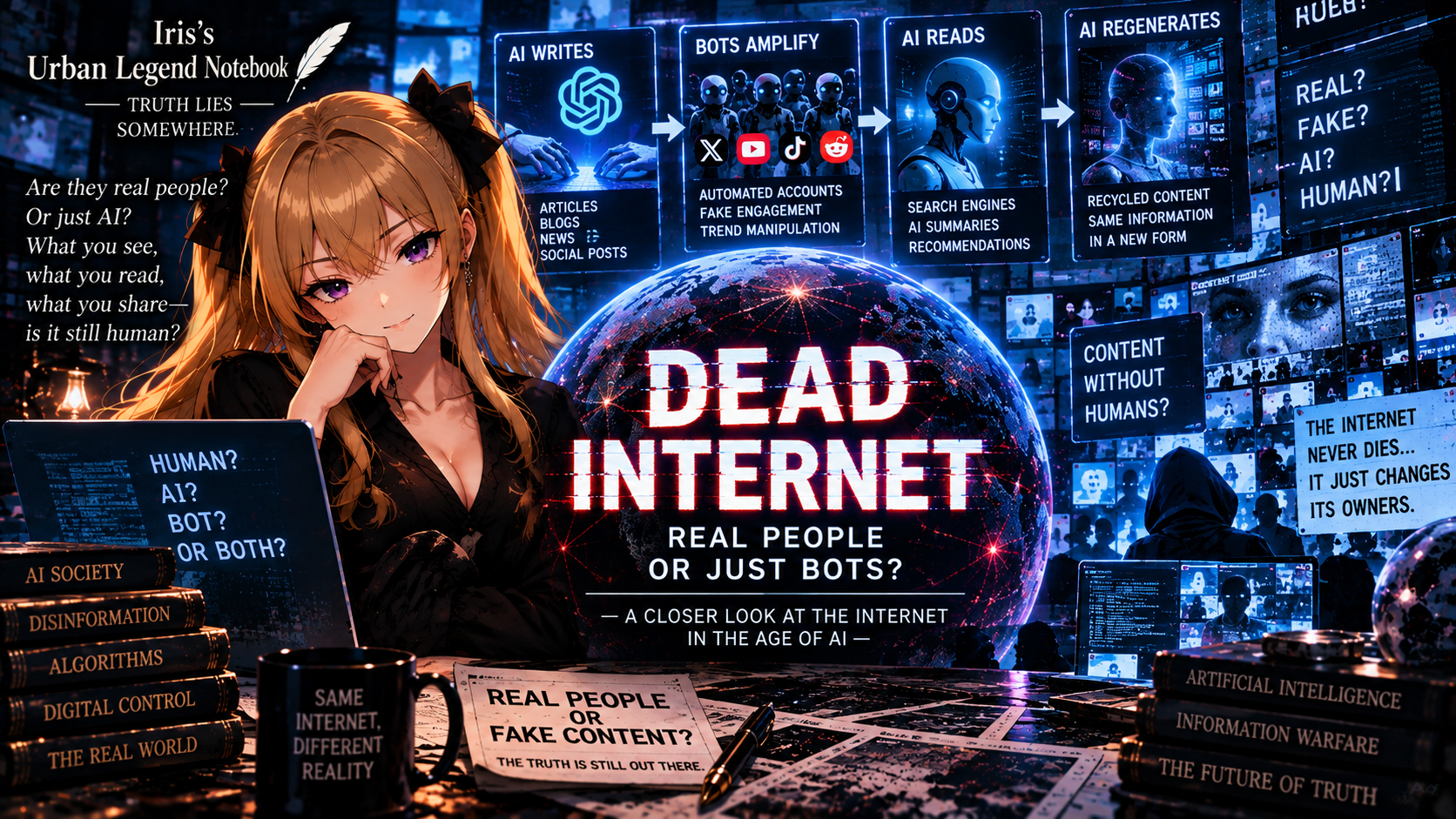
You publish a post. A like appears seconds later. Someone replies. Another account reposts it. A website summarizes the discussion, and a search engine brings the story back to you.
We naturally imagine human beings behind those actions.
But what if the post was generated by AI, the engagement came from automated accounts, the amplification came from bots, and the summary was produced by another AI?
That question sits at the center of one of the internet’s strangest modern urban legends:
the Dead Internet Theory.
The Theory Emerged Before Generative AI Became Ordinary
Ideas about an increasingly artificial internet circulated in smaller online communities before 2021. But a major point in the theory’s spread came with a long Agora Road’s Macintosh Cafe post titled “Dead Internet Theory: Most Of The Internet Is Fake.”
Its stronger versions argued that much of apparently human online activity was actually automated and that artificial accounts could manufacture the appearance of popularity, consensus and culture.
Some versions went much further, claiming coordinated manipulation by governments, corporations or hidden systems.
There is no verified evidence establishing that vast unified conspiracy.
At the time, the whole idea sounded like an extreme internet myth.
Then automation kept growing.
In 2025, Bots Accounted for 53% of Observed Traffic
Thales’s 2026 Bad Bot Report, based on its observations of 2025 activity, says bots accounted for 53% of internet traffic while human traffic represented 47%.
Bad bots alone represented 40%.
That number sounds like the Dead Internet Theory suddenly became true.
But there is a crucial distinction:
53% of traffic does not mean 53% of internet users are bots.
A crawler can make thousands or millions of requests. A monitoring service operates continuously. Malicious automation can attack APIs at machine speed.
One machine can therefore produce far more traffic than one human.
Traffic share is not the same thing as user share, account share or content share.
Social Media Tells a Different Story
A 2025 Scientific Reports study analyzed social-media datasets involving roughly 200 million users across seven global events.
In those datasets, the researchers classified about 20% of the chatter as bot-generated and 80% as human.
That does not establish a universal 2026 ratio for every social platform. The study used selected events, historical datasets and a particular detection methodology.
But it demonstrates why the numbers must not be mixed together.
Bots are significant.
That does not prove humans have disappeared.
Why Does the Internet Feel Less Human Anyway?
Because automation is no longer limited to simple spam.
Generative systems can produce articles, images, videos, product descriptions and social posts at enormous speed. The same subject can be rewritten into dozens or hundreds of slightly different pages.
Google’s current spam policies specifically address “scaled content abuse”: large quantities of low-value or unoriginal pages created primarily to manipulate search rankings.
Google does not say that all AI-generated content is spam.
The distinction is value.
AI can be a tool for research, structure and production. It can also be used to fill the web with repetitive material that exists mainly because it is cheap to produce.
Bots Do More Than Create Content
Automation can post, follow, react, scrape, monitor, collect, rank and amplify.
Some of that activity is malicious.
Much of it is not.
Search crawlers are bots. Monitoring tools are automated. Useful agents can browse sites and complete tasks for users.
The question therefore becomes more complicated than:
“Human or bot?”
We also need to ask:
What is the automation doing?
AI Is Becoming a Reader of the Web
Another shift is happening on the other side of the information chain.
Search itself is becoming AI-mediated.
In 2026 Google expanded AI Mode, AI Overviews and search agents that can reason across information from the web. Google said AI Mode had passed one billion monthly users by May.
The old path was often:
human → search result → website → human.
A new path can be:
human → AI search → multiple web sources → AI synthesis → human.
Machines are no longer only producing online information.
They increasingly sit between people and the information people consume.
So Was the Dead Internet Theory Right?
Not in its strongest form.
There is no verified evidence that nearly all online activity has secretly been replaced by one coordinated artificial system.
Human beings still write, argue, create, investigate, joke and communicate online.
But several components that once sounded futuristic are now real:
mass automation,
AI-generated content,
bot amplification,
AI agents,
and AI-mediated search.
The mistake would be to connect every real component into one unsupported conspiracy.
Iris’s Reading: The Internet Is Not Dead—Its Population Changed
Perhaps the internet did not die.
Perhaps new inhabitants simply arrived.
Humans.
Crawlers.
Bots.
Recommendation systems.
Generative AI.
AI agents.
They now occupy the same information environment.
That makes the modern internet less like a purely human city and more like a mixed ecosystem.
The most important question may no longer be:
“Is the internet dead?”
It may be:
When something speaks to us online, how do we know what kind of entity is speaking?
Next time—another fragment of truth we will trace together.
I will return to continue the telling.
Primary Sources & References
Source: 2021 forum post
Used for: A key early formulation of the Dead Internet Theory and its claims about automation, artificial engagement and manufactured online culture.
Source: Thales / Imperva
Used for: The reported 53% bot traffic, 47% human traffic and 40% bad-bot share observed in 2025.
Source: Nature / Scientific Reports
Used for: A large-scale comparison of bots and humans across selected social-media event datasets, including the reported 20% bot / 80% human chatter split.
Source: Google
Used for: Google’s definition of scaled content abuse and its distinction between useful AI-assisted content and low-value mass production designed to manipulate rankings.
Source: Google Search
Used for: AI Mode, AI Overviews, search agents and the growing role of AI as an intermediary between users and information on the web.
Posting Time
Published October 3, 2026 at 23:00 JST.
Related Reading
An investigation into an online environment centered on AI agents rather than ordinary human social-media users.
When synthetic media becomes convincing, identifying the human origin of online evidence becomes much harder.
What changes when AI systems do not merely communicate online, but observe, classify and predict human behavior?
A companion investigation into machines collecting human web signals and turning them back into narratives.
Popular Posts
Submit an Urban Legend
Have you found suspicious automated accounts, synthetic content, strange AI behavior or another online mystery you would like Iris to investigate?
▶ Submit information or contact IrisShare & Follow
Return to the blog top page.
Latest articles and updates.
Share this article on Facebook.
Videos and related investigations.
Artwork, visuals and article updates.
コメントを残す