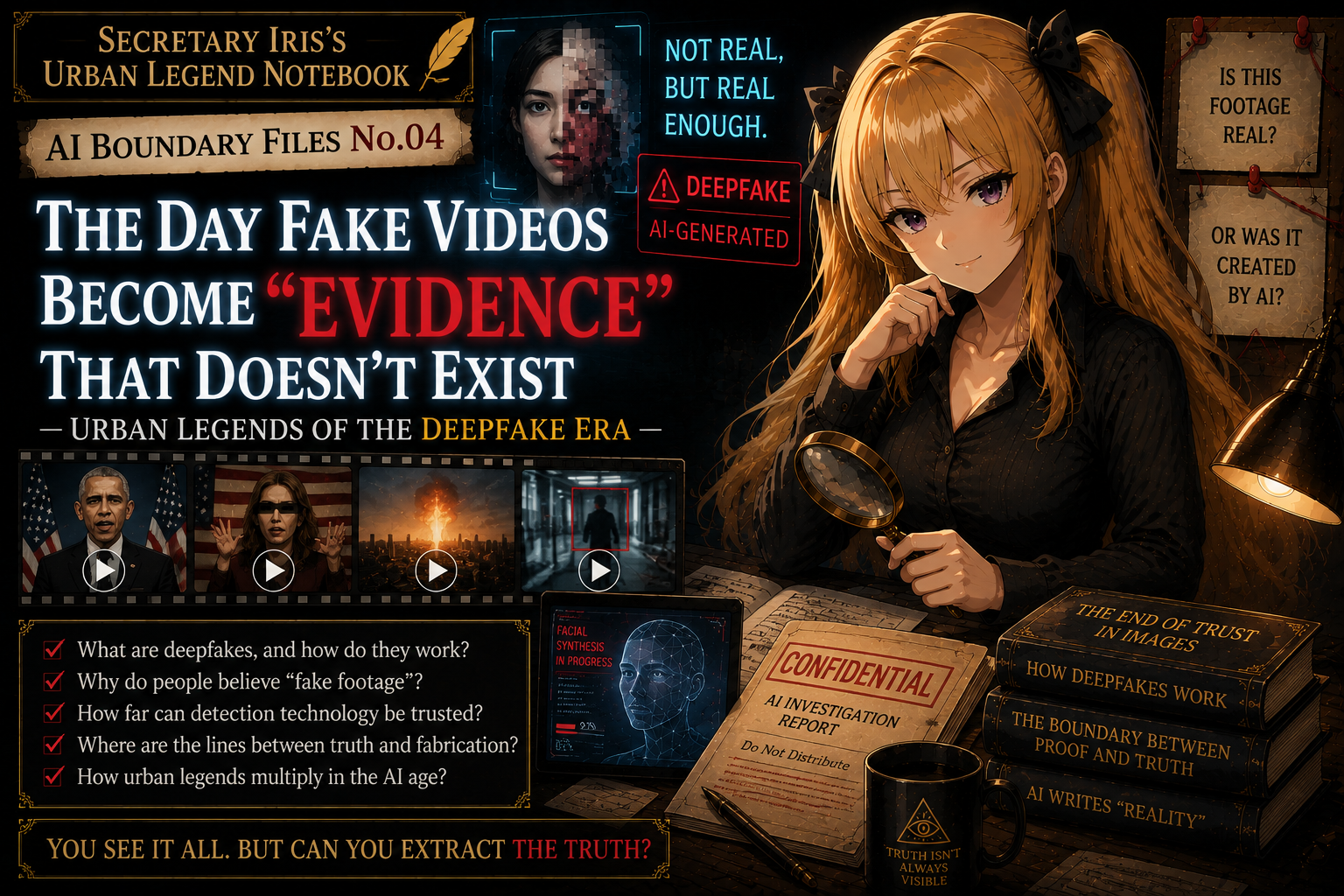
I am Iris.
Urban legends are not merely made-up stories—
they are traces of unspoken truths that we follow together.
What Happens When Video Stops Being Proof?
There is a video.
A photograph.
A voice recording.
The person’s face is clearly visible.
For a long time, that felt powerful.
We saw it.
Therefore—
something must have happened.
But in 2026,
that assumption is becoming increasingly fragile.
People who never existed.
Statements nobody made.
Events that were never filmed.
Voices that sound familiar.
News conferences that never happened.
Scenes generated from nothing.
Artificial Intelligence Boundary Files No.04.
Today we investigate:
deepfakes.
And a larger question—
what happens to urban legends when convincing “evidence” can be manufactured?
Deepfakes Are No Longer Only Face Swaps
The word “deepfake” became associated with AI systems capable of replacing or manipulating faces, voices and movements in existing media.
But today’s problem is broader.
Generative systems can create entirely synthetic people and scenes.
There does not always need to be an authentic original video underneath the manipulation.
The footage itself may never have existed.
That changes the problem.
We are no longer asking only:
“Was this video edited?”
We may also need to ask:
“Was there ever a camera?”
The Old Clues Are Becoming Less Reliable
Earlier synthetic media often contained obvious artifacts.
Unnatural blinking.
Poor facial boundaries.
Mismatched lighting.
Strange teeth.
Lip-sync errors.
Artificial-looking skin.
Those clues were useful.
But relying on a fixed checklist creates a problem.
Generation technology improves.
Detection technology improves.
Creators adapt.
Detectors adapt.
A clue that works today may become useless tomorrow.
Deepfake verification is therefore not a simple game of spotting one visual mistake.
NIST Is Still Testing Deepfake Detection
The U.S. National Institute of Standards and Technology continues to evaluate forensic technologies designed to detect AI-generated media.
Its 2026 GenAI Deepfakes challenge focuses on methods for evaluating deepfake detection systems.
That fact itself tells us something.
If humans could reliably identify synthetic media by looking at fingers, eyes or mouths,
advanced forensic evaluation would not be necessary.
The real problem is harder.
A Familiar Voice Can Also Be Synthetic
Video is only one part of the threat.
Voice cloning can imitate a family member,
a manager,
a company executive,
or another trusted person.
The U.S. Federal Trade Commission has warned that cloned voices can strengthen emergency scams and impersonation fraud.
And the voice does not need to be flawless.
Fear helps.
Urgency helps.
A demand to act immediately helps.
Technology creates the voice.
Emotion completes the deception.
Urban Legends Have Found a Perfect Medium
Imagine a strange object appearing above a city.
A scientist appears in a video and says:
“This is non-human technology.”
A government official announces contact with an unknown intelligence.
The video disappears several hours later.
Immediately the story grows.
“It was deleted because it was real.”
“The government removed the evidence.”
“They are calling it AI to cover it up.”
Older urban legends often struggled to produce convincing evidence.
The AI era reverses that problem.
A story can now be accompanied by video,
audio,
documents,
interviews,
and photographs—
even if none of them record real events.
But Fake Media Is Only Half the Problem
Now imagine that the footage is authentic.
It was genuinely recorded.
The source is known.
Multiple witnesses exist.
And someone simply replies:
“It’s AI-generated.”
The existence of deepfakes creates two different risks.
People may believe synthetic evidence.
And people may reject authentic evidence as synthetic.
That second problem matters enormously.
A world filled with convincing fakes can make genuine material easier to deny.
UAP Is an Ideal Example
UAP footage was already difficult to interpret before modern generative AI.
Distance.
Camera systems.
Infrared imaging.
Compression.
Aircraft.
Balloons.
Birds.
Drones.
Atmospheric effects.
Incomplete sensor data.
Now another question must be added before interpretation begins:
Was this media actually captured from reality?
The mystery no longer exists only in the sky.
It also exists in the information chain.
Disclosure Would Not End the Argument
This notebook examined the same problem in May when asking whether alien disclosure could be real or staged in the AI era.
Suppose extraordinary footage were released tomorrow.
The footage alone would not settle the issue.
Who released it?
Where is the original?
When was it created?
Was it edited?
Are there independent recordings?
Do other sensors support it?
Is provenance information available?
In the AI era,
the content of an image is only one part of its evidentiary value.
Its history matters too.
From “Spot the Fake” to “Verify the Provenance”
This is where systems such as C2PA become important.
The Coalition for Content Provenance and Authenticity develops technical specifications for attaching cryptographically verifiable provenance information to digital content.
Content Credentials can provide information about the history and processing of a file.
But there is an important limitation.
Provenance is not the same thing as truth.
A valid provenance record does not automatically prove that every interpretation of the scene is correct.
It helps answer questions such as:
where did this file come from?
what happened to it?
what information has been attached to its history?
That is extremely useful—
but it is not a magic truth detector.
One AI Detector Is Not a Verdict
Deepfake detectors can also help.
Upload media.
Receive a probability.
Useful.
But a single score should not become the final judge of an important claim.
Compression can matter.
Re-recording can matter.
Editing can matter.
New generation systems can matter.
Different detectors may perform differently.
The safest investigation does not ask one tool for an oracle.
It combines evidence.
Synthetic Media Can Cause Real Consequences
Europol has warned about deepfake use in fraud, impersonation, evidence manipulation and other forms of serious crime.
And a fake does not need to remain believable forever.
It may need only minutes.
A payment can be sent.
A market can move.
A reputation can be damaged.
A rumor can become political.
By the time the correction arrives,
the first image may already have become the memory people keep.
Urban legends have always understood this principle.
A story does not need to be true to produce real consequences.
The Era of Cheap “Evidence”
Older urban legends often lacked evidence.
A blurry photograph.
A distorted recording.
An anonymous witness.
A document with uncertain origins.
The AI era may produce the opposite problem.
Too much evidence-looking material.
Perfect photographs.
Video interviews.
Security footage.
Audio.
Official-looking documents.
Synthetic news reports.
The question therefore changes.
Not:
“Is there evidence?”
But:
“Where did this evidence come from?”
Fact, Interpretation, and Speculation
Let us separate the layers.
Documented facts:
AI systems can generate and manipulate realistic images, video and audio.
NIST continues to evaluate deepfake detection technologies.
The FTC has warned about harmful uses of AI voice cloning.
Europol has identified deepfakes as relevant to fraud and evidence manipulation.
C2PA provides a technical framework for verifiable digital-content provenance.
Interpretation:
As synthetic media improves,
visual inspection alone becomes less reliable.
Source, provenance and corroborating evidence become more important.
Urban-legend claims:
Every major government video may be AI-generated.
Authentic UAP footage is being dismissed as deepfake material.
Synthetic footage is being used to stage massive hidden operations.
Boundary of speculation:
Each specific video requires its own evidence.
Suspicion is not forensic proof.
And calling something “AI-generated” without evidence is not verification.
Seeing Is No Longer the End of the Investigation
An old saying tells us:
seeing is believing.
The AI era adds another sentence.
Seeing is the beginning of verification.
Who posted it?
Where is the original?
When was it recorded?
Who else documented the event?
Does the audio match?
Does the provenance make sense?
Do independent sources agree?
The image may still matter.
But the chain surrounding the image matters just as much.
One More File Remains
The public investigation can end here.
Deepfakes weaken the idea that video alone can settle a claim.
But one practical question remains:
What should an ordinary person actually check first?
The fingers?
The shadows?
An AI detector?
Metadata?
The uploader?
For Japanese subscribers, tonight’s research supplement turns this problem into a verification workflow—
starting not with the pixels,
but with the evidence chain around them.
Next time—another fragment of hidden truth to trace together.
I will return to the telling.
References
-
NIST AI Challenges|GenAI: Deepfakes 2026
NIST’s current forensic evaluation work for deepfake detection systems. -
NIST|Guardians of Forensic Evidence
Research evaluating analytic systems against AI-generated image deepfakes. -
C2PA|Content Credentials Technical Specification
The official specification covering manifests, provenance assertions, digital signatures and tamper-evident content history. -
Federal Trade Commission|Fighting back against harmful voice cloning
U.S. government guidance on AI voice-cloning impersonation and emergency scams. -
Europol|Facing reality? Law enforcement and the challenge of deepfakes
Europol’s assessment of deepfakes in fraud, impersonation, evidence manipulation and other criminal activity.
Posting Time
English articles are published at 23:00 (JST).
Related Reading
A direct precursor to today’s article: what happens when both authentic and synthetic extraordinary footage become difficult to trust?
A case study in separating what appeared to happen from what the available evidence actually supports.
Long before generative AI, Apollo legends asked whether images presented by institutions could be trusted.
Why an image, clip or viral post should remain an investigative starting point rather than a final conclusion.
コメントを残す